Propel IP, based in Raleigh, NC, presented this 15-slide deck in May 2016 to secure $300,000 for the launch of Catch Commander. The product is a Bluetooth-enabled digital fishing scale that syncs with a smartphone app to record weight, length, GPS location, and weather data automatically. The deck emphasizes a strong go-to-market strategy, citing interest from major retailers like Cabela’s and Bass Pro Shops, and a manufacturing partnership already in place. While the financial projections are ambitious—forecasting a jump from 1,000 units in 2016 to over 161,000 by 2020—the deck lacks a clear…
Key takeaways
- The company targets a massive U.S. market of 46 million anglers, specifically focusing on 1.2 million 'Super Users' in fishing leagues (Slide 4).
- Catch Commander solves the 'piercing hook' problem by using a non-piercing clamp to improve fish survivability during weigh-ins (Slide 6).
- Traction is demonstrated through exhibitions at eight trade shows and interest from major retailers like Dick’s Sporting Goods and Bass Pro Shops (Slide 7).
- The deck identifies a direct competitor, Connect Scale, and explicitly mentions potential patent infringement as a strategic leverage point (Slide 9).
- Propel IP holds specific intellectual property, including U.S. Pat. No. 7,173,197 and several pending utility applications (Slide 10).
- The $300,000 ask is earmarked for design finalization, manufacturing tooling, and initial inventory stock (Slide 11).
- The management team possesses significant industry exits, including the sale of XTOOLS LLC to Jarden Corporation (Slide 13).
- Financial projections estimate reaching $16.9 million in revenue by 2020 with a 27% EBIT margin (Slide 15).
Slide-by-Slide Teardown
Slide 1: Title Slide
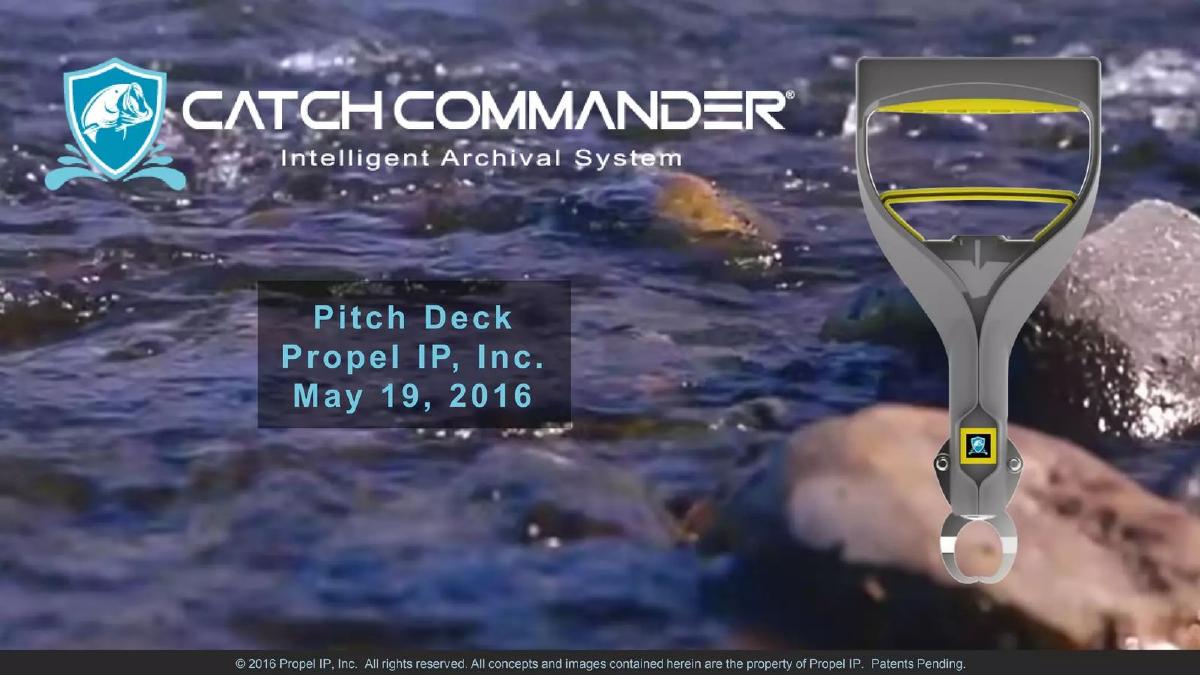
The deck opens with the Catch Commander logo and the subtitle 'Intelligent Archival System.' The visual features a 3D render of the hardware against a background of rushing water. It is dated May 19, 2016, and establishes the company name as Propel IP, Inc. The inclusion of a 'Patents Pending' notice at the bottom sets an early tone regarding the importance of intellectual property to the business model.
Slide 2: Introducing Propel IP, Inc.
This slide serves as an executive summary. It defines the company as an emerging technology firm in Raleigh, NC, focused on the North American sporting goods industry. Key claims include a 'well-positioned' status to disrupt the fishing industry with Bluetooth scales and proprietary software. It identifies a target demographic of 2 million 'Super Anglers' and reiterates that IP holdings will serve as a barrier to entry for competitors.
Slide 3: Traction
Propel IP lists several milestones to validate their progress. They claim to have held presentations with 'top industry retailers' and state that over 200 independent dealers have requested stock. The slide mentions recognition at iCast 2015, the world's largest fishing show, and the alignment with an overseas manufacturer for mass production starting in Q2 2016. Crucially, it notes a 'significant investment' closed on April 15, 2016, though the amount is not specified.
Slide 4: Market Opportunity
The market is segmented into three tiers: 46 million total U.S. anglers, 1.2 million 'Super Users' (tournament members), and 750,000 'Highly Dedicated Users.' The slide estimates that 800,000 fishing scales are sold in the U.S. annually. A graphic illustrates the data points captured by the app: Weight, Length, Catch Details, GPS Location, Social Media sharing, Image, and Weather.
Slide 5: Problems with Existing Market Products
The deck identifies eight specific pain points. These range from the 'time consuming and cumbersome' process of manual logging to physical issues like 'piercing hooks' that contribute to fish mortality. It also highlights the inefficiency for tournament directors who must deploy 'considerable resources' to track leaderboards manually.
Slide 6: Catch Commander Solution
The solution slide mirrors the problem slide. It promises an automated fish log created in seconds via Bluetooth. Key features include one-handed operation, a non-piercing clamp for improved fish health, and tournament management modules that allow for digital weigh-ins. This last point is positioned as a way to improve the 'survivability of the catch,' a major concern in competitive fishing.
Slide 7: Sales Channels
This slide lists specific retail targets. It claims interest from Cabela’s, Dick’s Sporting Goods, Bass Pro Shops, and Field and Stream. It also mentions 'online behemoths' like Tackle Warehouse and Tackle Direct. The strategy appears to be a mix of big-box retail, specialty online stores, and hundreds of small independent dealers.
Slide 8: Revenue Drivers
The revenue strategy focuses on 'Super Users' and influencers. The company plans to target 50,000 domestic fishing tournaments annually, providing the product as rewards to build brand awareness. It also mentions interest from professional anglers who would act as marketing partners.
Slide 9: The Competition
Propel IP lists national market leaders including Rapala-Normark Group, Pure Fishing, Lowrance, Johnson Outdoor, and Garmin. Interestingly, it calls out a specific direct competitor, 'Connect Scale,' which launched two years after Propel IP filed its patents. The slide suggests a litigious or licensing-based strategy, stating that Connect Scale's product 'may potentially infringe our patent' and that Propel IP sees this as an opportunity to license technology to them.
Slide 10: Competitive Edge
This slide doubles down on the IP strategy. It lists U.S. Patent No. 7,173,197 and two specific utility applications (14/252,369 and 14/210,686). It also mentions a trademark for 'CATCH COMMANDER' filed in late 2014. The 'edge' is defined as the combination of hardware, firmware, and software expertise.
Slide 11: Use of Funds
The 'Desired Transaction' is $300,000. The funds are allocated to:
Finalizing design, engineering, and software. · Purchasing die/tooling for manufacturing. · Stocking inventory for existing buyer requests. · Developing direct-to-consumer (DTC) marketing and website.
The slide also lists existing investors: Thomas Wye and Blue Flip, LLC.
Slide 12: Management Team
Robert A. Jones (President) is credited with 22 years of experience in manufacturing and supply chain management. Brenda S. Jones (CEO) is described as a creative leader with a background in product development since 1983, having worked with Fortune 100 clients like Disney and Pfizer. She is noted for launching a marketing company, Adstracts, and holding over 25 patents.
Slide 13: Management Team Cont.
This slide introduces the heavy hitters in the fishing industry. Dickie Herbst (COO) founded XTOOLS LLC, grew it to $3.6 million in sales, and sold it to Jarden Corporation. Mike Blocher (Director of Marketing) has 19 years of experience and operates the Xtreme Fishing Series, a large tournament circuit in Florida. This provides the company with a direct line to their 'Super User' target market.
Slide 14: Advisors
The company lists a robust roster of advisors covering Legal (Forrest Law Firm, Wyrick Robbins), IP (Myers Bigel Sibley & Sajovek), Accounting, and Retail Consulting. This slide aims to show professional oversight across all business functions.
Slide 15: Pro-forma Financial Summary
2016: 1,000 units, $0 Revenue (likely due to mid-year launch/tooling), ($369k) EBITDA. · 2017: 39,875 units, $4.47M Revenue, $1.18M EBITDA. · 2020: 161,875 units, $16.96M Revenue, $4.39M EBITDA.
The slide claims an 'Overall Internal Rate of Return' of 45.8%.
What Propel IP Does Well
The deck excels at identifying a highly specific, underserved niche. By focusing on 'Super Anglers' and the tournament circuit, they move away from a generic consumer play into a high-utility professional tool. The emphasis on fish survivability (non-piercing clamps) is a brilliant 'insider' detail that demonstrates deep market knowledge. Furthermore, the team slide is exceptionally strong for a seed-stage hardware company; having a COO who has already successfully exited a company in the exact same sector (fishing accessories) significantly de-risks the execution for investors.
What is Missing from the Deck
The most glaring omission is a detailed breakdown of unit economics. While the pro-forma summary on Slide 15 shows 'Cost of Goods,' it doesn't specify the MSRP (Manufacturer's Suggested Retail Price) or the margin per unit. Investors in hardware need to know if the product is being sold for $50 or $250 to judge the feasibility of the $16M revenue target. Additionally, there is no mention of Customer Acquisition Cost (CAC). While they mention retail interest, the marketing spend on Slide 15 ($40k in 2016 jumping to $1.8M in 2020) isn't tied to a specific strategy other than 'grassroots' and 'tournaments.'
What a Founder Should Copy
Founders should emulate the 'Problem' and 'Solution' alignment found in Slides 5 and 6. Each pain point is directly answered by a product feature, making the value proposition undeniable. The use of a 'Traction' slide (Slide 3) that includes both retail interest and manufacturing readiness is also a best practice for hardware startups, as it proves the 'pipes' are ready for the product to flow through. Finally, the explicit mention of intellectual property as a competitive moat (Slide 10) is a strong way to justify a valuation in a market where larger competitors like Garmin could easily replicate features.
Frequently asked questions
- What is the primary problem Propel IP is solving?
- Propel IP addresses the manual, time-consuming nature of catch logging. Traditional methods involve paper journals or manual app entry. Furthermore, standard scales use piercing hooks that harm fish health. Catch Commander automates data capture (GPS, weather, weight) via Bluetooth and uses a non-piercing clamp to ensure fish survivability, which is critical for tournament regulations.
- How does the company plan to defend its market position?
- The company relies heavily on its intellectual property portfolio. Slide 10 lists U.S. Patent No. 7,173,197 and multiple utility applications covering the scale hardware, the smartphone integration, and even a version with an on-board camera. They also explicitly state that they have monitored competitors for potential infringement to protect their segment.
- Who are the key members of the management team?
- The team is led by Robert A. Jones (President) and Brenda S. Jones (CEO), who bring over 50 combined years of manufacturing and retail marketing experience. Notably, COO Dickie Herbst previously founded and sold a fishing accessory company, XTOOLS, which achieved $3.6 million in sales before its acquisition by a major industry player.
- What are the projected financials for Catch Commander?
- According to Slide 15, the company projected zero revenue for 2016 (the launch year) but expected to scale rapidly to $4.47 million in 2017 and $16.96 million by 2020. They anticipated selling 161,875 total units by 2020, maintaining an EBIT margin between 24% and 28% throughout their growth phase.
- What is the specific funding request and its intended use?
- Propel IP sought $300,000 in financing. The funds were designated for finalizing design and software, purchasing the necessary die and tooling for mass production, stocking initial inventory for retail partners who had already requested stock, and developing direct-to-consumer marketing programs.