Promethium’s 15-slide Series A deck is a textbook example of how to sell a complex, technical B2B SaaS product by focusing on outcomes rather than just features. The company raised $26M in 2022 by positioning itself as the 'only' solution for fast decision-making in a hybrid data world. The deck excels by contrasting a grueling 9-step legacy data process against its own streamlined 4-step workflow. It leans heavily on 'social proof' through massive usage stats—14,714 questions answered in 9 months—and a team slide that highlights multiple successful exits. While it lacks explicit financial pr…
Key takeaways
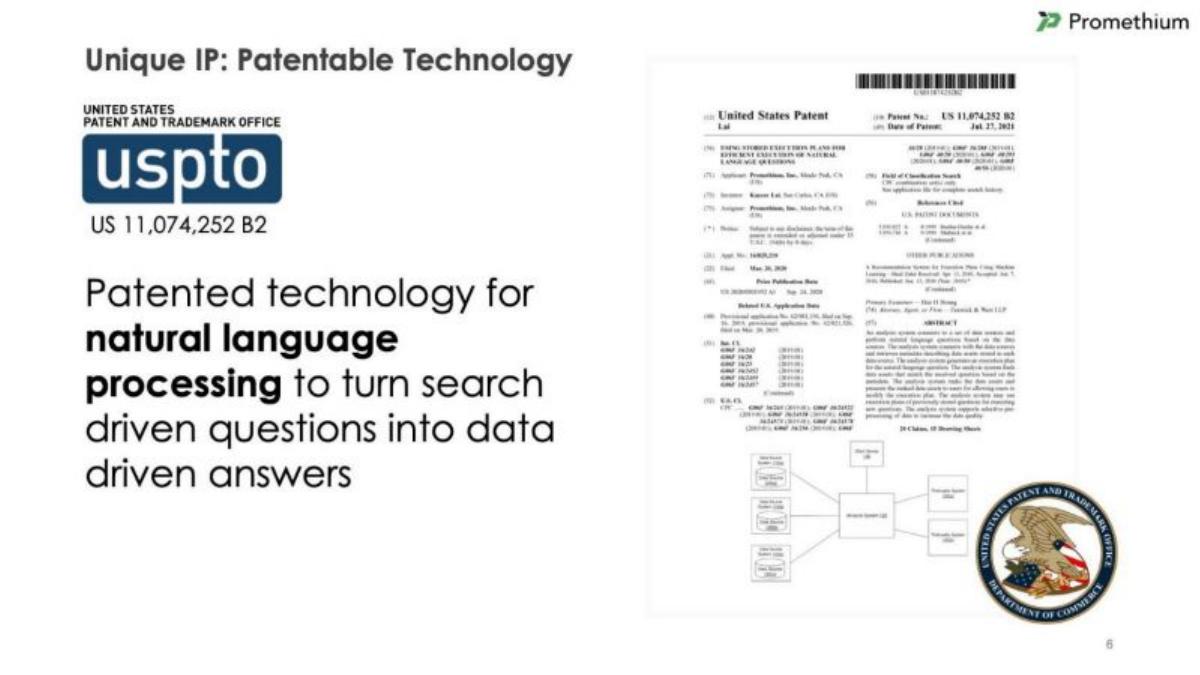
- The deck establishes a clear technical moat by showcasing USPTO Patent US 11,074,252 B2 for natural language processing on slide 6.
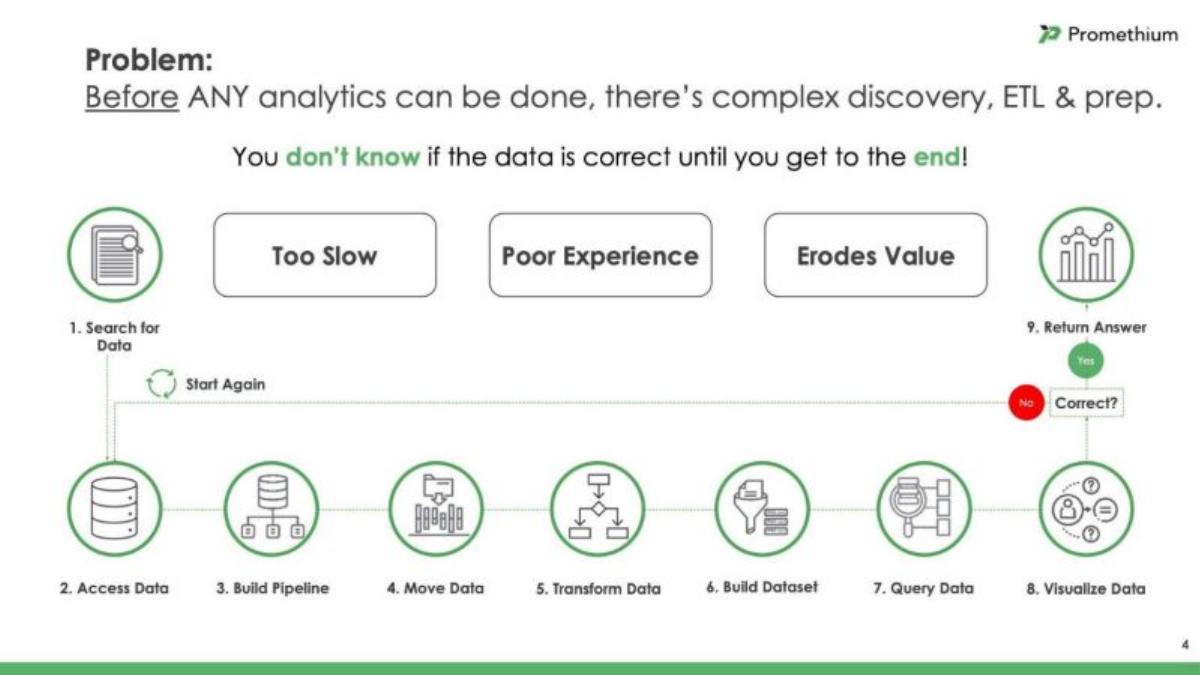
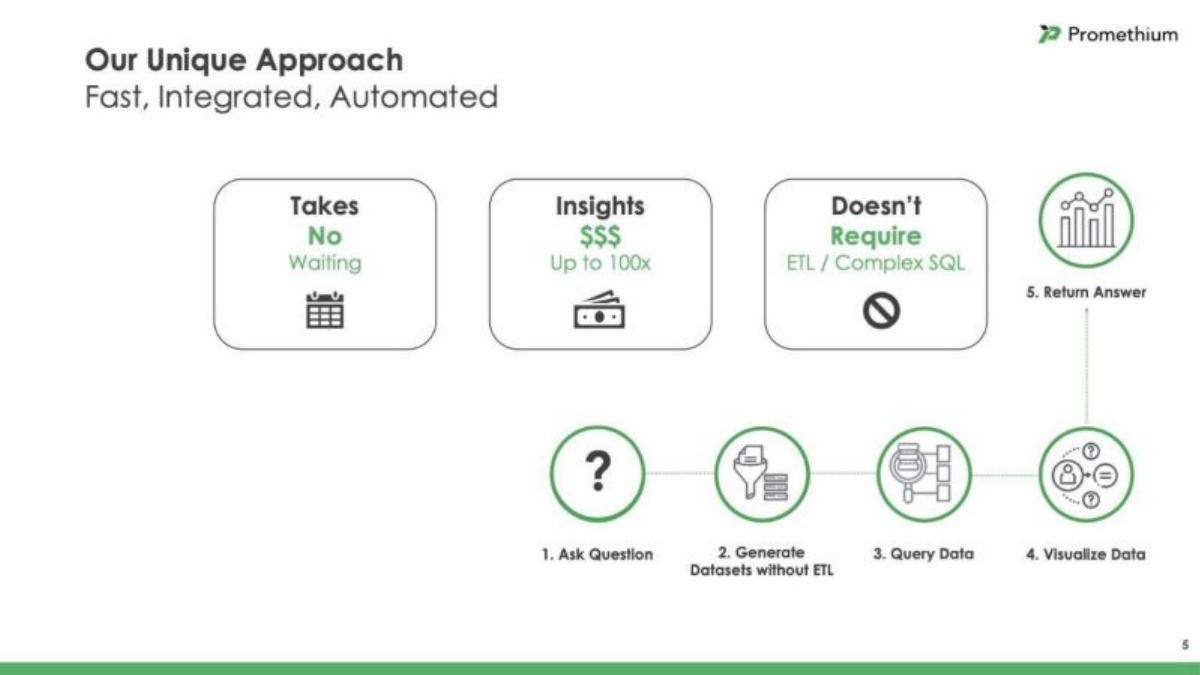
- Promethium uses a 'Before vs. After' visualization to show a reduction from a 9-step manual ETL process to a 4-step automated workflow on slides 4 and 5.
- Usage metrics are used as a proxy for product-market fit, citing 1.1 million queries and 9.1 PB of data accessed on slide 7.
- The 'Why Now' slide (10) effectively links the product's viability to the maturation of robust APIs and data virtualization technologies like Presto and Trino.
- The team slide (12) focuses on 'Serial Data Entrepreneurs,' listing five specific company acquisitions (by Dell EMC, VMware, Salesforce, etc.) tied to the executive team.
- A customer case study on slide 8 quantifies the value proposition by stating each data engineer can do '1000X more' with the platform.
- The deck identifies over 200 supported data sources, including Snowflake, AWS, and Oracle, to demonstrate enterprise readiness on slide 9.
- The competitive positioning on slide 13 uses a 2x2 matrix to place Promethium as the leader in both 'Data Accessibility' and 'Ease of Use' compared to legacy categories.
The Introduction: Setting the Stage for Data Transformation
Slide 1: Title and Branding
The deck opens with a clean, dark-themed title slide. It identifies Kaycee Lai as the CEO and Founder and dates the presentation to November 2021 . The branding is professional, utilizing a geometric 'P' logo and a background that suggests a data mesh or network, immediately signaling the company's focus on complex data environments.
Slide 2: The Bold Claim
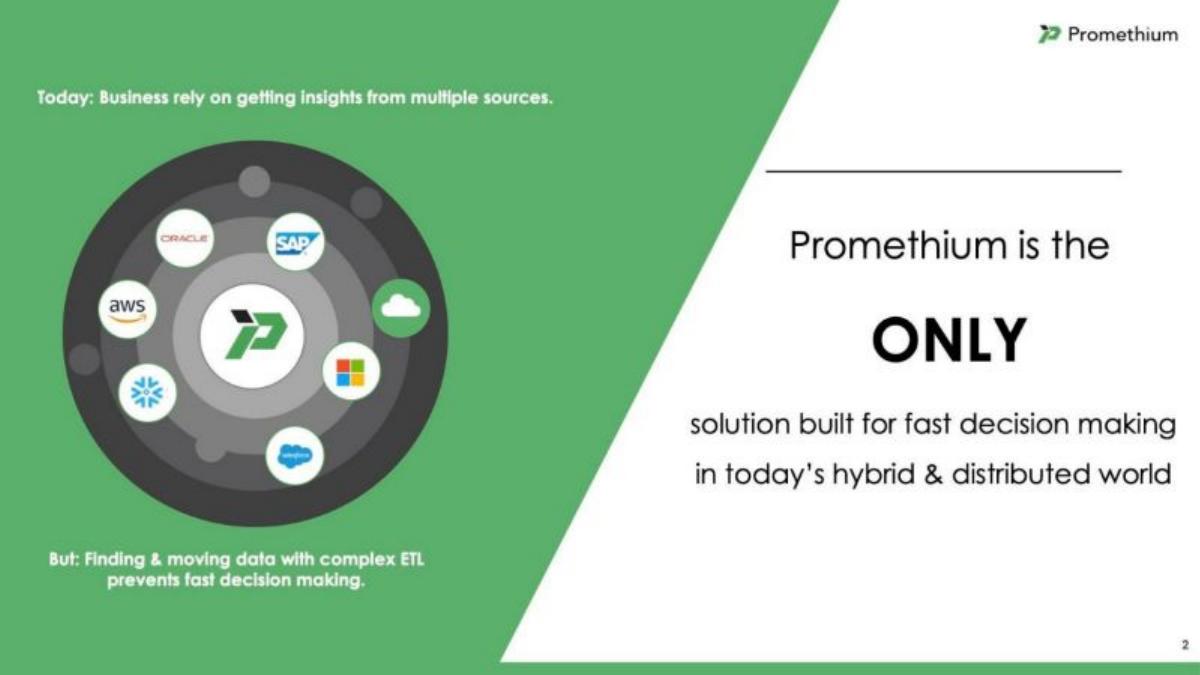
Slide 2 wastes no time in positioning. It claims Promethium is the ONLY solution built for fast decision-making in a hybrid and distributed world. It uses logos from major data players like Oracle, SAP, AWS, Snowflake, Salesforce, and Microsoft to illustrate the 'multiple sources' businesses rely on. The bottom of the slide introduces the friction: 'Finding & moving data with complex ETL prevents fast decision making.'
The Problem: The High Cost of 'Gut Feel'
Slide 3: Market Statistics
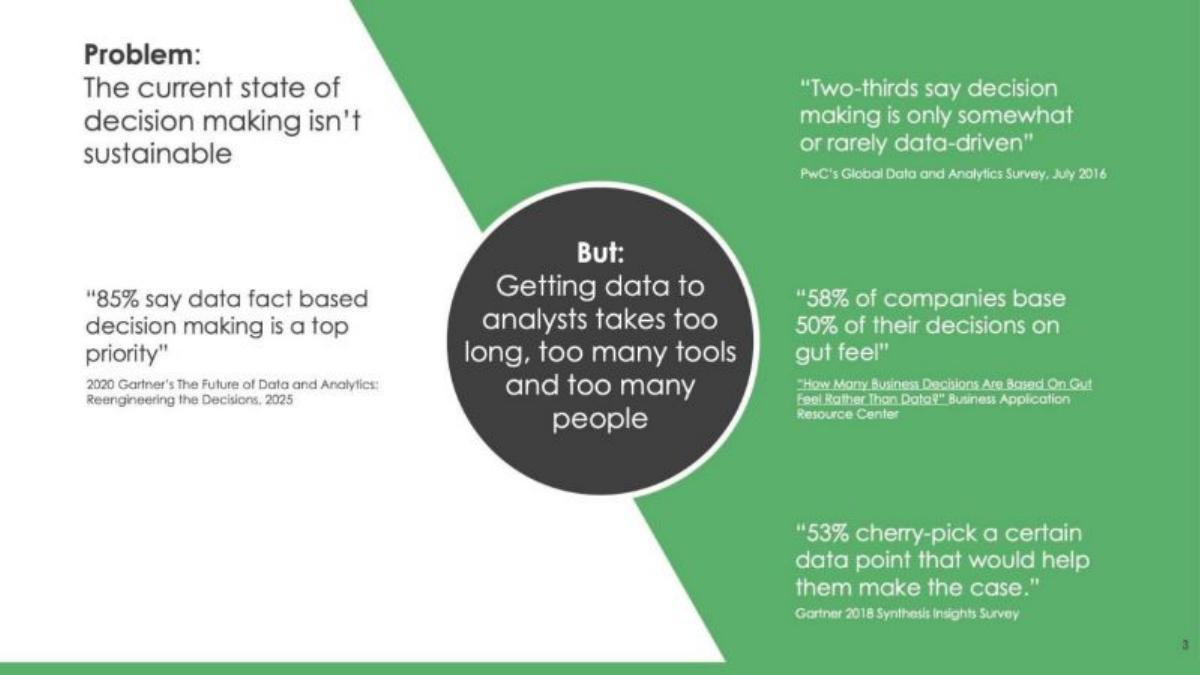
Promethium uses third-party validation to frame the problem. They cite Gartner and PwC to show that while 85% of companies prioritize data-driven decisions, 58% still base half their decisions on 'gut feel.' The central message is that getting data to analysts involves 'too many tools and too many people.'
Slide 4: The Legacy Workflow
This is a critical 'Problem' slide. It maps out a 9-step process required before any analytics can be done: Search, Access, Build Pipeline, Move Data, Transform, Build Dataset, Query, Visualize, and finally, Return Answer. The slide highlights three pain points: Too Slow, Poor Experience, and Erodes Value . Crucially, it notes that users don't know if the data is correct until the very end of this cycle.
The Solution: A Patented Shortcut to Insights
Slide 5: The Promethium Workflow
Directly countering the previous slide, slide 5 shows the 'Unique Approach.' The 9-step process is condensed into 4 steps : Ask Question, Generate Datasets without ETL, Query Data, and Visualize Data. The slide promises 'No Waiting' and insights that are 'Up to 100x' faster because the solution doesn't require ETL or complex SQL.
Slide 6: The Technical Moat
In a Series A deck, proving defensibility is vital. Slide 6 displays United States Patent US 11,074,252 B2 . The patent covers 'natural language processing to turn search driven questions into data driven answers.' This slide serves as a powerful signal to investors that the company isn't just a wrapper for existing tools but owns its core IP.
Traction and Validation: Proving the Hypothesis
Slide 7: Usage Metrics
Slide 7 presents 'Hypothesis Validation.' It lists impressive numbers from a 9-month period: 14,714 questions answered , 1.1 million queries run , and 9.1 PB of data accessed . By showing that customers are querying 600 billion rows of data, Promethium proves its platform can handle enterprise-scale workloads.
Slide 8: Customer Case Study
The case study slide focuses on a 'Business Driver': discovering new product offerings. It contrasts the 'Before' (not enough data engineers, months to complete) with the 'With Promethium' state. The claim that 'Each Data Engineer does 1000X more' is a bold efficiency metric designed to appeal to CFOs and technical leaders alike.
Slide 9: Product Architecture
This slide provides a high-level look at the 'One UI | No Code' solution. It shows a stack that sits on top of 200+ Data Sources (Data Lakes, Warehouses, SaaS Apps). The layers include a Metadata Index, Discovery & Governance, and an AI/ML layer for suggestions. It positions Promethium as an orchestration and collaboration layer for business users.
Market Context and Strategy
Slide 10: Why Now?
The 'Why Now' slide attributes Promethium's feasibility to the maturation of three things: Robust APIs , Data Virtualization (citing Presto and Trino ), and No Code platforms . This explains why this solution wasn't possible five years ago, addressing a common investor question about market timing.
Slide 11: GTM Motion & Traction
Slide 11 shows a bar chart titled 'Product Market Fit' with five quarters of growth (Q1 21 to Q1 22). While the Y-axis lacks specific dollar amounts, the trend is clearly upward. The slide also checks off four 'GTM Clarity' boxes, including 'Repeatable sales motion' and 'Referenceable Customers.'
The Team: Serial Data Entrepreneurs
Slide 12: Executive Pedigree
This is arguably the strongest slide in the deck. It features four leaders: Kaycee Lai (CEO), Puneet Gupta (VP Product), Ravi Kasamsetty (VP Engineering), and Brett Arnott (VP Marketing). The bottom of the slide lists 'Exits From Executive Team,' showing companies acquired by Dell EMC, VMware, Hitachi Vantara, Salesforce, and Apptio . This establishes the team as seasoned veterans with a track record of building and selling data companies.
Slide 13: Competitive Landscape
The deck uses a standard 2x2 matrix. The axes are 'Data Accessible' and 'Ease of Use.' Promethium places itself in the top-right quadrant, superior to categories labeled 'Virtualize,' 'AI/NLP/ML,' and 'Unified Workflow.' The slide includes a call to 'See us in action,' suggesting a demo-heavy follow-up.
Slides 14-15: Closing
The deck concludes with a 'Thank You' slide and a promotional slide for the source library. Notably, there is no 'Ask' slide in this version of the deck, which is common in publicly shared versions of successful pitches to protect sensitive financial terms.
What Works and What is Missing
What Works: The deck is exceptionally strong on technical defensibility and team credibility . By leading with a patent and a team of 'Serial Data Entrepreneurs,' Promethium mitigates the risk of being seen as a 'feature' that a larger player like Snowflake could easily replicate. The usage of '9.1 PB of data' provides a sense of scale that is rare in Series A decks.
What is Missing: The deck lacks unit economics (CAC, LTV, Magic Number) and financial projections . While the GTM slide mentions a 'repeatable sales motion,' it doesn't show the actual revenue growth or pipeline velocity. There is also no explicit mention of the competitor names in the 2x2 matrix, only broad categories, which can sometimes feel evasive to a sophisticated investor.
Founder Takeaways: What to Copy
The 'Before vs. After' Workflow: If you are disrupting a manual process, visually mapping the steps you eliminate (Slide 4 vs. Slide 5) is the most effective way to communicate value. · IP as a Moat: If you have a patent, show it. It’s a tangible asset that justifies a higher valuation. · Outcome-Based Case Studies: Instead of listing features, Slide 8 focuses on the 'Business Driver' (releasing new products). Always tie your tech back to a CEO-level business goal. · The 'Why Now' Slide: Explicitly naming the technologies that make your product possible today (Slide 10) helps investors understand the tailwinds behind your business.
Frequently asked questions
- How much did Promethium raise with this deck?
- According to the catalogue listing, Promethium raised $26M in a Series A round in 2022. The deck itself focuses on the value proposition and traction rather than the specific dollar amount requested.
- What is Promethium's core technical advantage?
- The core advantage is its patented NLP technology (US Patent 11,074,252 B2), shown on slide 6. This allows users to turn search-driven natural language questions into data-driven answers without needing complex SQL or manual ETL processes.
- Who are the key members of the Promethium team?
- The team is led by CEO and Founder Kaycee Lai, formerly of Virsto and Waterline Data. Other key executives include Puneet Gupta (VP Product), Ravi Kasamsetty (VP Engineering), and Brett Arnott (VP Marketing), all with backgrounds at major firms like Salesforce, Oracle, and VMware.
- What problem does Promethium solve for enterprises?
- As detailed on slides 3 and 4, Promethium addresses the 'unsustainable' state of decision-making where 58% of companies rely on gut feel because getting data to analysts takes too long and involves too many manual steps (ETL, pipeline building, and data movement).
- What kind of traction does the deck show?
- Slide 7 highlights significant usage: 14,714 questions answered in 9 months, 1.1 million queries run, and 9.1 PB of data accessed. Slide 11 also shows a bar chart indicating consistent growth in 'Product Market Fit' from Q1 2021 through Q1 2022.