Prolaera's 2015 pre-seed deck is a masterclass in 'show, don't tell' regarding user pain points. By using a literal screenshot of a complex, messy spreadsheet on slide 4, the founders immediately validate the problem for anyone familiar with professional compliance. The deck targets a specific niche—CPAs—before suggesting a broader $10 billion market. While the deck is light on competitive analysis and specific financial projections, its strength lies in its dual-revenue business model (SaaS fees plus a 40% course revenue share) and clear traction metrics showing growth from near-zero to 1,80…
Key takeaways
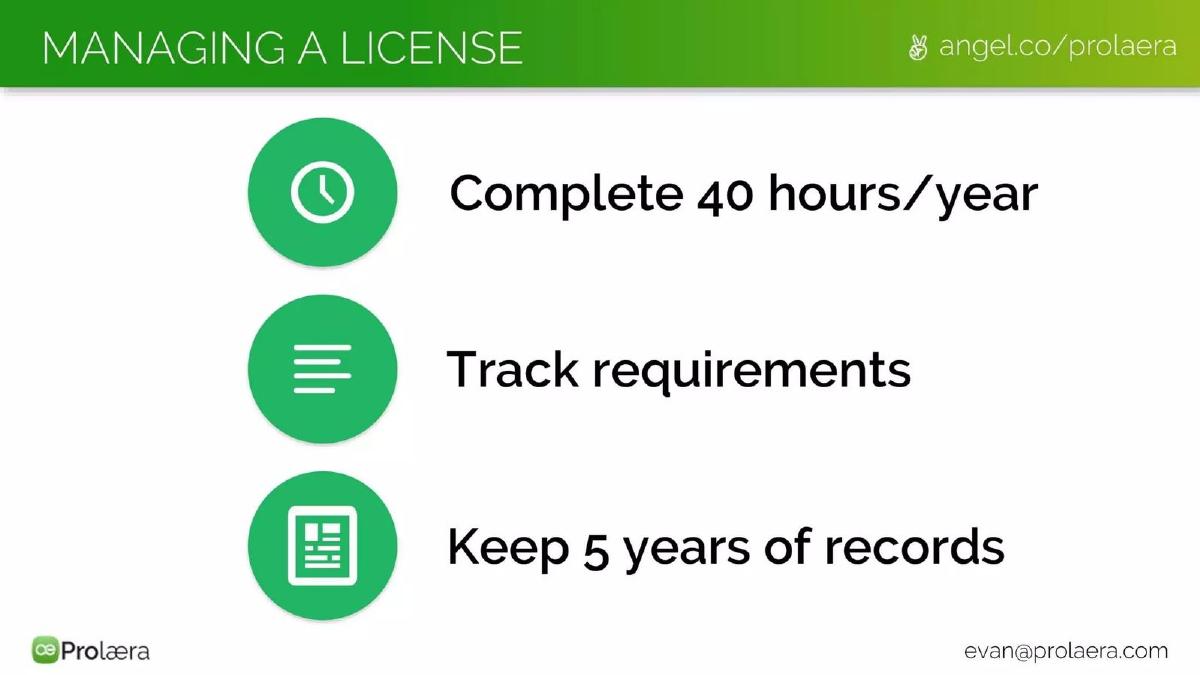
- The deck identifies a high-friction compliance requirement: CPAs must complete 40 hours of CPE per year and track 5 years of records (Slide 3).
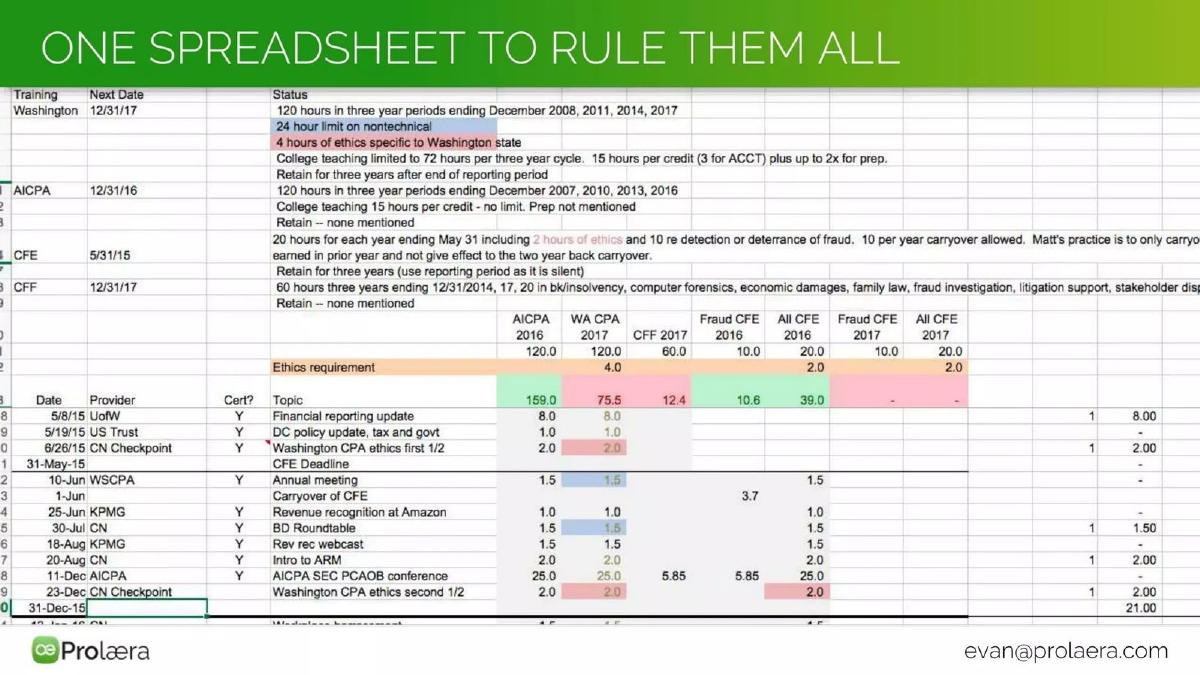
- Slide 4 uses a 'One Spreadsheet to Rule Them All' visual to visceralize the complexity of manual tracking across multiple certifications.
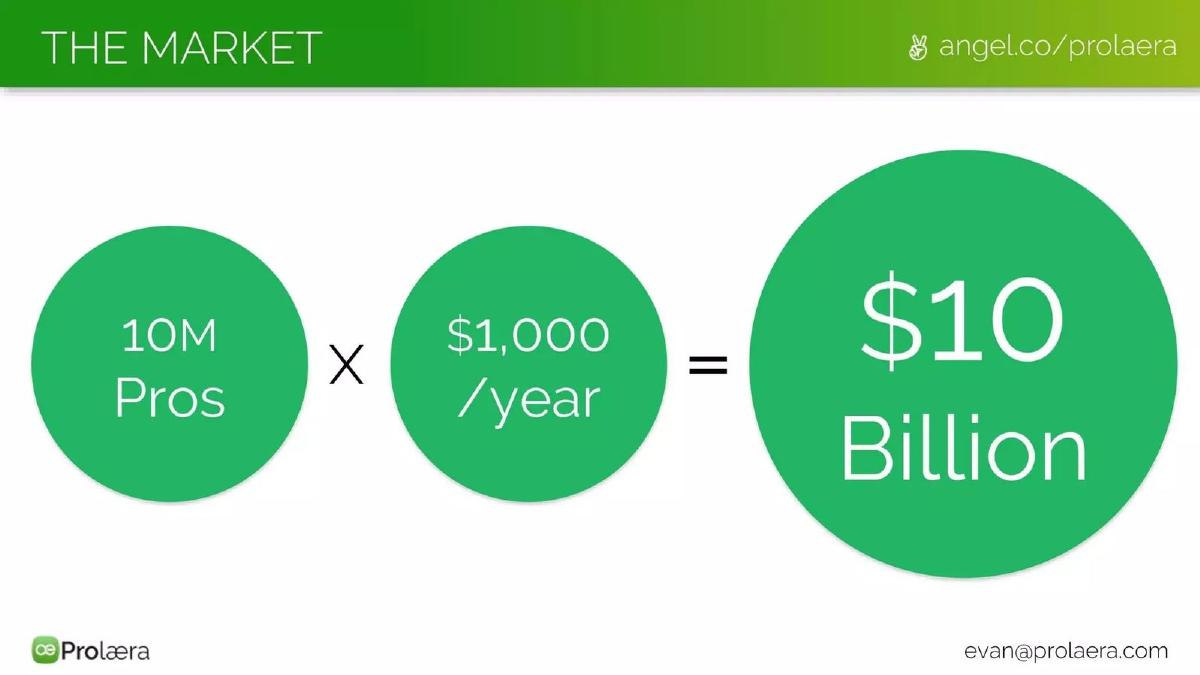
- The market size is calculated using a simple bottom-up formula: 10 million professionals spending $1,000 per year equals a $10 billion market (Slide 6).
- The product is positioned as a two-sided solution: automated license tracking (Slide 7) and an easy-to-use course interface (Slide 8).
- Prolaera employs a hybrid business model, charging $5 per user per month for SaaS plus a 40% revenue share on courses (Slide 9).
- Traction is demonstrated through a clear line graph showing growth to 1,800 users and a library of 1,500 courses by July (Slide 10).
- The team slide highlights relevant corporate experience from Boeing, Zodiac Aerospace, and Galvanize (Slide 11).
- The deck completely omits a specific 'Ask' slide, failing to state the amount of capital being raised or the intended use of funds.
The Compliance-First Approach to EdTech
Prolaera’s 2015 pitch deck is a focused, 12-slide presentation that leans heavily on the 'pain' of administrative compliance. In the world of professional services, Continuing Professional Education (CPE) is not a luxury; it is a mandatory requirement for maintaining a license. By framing the problem as a tracking and record-keeping nightmare rather than just a lack of content, Prolaera identifies a high-retention entry point into the enterprise education market. The deck is clean, uses a consistent green-and-white color palette, and follows a logical progression from persona to problem, solution, and finally, traction.
Slides 1-5: The Persona and the Spreadsheet Nightmare
Slide 1: Title Slide The deck opens with the Prolaera logo and the tagline 'Professional Learning. Simplified.' It includes contact information for the founder and a link to their AngelList profile. This is standard and functional.
Slide 2: Our Customer The founders introduce 'Claire, CPA.' Using a specific persona helps investors visualize the end-user. By narrowing the focus to CPAs initially, the deck avoids the trap of being 'too broad' too early, even though they later claim a much larger market.
Slide 3: Managing a License This slide establishes the 'Why now?' and the regulatory burden. It lists three key requirements: 40 hours of completion per year, tracking requirements, and keeping 5 years of records. This slide effectively sets the stage for the friction the product will remove.
Slide 4: One Spreadsheet to Rule Them All This is arguably the most effective slide in the deck. It shows a real, messy spreadsheet filled with dates, providers, and credit hours for different certifications (AICPA, WA CPA, CFE). It visually demonstrates the 'status quo' that Prolaera intends to disrupt. The complexity shown here makes the 'Simplified' promise of the title slide feel necessary.
Slide 5: Death by 1,000 Spreadsheets A transition slide featuring a stock photo of a stressed professional covered in sticky notes. While a bit cliché, it reinforces the emotional toll of the administrative burden described in the previous slide.
Slides 6-9: Market Size, Product, and Revenue
Slide 6: The Market Prolaera uses a simple bottom-up calculation: 10 million professionals multiplied by $1,000 per year equals a $10 billion market. While $1,000 per year might seem high for a single user, it likely accounts for the total spend on both the software and the actual course content. However, the deck does not cite the source for the '10M Pros' figure.
Slide 7: Simple License Tracking This slide shows the product solution. The UI screenshot highlights a dashboard showing 'Total Hours Completed: 62.5 out of 120' and a breakdown of 'Non-Technical' hours. It directly addresses the pain point from Slide 4 by showing a clean, automated alternative to the spreadsheet.
Slide 8: Courses Made Easy Beyond tracking, Prolaera shows its content side. The slide displays an 'Internal Audit Process' course module. This demonstrates that the platform is a full-stack solution: it tracks the credits, but it also provides the venue to earn them.
Slide 9: Business Model The revenue strategy is clear and diversified. They list a SaaS component ($5 per user/month) and a marketplace component (40% Revenue Share). This is a strong model because the SaaS fee provides predictable recurring revenue, while the revenue share offers high-margin upside as the course library grows.
Slides 10-12: Traction, Team, and Conclusion
Slide 10: Traction The deck shows a growth curve from January to July. The figures cited are 1,800 users and 1,500 courses. The slope of the line graph suggests accelerating adoption, which is exactly what pre-seed investors want to see. It proves that the 'Claire, CPAs' of the world are actually signing up.
Slide 11: Team The team consists of Evan Hiner (CEO & Founder), Teagan Wrest (Lead Developer), and Chris Hansen (Head of Product). The slide includes logos for Boeing, Zodiac Aerospace, Galvanize, and MetricStory. This suggests a mix of enterprise experience and technical capability, though it doesn't explicitly state what roles they held at those companies.
Slide 12: Join Us The final slide summarizes the value proposition: simplifying compliance, big market with slow competition, and accelerating adoption. It repeats the contact information from the first slide.
What Works in the Prolaera Deck
Visceral Problem Identification: The use of the actual spreadsheet on Slide 4 is excellent. It moves the conversation from abstract 'inefficiency' to a concrete, recognizable mess that any professional in a regulated industry has dealt with. This builds immediate empathy with the investor.
Dual Revenue Streams: Combining SaaS with a marketplace revenue share is a sophisticated move for a pre-seed company. It shows the founders understand that tracking is the 'hook' (retention), but content is the 'scale' (monetization).
Clear Traction: Showing a 7-month growth trend with 1,800 users provides enough data to suggest product-market fit. For a $185,000 raise, these numbers are quite healthy and suggest the team can execute on a lean budget.
What is Missing from the Prolaera Deck
The Ask: The most glaring omission is a slide detailing how much money they are raising and what they plan to do with it. While the catalogue listing says $185,000, a potential investor reading this deck in isolation would have no idea what the capital requirements are.
Competitive Landscape: The 'Join Us' slide mentions 'slow competition,' but the deck never identifies who those competitors are. Are they legacy LMS providers? State boards of accountancy? Other startups? Investors need to know why Prolaera wins against the incumbents.
Unit Economics: While the business model is stated ($5/user), there is no mention of Customer Acquisition Cost (CAC) or Lifetime Value (LTV). Even at the pre-seed stage, some indication of how they plan to acquire those 10 million professionals would be beneficial.
Regulatory Moat: CPE requirements are often governed by state boards with strict accreditation rules. The deck doesn't explain how Prolaera handles the legal/regulatory side of being a CPE provider, which is a significant barrier to entry.
What a Founder Should Copy
The 'Status Quo' Visual: If you are replacing a manual process, show the manual process in all its ugly glory. Don't just say 'spreadsheets are bad'; show a spreadsheet that looks like a headache. It is the fastest way to get a 'Yes' on the problem slide.
The Persona Entry Point: Prolaera starts with a CPA but claims a $10B market for 'professionals.' This is a good way to show a massive TAM while proving you have a specific, reachable beachhead market. It prevents the deck from feeling like a 'boil the ocean' pitch.
Simple UI Highlights: Instead of showing a full, complex software screenshot, Slide 7 uses a magnifying glass effect to focus on the most important metric: hours completed. This guides the investor's eye to the value proposition immediately.
Final Analysis
Prolaera’s deck succeeded because it identified a boring, mandatory, and painful administrative task and offered a modern software solution. By 2015 standards, the traction was solid for a pre-seed round. The lack of a formal 'Ask' slide suggests this deck may have been used as a teaser or as part of a larger conversation, but for a standalone pitch, that omission is a mistake. Nevertheless, the clarity of the business model and the undeniable evidence of the 'spreadsheet problem' make this a strong example of niche-focused EdTech fundraising.
Frequently asked questions
- How much did Prolaera raise with this deck?
- According to the catalogue listing, Prolaera raised $185,000 in 2015 during its Pre-Seed stage. The deck itself does not specify the round size or terms, which is a common omission in early-stage decks used for initial conversations rather than final closings.
- What is the primary problem Prolaera is solving?
- The deck focuses on the administrative burden of Continuing Professional Education (CPE). Specifically, Slide 3 notes that professionals must complete 40 hours of training annually and maintain five years of records. Slide 4 illustrates that most professionals currently manage this through complex, error-prone spreadsheets.
- What is the business model described in the deck?
- Prolaera uses a dual-stream revenue model as shown on Slide 9. They charge a SaaS fee of $5 per user per month for the tracking and compliance software. Additionally, they take a 40% revenue share from courses sold through their platform.
- Who is the target audience for this product?
- While Slide 6 mentions a broad market of 10 million professionals, the deck uses 'Claire, CPA' as the primary customer persona (Slide 2). The spreadsheet examples on Slide 4 specifically mention AICPA, Washington CPA, and Fraud CFE requirements, indicating a heavy initial focus on the accounting and audit sectors.
- What metrics does the deck use to show traction?
- Slide 10 displays a growth chart from January to July. It reports reaching 1,800 total users and offering 1,500 courses. The graph shows an accelerating adoption curve, moving from nearly zero users in January to the 1,800 mark by July.