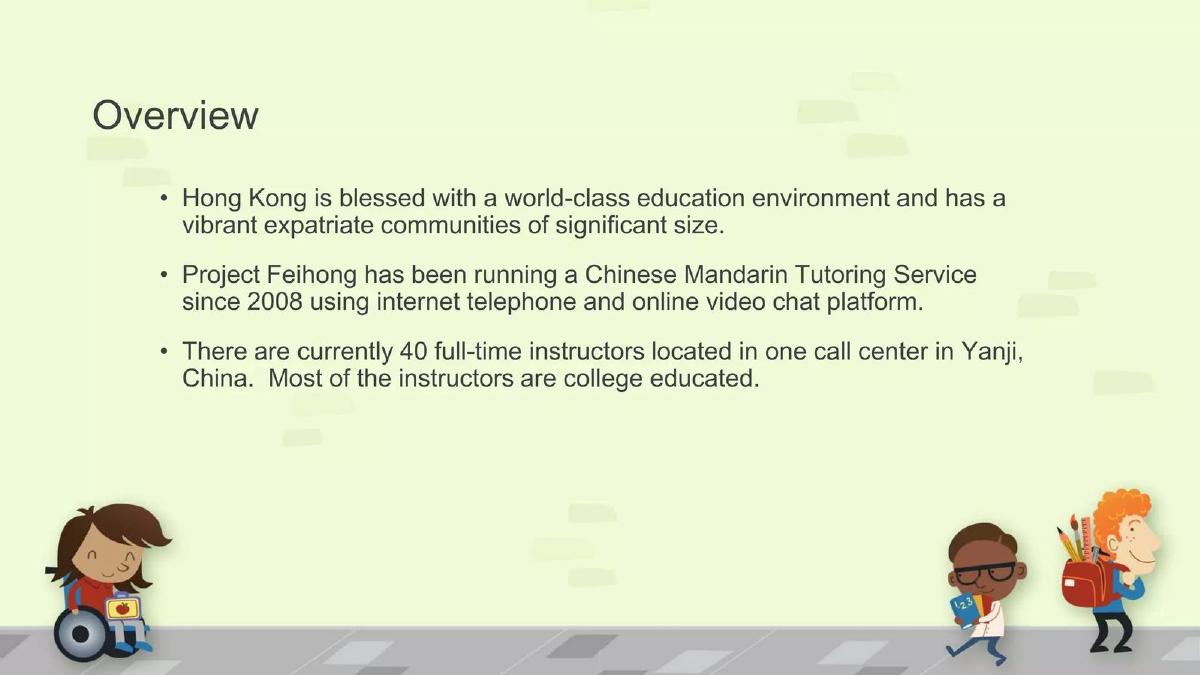
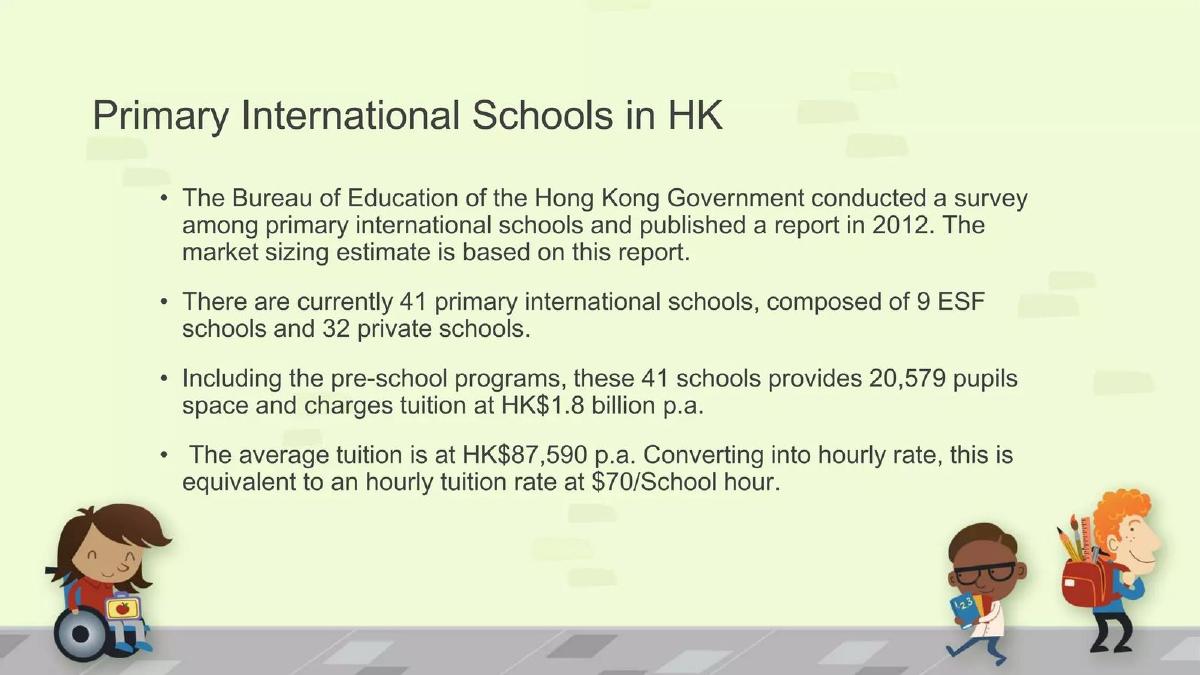
Project Feihong, operating under the brand Imagine Tutors, targets the specific niche of Mandarin language education for Non-Mandarin Speaking (NMS) families in Hong Kong. The deck is characterized by a bottom-up market sizing approach that utilizes historical tuition data from international schools to estimate a total addressable market of HK$54 million per annum. While the deck provides granular data on student populations by nationality and school tuition rates, it lacks critical operational details such as the product interface, team background, or a specific funding ask. The presentation…
Key takeaways
- The company identifies a specific market gap where Cantonese and English are dominant, leaving Mandarin as a 'learned' language for 7.8 million people (Slide 2).
- Market sizing is calculated by taking HK$1,800 million in total primary tuition and applying a 15% tutoring usage rate and 20% Mandarin-specific rate (Slide 4).
- The total estimated market for Chinese Mandarin tutoring is valued at HK$54 million per annum (Slide 4).
- Project Feihong targets market share tiers of 5%, 10%, and 20%, representing revenue potentials of HK$2.7M to HK$10.8M (Slide 4).
- The deck includes a detailed breakdown of 16,525 pupils across 13 nationalities in international schools as of 2012 (Slide 5).
- British and HK Local students represent the largest tuition contributors, accounting for 20% and 18% of the international school market respectively (Slide 5).
- Pricing strategy is derived from school tuition rates, proposing an hourly rate adjusted for 5% inflation since 2012 (Slide 6).
- The deck omits a team slide, a product demo, a competitive analysis, and a clear investment ask.
Executive Summary: The Niche Language Play
Project Feihong, branded as Imagine Tutors, presents a highly localized business case for Mandarin language instruction in Hong Kong. The deck is notable for its narrow focus on market data and tuition statistics rather than product features or visionary growth. It operates on the premise that in a market where Cantonese and English dominate, there is a quantifiable and underserved demand for Mandarin tutoring among non-native families. However, the reliance on data from 2012 suggests this deck may be dated or was used for a very specific, time-sensitive feasibility study.
Slide 1: Title and Positioning
The cover slide introduces the brand name "Imagine Tutors" and the project name "Project Feihong." The subtitle, "Chinese Learning for Non-Mandarin Speaking (NMS) Families," immediately defines the target audience. The visual style uses child-friendly illustrations, signaling that the primary end-users are children, even if the customers are the parents. It is a standard, clear opening that establishes the sector (EdTech/Tutoring) and the specific niche (Mandarin for NMS).
Slide 2: Market Overview and Problem Statement
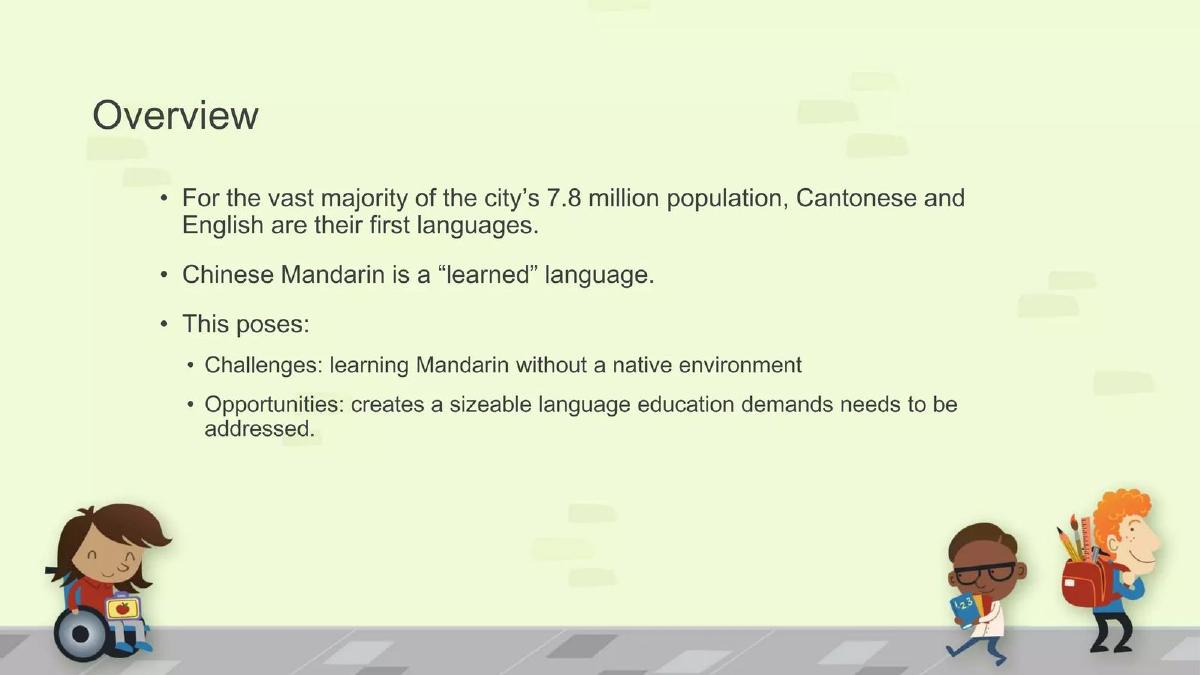
Slide 2 sets the scene by citing a population of 7.8 million people. It notes that for the vast majority, Cantonese and English are first languages, rendering Mandarin a "learned" language. The slide identifies two key points: the challenge of learning Mandarin without a native environment and the opportunity created by the resulting demand for language education. This slide effectively establishes the "Why Now" and the "Problem," though it lacks specific pain points beyond the general difficulty of language acquisition.
Slide 3: Market Sizing Transition
Slide 3 is a simple transition slide titled "Market Sizing." While it maintains the visual theme of the deck, it provides no new information. In an 11-slide deck, using a full slide for a transition is often considered a waste of valuable real estate, especially when so many other critical business components are missing from the presentation.
Slide 4: The Financial Formula
This is the most critical slide in the deck. It provides a mathematical breakdown of the Chinese Mandarin Tutoring Market Size Estimate. The formula used is: Total Primary Tuition X % of Tutoring Service Usage X % of Chinese Tutoring Usage. The figures cited are HK$1,800 million X 15% X 20%, resulting in a market size of HK$54 million per annum. The slide then projects revenue based on capturing 5% (HK$2.7M), 10% (HK$5.4M), or 20% (HK$10.8M) of that market. This bottom-up calculation is logical, though the source of the 15% and 20% assumptions is not cited on the slide.
Slide 5: International School Data Breakdown
Slide 5 provides a deep dive into the "Primary International Schools Rank by Tuition Paid." It lists 13 nationalities and the number of pupils associated with each. The table shows a total of 16,525 pupils who paid a combined HK$1,449,813,074 in tuition in 2012. The average tuition rate is listed as HK$87,732. This data is used to validate the spending power of the target demographic, specifically highlighting that British, HK Local, and American families account for 55% of the total international school tuition spend.
Slide 6: Hourly Rate Projections
The final slide provided, Slide 6, attempts to derive a service price from the tuition data. It lists annual tuition brackets (from HK$75,000 to HK$122,732) and assigns a "Per Hour Tuition Rate" ranging from HK$60 to HK$97. It then applies an "Adj Inflation 5% Since 2012" to reach a final estimated hourly rate. The logic here is that tutoring rates should be commensurate with what parents are already paying for formal schooling on an hourly basis. This is an unusual way to set pricing, as tutoring usually commands a premium over the per-hour cost of general schooling.
What Project Feihong Does Well
The deck excels at market segmentation. By focusing specifically on Non-Mandarin Speaking families within the international school system, the founders have identified a high-intent, high-spending customer base. The use of granular data regarding pupil counts by nationality (Slide 5) shows a level of research that many early-stage decks lack. It allows a potential investor to see exactly where the customers are located and what their current educational spend looks like.
Furthermore, the market sizing formula on Slide 4 is transparent. Even if an investor disagrees with the percentages used (15% and 20%), the logic is easy to follow and adjust. This is far better than presenting a massive, unsubstantiated "Trillion Dollar Market" figure that many startups fall prey to.
What is Missing from the Deck
The omissions in this deck are significant and would prevent it from being a successful fundraising tool in a modern venture capital environment. First, there is no Team Slide . In early-stage EdTech, the pedagogical background of the founders is as important as the market data. We do not know if the founders are educators, technologists, or business analysts.
Second, there is no Product Slide . It is unclear if Project Feihong is a marketplace for tutors, a physical learning center, or a software-as-a-service (SaaS) platform. Without knowing the delivery mechanism, it is impossible to evaluate the scalability or the unit economics of the business.
Third, there is no Competitive Landscape . Hong Kong has a saturated tutoring market. The deck fails to mention existing players or how Imagine Tutors differentiates itself from local "cram schools" or established international tutoring franchises. Finally, there is no Ask . A pitch deck must eventually ask for a specific amount of capital to achieve specific milestones; this deck ends its data presentation without a call to action.
Founder's Guide: What to Copy and What to Avoid
Copy the data-driven approach to pricing. While the specific formula here is unique, the attempt to anchor tutoring rates to existing educational spending (Slide 6) is a sophisticated way to justify a pricing model. It shows that the founders are thinking about the customer's wallet share and price sensitivity relative to their other expenses.
Avoid the lack of currency. Using 2012 data in a pitch (as seen on Slides 5 and 6) is a major red flag for investors unless the deck was produced in 2012. If this were presented today, the data would be over a decade old, rendering the market sizing and inflation adjustments obsolete. Always use the most recent census or industry report data available.
Avoid the "Missing Middle." This deck has a beginning (the market problem) and an end (the financial potential), but it misses the middle: the solution. A founder should never leave an investor wondering what the actual product is. Ensure that at least two to three slides are dedicated to the user experience, the technology stack, and the unique value proposition of the service itself.
Final Analysis
Project Feihong's deck for Imagine Tutors is a clinical exercise in market analysis. It successfully identifies a lucrative niche in the Hong Kong education sector and backs it up with specific demographic and financial data. However, as a pitch for a startup, it is incomplete. It reads more like a consultant's report on market feasibility than a founder's vision for a disruptive company. To be viable for fundraising, it would require a complete overhaul to include team credentials, product mechanics, and a clear roadmap for how that HK$54 million market will actually be captured.
Frequently asked questions
- What is the core problem Project Feihong is trying to solve?
- According to slide 2, the problem is the lack of a native environment for learning Mandarin in a city where Cantonese and English are the primary languages. This creates a 'learned language' barrier for the 7.8 million residents, specifically targeting Non-Mandarin Speaking (NMS) families who require supplemental tutoring to achieve proficiency.
- How does the company calculate its Total Addressable Market (TAM)?
- The TAM is calculated on slide 4 using a top-down formula: Total Primary Tuition (HK$1,800 million) multiplied by the percentage of tutoring service usage (15%) and the percentage of Chinese-specific tutoring usage (20%). This results in a calculated annual market size of HK$54 million.
- What demographic data does the deck use to justify its focus?
- Slide 5 provides a granular table of Primary International Schools ranked by tuition paid. It identifies 16,525 total pupils, with British (3,319), HK Local (2,769), and American (2,118) students being the largest groups. This data is used to show where the highest concentration of education spending currently exists.
- What is the proposed pricing model for the tutoring services?
- Slide 6 outlines an hourly rate estimate based on annual school tuition. The rates range from HK$60 to HK$97 per hour, which are then adjusted by a 5% inflation factor (calculated from a 2012 baseline) to reach adjusted rates between HK$62.50 and HK$102.28 per hour.
- What essential startup pitch elements are missing from this deck?
- The deck is significantly incomplete by modern standards. It lacks a Team slide (who is building this?), a Product slide (is it an app or a physical center?), a Competition slide (who else is tutoring?), and a clear Ask (how much money is needed and for what?). It functions more as a market analysis than a business plan.