The ProcureNow (formerly Govlist) deck is a concise, 10-slide presentation that leans heavily on storytelling and early social proof. By framing the massive $38 billion daily government procurement market through the lens of a fictionalized 'Commissioner Gordon' persona, the founders successfully bypassed the dry, bureaucratic jargon that often plagues GovTech pitches. The deck highlights significant early wins with major municipalities like Boston and Palo Alto, providing immediate credibility. However, it is structurally incomplete by modern standards, entirely omitting a team slide, a form…
Key takeaways
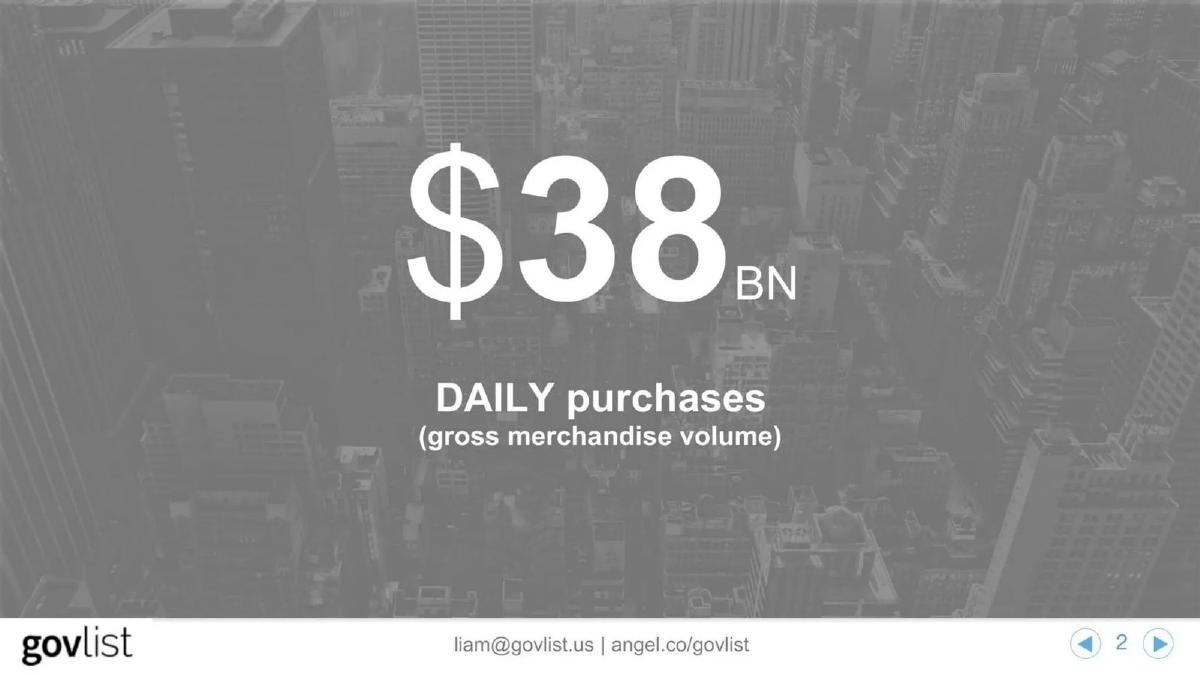
- The deck establishes market scale immediately, citing $38 billion in daily purchases as gross merchandise volume on slide 2.
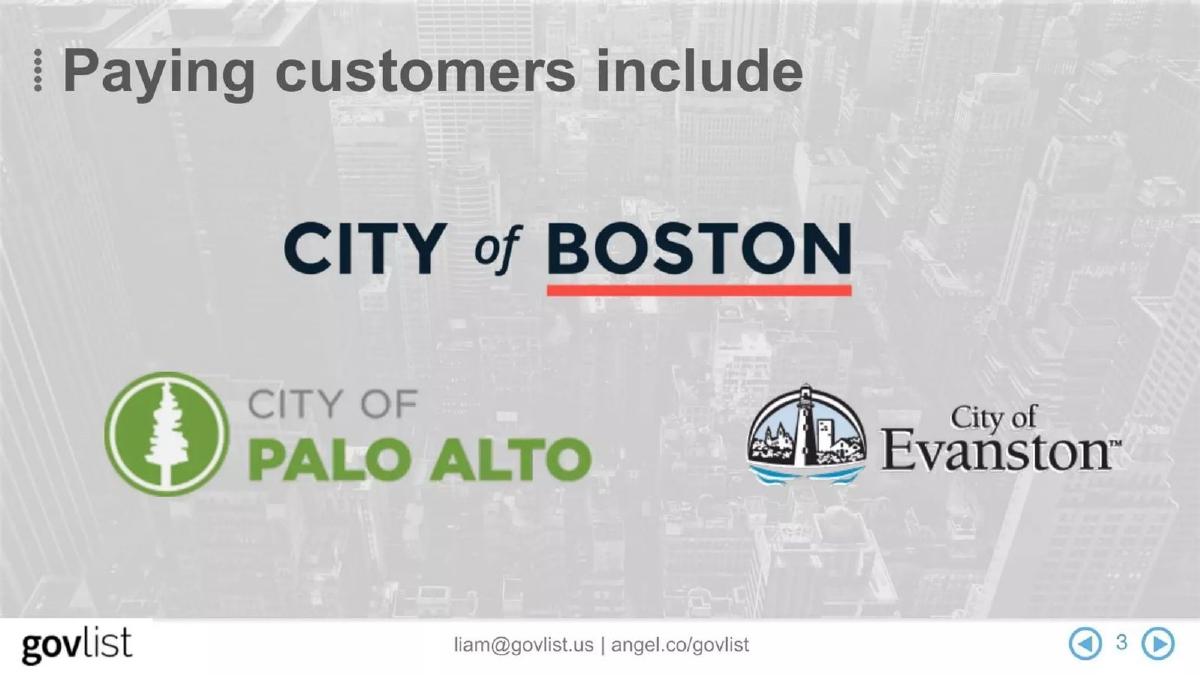
- Social proof is prioritized early, listing the City of Boston, City of Palo Alto, and City of Evanston as paying customers on slide 3.
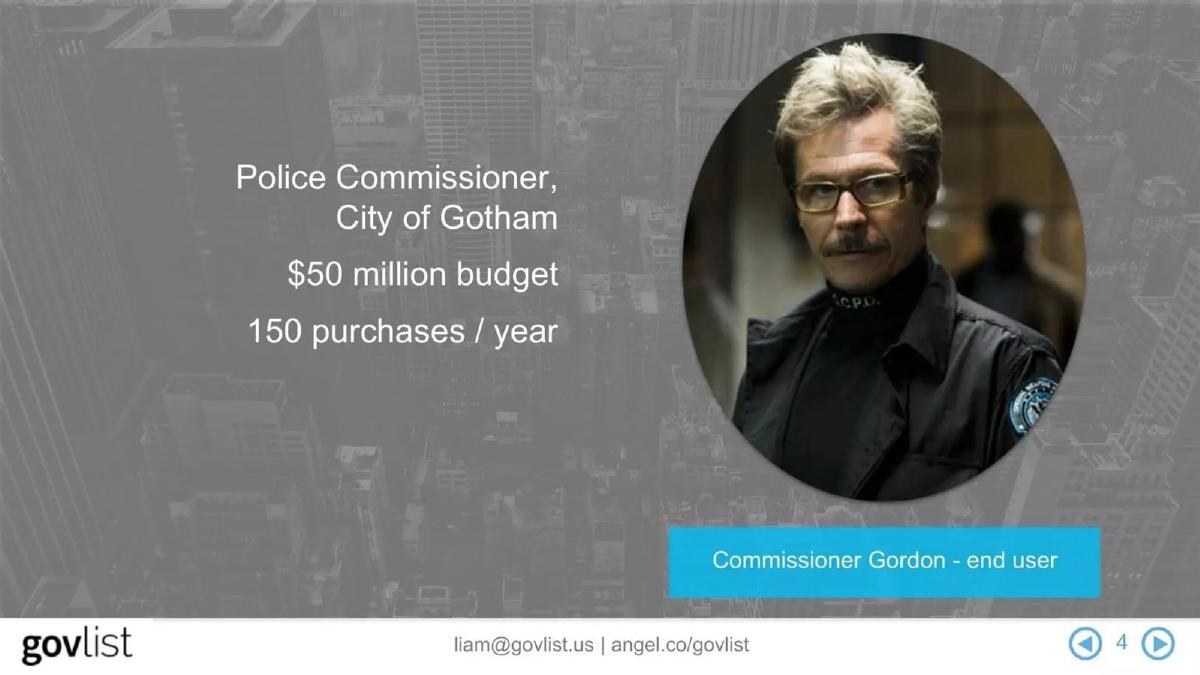
- A fictional persona, Commissioner Gordon of Gotham City, is used to humanize the end-user experience on slide 4.
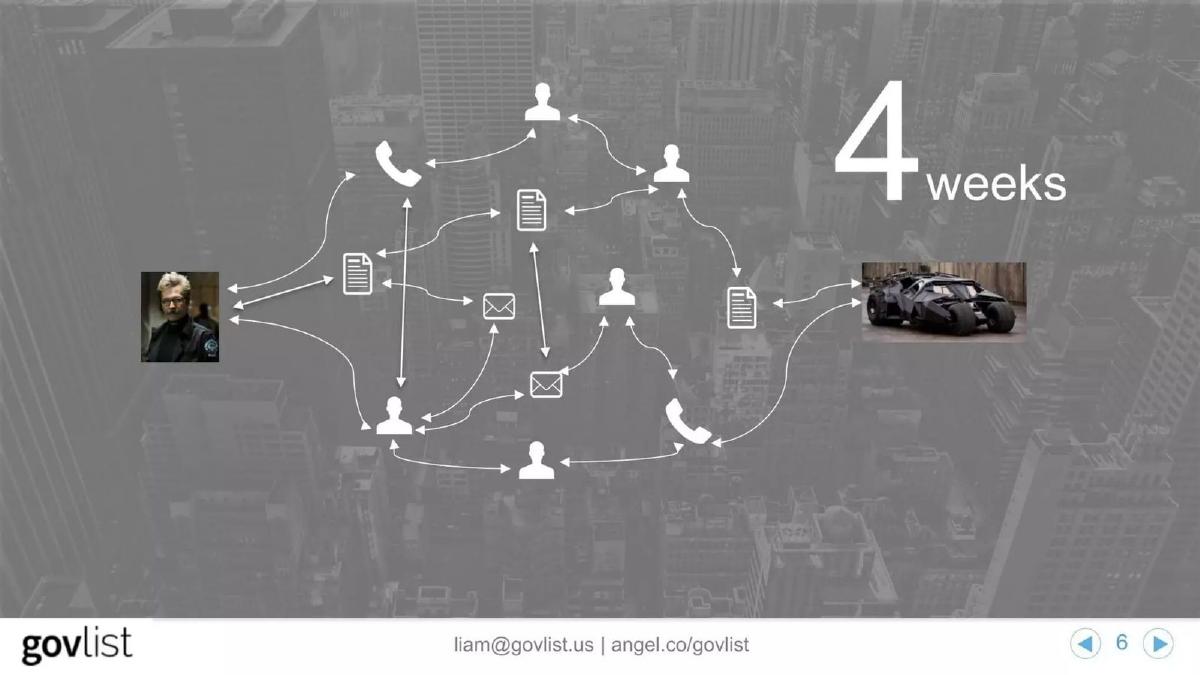
- The problem is illustrated as a complex web of communication taking 4 weeks for a single acquisition on slide 6.
- The product interface is shown across desktop, tablet, and mobile devices on slide 7, emphasizing a modern UI.
- The company claims a 3-month average sales cycle, which is exceptionally fast for government contracts, on slide 8.
- Sales qualified pipeline grew 6.7x, from $125K to $835K, as shown on slide 9.
- The deck completely omits a team slide, leaving the founders' backgrounds unknown to the reader.
Introduction: The Lean GovTech Narrative
The ProcureNow (formerly Govlist) pitch deck from 2016 is a masterclass in brevity, consisting of only 10 slides. In a sector often characterized by dense white papers and regulatory hurdles, this deck opts for a high-level narrative approach. It focuses on the sheer volume of capital moving through government channels and the inefficiency of the current manual processes. While it lacks several standard components of a venture deck, its focus on early 'lighthouse' customers and a relatable problem statement provided a clear path to its Seed round.
Slides 1-3: The Hook and Social Proof
Slide 1 is a minimalist title slide featuring the original brand name, 'govlist,' in white text on a black background. There is no tagline or mission statement here, which forces the viewer to move quickly to the next slide to understand the value proposition.
Slide 2 delivers the 'Big Number.' It states there are $38 BN in DAILY purchases , defined as gross merchandise volume. By leading with this, the company establishes that they are playing in a massive, albeit fragmented, market. The background image of a dense city skyline reinforces the urban/municipal focus of the product.
Slide 3 immediately addresses the biggest hurdle in GovTech: credibility. It lists 'Paying customers include' followed by the logos for the City of Boston , City of Palo Alto , and City of Evanston . For a seed-stage company, having a Tier-1 city like Boston as a paying customer is a significant validator that the product can survive municipal scrutiny.
Slides 4-6: The Gotham City Case Study
Instead of using a real, potentially confidential case study, the deck pivots to a fictional persona to explain the product's utility. Slide 4 introduces 'Commissioner Gordon' of the 'City of Gotham.' It lists his profile: a $50 million budget and 150 purchases per year . This slide identifies the 'end user' as a department head with significant purchasing power but high administrative overhead.
Slide 5 defines the specific 'need': Gordon wants to acquire a Batmobile with a budget of $10MM and a timeline of 3 months . This playful approach keeps the investor engaged while clearly outlining the parameters of a typical government procurement project: asset type, budget, and deadline.
Slide 6 illustrates the 'Problem.' It shows a chaotic web of icons representing phone calls, emails, and paper documents connecting Commissioner Gordon to the vendor. The slide notes this process currently takes 4 weeks . This visualizes the 'administrative friction' that ProcureNow aims to eliminate, showing that the delay isn't in the manufacturing of the goods, but in the bureaucratic communication required to start the purchase.
Slides 7-8: Product and Efficiency Metrics
Slide 7 provides a product overview. It shows the software running on a laptop, tablet, and smartphone. The interface includes a 'What Would You Like to Purchase?' modal with categories like Arts & Entertainment, Commodities, Construction, and Technology. This demonstrates that the platform is a horizontal solution capable of handling diverse procurement needs across different government departments. The mobile view shows a pie chart of 'Currently 36 Projects,' suggesting a dashboard for oversight.
Slide 8 focuses on the value proposition, using three icons for Acceleration , Compliance , and Outcomes . Below this, it highlights a critical metric: a 3 Months average sales cycle . In the world of government sales, where cycles often span fiscal years, a three-month turnaround is a competitive advantage that suggests a 'land and expand' strategy is viable.
Slides 9-10: Pipeline Growth and Contact
Slide 9 uses a simple bar chart to show momentum. It claims a 6.7x sales qualified pipeline growth, moving from $125K to $835K . While the absolute dollar amounts are modest for a venture-scale company, the growth multiplier over an unspecified period indicates that the sales team (or founders) found a repeatable way to generate interest.
Slide 10 is the closing slide, featuring the logo and a contact email for 'liam@govlist.us.' The background is a faded historical painting, perhaps nodding to the 'public service' nature of the business, but it provides no further information on the team or the raise.
What Works in This Deck
The Persona Strategy: Using a fictional character like Commissioner Gordon allows the founders to explain a complex, boring process without losing the audience. It makes the '4-week' delay feel tangible. · Early Validation: Leading with the City of Boston (Slide 3) removes the 'will governments actually buy this?' doubt that investors usually have regarding startups in this space. · Focus on Velocity: By highlighting the 3-month sales cycle (Slide 8), the deck attacks the primary reason investors avoid GovTech: the fear of slow, stagnant growth.
What is Missing
The Team: There is no team slide. Investors at the seed stage invest in people. Not knowing if the founders have procurement experience or technical backgrounds is a significant omission. · The Ask: The deck does not state how much money is being raised, the valuation, or what the milestones for the next 18 months are. · Competition: The deck assumes a vacuum. It doesn't mention legacy players (like Tyler Technologies) or other startups in the space, leaving the 'why us' question partially unanswered. · Business Model: There is no mention of pricing. Is it a SaaS subscription based on city population, a percentage of GMV, or a per-user fee?
What a Founder Should Copy
The 'Big Number' Slide: Slide 2 is excellent. It defines the market size not by a vague 'TAM' but by the actual daily volume of transactions occurring in the target sector. · Visualizing the 'Mess': Slide 6 effectively visualizes the 'before' state. Founders should always try to draw the 'chaos' their software replaces; it is often more effective than a list of bullet points. · Device Diversity: Showing the product on mobile and tablet (Slide 7) is important for field-heavy industries like government and construction, as it proves the software is accessible to workers who aren't always at a desk.
Frequently asked questions
- Why does the deck use Batman characters?
- GovTech procurement is notoriously dry and complex. By using Commissioner Gordon and the Batmobile as a case study (slides 4-6), the founders created a memorable, easily understood narrative. It allows investors to focus on the process friction—the '4 weeks' of back-and-forth communication—rather than getting bogged down in real-world municipal regulations.
- How significant is the traction shown in this deck?
- For a 2016 seed-stage GovTech company, the traction is high-quality. Slide 3 lists the City of Boston and City of Palo Alto as 'paying customers.' These are high-profile 'lighthouse' accounts that signal the product can pass the rigorous security and procurement hurdles of major U.S. cities.
- What are the biggest risks missing from the deck?
- The deck ignores competition and the 'moat.' It doesn't explain how ProcureNow integrates with existing ERP systems like SAP or Oracle, which are common in government. Additionally, the lack of a team slide is a major red flag for most investors, as it hides the founders' domain expertise.
- Is a 3-month sales cycle realistic for government software?
- A 3-month sales cycle (slide 8) is very aggressive for local government, which typically operates on 6-to-18-month cycles. If accurate, this metric is the strongest part of their value proposition, suggesting their 'guided step-by-step' approach significantly lowers the barrier to entry for department heads.
- What happened to the company after this deck?
- The company successfully rebranded from Govlist to ProcureNow and was eventually acquired by OpenGov in 2021. This deck represents the early seed stage where they were proving the core workflow automation could scale across different municipal departments.