Synthflow’s Series A deck is a masterclass in positioning a complex technical product as essential infrastructure. By framing themselves as the 'Stripe for Voice' on slide 2, they immediately communicate a high-ceiling platform play rather than a niche tool. The deck relies heavily on massive scale indicators, citing 45 million calls processed (slide 3) and 5 million hours saved (slide 4) to prove market fit. While the deck is light on financial unit economics and specific revenue figures, it compensates with a strong 'Product-as-Demo' approach, including a live phone number for investors to…
Key takeaways
- Synthflow positions itself as the 'OS and infrastructure' for voice AI, using a 'Stripe for Voice' analogy to signal platform-level ambitions (Slide 2).
- The company demonstrates significant scale with over 45,000,000 calls processed on the platform (Slide 4).
- The deck highlights a 99.9% uptime and +35% faster customer support as key enterprise-grade performance metrics (Slide 4).
- A live demo is integrated directly into the deck via a functional phone number (+1 650 250 0929), reducing friction for investor due diligence (Slide 5).
- The technical architecture is presented as a multi-layered 'Operating System' including memory, knowledge retrieval, and telephony connectivity (Slide 7).
- The platform targets three distinct customer segments: BPOs, CRM platforms (embedded), and mid-market companies (Slide 9).
- The founding team brings experience from high-growth environments like BCG, Rocket Internet, and Deutsche Bank (Slide 10).
- The deck omits a specific 'Ask' slide, financial projections, and a detailed competitive landscape analysis.
Introduction: The Infrastructure Play for Voice AI
Synthflow’s pitch deck represents a shift in the AI narrative from 'experimental tool' to 'enterprise infrastructure.' Based in Berlin, the company successfully raised $20M in 2024 (as reported by Business Insider) by positioning itself as the foundational layer for voice-based customer interactions. The deck is visually clean, metric-heavy, and focused on the 'no-code' accessibility of their technology.
Slide 1-2: Positioning and the 'Stripe' Analogy
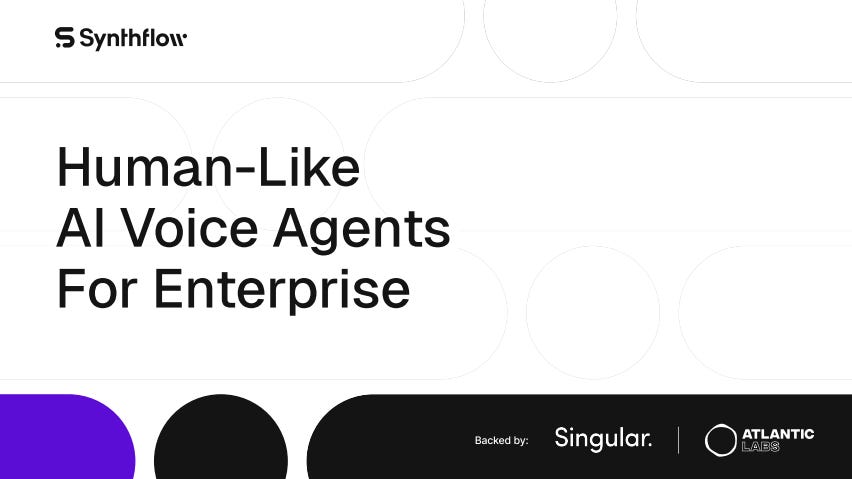
The deck opens with a clear, bold statement: 'Human-Like AI Voice Agents For Enterprise.' The inclusion of existing backers like Singular and Atlantic Labs on the cover slide immediately establishes institutional credibility. Slide 2 introduces the core strategic hook: 'Synthflow is like Stripe for Voice.' This is a classic fundraising tactic—using a well-known 'unicorn' as a mental model to explain a complex product. By calling themselves the 'OS and infrastructure,' they move the conversation away from being a simple SaaS tool to being a platform that other companies build upon.
Slide 3-4: The Power of Big Numbers
Slide 3 is a 'traction teaser' featuring a single large figure: 45M+ calls handled. This is designed to stop an investor from skimming and force them to acknowledge the scale of the operation. Slide 4, titled 'About Synthflow AI,' expands on these metrics. It lists 45,000,000+ calls processed, ~$10M previously raised, and 5M+ hours of contact center operations saved. The inclusion of compliance badges like AICPA SOC and GDPR, alongside a 99.9% uptime metric, signals that the company is ready for the rigorous security requirements of enterprise clients.
Slide 5: The Interactive Demo
One of the most effective slides in the deck is Slide 5, which simply provides a phone number: +1 (650) 250 0929. In an era of 'AI hype,' providing a live, functional number for investors to call and experience the 'human-like' quality of the voice agent is a high-conviction move. It removes the need for a scheduled demo and allows the product to speak for itself—literally.
Slide 7: The Technical 'Operating System'
To justify the 'Stripe for Voice' claim, Slide 7 breaks down the 'Voice AI Operating System' into its component layers. These include the Real-Time Speech Engine, Memory & Knowledge Retrieval, API Integration, Agent Brain, Telephony Connectivity, and Security/Compliance. This architecture slide is crucial for technical due diligence, as it shows that Synthflow isn't just a wrapper around a single LLM, but a full-stack solution handling everything from the 'brain' to the actual phone line connection.
Slide 8-9: Use Cases and Customer Verticals
Slide 8 highlights four impact-driven use cases: Support, Scheduling, Lead Qualification, and Live Transfer. The visuals here use UI mockups to show how the AI interacts with calendars and CRMs. Slide 9 categorizes their market into three buckets: BPOs (who white-label the tech), CRM Platforms (who embed it), and Mid-Market Companies (who use it directly). The slide includes logos of current users like Yardi, Smartcat, and Krisp, though some logos are blurred, likely for confidentiality reasons during the round.
Slide 10: The Team
The team slide (Slide 10) showcases a balanced leadership group. CEO Hakob Astabatsyan and CPO Albert Astabatsyan highlight their experience at BCG and Rocket Internet, emphasizing their ability to scale ventures. CTO Sassun Mirzakhan-Saky brings the technical depth with a background in ML infrastructure at Deutsche Bank. The 'Head of' roles include veterans from Delivery Hero, Picsart, and AT&T, suggesting a team that understands both high-growth startups and legacy enterprise environments.
What Works in the Synthflow Deck
Platform Positioning: By framing the product as an 'Operating System' rather than a 'Bot,' Synthflow justifies a higher valuation multiple. They aren't just selling a service; they are selling the pipes that the service runs through.
Massive Proof Points: Citing 45 million calls is a staggering figure for a Series A company. It proves that the technology is stable enough to handle massive loads, which is the number one concern for enterprise buyers looking at AI startups.
Frictionless Demo: The 'Call Synthflow' slide is a brilliant way to handle the 'show, don't tell' requirement of a pitch. It creates an immediate 'aha' moment for the investor.
What is Missing from the Synthflow Deck
Financial Specifics: The deck is entirely devoid of revenue figures. While 'calls handled' is a great proxy for usage, investors generally want to see how that translates into ARR (Annual Recurring Revenue) and what the take-rate per call or per seat looks like.
Competitive Landscape: The voice AI space is becoming crowded with players like Retell AI, Vapi, and Bland AI. Synthflow does not include a slide explaining their moat or how they differ from these competitors, relying instead on their 'OS' framing to imply superiority.
The 'Ask': There is no slide detailing how much they are raising or how they intend to spend the capital. While this information is often shared in a separate teaser or during the first meeting, its absence in the main deck leaves the narrative somewhat open-ended.
Founder Takeaways
Use 'The [X] for [Y]' wisely: If you are building infrastructure, comparing yourself to Stripe or AWS helps investors quickly categorize your business model and potential scale. · Lead with your strongest metric: If you have processed millions of units (calls, transactions, files), put that number on its own slide. It builds immediate momentum. · Prove enterprise readiness: Don't wait for due diligence to mention SOC2 or GDPR compliance. Putting those badges next to your traction metrics shows you understand the 'boring' parts of enterprise sales that actually close deals. · Make the product accessible: If your product is a voice AI, give them a number to call. If it's a web app, give them a guest login. The faster an investor can touch the product, the faster they can get to a 'yes.'
Frequently asked questions
- What is Synthflow's core value proposition?
- Synthflow provides a no-code platform for deploying human-like AI voice agents. They position themselves as the infrastructure layer (the 'OS') that allows enterprises to build, run, and scale voice interactions for support, sales, and scheduling without increasing headcount. Their primary claim is saving 5 million hours of contact center operations while maintaining 99.9% uptime.
- How much did Synthflow raise with this deck?
- According to publisher reports from Business Insider, Synthflow raised $20 million in a Series A round in 2024. The deck itself mentions approximately $10 million previously raised from 'renowned investors in the AI space' on slide 4, indicating the $20 million was the subsequent round following the metrics shown.
- Who are the founders of Synthflow?
- The company was co-founded by Hakob Astabatsyan (CEO), Sassun Mirzakhan-Saky (CTO), and Albert Astabatsyan (CPO). The team features a mix of strategic experience from BCG and Rocket Internet, alongside technical leadership in ML and AI infrastructure from firms like Friendsurance and Deutsche Bank.
- What specific use cases does the platform support?
- Slide 8 outlines four primary enterprise use cases: Customer Support (handling L1/L2 requests), Appointment Scheduling (calendar management and reminders), Lead Qualification (syncing voice AI results to CRM), and Live Transfer (detecting intent and escalating to human agents).
- Does the deck include financial projections or revenue?
- No. The deck focuses entirely on operational metrics (calls handled, hours saved, uptime) and product architecture. It does not disclose Annual Recurring Revenue (ARR), burn rate, or specific financial forecasts for the coming years, which is common in high-growth AI infrastructure decks where usage volume is the primary proxy for value.