"X for Y" Analogies in a Pitch Deck: When to Say "We Are
Should you describe your startup as "the Uber for" or "the Stripe for" something?
"X for Y" Analogy Slide: Say Which Part of the Famous Company You Mean, Then Show It
Many founders describe their startup by pointing at a famous company: "the Stripe for voice", "the LinkedIn for companies", "Shopify for creators". The shortcut is popular because it works fast. In five words an investor knows roughly what kind of business this is. It is also risky. Each famous company stands for several things at once, such as a product, a business model, a type of customer and a market position, and the listener picks whichever one they think of first. This guide uses six slides from six startup decks to show when an analogy helps, what it has to be followed by, and what happens when the comparison is left to do all the work.
TL;DR
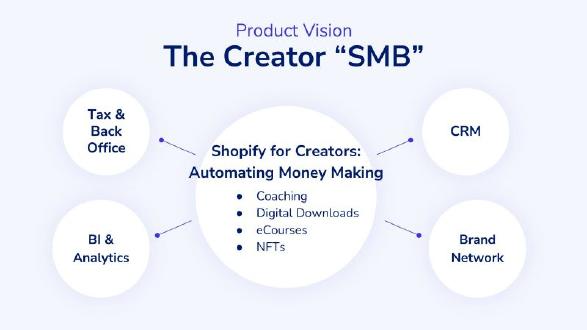
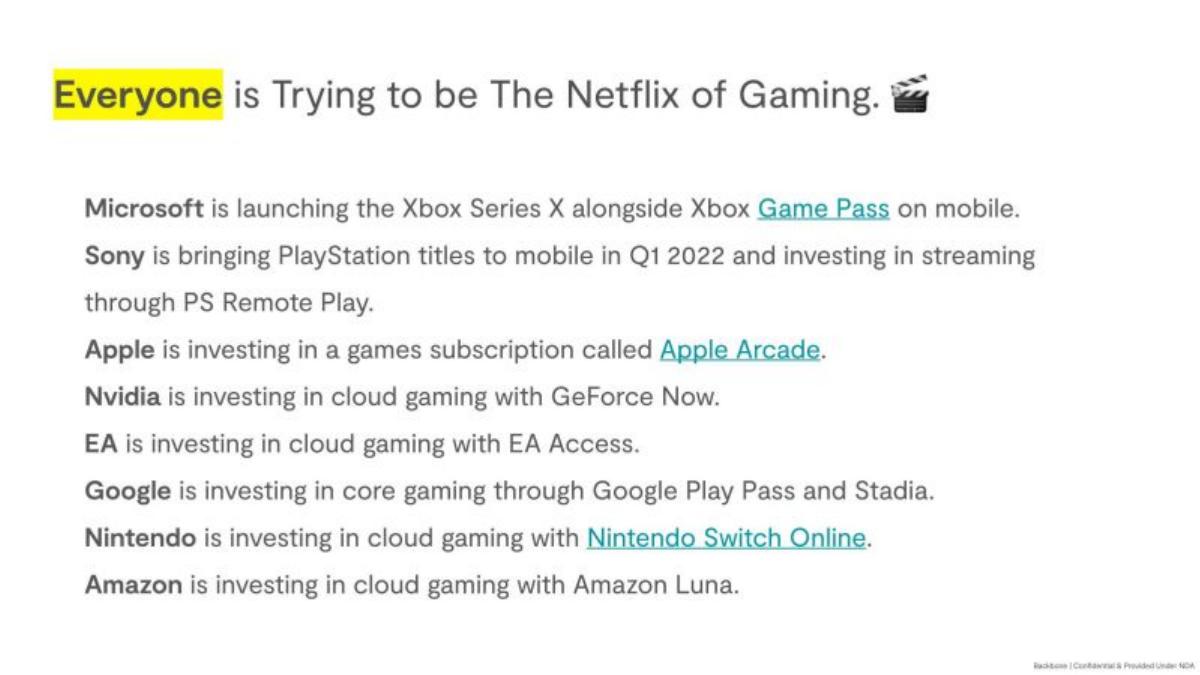
Use a company analogy only as a quick label, say which part of the famous company you mean, and put proof on the same slide or the next one. Crunchbase does this best: "Crunchbase: the LinkedIn for Companies" sits above a screenshot of a company profile page with funding rounds, so the slide shows exactly what "LinkedIn for companies" means. Synthflow says it is "like Stripe for Voice" and then explains the borrowed part in the same sentence: "powering the OS and infrastructure enterprises need to build, run, and scale voice AI agents". Opkit puts "Stripe for Healthcare" in a small label above a plain sentence about making insurance "as easy as using your credit card". Muck Rack uses Salesforce as a comparison for a category, not a company. Stan's "Shopify for Creators" sits inside a diagram of four future product areas, so the analogy describes a vision rather than today's product. Backbone uses the analogy in reverse: "Everyone is Trying to be The Netflix of Gaming", followed by eight large companies doing it.
Six analogy slides, read in full
Each example shows how the slide uses the famous company's name, what it gets right and what to change. Quotes are taken from the slide images at full size.
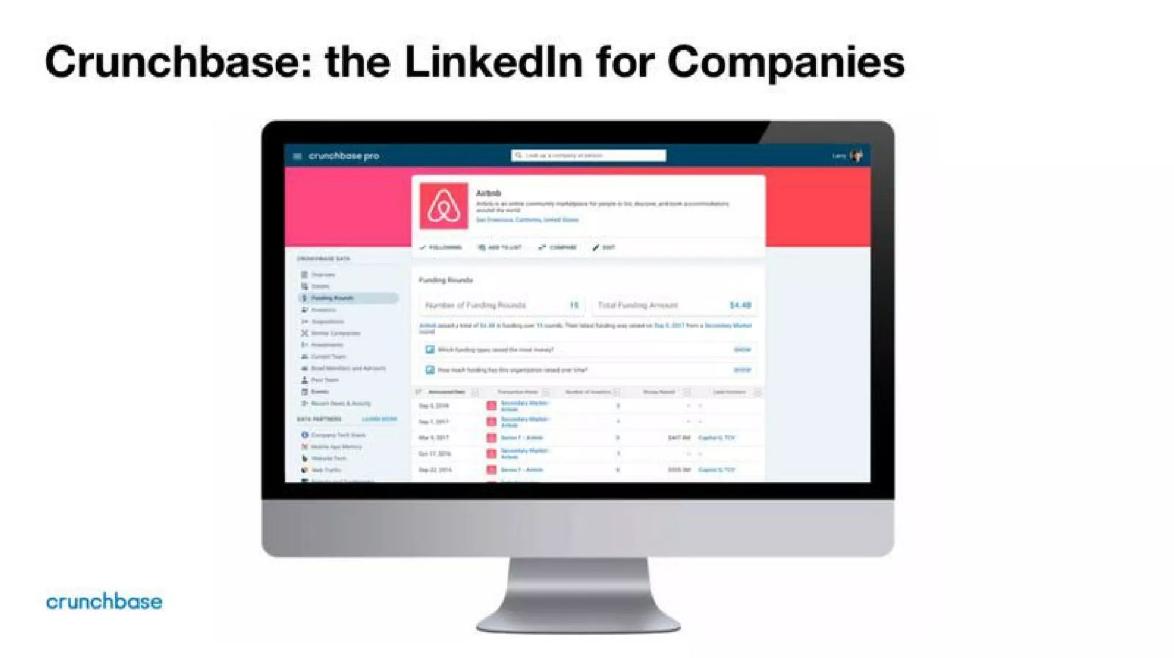
Crunchbase solution slide — slide 12
Company database. Product slide with an analogy as the title.
Crunchbase deck, slide 12. Exact stored slide matched to this analysis.
Our analysis: The picture shows which part of LinkedIn is meant: a profile page per company.
Evidence and limitation: A product screenshot; no usage or revenue figures on this slide.
What a founder can adapt: Put a real product screen directly under your analogy.
Supporting analysis
What the deck claims: "Crunchbase: the LinkedIn for Companies"; screenshot of a Crunchbase Pro company profile with "Funding Rounds", "Number of Funding Rounds" and "Total Funding Amount".
Presentation choice: The reader does not have to guess what the analogy means.
When it does not fit: Letting the analogy stand in for evidence of demand.
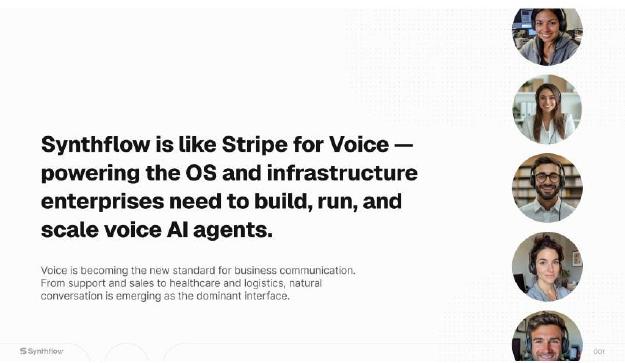
Synthflow deck, slide 2. Exact stored slide matched to this analysis.
Our analysis: The second half of the sentence names the borrowed part: infrastructure others build on.
Evidence and limitation: No figures or product image on this slide.
What a founder can adapt: Follow "like X for Y" with "meaning we..." in the same sentence.
Supporting analysis
What the deck claims: "Synthflow is like Stripe for Voice — powering the OS and infrastructure enterprises need to build, run, and scale voice AI agents."
Presentation choice: Narrowing the analogy in one clause stops it being read as voice payments.
When it does not fit: Leaving the next slides without a customer example.
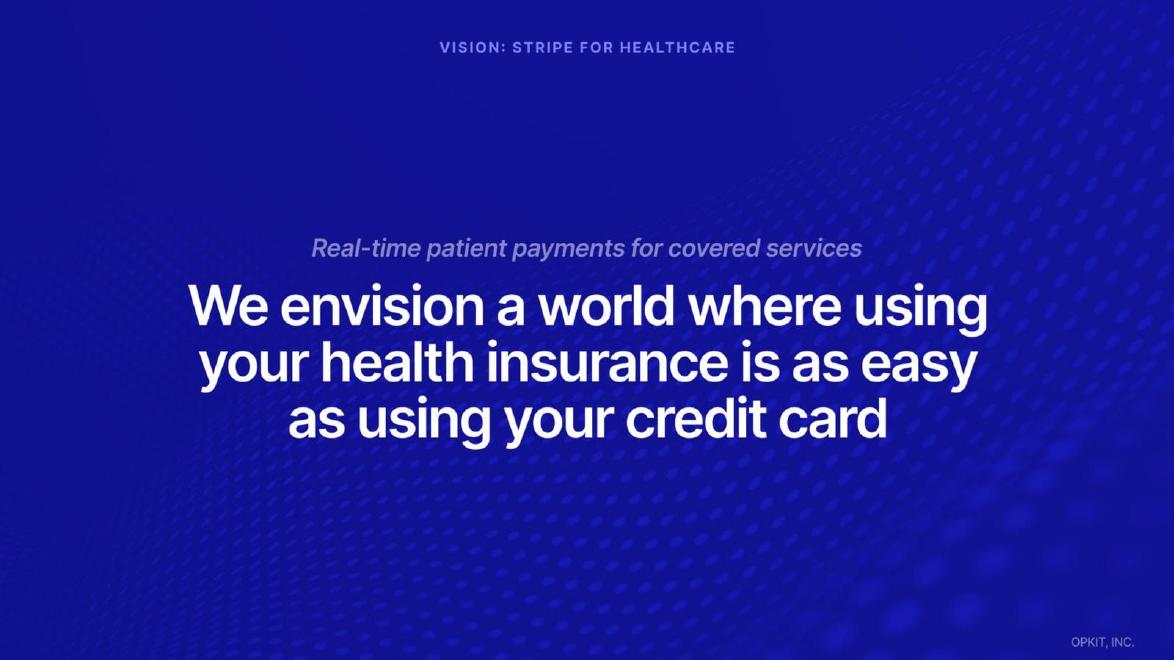
Opkit deck, slide 8. Exact stored slide matched to this analysis.
Our analysis: The analogy is a small tag; the headline is plain language, marked as vision.
Evidence and limitation: A statement of intent; no figures.
What a founder can adapt: Keep the analogy as a label and make the main sentence stand on its own.
Supporting analysis
What the deck claims: "VISION: STRIPE FOR HEALTHCARE"; "Real-time patient payments for covered services"; "We envision a world where using your health insurance is as easy as using your credit card".
Presentation choice: Readers who do not know Stripe still understand the promise.
When it does not fit: A vision slide without a nearby slide on what works today.
Software for PR teams. Category positioning slide.
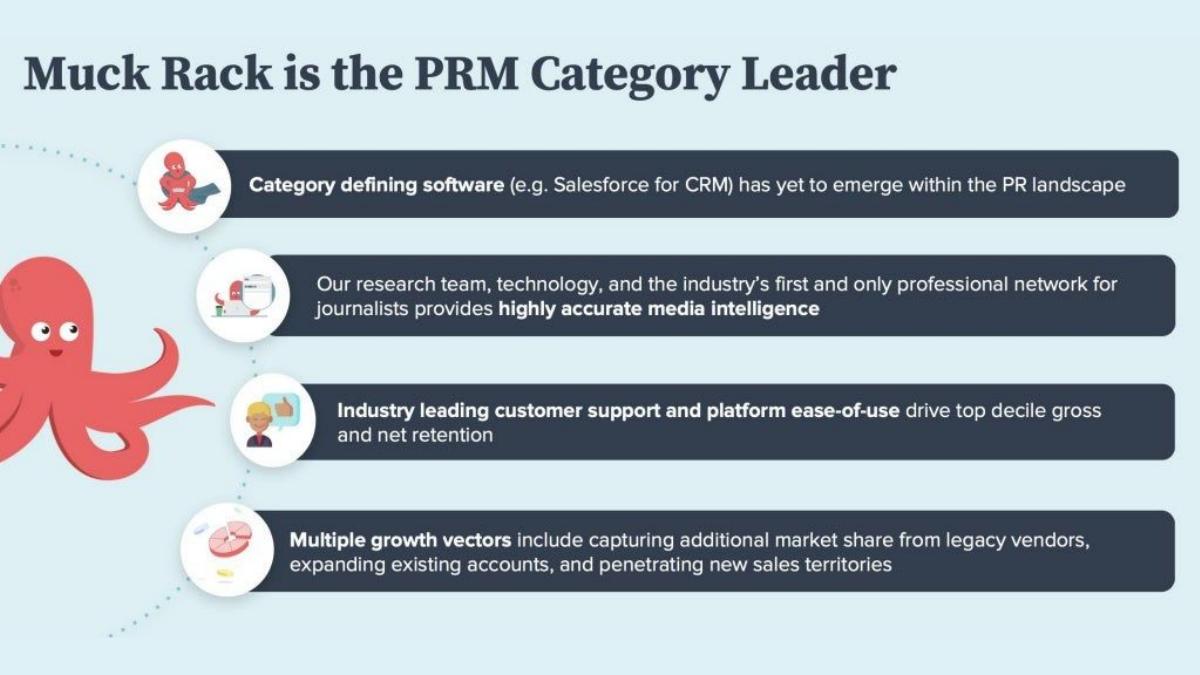
Muck Rack deck, slide 6. Exact stored slide matched to this analysis.
Our analysis: The famous name describes a category gap, not the company itself.
Evidence and limitation: Retention described as "top decile" with no figure or comparison set.
What a founder can adapt: Use the reference to describe the category you intend to define.
Supporting analysis
What the deck claims: "Muck Rack is the PRM Category Leader"; "Category defining software (e.g. Salesforce for CRM) has yet to emerge within the PR landscape"; "top decile gross and net retention".
Presentation choice: A claim about a market is easier for an investor to test than a claim of likeness.
When it does not fit: A title that claims leadership while the text says the leader has not emerged.
Backbone deck, slide 6. Exact stored slide matched to this analysis.
Our analysis: The analogy is used to show where the industry is going, not to describe Backbone.
Evidence and limitation: Named company initiatives; no dates or sources on the slide.
What a founder can adapt: End the list with one line on where your company fits.
Supporting analysis
What the deck claims: "Everyone is Trying to be The Netflix of Gaming." Eight lines on Microsoft, Sony, Apple, Nvidia, EA, Google, Nintendo and Amazon, from "Xbox Game Pass on mobile" to "cloud gaming with Amazon Luna".
Presentation choice: Large companies moving games to phones supports demand for a phone controller.
When it does not fit: A list of other companies that never mentions yours.
Whether the borrowed part is clear, what follows the analogy, and whether it describes today or the future.
Example
Borrowed part made clear
What follows it
Today or future
Crunchbase
Yes, by the screenshot
Product picture
Today
Synthflow
Yes, in the same sentence
Short market paragraph
Today
Opkit
Through the plain headline
Statement of intent
Future, labelled
Muck Rack
Category, not company
Claims without figures
Mixed
Stan
By the diagram
Future product areas
Future, labelled
Backbone
Used as market signal
List of large companies
Today
Key Takeaways
An analogy is a label, not proof.
Say which part of the famous company you mean.
Show the product right after the analogy.
Mark an analogy about the future as the vision.
A crowded analogy can be a market signal, if you say where you fit.
Write your analogy
Answer each prompt before putting a famous company's name in your deck.
Reference. Which company, and what single thing is it best known for?
Borrowed part. Which part do you mean: product, business model, customer or market position?
Difference. Where does your business work differently from it?
Proof. What picture or fact on this slide or the next shows the analogy is true?
Test. What did someone outside your industry repeat back when you said it?
Copyable framework: [Company] is like [famous company] for [market] — [the borrowed part, in plain words]. [Picture or fact that shows it].
Illustrative example 1 — written by us
Before: We are the Uber for home repairs.
After: We are like Uber for home repairs: customers book a vetted plumber in the app and pay on completion. Unlike Uber, our plumbers are licensed contractors who set their own prices.
What improved: Our illustrative rewrite; the company is invented for the example. It names the borrowed part, states the difference in business model and invites a product picture to follow.
The question this guide answers
Founders ask whether they should describe their company as "the X for Y", and if so, where in the deck and how. The solution guides in this library cover how to describe what the product does; the competition guides cover how to compare the company with direct rivals; the cover slide guide covers the one-line description at the start. None covers the specific choice of borrowing a famous company's name to explain your own, which is a different move from comparing yourself to competitors. The famous company is usually not a competitor at all. It is a reference point the investor already understands.
The answer is not "never use an analogy". Investors hear many pitches, and a familiar reference can save a minute of explanation. The answer is that the analogy has to be narrowed and backed up. A listener who hears "Uber for after-school pickup" might picture an app, a gig-worker supply model, surge pricing, a two-sided marketplace or a company that burned cash for a decade. Only one or two of those are what the founder meant.
How we chose and read the examples
We searched the extracted text of the slide library for phrases such as "Uber for", "Airbnb for", "Netflix of", "Stripe for", "Shopify for", "Salesforce for" and "LinkedIn for". We removed investment funds, public-company presentations, consulting decks and slides where the phrase appeared only in a list of other companies. We viewed the remaining candidates and kept six slides from six startup decks, each showing a different way of using, or misusing, the analogy.
Every slide was rendered from the original deck at full size and read in full before we wrote about it. We quote what is visible on each slide. We make no claim that any analogy helped or hurt the company's fundraising, and we have not checked the facts on the slides.
Analogy followed by a picture of the product
Crunchbase, the company database, titles a slide "Crunchbase: the LinkedIn for Companies". Below the title, almost the whole slide is a screenshot of the Crunchbase Pro page for Airbnb: a logo, a short description, a "Funding Rounds" panel with "Number of Funding Rounds" and "Total Funding Amount", and a table of past rounds with dates, amounts and lead investors.
This is the strongest example in the set because the picture narrows the analogy for the reader. LinkedIn stands for many things, including a recruiting business, an advertising business and a social feed. The screenshot shows which one Crunchbase means: a public profile page for every company, the way LinkedIn has one for every person. An investor does not have to guess.
What it does not show is anything about the business. The slide makes no claim about users, revenue or how the profiles are filled in. That is fine for a slide whose job is to explain the product, as long as other slides carry the evidence.
Analogy with the borrowed part spelled out
Synthflow, which makes software for voice AI agents, opens its deck with a single sentence: "Synthflow is like Stripe for Voice — powering the OS and infrastructure enterprises need to build, run, and scale voice AI agents." Below it, a smaller paragraph says "Voice is becoming the new standard for business communication", naming support, sales, healthcare and logistics as areas where "natural conversation is emerging as the dominant interface".
Stripe could mean payments, developer tools, an API business or simply a very valuable company. The second half of Synthflow's sentence tells the reader which part it means: infrastructure that other companies build on. That clause is what makes the analogy useful. Without it, "Stripe for Voice" could be read as voice payments.
The weakness is that the slide has no picture of the product and no evidence. "Enterprises" and "build, run, and scale" are claims. As an opening slide it works, but the next slides need to show a customer building on Synthflow, otherwise the analogy is the only thing the investor remembers.
Analogy as a small label above a plain sentence
Opkit, a healthcare payments company, puts the analogy in small capitals at the top of a slide: "VISION: STRIPE FOR HEALTHCARE". The main text is a plain sentence: "We envision a world where using your health insurance is as easy as using your credit card", with the line "Real-time patient payments for covered services" above it.
This is a careful way to use an analogy. The headline that the reader actually reads is a promise anyone can understand without knowing Stripe. The analogy is a tag that gives an investor a category, and the word "Vision" marks it as where the company is going, not what it already is.
The risk is the same as with any vision slide: it describes the destination. An investor will want the next slide to show what Opkit does now, for whom, and what part of "real-time patient payments" already works.
Analogy for a category, not a company
Muck Rack, which sells software to public relations teams, titles a slide "Muck Rack is the PRM Category Leader". Its first point reads: "Category defining software (e.g. Salesforce for CRM) has yet to emerge within the PR landscape." The other three points cover its media data and "first and only professional network for journalists", customer support that it says drives "top decile gross and net retention", and "multiple growth vectors".
Muck Rack uses the famous name differently from the other examples. It is not saying "we are Salesforce for PR". It is saying that sales teams have one dominant software category and PR teams do not yet, and that Muck Rack intends to define that category. That is a claim about the market, and it is easier for an investor to test: are there several fragmented PR tools today, and is one gaining?
Two things weaken the slide. "Category leader" in the title and "has yet to emerge" in the first point pull against each other: if no category leader has emerged, the title is a goal. And "top decile" retention is a ranking with no number or comparison set behind it.
Analogy that describes the future, not today
Stan, a tool for online creators, titles a slide "Product Vision" and "The Creator “SMB”". In the centre circle: "Shopify for Creators: Automating Money Making", over a list of "Coaching", "Digital Downloads", "eCourses" and "NFTs". Four circles around it read "Tax & Back Office", "CRM", "BI & Analytics" and "Brand Network".
The slide is honest about what it is. The heading says "Product Vision", and the surrounding circles are clearly future product areas. Shopify is a fair reference: a platform where small sellers run a business, with tools added around the store over time. The diagram shows the reader which part of Shopify Stan means.
What it does not do is separate what exists today from what is planned. An investor reading quickly could take all four outer circles as current features. One label per circle, such as "live", "in beta" or "planned", would fix that without changing the design.
Analogy used as a market signal
Backbone, which makes a game controller for phones, turns the analogy around. Its slide is titled "Everyone is Trying to be The Netflix of Gaming." Below, eight lines name Microsoft, Sony, Apple, Nvidia, EA, Google, Nintendo and Amazon and what each is investing in, from "Xbox Game Pass on mobile" to "cloud gaming with Amazon Luna".
This is a useful pattern. Instead of claiming to be the Netflix of gaming, Backbone uses the phrase to show that the largest companies in the industry are pushing games onto phones and subscriptions. That is a signal about where players will be, which matters to a company selling a phone controller.
The slide stops one step short. It never says where Backbone fits: whether these services need a controller, whether Backbone works with them, or whether one of these companies could build its own. A last line such as "Each of these services plays better with a controller; Backbone works with all of them" (if true) would turn a list of other companies into an argument for this one.
Where an analogy belongs in the deck
The examples show three workable places. On the opening slide, as Synthflow does, an analogy gives the investor a frame for everything that follows; it then needs a product slide soon after. On the product slide, as Crunchbase does, it serves as a caption for a picture. On a vision slide, as Opkit and Stan do, it describes where the company is heading, and the word "vision" tells the reader not to read it as a current fact.
Two places work less well. An analogy on the traction or financials slide invites comparison with the famous company's numbers, which no early startup wins. And an analogy repeated on several slides starts to sound like a substitute for an explanation.
Choosing the reference company
Pick a company whose relevant part is obvious. Stripe is widely understood as developer infrastructure; LinkedIn as profiles; Shopify as tools for small sellers. A company known for one thing makes a clearer analogy than one known for many. Avoid companies whose reputation might work against you with the investor in the room, such as a company known for losses, lawsuits or a recent collapse.
Check that the analogy matches your business model, not just your product. If you say "Uber for" but sell software to fleets rather than running a marketplace, investors will build the wrong financial model in their heads. If the business model differs, say so: "like Stripe, we charge per transaction" or "unlike Uber, we do not employ the drivers".
Finally, test it on someone outside your industry. If they repeat back the wrong thing, the analogy is costing you time rather than saving it.
When to leave the analogy out
Leave it out when a plain sentence is just as short. "We help clinics collect payment from insurers on the day of the visit" may be clearer than any analogy. Leave it out when the reference company is in your own market, because then it is a competitor and belongs on the competition slide with a real comparison. And leave it out when the investor is a specialist in your field, who will usually find the comparison less precise than the plain description.
If the deck is sent by email rather than presented, an analogy carries more weight, because there is no founder to correct a misreading. In that case, follow it on the same slide with the borrowed part spelled out, as Synthflow does.
Common mistakes
Analogy with no explanation. Say which part of the famous company you mean.
Analogy instead of evidence. Follow it with a product picture or a fact.
Wrong business model. If your model differs, say how.
Future dressed as today. Mark vision slides as vision.
A competitor as the reference. That belongs on the competition slide.
Diagnostic checklist
One analogy, used once.
Borrowed part named in plain words.
Business-model differences stated.
Product picture or fact on the same or next slide.
Vision analogies labelled as vision.
Frequently asked questions
Do investors dislike "Uber for X" pitches?
Many have heard the phrase often, so it no longer surprises them. It still works as a quick label if you say which part you mean and show the product straight after.
Should the analogy go on the cover slide?
It can, if the one-line description that follows explains the borrowed part. Synthflow puts its analogy and the explanation in one sentence on its opening slide.
Can I use two analogies, such as "Airbnb meets LinkedIn"?
It usually confuses more than it explains, because the reader has to combine two sets of meanings. Pick one and state the rest plainly.
Is it a problem if the famous company later fails?
It can be. A reference that was flattering when the deck was written can become a liability. Update the deck if the reference company's reputation changes.
How we chose these examples
Corpus: published pitch deck teardowns on StartupFundraising.com. Founder-uploaded private decks are excluded.
Selection (2026-10-01): we searched extracted slide text for "X for Y" and "X of Y" phrases naming well-known companies, excluded investment funds, public-company presentations and slides where the phrase appeared only in a list, and kept six slides from six startup decks that each show a distinct use of a company analogy.
Review: all six slides were rendered from the source decks at full size on 2026-10-01 and read in full against company, deck and page number (editorial model review, with AI assistance in drafting). No person has yet completed an editorial review of this page. We did not check the facts on the slides.