Crunchbase raised $30M in 2019 using a 13-slide deck that emphasizes the transition from a media asset to a SaaS prospecting tool. The deck identifies a massive shift in the market, noting that the number of public companies in the US has halved in 10 years, while private company funding has reached $3T (Slide 2). By positioning themselves as the 'LinkedIn for Companies' (Slide 12), Crunchbase demonstrates how their proprietary data platform—fueled by a community of one million members and 4,000 partners (Slide 6)—creates a moat that competitors cannot easily replicate. The deck is light on s…
Key takeaways
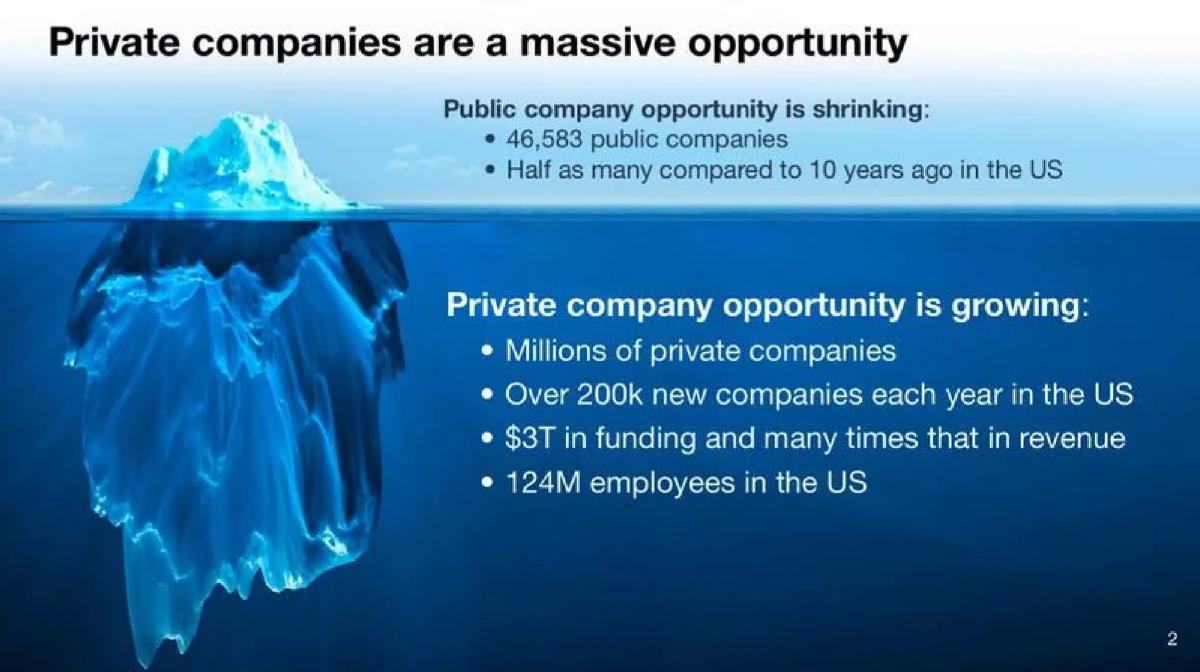
- The deck identifies a structural market shift: public company opportunities are shrinking while private company data is growing, with $3T in funding (Slide 2).
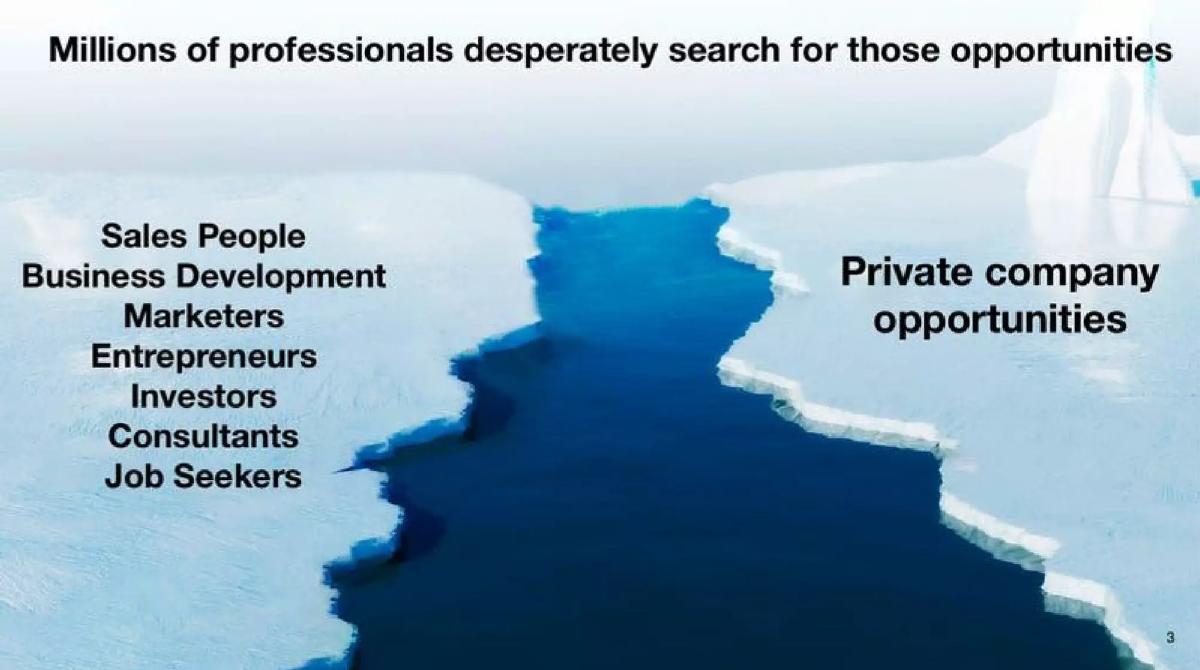
- Crunchbase targets a broad user base including sales people, marketers, and job seekers who 'desperately search' for private company data (Slide 3).
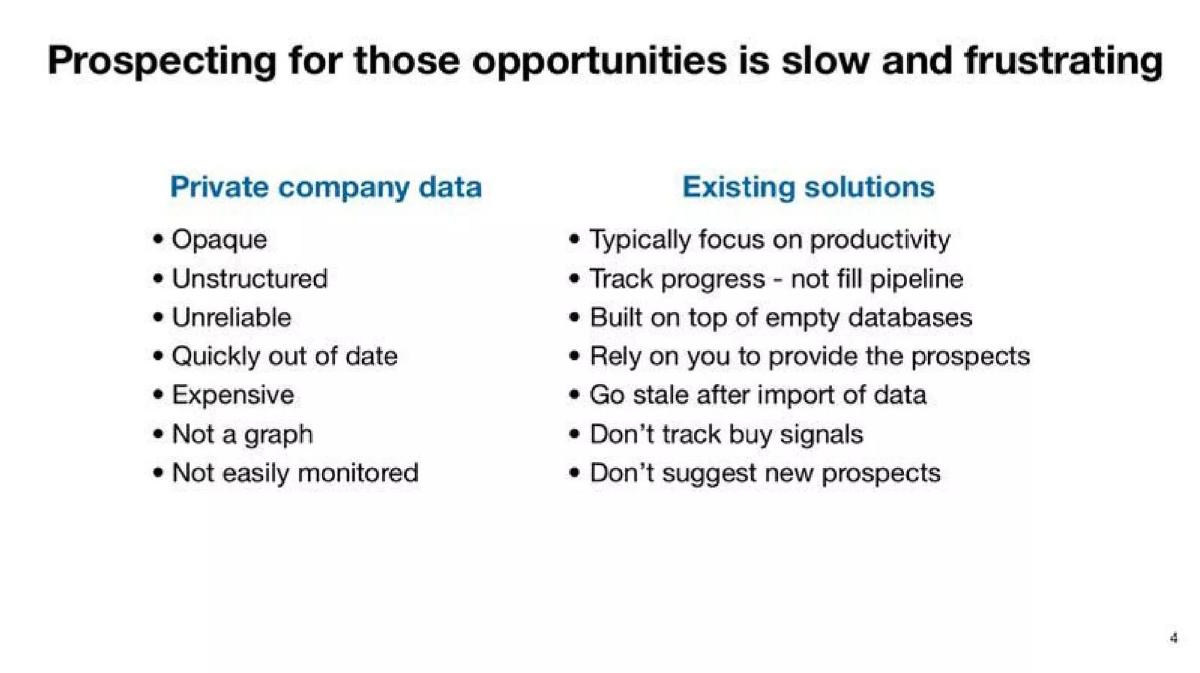
- The product is positioned as a solution to 'opaque' and 'unstructured' data that is typically 'expensive' and 'not a graph' (Slide 4).
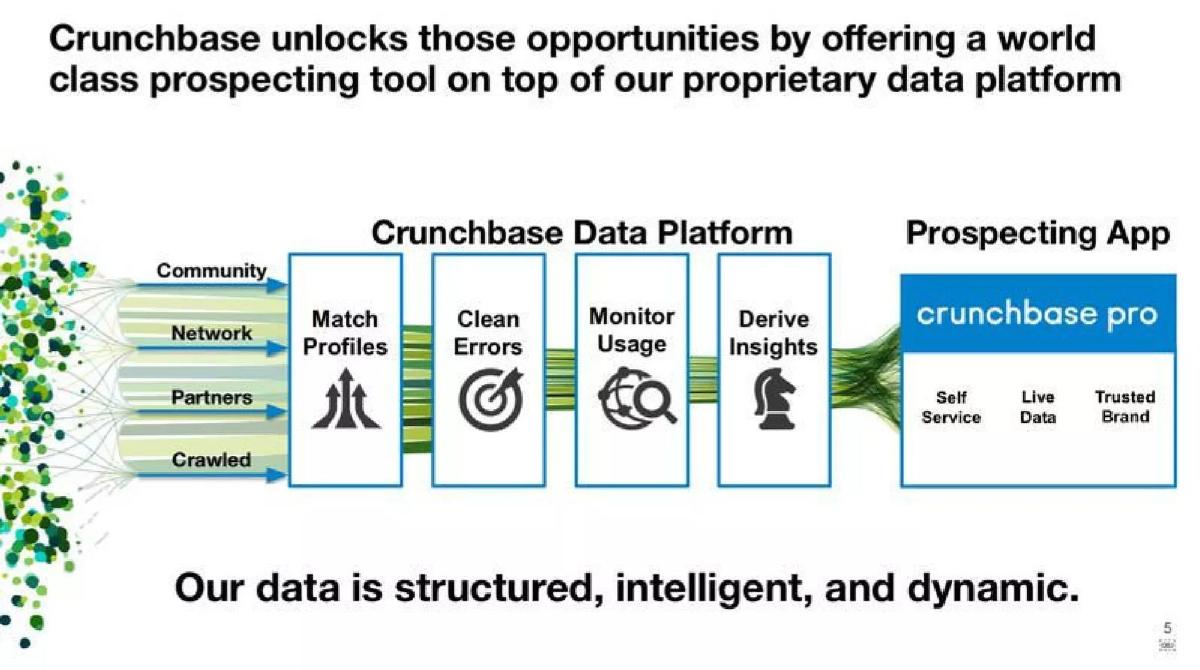
- A proprietary data platform is shown to ingest data from community, network, partners, and crawling to feed the 'Crunchbase Pro' app (Slide 5).
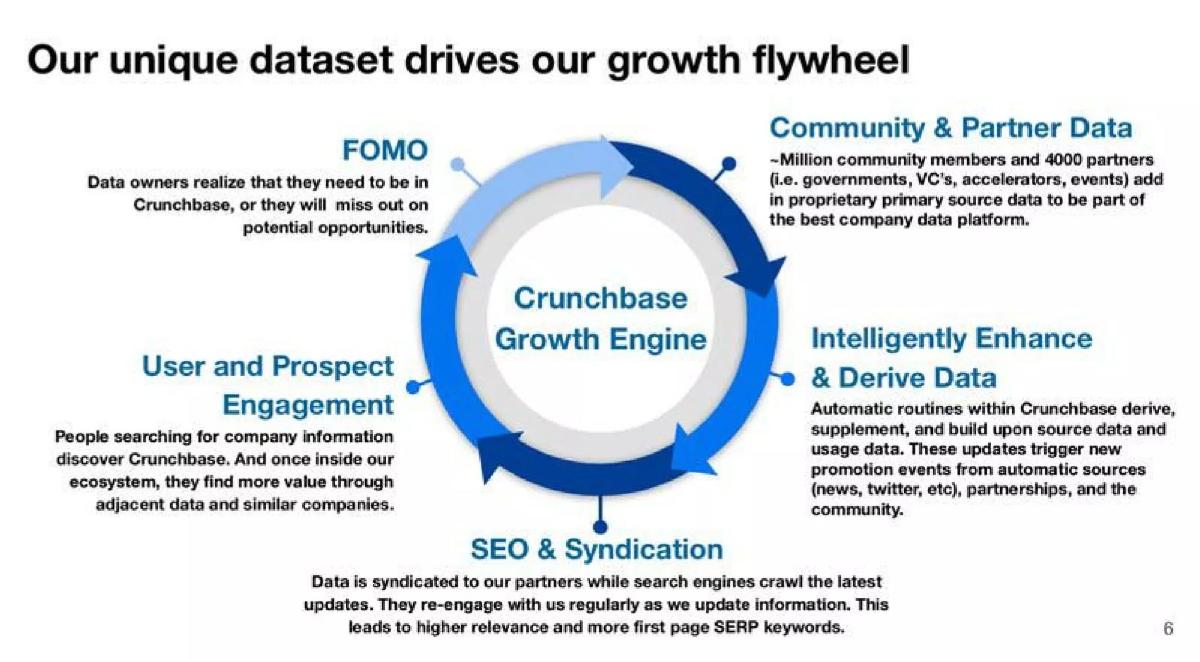
- The growth flywheel is powered by 'FOMO,' where data owners feel they must be on the platform to avoid missing opportunities (Slide 6).
- Revenue traction is demonstrated via a steep ARR growth chart, though specific dollar amounts are omitted from the slide (Slide 7).
- The company defines a $35B total addressable market consisting of 100M business users connecting to private companies (Slide 10).
- The leadership team features deep experience from Salesforce, Dropbox, Google, and Zillow, supported by top-tier investors like Mayfield and Emergence (Slide 11).
The Evolution of a Data Giant
Crunchbase occupies a unique position in the startup ecosystem. Originally founded within TechCrunch, it spun out to become the definitive record of venture capital and private company profiles. By 2019, the company needed to prove it was more than just a media-adjacent database; it needed to show it was a scalable SaaS powerhouse. This 13-slide deck is the narrative vehicle for that $30M Series C round. It is lean, visually consistent, and focused entirely on the 'flywheel' effect of their data.
Slides 1-4: The Macro Shift and the Information Gap
Slide 1 is a standard title slide featuring the brand logo against a blue, networked globe background. It establishes the brand identity immediately without the need for a tagline.
Slide 2 sets the stage with a classic 'iceberg' visual. The headline, "Private companies are a massive opportunity," is supported by a stark contrast: the public company market is shrinking (46,583 companies, half as many as 10 years ago in the US), while the private market is exploding. The slide cites "$3T in funding" and "124M employees in the US" as evidence of the scale beneath the surface. This creates a sense of urgency for investors—the old way of looking at markets (public) is dying, and the new way (private) is where the value lies.
Slide 3 identifies the personas affected by this shift. It lists "Sales People, Business Development, Marketers, Entrepreneurs, Investors, Consultants, Job Seekers" as the millions of professionals searching for these opportunities. By widening the net beyond just VCs, Crunchbase justifies a much larger TAM (Total Addressable Market).
Slide 4 defines the problem with current data. It describes private company data as "Opaque, Unstructured, Unreliable," and "Expensive." Crucially, it notes that existing solutions "Don't suggest new prospects" and "Don't track buy signals." This slide is essential because it moves the conversation from 'having data' to 'using data for prospecting,' which is a much higher-value activity.
Slides 5-6: The Proprietary Engine
Slide 5 explains the 'how.' It visualizes the "Crunchbase Data Platform" as a pipeline. Data flows from four sources—Community, Network, Partners, and Crawled—into a processing engine that "Match Profiles," "Clean Errors," "Monitor Usage," and "Derive Insights." The output is "crunchbase pro," described as a prospecting app built on "Live Data" and a "Trusted Brand." This slide addresses the 'moat'—anyone can crawl the web, but not everyone has a community-validated cleaning engine.
Slide 6 is perhaps the most important slide in the deck: "Our unique dataset drives our growth flywheel." It details four quadrants of growth:
FOMO: Data owners realize they need to be in Crunchbase or miss out. · Community & Partner Data: 1 million members and 4,000 partners (governments, VCs, accelerators) add primary source data. · Intelligently Enhance & Derive Data: Automatic routines build upon source data, triggering news and social events. · SEO & Syndication: Data is crawled by search engines, leading to first-page SERP keywords and re-engagement.
This slide proves that the more people use Crunchbase, the better the data gets, and the harder it is for a competitor to catch up.
Slides 7-9: Traction and Product Validation
Slide 7 shows the results of the flywheel. The headline "And it's paying off: we make money quickly and efficiently" sits above a "Total ARR" chart. The chart shows a clear exponential curve starting from Q1 of an unspecified year through Q3 of another. While the lack of numbers is a common redaction for public versions of decks, the shape of the curve is intended to signal that the product-market fit for the 'Pro' subscription has been achieved.
Slide 8 provides a glimpse into the product interface. The headline "Over xxk professionals pay us for prospecting tools" uses a placeholder for the user count. The slide highlights features like "multi-join dynamic searches," "customizable columns," and "statistics and analysis." This moves the deck from abstract concepts to a tangible tool that users are already paying for.
Slide 9 uses a 'proven model' comparison to anchor Crunchbase's value. It compares the company to LinkedIn (resumes), Zillow (houses), G2 Crowd (products), and Yelp (restaurants). By placing "crunchbase (companies)" at the center of this group, the founders are telling investors that they are building a category-defining utility. This is a powerful psychological tactic; investors who missed out on LinkedIn or Zillow are invited to see Crunchbase as the equivalent for the corporate entity.
Slides 10-13: Market, Team, and Vision
Slide 10 breaks down the "Massive $35B market." It uses a nested rectangle chart to show three tiers:
$19B Market: 55M yearly users prospecting on Crunchbase. · $25B Market: 1M global businesses selling to private companies. · $35B Market: 100M business users connecting to private companies.
This slide attempts to show that even their most conservative market estimate is huge, and their ceiling is even higher.
Slide 11 introduces the team. Jager McConnell (CEO) is highlighted for running the SFA product line at Salesforce . Other leaders come from Dropbox, Google, Zillow, and Walmart.com. The bottom of the slide displays an impressive roster of existing investors, including Mayfield, Emergence, Felicis Ventures, Salesforce, Cowboy Ventures, 8VC, SVAngel, and Verizon Ventures. For a Series C, this slide is about credibility and the 'who's who' of Silicon Valley backing.
Slide 12 reinforces the vision with a high-resolution product shot on an iMac, reiterating the tagline: "Crunchbase: the LinkedIn for Companies." It uses Airbnb’s profile as an example, showing the depth of funding and team data available.
Slide 13 is a simple closing slide with the logo, mirroring the opening.
What Works in This Deck
The primary strength of this deck is its narrative focus on the 'Flywheel.' Many data companies struggle to explain why their data is better than a competitor's. Crunchbase solves this by showing that their data is a living ecosystem fueled by 'FOMO' and community contributions. If you are a startup, you want to be on Crunchbase so VCs can find you; this creates a self-updating database that costs the company very little to maintain compared to manual research firms.
The Category Anchoring on Slide 9 is also masterfully done. By comparing themselves to LinkedIn and Zillow, they bypass the need to explain their business model in depth. Investors immediately understand that 'Data + Destination Website + Prospecting Tools = Massive Valuation.'
What is Missing
For a Series C deck, there is a notable lack of unit economics. There is no mention of Customer Acquisition Cost (CAC), Lifetime Value (LTV), or churn rates. While the ARR chart shows growth, it doesn't show the efficiency of that growth. Additionally, there is no 'Ask' slide. The deck ends on a vision statement without specifying how much capital is being raised or how it will be deployed (e.g., hiring, international expansion, or R&D). While this information was likely shared in the verbal pitch or a separate data room, its absence in the deck leaves the 'why now' question partially unanswered.
What a Founder Should Copy
1. The 'Iceberg' Problem Slide: If you are in a market that is shifting from a visible segment to a hidden one, use the iceberg analogy. It is a fast way to communicate that the 'old' market data is no longer sufficient.
2. The Flywheel Visualization: Don't just list your features. Show how your users, your partners, and your technology interact to create a virtuous cycle that makes your product better over time.
3. The Category Anchor: If your product is 'The [Famous Company] for [New Industry],' say it. It reduces cognitive load for the investor and helps them place you in a mental bucket of 'potentially huge winners.'
4. Brevity: Raising $30M with 13 slides is a testament to the power of a clear message. Avoid 'wall of text' slides. Every slide in this deck has a single, clear takeaway expressed in a bold headline.
Frequently asked questions
- How much did Crunchbase raise with this deck?
- According to the catalogue facts, Crunchbase raised $30M in 2019. This was a Series C round led by OMERS Ventures, intended to accelerate their transition into a full-scale prospecting platform for sales and recruiting professionals.
- What is the core value proposition presented in the slides?
- The core value proposition is the 'unlocking' of private company opportunities through a proprietary data platform. Slide 5 illustrates how they take raw data from community and partners, clean it, and derive insights to power a 'world class prospecting tool' called Crunchbase Pro.
- Does the deck include specific financial metrics?
- No. Slide 7 shows a 'Total ARR' chart that indicates rapid, exponential growth, but it lacks Y-axis values or specific revenue figures. Similarly, Slide 8 mentions 'Over xxk professionals' pay for the tools, leaving the exact number redacted or placeholder-style for the presentation.
- How does Crunchbase define its competition?
- The deck doesn't name specific competitors like PitchBook or ZoomInfo. Instead, Slide 4 critiques 'Existing solutions' generally, stating they focus on productivity rather than filling pipelines, rely on users to provide prospects, and 'go stale' quickly after data import.
- What is the significance of the 'LinkedIn for Companies' comparison?
- This comparison on Slide 12 serves as a 'category anchor.' By aligning themselves with LinkedIn (resumes), Zillow (houses), and Yelp (restaurants), Crunchbase defines their territory as 'companies.' It suggests a platform play where the data is the foundation for multiple high-value applications.