The Q1 2015 investor presentation for Cornerstone OnDemand (CSOD) serves as a strategic update for a mature SaaS company. Rather than the 'problem-solution' framework typical of early-stage decks, CSOD focuses on 'Established Market Leadership' (Slide 6) and 'Consistent Improvement in Profitability' (Slide 17). The deck highlights a significant transition from a -22% Non-GAAP Net Loss Margin in 2010 to -6% in 2014, signaling a clear path toward breakeven. With a claimed 26% share of the current SaaS market (Slide 25) and a total addressable market of $31 billion (Slide 21), the narrative shif…
Key takeaways
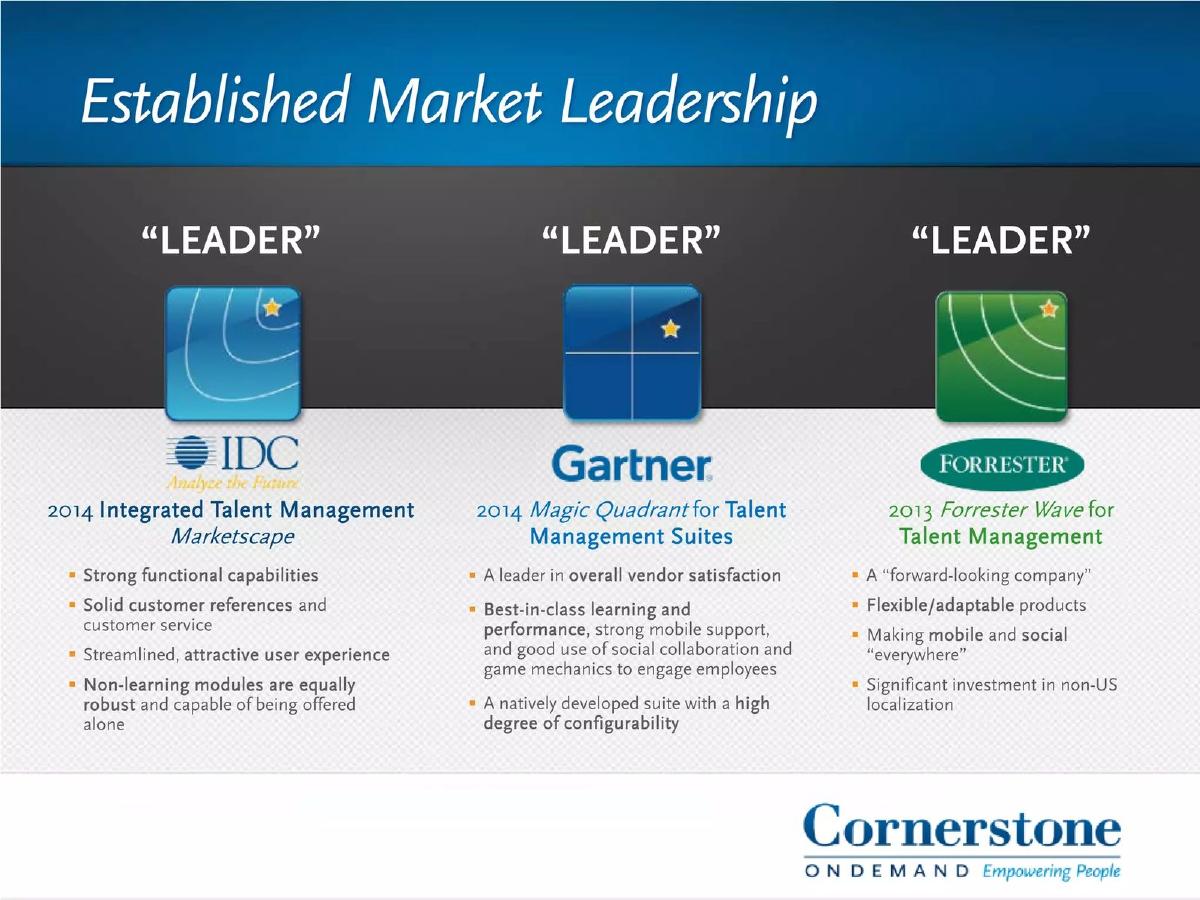
- CSOD uses third-party validation from IDC, Gartner, and Forrester to claim 'Leader' status across three consecutive years (Slide 6).
- The company positions itself as a 'Best of Breed' pure SaaS alternative to legacy ERP suites, emphasizing organic growth and innovation (Slide 9).
- Financial transparency is high, showing Non-GAAP Operating Cash Flow growth from $0.2 million in 2010 to $33.3 million in 2014 (Slide 17).
- The deck highlights a narrowing Net Loss Margin, improving from -22% to -6% over a five-year period (Slide 17).
- Market penetration is framed as early-stage, with 18.1 million users out of a potential 400 million addressable seats (Slide 21).
- CSOD claims a dominant 26% share of the current SaaS market, positioning itself as the primary incumbent in the space (Slide 25).
- The 'Extended Enterprise' strategy is showcased through the American Bankers Association case study, demonstrating a user-to-employee ratio of 150:1 (Slide 29).
- The deck lacks a specific 'Ask' or 'Use of Funds' slide, typical for a public company investor presentation rather than a private round pitch.
Cornerstone OnDemand (CSOD) 2015 Investor Deck Analysis
The Cornerstone OnDemand (CSOD) deck from Q1 2015 is a quintessential example of a late-stage growth company communicating with institutional investors. At this stage, the 'why' of the product is already established; the deck's primary job is to prove market dominance, financial discipline, and the sheer scale of the remaining opportunity. With 31 slides in the full version, the presentation is comprehensive, though this teardown focuses on the eight key slides provided.
Slide 1: Title Slide
The title slide is functional and corporate. It identifies the company as Cornerstone OnDemand with the tagline 'Empowering People.' The specific dating of 'First Quarter 2015' indicates this is a periodic investor update rather than a one-time pitch for a specific funding round. The branding is consistent with mid-2010s enterprise software aesthetics: clean, blue-toned, and professional.
Slide 6: Established Market Leadership
This slide is the 'social proof' powerhouse of the deck. CSOD avoids making self-aggrandizing claims by letting third-party analysts do the talking. They cite three major reports:
IDC (2014): Integrated Talent Management Marketscape, noting 'strong functional capabilities' and an 'attractive user experience.' · Gartner (2014): Magic Quadrant for Talent Management Suites, highlighting 'overall vendor satisfaction' and 'best-in-class learning.' · Forrester (2013): Forrester Wave for Talent Management, calling them a 'forward-looking company' with 'flexible/adaptable products.'
By securing the 'Leader' designation from all three major firms, CSOD effectively neutralizes the risk for conservative enterprise buyers and institutional investors.
Slide 9: The New Competitive Landscape
CSOD uses a classic 'Us vs. Them' dichotomy here, but they frame it as a shift in the industry rather than a petty feature war. They contrast ERP Suites against Best of Breed solutions. The ERP side is characterized by 'built through acquisition,' 'mix of SaaS and On-Premise,' and being a 'system of record.' CSOD positions itself as the 'Best of Breed' alternative: 'organically grown,' 'pure SaaS,' and a 'system of engagement.' This is a strategic move to frame their competitors as clunky, legacy dinosaurs while positioning CSOD as the modern, innovative choice.
Slide 16: Financial Results (Section Header)
This is a simple transition slide. In a 31-slide deck, section headers are vital for maintaining the narrative flow. It signals to the audience that the qualitative 'vision' portion of the deck is over, and the quantitative 'proof' portion is beginning.
Slide 17: Consistent Improvement in Profitability
This is arguably the most important slide for an investor. It shows two critical trends from 2010 to 2014:
Non-GAAP Operating Cash Flow: A massive jump from $0.2 million in 2010 to $33.3 million in 2014. This proves the business model generates real cash. · Non-GAAP Net Loss Margin: A steady improvement from -22% in 2010 to -6% in 2014.
For a SaaS company in 2015, being 'almost profitable' while growing rapidly was the ideal state. The chart clearly visualizes a 'path to profitability' that is nearing its conclusion.
Slide 21: Large Underpenetrated Market
To justify continued investment, CSOD needs to show that they haven't hit a ceiling. They define an Addressable Market of $31 Billion . The visualization is a set of concentric circles:
400 Million addressable seats (the total potential). · 69 Million estimated users in the current market. · 18.1 Million Cornerstone users.
By showing they have only captured a fraction of the 'addressable seats,' they argue that there is still a 20x growth multiple possible in the user base alone.
Slide 25: Increasing Market Share
This slide reinforces their dominance within the existing SaaS ecosystem. It claims a 26% Current SaaS Market Share . The graphic uses upward-pointing arrows to suggest that this share is not static but growing. For an investor, a 26% share in a fragmented market suggests that CSOD is the 'default' choice, which lowers customer acquisition costs over time due to brand recognition.
Slide 29: Extended Enterprise Opportunity
This slide introduces a sophisticated growth lever: the 'Client Ecosystem.' Instead of just selling to HR for internal employees, CSOD sells to organizations that need to train external partners, customers, and members. The American Bankers Association (ABA) spotlight is a perfect case study:
This demonstrates that CSOD can achieve 150x leverage on a single contract. It changes the math of the business from 'revenue per employee' to 'revenue per ecosystem,' which is a much more scalable model.
What Cornerstone OnDemand Does Well
CSOD excels at institutional framing . They don't just say they are good; they show that Gartner and IDC say they are good. They don't just say they are growing; they show the exact margin improvement over a five-year horizon. The use of the 'Extended Enterprise' case study is particularly brilliant because it addresses the common SaaS concern of 'headcount-limited growth.' By showing they can serve 150,000 users for a 1,000-person company, they blow the doors off traditional TAM calculations.
What is Missing from the Deck
Because this is a public-facing investor presentation for a company already trading (CSOD went public in 2011), it lacks several elements found in a standard startup pitch deck:
The Team Slide: In these 8 slides, there is no mention of the executive leadership. For a public company, this is usually handled in the annual report or a separate 'Management' section of the full deck. · The Ask: There is no slide asking for $20M at a $100M valuation. The 'ask' is implicit: 'Buy our stock because we are the market leader with improving margins.' · Unit Economics: While they show aggregate cash flow, they do not show CAC (Customer Acquisition Cost), LTV (Lifetime Value), or Churn rates in these specific slides. These are the 'heartbeat' metrics of SaaS, and their absence here suggests they were either in the other 23 slides or were reserved for deeper financial filings.
Founder Takeaways
1. Use Third-Party Validation Early and Often: If you have a 'Leader' badge from a recognized analyst or even a high rating on G2 Crowd, make it a centerpiece. It removes the 'founder bias' from your claims of superiority.
2. Visualize the Path to Profitability: Even if you are losing money, showing a consistent year-over-year improvement in net loss margin (as seen on Slide 17) is incredibly comforting to investors. It shows the 'burn' is a choice for growth, not a structural flaw in the business.
3. Define Your Own Category: CSOD didn't just call themselves 'HR Software.' They called themselves 'Best of Breed' and 'System of Engagement.' By creating these labels, they forced their competitors into the less-desirable 'Legacy ERP' and 'System of Record' buckets.
4. Look for the 'Ecosystem' Play: If your software can be used by your customer's customers (like the ABA example on Slide 29), highlight it. It is the ultimate proof of scalability and product-market fit beyond the initial buyer.
Frequently asked questions
- What is the primary value proposition of CSOD according to the deck?
- CSOD positions itself as a 'Best of Breed' SaaS provider that focuses on innovation and client success, contrasting itself against legacy ERP suites. According to Slide 9, they emphasize being 'organically grown' and a 'system of engagement' rather than just a 'system of record.' This distinction is meant to highlight their agility and user-centric design compared to older, acquisition-heavy competitors.
- How does CSOD demonstrate its financial health?
- The company uses two primary metrics on Slide 17: Non-GAAP Operating Cash Flow and Non-GAAP Net Loss Margin. They show a significant upward trajectory in cash flow, reaching $33.3 million in 2014. Simultaneously, they show a steady narrowing of losses, moving from a 22% loss margin in 2010 to just 6% in 2014, suggesting they are nearing profitability.
- What is the scale of the market opportunity CSOD identifies?
- On Slide 21, CSOD identifies a total addressable market (TAM) of $31 billion. They estimate the current market at 69 million users, with their own footprint at 18.1 million users. They point to a massive untapped potential of 400 million addressable seats, suggesting that despite their leadership, they have only captured a small fraction of the global opportunity.
- What is the 'Extended Enterprise' strategy mentioned in the deck?
- This strategy involves selling the platform not just for a company's internal employees, but for their entire ecosystem. Slide 29 illustrates this with the American Bankers Association (ABA). While the ABA has fewer than 1,000 employees, they use CSOD to provide training to over 150,000 users across 3,400+ banks. This demonstrates how CSOD can achieve massive user scale without relying solely on headcount growth.
- How does CSOD compare itself to competitors?
- Instead of a standard feature-comparison grid, CSOD uses Slide 9 to categorize the 'New Competitive Landscape.' They group competitors into 'ERP Suites' (built through acquisition, mix of SaaS/On-Premise) and themselves as 'Best of Breed' (organically grown, pure SaaS). They also rely on Slide 6 to show they are ranked as a 'Leader' by all three major industry analysts: IDC, Gartner, and Forrester.