Scrintal’s 2022 Seed deck is a masterclass in narrative-driven software positioning. By identifying a specific gap in the productivity stack—the 'broken process' between thinking, developing, and sharing—the company successfully raised $1.08M. The deck leans heavily on the 'visual knowledge base' category, contrasting it against traditional text-based tools like Notion and brainstorming tools like Miro. While the version of the deck analyzed contains several redacted placeholders for sensitive metrics, the structural logic remains clear: solve the '74% wasted time' problem for high-value know…
Key takeaways
- Scrintal positions itself as a 'Visual knowledge base,' a hybrid category between whiteboarding and documentation (Slide 1).
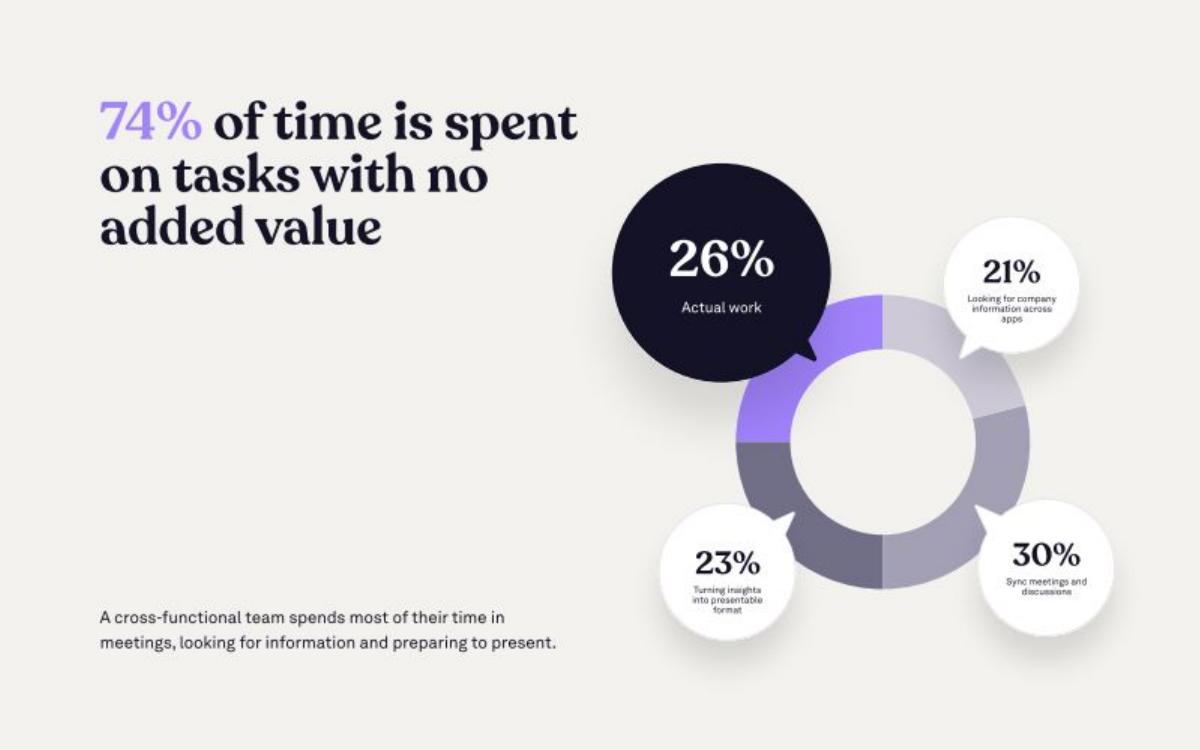
- The problem is framed as a time-sink, claiming 74% of time is spent on tasks with no added value (Slide 3).
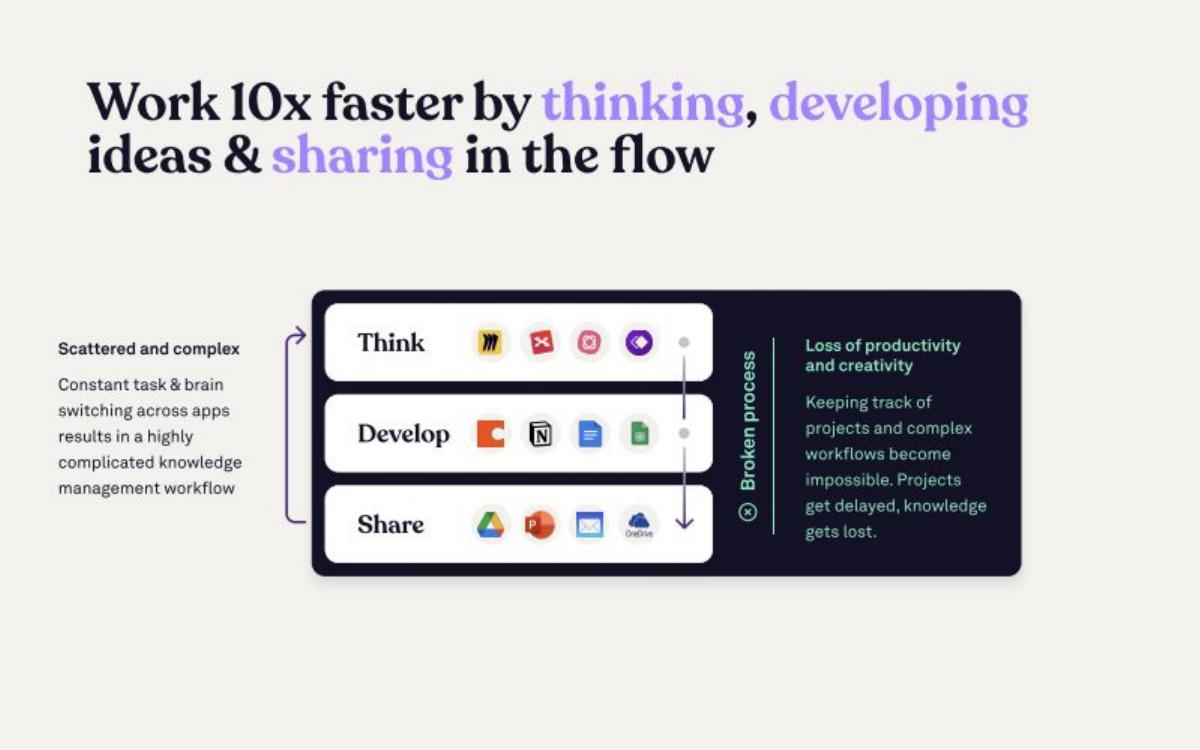
- The product aims to replace a fragmented stack of 12+ apps across the 'Think, Develop, Share' workflow (Slide 6).
- Growth is driven by an organic waitlist that reached 'xx 000+' users with €0.0X spent per sign up (Slide 8).
- The business model targets 'gatekeepers'—strategists and managers where 75% control the budget (Slide 11).
- The company sets a massive vision of a €119b market in Europe by 2026, aiming for a 10% market share (Slide 13).
- The competitive matrix places Scrintal alone in the top-right quadrant for 'Visuality' and 'Final work' (Slide 18).
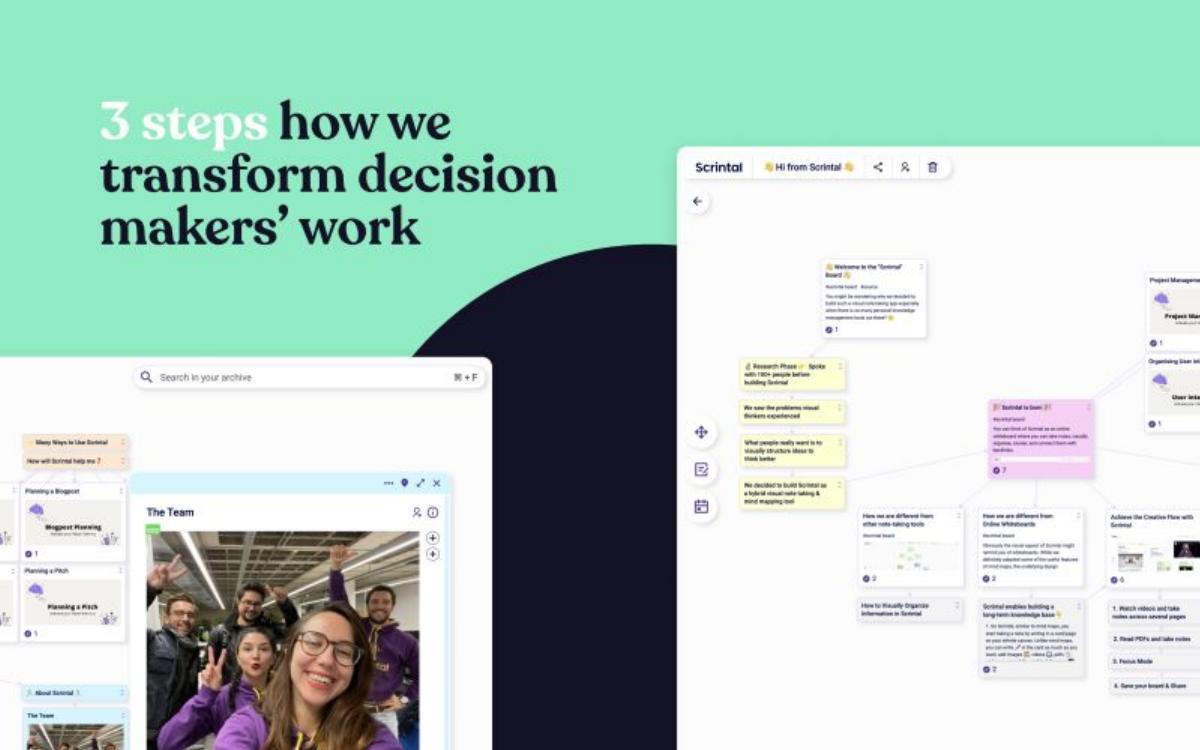
- The deck lacks a dedicated team slide in the main sequence, though a team photo appears in a product mockup (Slide 4).
The Narrative of the Visual Knowledge Base
Scrintal enters a crowded productivity market with a specific angle: the visual organization of ideas. In 2022, the 'Tools for Thought' (TfT) space was peaking, and Scrintal’s deck reflects the zeitgeist of that era—moving away from linear documents toward networked, spatial canvases. This teardown examines the 20-slide deck used to secure their Seed funding.
Slide 1: Title and Mission
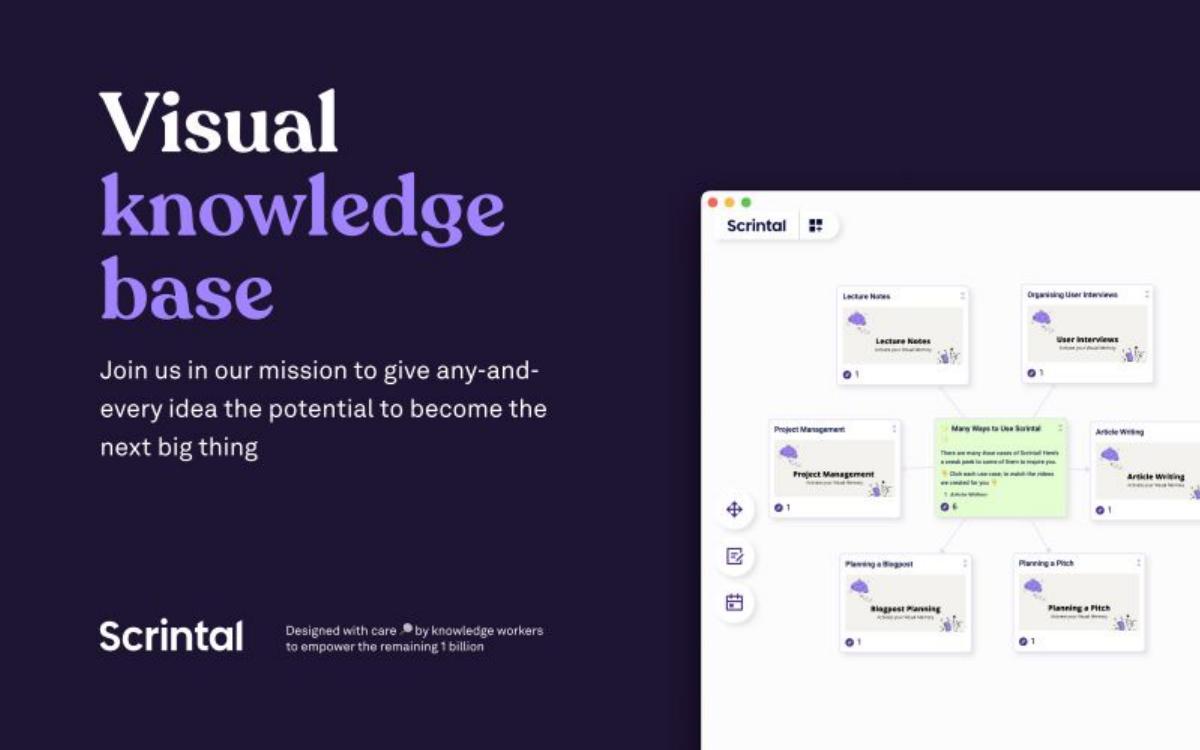
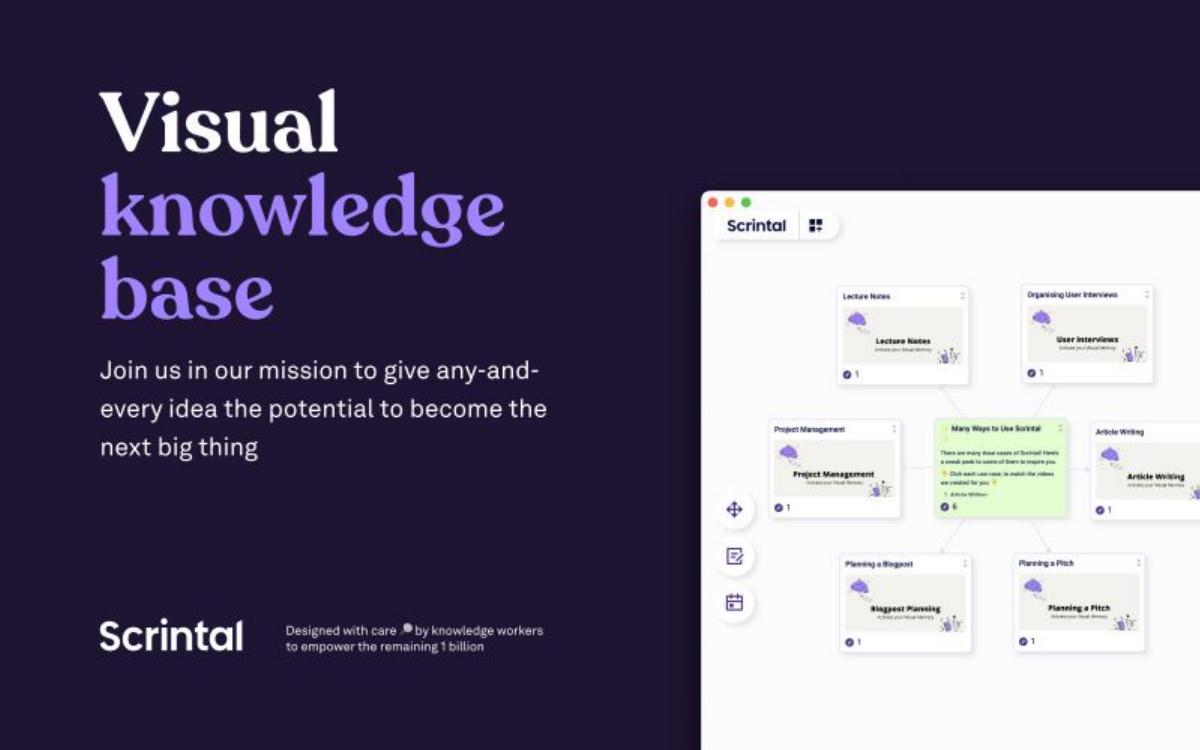
The deck opens with a bold declaration: "Visual knowledge base." The subtitle, "Join us in our mission to give any-and-every idea the potential to become the next big thing," is a high-level vision statement. A product mockup on the right shows a networked graph of notes, immediately signaling that this is not a standard word processor.
Slide 2: The User Persona (Ece)
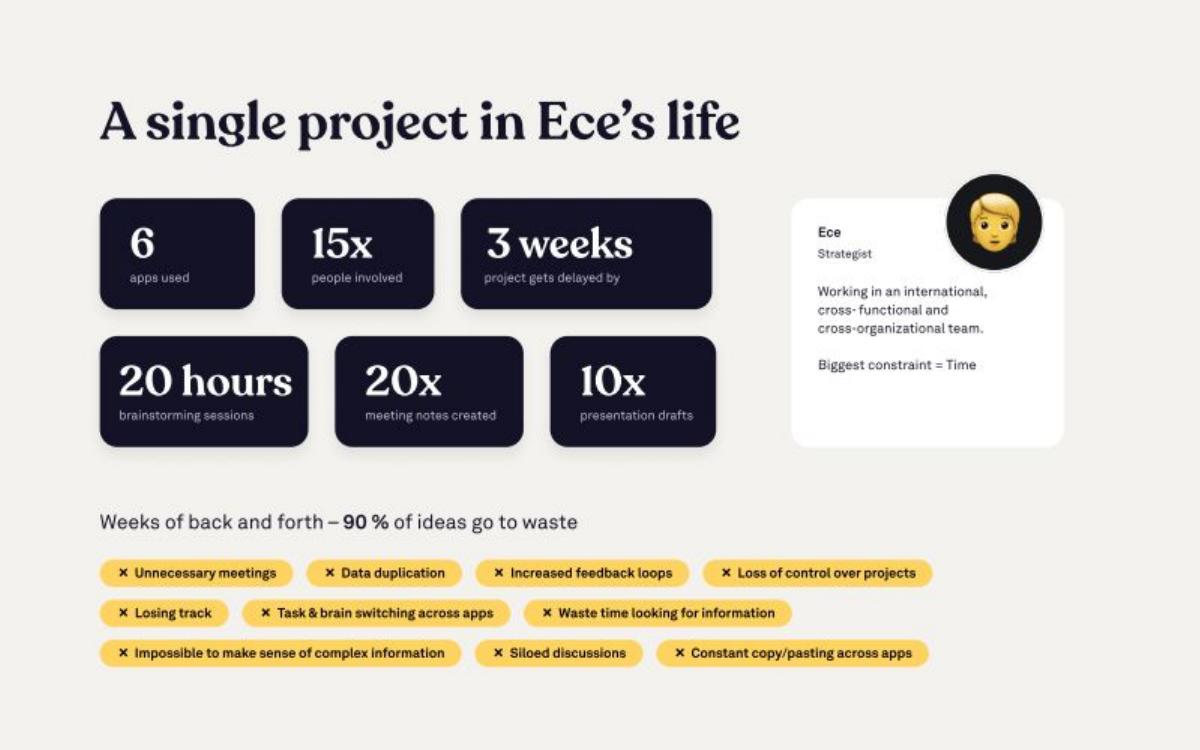
Scrintal uses a persona named "Ece," a Strategist, to ground the problem. The slide lists staggering friction points: 6 apps used, 15 people involved, and a 3-week delay per project. It claims "90% of ideas go to waste" due to unnecessary meetings and siloed discussions. This slide effectively quantifies the chaos of modern knowledge work.
Slide 3: The Value Gap
This slide presents a pie chart stating that "74% of time is spent on tasks with no added value." It breaks this down into 30% sync meetings, 23% turning insights into presentable formats, and 21% looking for information across apps. Only 26% is categorized as "Actual work." This is a classic 'gap' slide designed to make the investor feel the inefficiency of the status quo.
Slide 4: The Transformation
Titled "3 steps how we transform decision makers’ work," this slide features more product mockups. Interestingly, it includes a photo of the team within a Scrintal 'card,' which serves as a soft introduction to the founders without a formal team slide. It emphasizes the 'hybrid' nature of the tool—part note-taking, part mind-mapping.
Slide 5: The Single App Solution
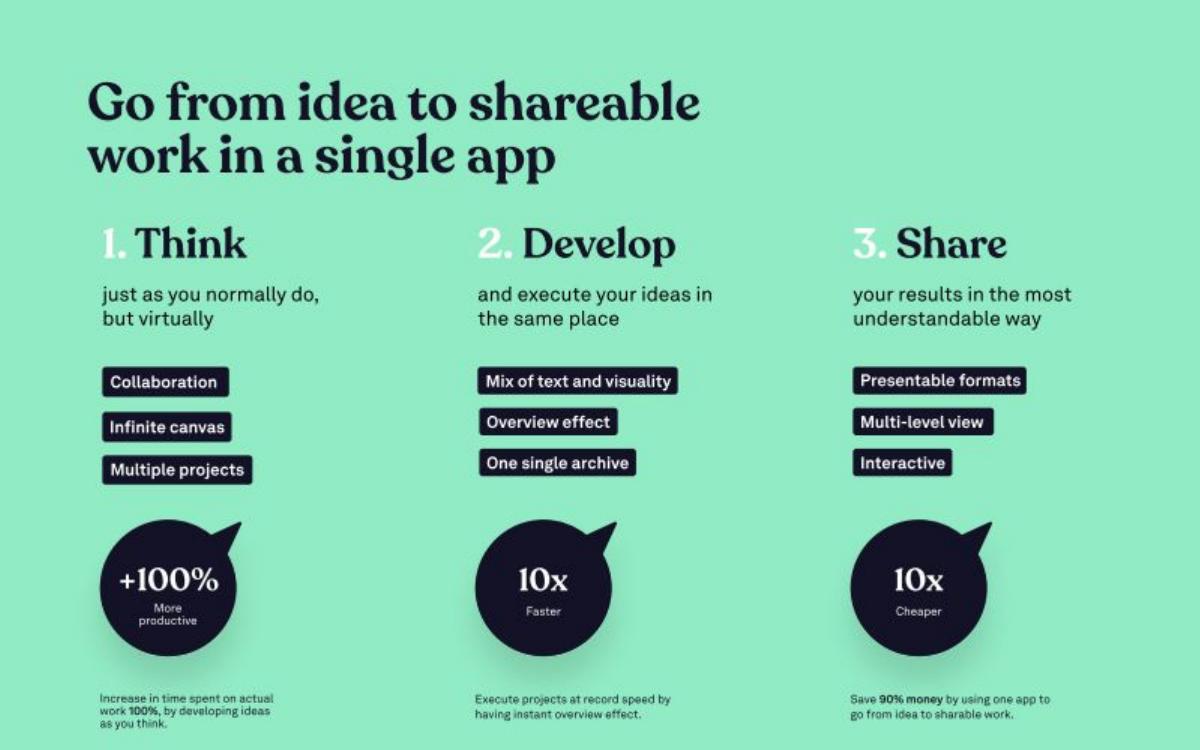
Scrintal promises a workflow that goes from idea to shareable work in one place. They claim three outcomes: "+100% More productive," "10x Faster," and "10x Cheaper." While these are bold claims, they are supported by the logic of consolidating the stack to save the 90% of money currently wasted on fragmented tools.
Slide 6: The 'Broken Process' Diagram
This is one of the strongest slides in the deck. It maps the current 'Scattered and complex' workflow. It shows logos for Miro, Mural, and MindMeister for 'Think'; Notion, Google Docs, and Coda for 'Develop'; and Drive, PowerPoint, and Outlook for 'Share.' Scrintal positions itself as the vertical arrow that connects all three stages, solving the 'Loss of productivity and creativity.'
Slide 7: User Testimonials
The deck provides four testimonials from a Marketing Director, Senior Talent Manager, Engineering Manager, and Sales & Partnerships Manager. Key metrics mentioned in these quotes include a "-30% # Meetings" and "5x Speed" increase. Using specific job titles helps prove the tool's versatility across different corporate functions.
Slide 8: Organic Growth and Waitlist
This slide focuses on traction. It shows a graph of "Actual growth" significantly outperforming the "Initial target." While the Y-axis is redacted, it notes "xx 000+ in the waitlist" and "€0.0X spent per sign up." This highlights a low-cost, high-intent customer acquisition strategy.
Slide 9: Early Revenue
Scrintal demonstrates early monetization through an early access plan announced on September 29th. The pricing is "$60 per user upfront pricing" for annual usage. The total revenue and number of buyers are redacted as "$X" and "X+," but the slide serves to prove that users are willing to pay for the product even in its early stages.
Slide 10: Retention Metrics
Retention is shown via two cohort-style charts for "Power users" and "All onboarded users." The percentages and months are redacted, but the visual intent is to show a flat line (high retention) rather than a decaying curve. They define power users as Business Executives, Consultants, and Tech Managers.
Slide 11: The Growth Engine
This slide explains why they target specific users. "75% control work tool budget" and "44% work across organizations." This is a sophisticated 'Land and Expand' strategy; by capturing the consultants and strategists who move between companies, Scrintal creates a natural referral loop.
Slide 12: Future Projections
A bar chart shows the path to "€X million ARR." It marks milestones like the "Early Access Plan Release" and "Public Launch." This slide is intended to show the scale of the ambition, even if the specific numbers are hidden in this public version.
Slide 13: Market Size and Vision
Scrintal targets a "€119b market in 2026" (Europe only). They aim for a 10% market share, which they equate to a "€10b enterprise." To justify this, they list comparable platform models: Atlassian ($2.1b revenue), LinkedIn ($1.5b revenue), Notion ($10b valuation), and Miro ($17.5b valuation). This places Scrintal in the company of 'Decacorns.'
Slide 14: The Ask
The company seeks "€X million" to launch and expand. The goals are specific: live collaboration, ecosystem expansion, cross-platform operability, enterprise integrations, and a public API. They also project a "Total headcount by the end of 2023" of "X."
Slide 15: Closing and Contact
The final slide repeats the mission statement and provides contact information for Ece Kural. It includes a small illustration of a head with geometric shapes emerging from it, reinforcing the 'visual thinking' brand.
Slide 16-20: Appendices
The appendix section includes a "Why now?" slide (Slide 17) noting that "productivity management software grows 14% yearly" and remote work has grown 159% in 12 years. Slide 18 is the competitive matrix, placing Scrintal as the only tool that handles both 'Visuality' and 'Final work.' Slide 19 outlines the 'defensible and scalable' business model, citing switching costs and network effects as key moats.
What Scrintal Does Well
Category Creation: By calling themselves a "Visual knowledge base," they avoid being compared directly to simple note-takers or simple whiteboards. · Persona-Led Problem: Starting with "Ece" makes the abstract problem of "information silos" feel personal and urgent. · Workflow Mapping: Slide 6 is a perfect example of how to visualize a fragmented market and show exactly where your product fits. · Strategic Targeting: Identifying consultants as "gatekeepers" shows a clear understanding of B2B SaaS distribution.
What is Missing from the Deck
Team Slide: There is no slide dedicated to the founders' backgrounds, previous exits, or technical pedigree. In a Seed round, the team is often the most important factor. · Unit Economics: While they mention a $60 price point, there is no mention of LTV, CAC (beyond the waitlist), or churn rates. · Product Depth: The deck stays very high-level. It doesn't explain how the technology works or if there are proprietary features (like a specific graph database) that make their 'infinite canvas' better than competitors.
What Other Founders Should Copy
The 'Broken Process' Slide: Every founder in a crowded space should have a slide that shows the 10 apps their customers currently use and how their product bridges the gap. · Waitlist Strategy: Scrintal proved demand before they had a public product. Showing a graph of organic, zero-cost signups is a powerful signal of Product-Market Fit. · The Competitive Matrix: Instead of a standard 'check-box' feature list, Scrintal used an X/Y axis that focused on the nature of the work (Brainstorming vs. Final Work), which is more strategic.
Frequently asked questions
- How much did Scrintal raise with this deck?
- According to the catalogue facts, Scrintal raised $1.08M in a Seed round in 2022. The lead investor was Spintop Ventures, with participation from Icebreaker.vc and Jacob Hellqvist.
- What is Scrintal's core value proposition?
- Scrintal aims to eliminate 'task and brain switching' by providing a single app where users can think (infinite canvas), develop (text and visuals), and share (presentable formats). They claim this makes users 10x faster and 10x cheaper than using a fragmented tool stack.
- Who is the target customer for Scrintal?
- The deck specifically targets 'Strategists,' including consultants, business division heads, and tech leads. They focus on these roles because 75% of them control work tool budgets and 44% work across multiple organizations, acting as growth catalysts.
- How does Scrintal compare itself to competitors like Notion or Miro?
- On Slide 18, Scrintal uses a 2x2 matrix. It categorizes Miro and Mural as 'Brainstorming + Visuality' and Notion and Google Docs as 'Final work + Text-based.' Scrintal claims the top-right quadrant: 'Visuality + Final work,' serving as an end-to-end tool.
- What are the main omissions in this pitch deck?
- The most notable omission is a dedicated 'Team' slide highlighting founder backgrounds and expertise. Additionally, several key metrics (ARR targets, specific waitlist numbers, and the exact funding ask) are redacted with 'X' placeholders in this version.