Scribe raised $75M in a Series C round led by StepStone Group, with participation from Redpoint Ventures and Amplify Partners. The 15-slide deck focuses heavily on the company's rapid adoption within the Fortune 500 and its massive proprietary dataset of over 10 million workflows. Rather than spending time on basic market education, the deck leans into the 'AI adoption' problem, positioning Scribe as the essential visibility layer for enterprise automation. The presentation is light on financial specifics—omitting revenue, burn, and a specific 'ask' slide—but compensates with overwhelming evi…
Key takeaways
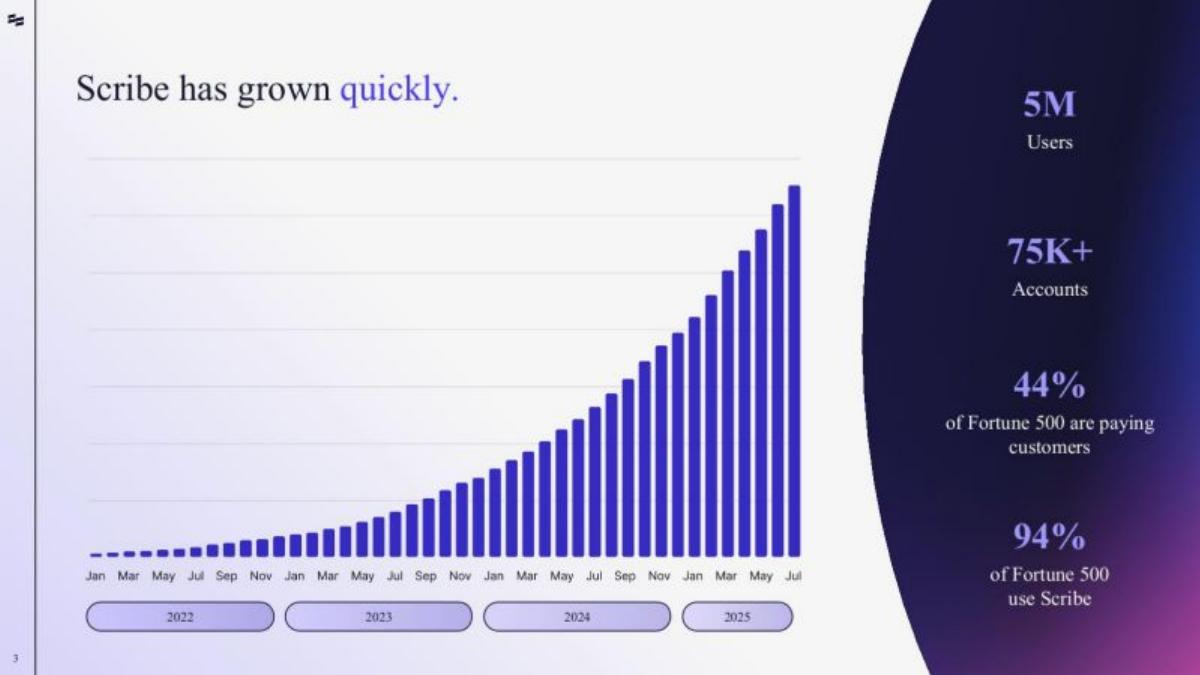
- Scribe reports having 5 million users and over 75,000 accounts as of July 2025 (Slide 3).
- The company claims that 94% of the Fortune 500 use Scribe, with 44% being paying customers (Slide 3).
- The platform has captured a proprietary dataset consisting of 10M+ workflows across 60K+ applications (Slide 10).
- Case studies highlight significant ROI, such as 42 hours saved per creator per month at New York Life (Slide 12).
- Scribe positions itself as the solution to the 'manual' nature of enterprise AI and automation (Slide 7).
- The product is divided into three core functions: Capture, Guide Me, and Optimize (Slide 8).
- The deck highlights a Net Promoter Score (NPS) in the top 1% of all software companies (Slide 13).
- The founding team features deep pedigree from McKinsey, Google, Greylock, and Princeton/Yale (Slide 2).
The Series C Narrative: From Tool to Infrastructure
Scribe’s Series C pitch deck is a study in momentum. By the time a company reaches a $75M Series C, the question is no longer whether the product works, but how quickly it can become an indispensable part of the enterprise tech stack. Scribe answers this by positioning itself not just as a documentation tool, but as the 'Workflow AI platform' that enables all other AI initiatives within a large organization.
Slide 1: The Vision
The cover slide is minimalist, featuring the Scribe logo and the tagline: "The Workflow AI platform. How work gets done." This sets a broad, ambitious tone. It moves away from the 'screenshot tool' category and into the 'platform' category, which is essential for justifying a Series C valuation.
Slide 2: The Pedigree
The Founding team slide is a heavy-hitter. CEO Jennifer Smith brings experience from McKinsey & Company and Greylock Partners, while CTO Aaron Podolny comes from Google and a previously acquired startup (Onward). The inclusion of Princeton and Yale logos rounds out a high-pedigree profile. At this stage, the team slide serves to reassure investors that the leadership has the 'big company' experience to navigate the enterprise sales cycles mentioned later in the deck.
Slide 3: The Traction 'Hockey Stick'
Slide 3, titled "Scribe has grown quickly," is the most important slide in the deck. It features a bar chart showing consistent, accelerating growth from January 2022 to July 2025. The specific figures are staggering: 5M Users , 75K+ Accounts , and a dominant 94% of Fortune 500 use Scribe . The most impressive figure for a Series C investor is that 44% of Fortune 500 are paying customers . This proves that Scribe has successfully navigated the 'land and expand' strategy, moving from free users to enterprise-wide contracts.
Slides 4-7: The Problem and the AI Gap
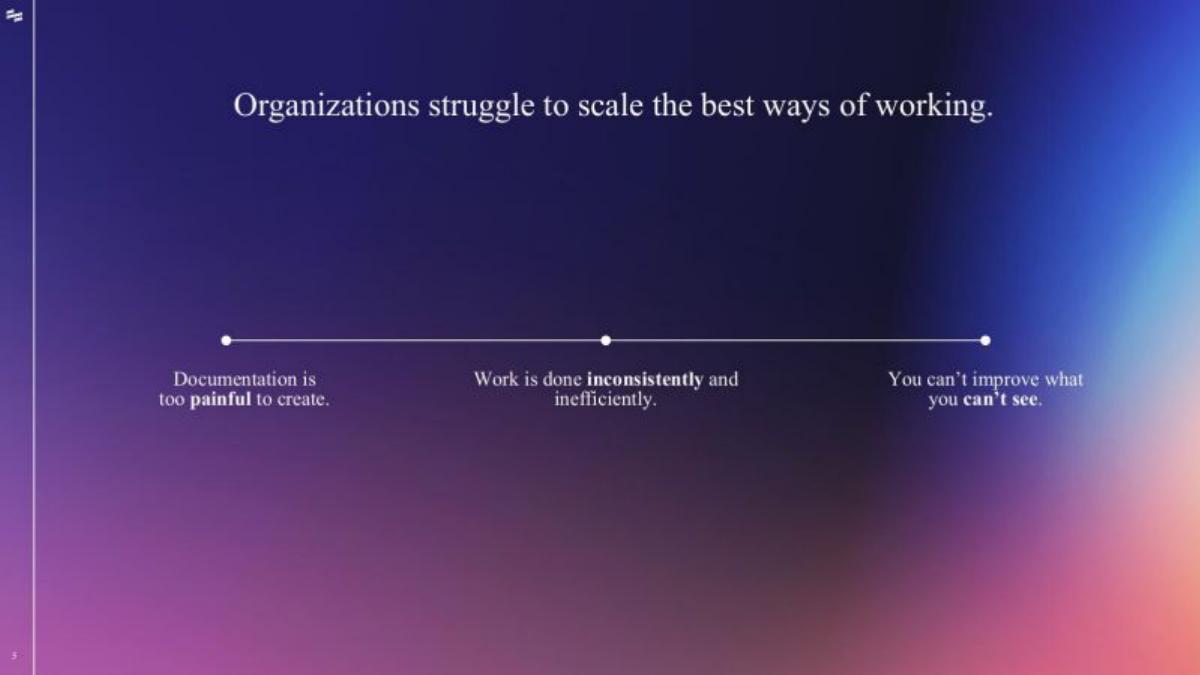
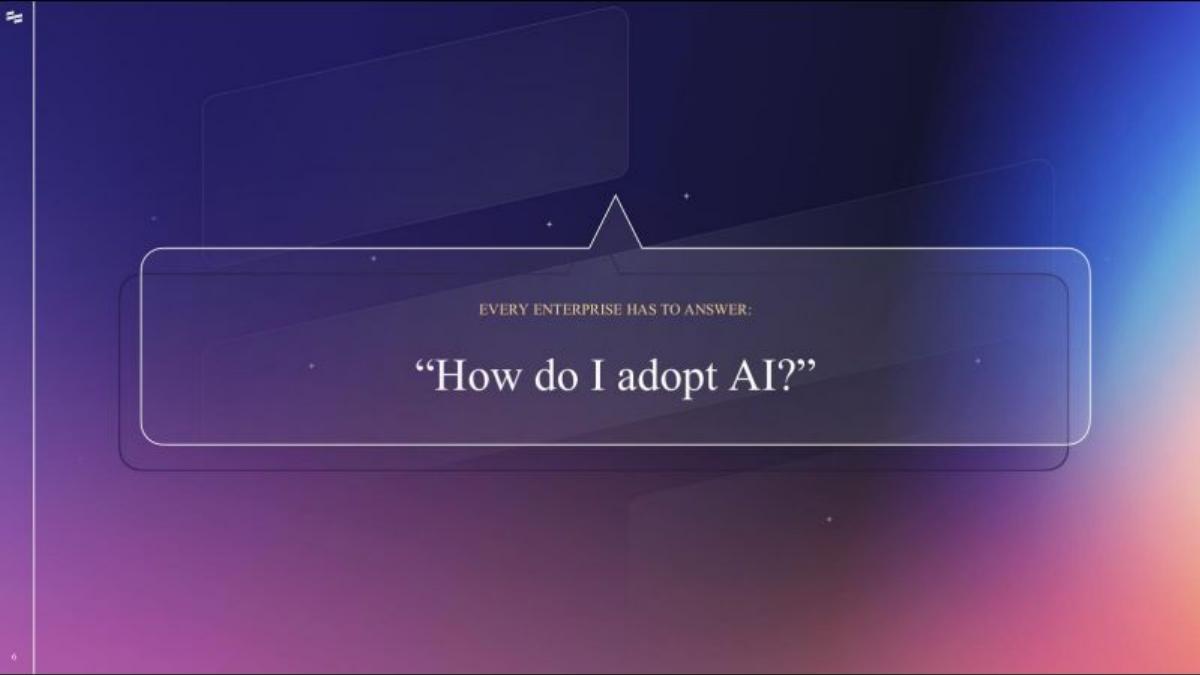
Slides 4 and 5 define the problem: "Organizations struggle to scale the best ways of working." They identify three pain points: documentation is too painful to create, work is done inconsistently, and 'you can’t improve what you can’t see.' Slide 6 pivots to the current market hype: "How do I adopt AI?" Slide 7 then delivers the 'hook': "But AI can’t fix what it can’t see, and enterprise AI and automation are highly manual." By framing Scribe as the necessary precursor to successful AI adoption, the company hitches its wagon to the largest spending trend in enterprise software.
Slides 8-9: The Solution and Workflow Mapping
Slide 8 breaks down the product into three pillars: Capture (automatic documentation), Scale (Guide Me), and Optimize (analysis). This slide uses UI mockups to show the product in action, specifically highlighting a 'How to create a new contact' guide in a CRM. Slide 9 reinforces the process flow, showing how Scribe moves from mapping the 'process universe' to rolling out improvements. It positions Scribe as a real-time view into the actual operations of a business.
Slide 10: The Data Moat
Defensibility is a key concern for AI startups. Slide 10 addresses this by highlighting Scribe’s "large, unique proprietary dataset." The company claims to have data on 10M+ Workflows , 60K+ Applications , and 600K+ Organizations . This data is the 'moat'—it suggests that Scribe understands how work happens across the entire software ecosystem better than any individual application provider like Salesforce or Microsoft could.
Slides 11-13: Social Proof and ROI
The final section of the deck is a barrage of social proof. Slide 11 features quotes from Fortune 500 CIOs and VPs, with one describing Scribe as "like deploying an army of business analysts working overtime for you." Slide 12 provides hard ROI metrics: 42 hours saved per creator per month at New York Life and a 40% reduction in new hire ramp time . The slide also features a 'logo wall' with over 25 major brands, including Indeed, T-Mobile, and Volvo. Slide 13 concludes with user sentiment, noting an NPS score in the Top 1% of all software companies .
Slide 14: The Conclusion
The deck ends with a "Thank you" slide that doubles as a trophy case. It lists accolades from Newsweek, Inc., Forbes, and LinkedIn, including "Next Billion Dollar Startups" and "Top 5 Fastest Growing Software." There is no 'Ask' slide, no mention of the $75M target, and no use-of-funds breakdown. This suggests the deck was used as a high-level narrative tool for a round that was already highly competitive.
What Works in this Deck
The Fortune 500 Density: Claiming 94% penetration of the Fortune 500 is a rare and powerful metric. It immediately signals that the product has viral, bottom-up adoption that scales into the largest organizations in the world. The AI Narrative Pivot: Scribe avoids being labeled as just a 'documentation tool' by positioning itself as the 'visibility layer' for AI. This makes the product feel like a strategic necessity rather than a tactical utility. The Data Moat: By quantifying their dataset (10M+ workflows), they answer the 'Why now?' and 'Why you?' questions that Series C investors obsess over.
What is Missing
Financial Transparency: There is zero mention of revenue, Gross Margin, or Net Revenue Retention (NRR). While the user growth is impressive, at Series C, investors typically want to see how that translates into a sustainable, high-margin business. Competitive Landscape: The deck ignores competitors like Tango, Loom, or traditional RPA players like UiPath. While Scribe’s growth suggests they are winning, a slide acknowledging the landscape would have shown strategic maturity. The Roadmap: The deck focuses almost entirely on what Scribe is today. It offers very little vision for what the product will become with an additional $75M in capital.
Founder Takeaways
Lead with your strongest signal: Scribe puts its growth chart and Fortune 500 stats on Slide 3. Don't bury your best metrics at the end of the deck. · Quantify the 'Unquantifiable': Documentation is often seen as a 'soft' benefit. Scribe turned it into a 'hard' benefit by citing 42 hours saved per month. · Build a 'Data Moat' slide: If you are an AI company, you must explain why your data is better than what is publicly available. Scribe's 10M+ workflows slide is a perfect example of this. · Use quotes as evidence, not fluff: The quotes in this deck aren't just 'we love Scribe.' They are specific strategic endorsements, like the CIO who noted that Scribe 'accelerates AI use and adoption.'
Frequently asked questions
- How much did Scribe raise with this deck?
- According to the catalogue listing, Scribe raised $75M in its Series C round. The round included high-profile investors such as StepStone, Amplify Partners, Redpoint Ventures, Tiger Global, Morado Ventures, and New York Life Ventures. The deck itself does not state the amount being raised, which is common for late-stage growth rounds where the terms are often pre-negotiated or handled in a separate data room.
- What is Scribe's primary value proposition for enterprises?
- Scribe positions itself as the 'visibility layer' for work. As stated on Slide 7, 'AI can't fix what it can't see.' The platform automatically captures how work is done, creating documentation and identifying optimization opportunities. This allows enterprises to map their workflow universe and identify automation candidates that were previously hidden in manual processes.
- What metrics does Scribe use to prove product-market fit?
- Scribe uses three tiers of metrics. First, scale: 5M users and 75K accounts (Slide 3). Second, enterprise penetration: 94% of the Fortune 500 (Slide 3). Third, user satisfaction: a top 1% NPS score and testimonials describing the tool as a 'lifesaver' and 'game-changer' (Slide 13). These metrics combined suggest deep horizontal adoption and high retention.
- Does the deck explain how the technology works?
- Slide 8 provides a high-level overview of the product suite. 'Scribe Capture' automatically generates documentation, 'Scribe Guide Me' provides in-context guidance across apps, and 'Scribe Optimize' analyzes workflows to identify improvements. The deck focuses more on the output (documentation and optimization) than the underlying technical architecture or AI models used.
- What is missing from this Series C deck?
- The deck is notably missing a detailed financial breakdown, including ARR, CAC/LTV, or churn rates. It also lacks a competitive analysis slide and a roadmap for future product development. For a Series C, these details are typically expected in a full due diligence process, but their absence in the primary pitch deck suggests the founders were relying on their massive traction and social proof to drive the initial conversation.