Screenloop’s 15-slide deck successfully secured $7M in Seed funding by positioning recruitment as a data problem rather than a workflow problem. Instead of competing directly with Applicant Tracking Systems (ATS), Screenloop presents itself as an intelligence layer that sits on top of existing tools like Greenhouse and Workday. The deck emphasizes three specific quality metrics—Process, Interview, and Hire—to solve the pain points of candidates, interviewers, and business leaders. While the public version of the deck redacts specific ARR figures, the growth trajectory and the caliber of early…
Key takeaways
- Screenloop identifies three distinct stakeholders—Candidates, Interviewers, and Business—each with specific frustrations in the current hiring mess (Slide 2).
- The platform introduces three proprietary quality metrics: Quality of Process, Quality of Interview, and Quality of Hire to remove the 'black box' from recruitment (Slide 3).
- A core value proposition is the ability to increase the offer-to-hire ratio by 25% through data-driven interview insights (Slide 4).
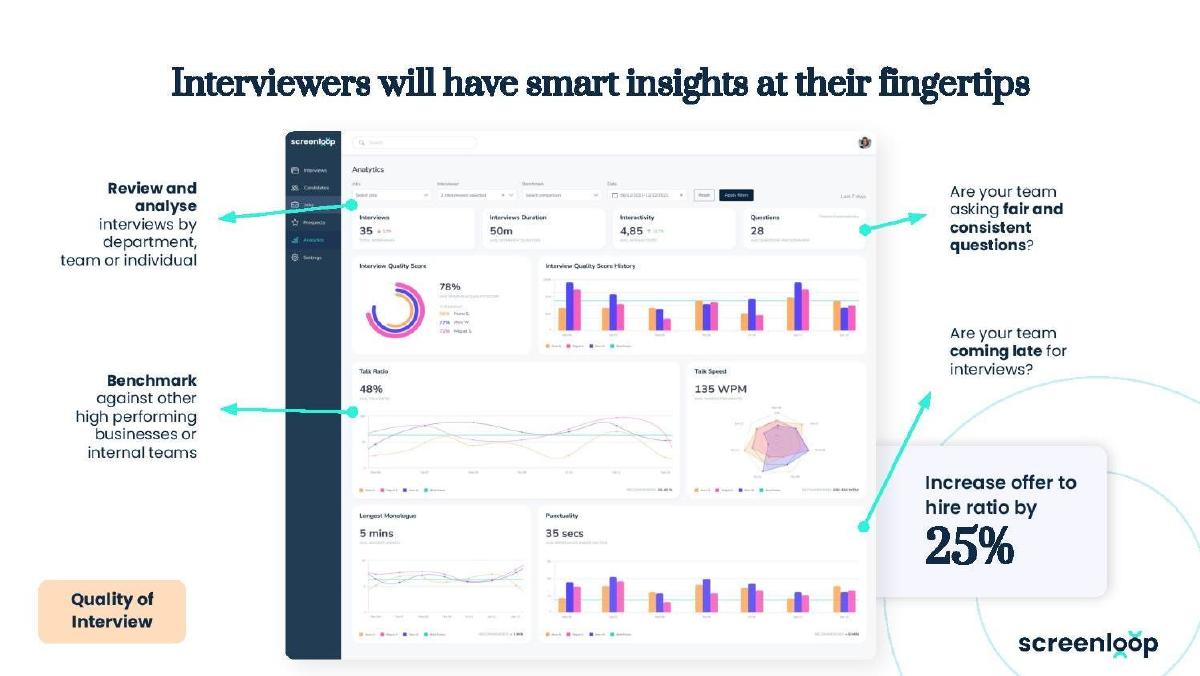
- The product tracks specific behavioral data points including Talk Ratio, Talk Speed (135 WPM), and Punctuality (Slide 4).
- Screenloop positions itself as an ecosystem player, integrating with 14 named platforms across ATS, HRIS, Sign-on, and Communication categories (Slide 5).
- Customer testimonials from Latana, Cytora, and Reachdesk highlight specific outcomes like reduced unconscious bias and faster time-to-hire (Slide 6).
- The deck features high-profile angel investors including Paul Foster (Indeed), Tom Blomfield (Monzo), and Doug Monro (Adzuna) (Slide 7).
- Revenue projections show a steep growth curve with specific targets set for the end of 2022, 2023, and 2024, though exact dollar amounts are redacted in the public version (Slide 7).
Screenloop Pitch Deck Teardown
Screenloop, a London-based HR tech startup, raised $7M in Seed funding in 2023. Their pitch deck is a masterclass in identifying a specific, high-friction niche within a crowded market. Rather than trying to replace the Applicant Tracking System (ATS), Screenloop focuses on the 'black box' of the actual interview. By providing data where there was previously only intuition, they make a compelling case for 'Hiring Intelligence.'
Slide 1: Title and Positioning
The deck opens with a clean, dark-themed slide featuring the company logo and the phrase Hiring Intelligence . This is a strategic choice. By avoiding generic terms like 'Recruitment Software' or 'HR Tech,' they immediately signal that their value proposition is about data and insights, not just workflow management.
Slide 2: The Problem Statement
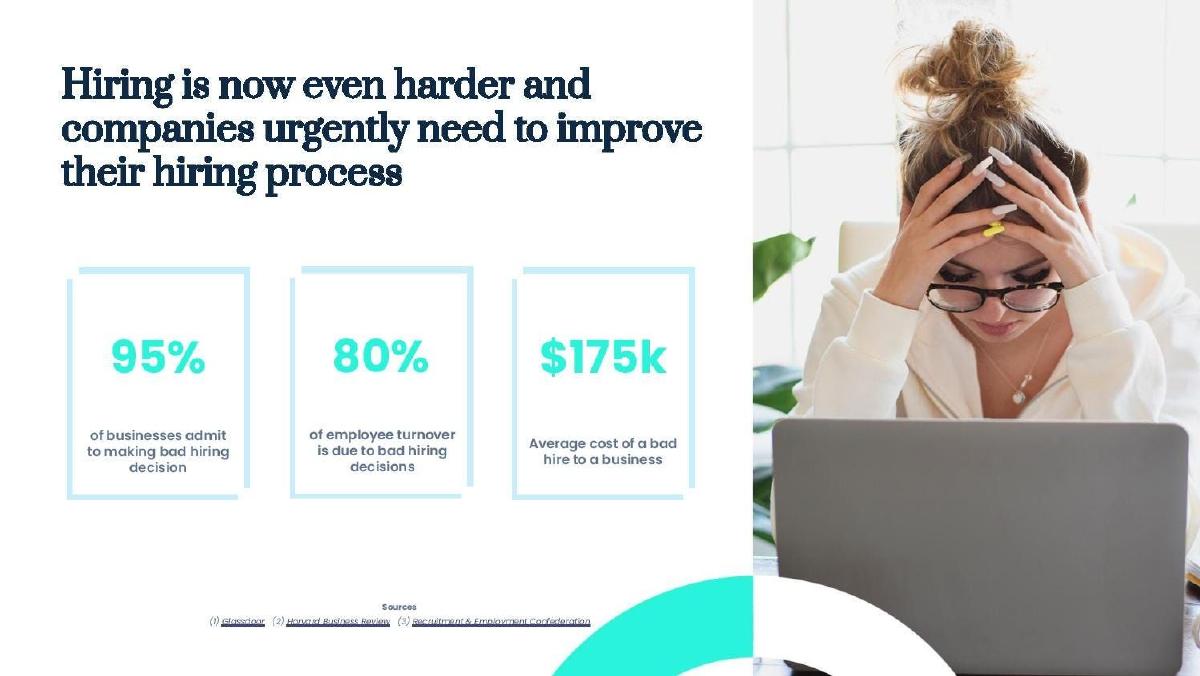
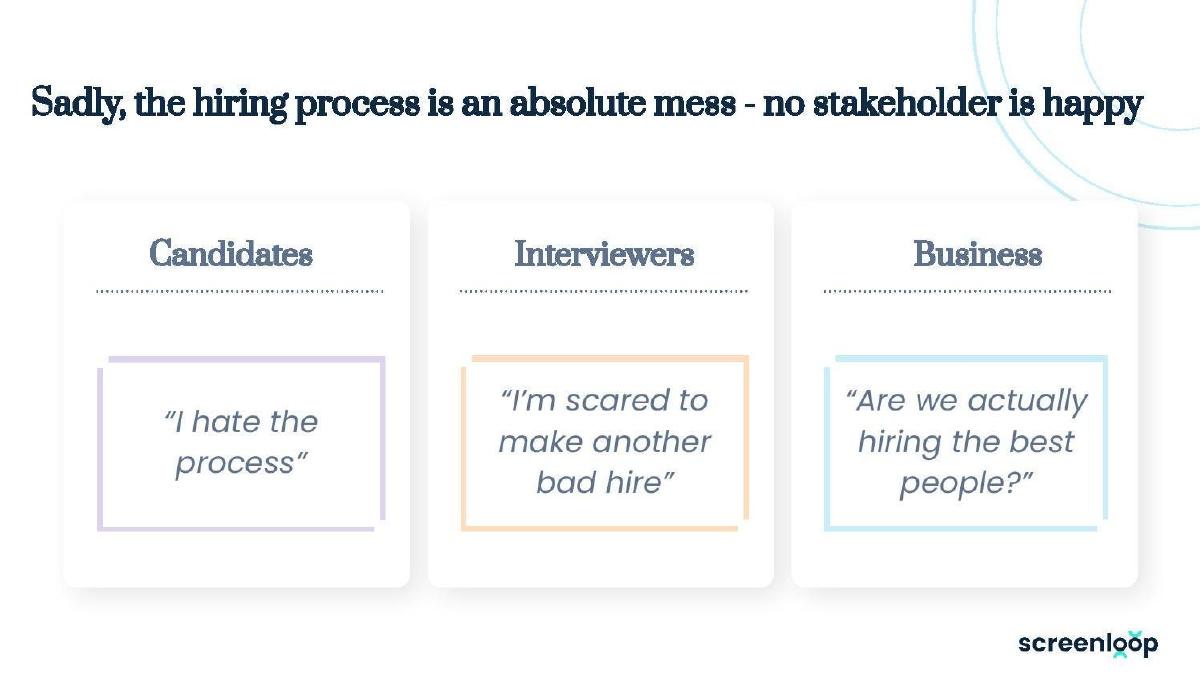
Slide 2 uses a simple three-column layout to describe why the current hiring process is an 'absolute mess.' They break it down by stakeholder:
Candidates: 'I hate the process' · Interviewers: 'I'm scared to make another bad hire' · Business: 'Are we actually hiring the best people?'
This slide is effective because it acknowledges that recruitment isn't just a headache for HR; it affects the entire organization and the external brand perception.
Slide 3: The Solution and Framework
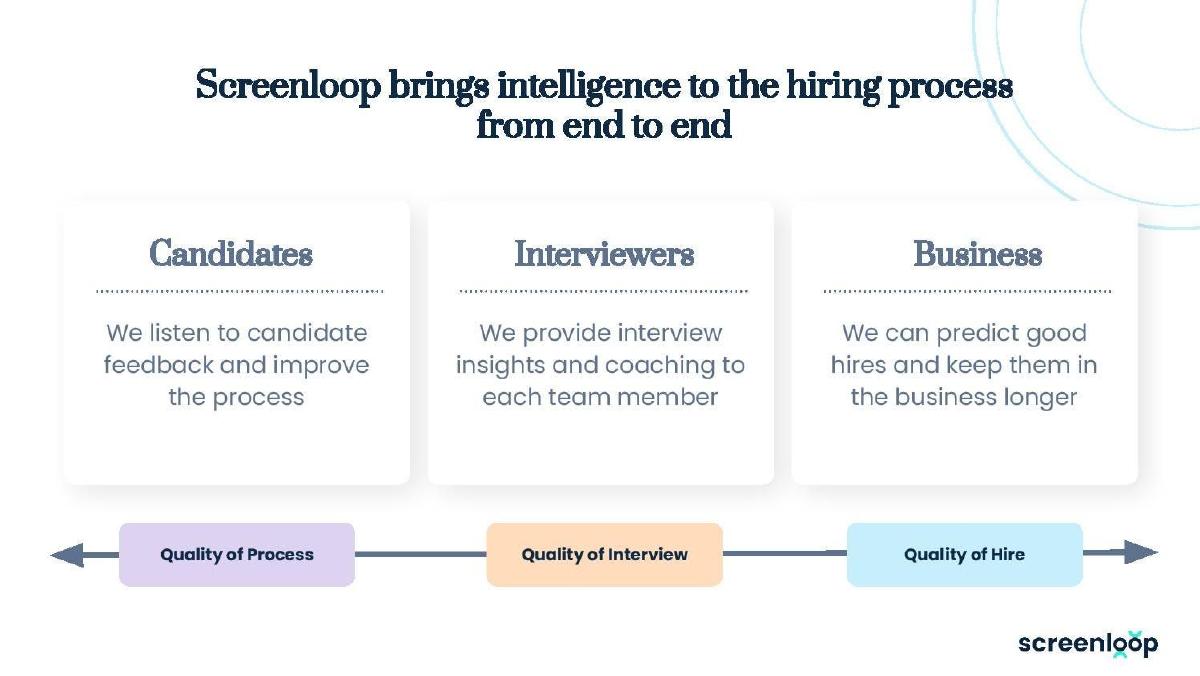
Screenloop introduces its platform as the solution to the 'black box.' The slide highlights 3 new quality metrics :
Quality of Process (via Screenloop Pulse) · Quality of Interview (via Screenloop Interview) · Quality of Hire (via Screenloop Success)
The diagram shows how the platform sits between the ATS/HRIS layer and the final insights/benchmarking layer. This positioning is crucial for a Seed round because it demonstrates how the product fits into a customer's existing tech stack without requiring a 'rip and replace' strategy.
Slide 4: Product Deep Dive and ROI
This is the 'meat' of the deck. Slide 4 shows a detailed dashboard screenshot. It isn't just a pretty picture; it points to specific data points that Screenloop tracks:
Talk Ratio: 48% · Talk Speed: 135 WPM · Punctuality: 35 secs · Longest Monologue: 5 mins
The slide asks provocative questions like 'Are your team asking fair and consistent questions?' and 'Are your team coming late for interviews?' Most importantly, it anchors these features to a hard business outcome: 'Increase offer to hire ratio by 25%.' This turns a 'nice-to-have' analytics tool into a 'must-have' efficiency driver.
Slide 5: The Integration Ecosystem
For HR tech, integrations are everything. Slide 5 lists 14 major platforms that Screenloop integrates with. These include:
ATS: Workable, Greenhouse, Lever, Workday, SmartRecruiters. · HRIS: Namely, BambooHR, ADP, Workday. · Sign-on/Communication: Okta, G Suite, Zoom, Google Meet, Slack.
By showing this breadth, Screenloop de-risks the technical implementation for potential investors and customers alike.
Slide 6: Social Proof and Testimonials
Slide 6 features three testimonials from Latana, Cytora, and Reachdesk. The quotes are specific. Tom Coward from Cytora mentions reducing unconscious bias and helping with DEI initiatives . Mary Eagan from Reachdesk focuses on reducing time to hire . Using real faces and company logos at the Seed stage builds significant credibility.
Slide 7: Growth and Investor Pedigree
The growth slide shows a classic 'hockey stick' curve for Annual Recurring Revenue (ARR). While the exact figures are redacted as $XXm , the timeline spans from Q4 2021 to the end of 2024. The right side of the slide is equally important, listing 9 customers (including GoCardless and Synthesia) and a powerful list of Seed investors. Highlighting Paul Foster (Indeed) and Tom Blomfield (Monzo) tells investors that people who have built billion-dollar companies in this space believe in Screenloop's vision.
Slide 8: Closing and Call to Action
The final slide is a simple 'Thank you!' with a laptop mockup showing the website and the tagline 'Make every interview count.' It includes the website URL, screenloop.com, providing a clear next step for the viewer.
What Screenloop Does Exceptionally Well
The Screenloop deck succeeds because it is narrowly focused . It doesn't try to solve all of HR; it tries to solve the interview. By focusing on 'Quality of Interview,' they found a metric that most companies aren't tracking but desperately need to. The use of specific dashboard metrics (like WPM and Talk Ratio) makes the 'AI-powered' claims feel tangible rather than like buzzwords.
Furthermore, the investor slide is a masterclass in 'borrowed credibility.' For a Seed round, having the founder of the world's largest job site (Indeed) as an investor is a massive signal that the problem Screenloop is solving is real and valuable.
What is Missing from the Deck
Despite raising $7M, this version of the deck has a few notable omissions:
No Team Slide: While the investors are listed, the actual founding team and their backgrounds are not featured in these 8 slides. In a Seed round, the 'why us' is usually as important as the 'what.' · No Unit Economics: There is no mention of Customer Acquisition Cost (CAC), Lifetime Value (LTV), or the pricing model. Investors would likely want to know if this is a per-seat license or a per-interview fee. · No Competitive Landscape: The deck assumes Screenloop is the only player in 'Hiring Intelligence.' It doesn't address how they differ from other interview intelligence tools like Gong (which is often used for interviews) or specialized competitors like BrightHire. · No Specific 'Ask': The deck doesn't state how much they are raising or what the milestones for the next 18 months are.
Lessons for Founders
Founders can learn three key lessons from Screenloop: 1. Sell the 'Intelligence,' not the 'Tool.' Screenloop positions itself as a way to 'remove the blackbox.' They aren't selling a video recorder; they are selling the insights that come from the recording. 2. Focus on Integration. If your product needs to live inside an existing workflow, show the logos of the tools you play nice with. It proves you understand the enterprise environment. 3. Quantify the 'Soft' Problems. 'Bad hiring' is a soft problem. Screenloop makes it hard and measurable by tracking talk ratios and punctuality, then linking those to a 25% increase in hire ratios.
Frequently asked questions
- What is Screenloop's primary product focus?
- Screenloop focuses on 'Hiring Intelligence.' It is a platform designed to sit on top of existing HR tools to provide analytics on the interview process itself. By analyzing talk ratios, question consistency, and interviewer punctuality, it aims to reduce unconscious bias and improve the overall quality of hires.
- How does Screenloop integrate with existing HR software?
- As shown on Slide 5, Screenloop is built for deep integration. It connects with ATS providers like Greenhouse and Lever, HRIS systems like Workday and BambooHR, communication tools like Zoom and Slack, and identity providers like Okta to ensure data flows seamlessly without changing the recruiter's core workflow.
- What specific metrics does the platform track during interviews?
- According to the dashboard view on Slide 4, the platform tracks 'Talk Ratio' (e.g., 48%), 'Talk Speed' (e.g., 135 WPM), 'Punctuality' (e.g., 35 seconds late), and 'Longest Monologue' (e.g., 5 mins). It also assesses if teams are asking 'fair and consistent questions' to ensure a standardized process.
- Who are the key investors mentioned in the Screenloop deck?
- The deck lists institutional investors Passion Capital, Blissgrowth, and RLC Ventures. More notably, it highlights prominent angel investors: Paul Foster (Founder of Indeed), Tom Blomfield (Founder of Monzo Bank), and Doug Monro (CEO/Founder of Adzuna), providing significant industry validation.
- What is the claimed ROI for using Screenloop?
- Slide 4 explicitly states that using their 'Quality of Interview' insights can 'Increase offer to hire ratio by 25%.' Additionally, customer testimonials on Slide 6 claim the tool reduces 'time to hire' and 'time spent throughout the whole hiring process' while supporting DEI initiatives.