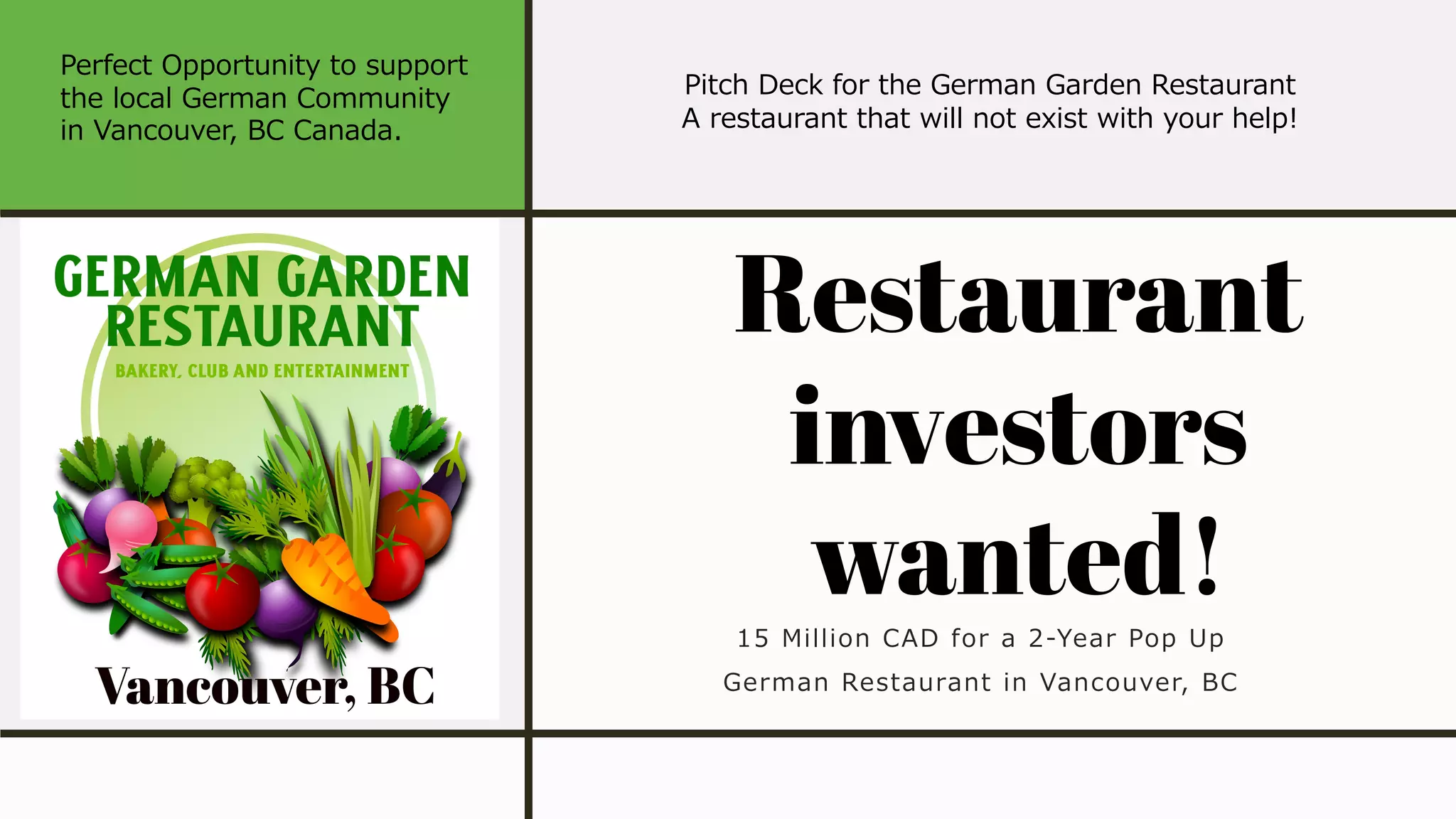
The German Garden Restaurant pitch deck is a 14-slide presentation (7 slides provided for review) seeking capital to launch a German-themed restaurant, bakery, and cultural center in Vancouver, BC. The proposal is characterized by a high degree of financial inconsistency; the title slide requests 15 Million CAD for a '2-Year Pop Up,' while the 'Ask' slide calculates a total requirement of 2 Million CAD for the same period. The deck focuses heavily on community value, offering a 'Little Germany' experience with specific accessibility features like senior nights and sign language support. Howev…
Key takeaways
- The deck contains a major discrepancy in funding requirements, citing 15 Million CAD on slide 1 and 2 Million CAD on slide 6.
- The business model is explicitly defined as a temporary '2-Year Pop Up' rather than a permanent establishment (Slide 1).
- The market slide notes that 60.0% of new full-service restaurants fail within three years, highlighting the high risk of the sector (Slide 4).
- The valuation is implied at 10 Million CAD, as the founders offer 5% equity for every $Half Million invested (Slide 6).
- Operational costs for the two-year period include $240,000 for a chef and $500,000 for rent and utilities (Slide 6).
- The project timeline was set for a 2023 launch, with a 'Soft Launch' in July and a full 'Opening' in August (Slide 7).
- The deck omits a professional team slide, instead mentioning a 'German trained chef' and a future 'volunteer Board of Directors' (Slides 3 and 7).
Slide-by-Slide Analysis
Slide 1: Title and Cover
The cover slide introduces the 'German Garden Restaurant' as a 'Bakery, Club and Entertainment' venue located in Vancouver, BC. It frames the project as an opportunity to support the local German community. The most striking element of this slide is the financial ask: '15 Million CAD for a 2-Year Pop Up.' The slide also contains a confusing subtitle: 'A restaurant that will not exist with your help!', which is likely a typographical error intended to say 'will not exist WITHOUT your help.'
Slide 2: Mission
The mission slide defines the project's scope and purpose. It aims to sustain the German community in Vancouver for the next two years. The vision includes being a 'cultural centre, museum, meeting hub and "Little Germany" of Western Canada.' The goal is to attract both local guests and tourists. The imagery features three glasses of beer and pretzels, reinforcing the traditional German theme.
Slide 3: What Solution are We Offering?
This slide breaks the offering into two categories. First, it promises traditional German cuisine, including meat and vegan options, prepared by a 'German trained chef.' Second, it positions the venue as a 'club and entertainment venue' designed to bring the community together. This suggests a multi-revenue stream model involving food, beverage, and potentially event programming.
Slide 4: The Market in Vancouver, BC Canada
The market slide provides high-level data but lacks specific competitive analysis. It cites Statistics Canada, noting that as of September 2018, BC food services and drinking place sales totaled $1,038,023,000 . It also includes a cautionary note from a 2017 source stating that 60.0% of new full-service restaurants close or change hands within three years . This is an unusual inclusion for a pitch deck, as it highlights the high failure rate of the very industry the founders are entering.
Slide 5: Accessibility ideas for all ages and stages
This slide focuses on operational differentiators. It lists specific 'theme nights,' such as Tuesday nights for Seniors (featuring quiet classical music and increased lighting) and Thursday 'date nights' (offering babysitting services). It also commits to physical accessibility for wheelchairs and strollers, sign language support on staff, and dietary inclusivity (vegan, gluten-free, and vegetarian options).
Slide 6: The Ask
This slide presents a major contradiction to the cover page. While the cover asked for $15 million, this slide details a 'Total Amount: $2,000,000 2 million CAD.' The budget breakdown includes: $240,000 for a chef over two years, $500,000 for rent and utilities over two years, $500,000 for initial equipment and food costs, and $500,000 for staff, marketing, and professional services (legal/accounting). The equity offer is '5% equity for every $Half Million you invest.' It also outlines a phased approach: leasing a space first, then potentially buying a smaller space, and finally moving into larger high-end premises.
Slide 7: Basic Timeline
The final provided slide outlines a launch schedule for 2023. It lists 'March 2023 - Startup,' 'July 2023 - Soft Launch,' and 'August 2023 - Opening.' It also mentions the intent to 'set up a volunteer Board of Directors to help run this project successfully.' The reliance on a volunteer board for a $2 million to $15 million operation is a non-standard management approach in the hospitality industry.
What the Deck Does Well
The deck is very clear about its niche. By focusing on a specific ethnic community in a specific geographic location (Vancouver), it identifies a clear target demographic. The inclusion of 'Accessibility ideas' shows a level of operational thought regarding how to fill tables during off-peak hours, such as targeting seniors on Tuesday nights. Furthermore, the budget breakdown on Slide 6 is specific, providing clear categories for where the capital will be deployed, even if the total amount is inconsistent with other parts of the deck.
What is Missing from the Deck
The most glaring omission is a Team Slide . In hospitality, the track record of the operator and the chef is paramount. While a 'German trained chef' is mentioned, there are no names, resumes, or past successes listed. There is also no Financial Projection slide showing expected revenue, margins, or a break-even analysis. Given the high failure rate cited on Slide 4, investors would need to see how this specific restaurant intends to be profitable. Additionally, the Competitive Landscape is missing; there is no mention of existing German restaurants or cultural centers in Vancouver that might compete for the same audience. Finally, the $13 million discrepancy between Slide 1 and Slide 6 is a critical error that undermines the credibility of the financial request.
What a Founder Should Copy
Founders should emulate the specific budget breakdown seen on Slide 6. Instead of just asking for a lump sum, the deck categorizes costs into rent, labor, equipment, and professional services. This allows investors to see that the founder has at least researched the basic costs of doing business. The phased approach mentioned in 'The Ask' (leasing before buying) is also a sound strategy for a new concept, as it demonstrates a desire to validate the model before committing to a permanent real estate purchase. Lastly, the community-centric mission is a strong way to frame a local business, as it appeals to the 'social impact' or 'community support' motivations of local angel investors.
Final Analysis
The German Garden Restaurant pitch deck is a conceptual proposal that lacks the professional rigor required for a multi-million dollar investment. The massive inconsistency regarding the total funding goal—alternating between $2 million and $15 million—is a 'red flag' that suggests the deck was not thoroughly proofread. Furthermore, the business model itself is confusing; it is described as a '2-Year Pop Up,' yet the 'Ask' slide discusses eventually buying a space and moving to high-end premises, which implies a long-term venture. Without a named management team or detailed financial forecasts, this deck functions more as a vision statement for a community project than a viable investment vehicle for a commercial restaurant.
Frequently asked questions
- How much capital is the company actually asking for?
- There is no clear answer due to internal contradictions. Slide 1 explicitly asks for '15 Million CAD for a 2-Year Pop Up.' However, Slide 6 provides a detailed breakdown of costs—including chef salary, rent, and equipment—that totals exactly '$2,000,000 2 million CAD.' This 7.5x difference between the cover page and the budget slide creates significant confusion for potential investors.
- What is the proposed equity structure for investors?
- According to Slide 6, the founders are offering 5% equity for every $500,000 CAD invested. This math suggests a post-money valuation of $10 million CAD. Given that the budget slide only accounts for $2 million in spending, it is unclear how the remaining equity would be distributed or if the founders are seeking multiple investors to fill the $2 million or $15 million goal.
- What makes this restaurant concept unique according to the deck?
- The deck positions the restaurant as more than a dining venue, calling it a 'cultural centre, museum, and meeting hub' (Slide 2). It emphasizes inclusivity through 'Accessibility ideas' (Slide 5), such as Tuesday nights for seniors with classical music, Thursday date nights with babysitting services, and having staff members who know sign language.
- What are the primary risks identified in the presentation?
- The deck surprisingly highlights industry-wide risks on Slide 4, noting that while barriers to entry are low, 'barriers to success... are relatively high.' It cites a statistic from 2017 stating that 60% of new full-service restaurants close or change hands within three years. This is particularly notable since the project is only planned for a two-year duration.
- Who is leading the project?
- The provided slides do not include a team slide or name any founders. Slide 3 mentions the food will be prepared by a 'German trained chef,' and Slide 7 mentions the intent to set up a 'volunteer Board of Directors.' The lack of a named management team with a track record in hospitality is a significant omission for a multi-million dollar ask.