Get Lighthouse raised $125,000 in 2014 using a 10-slide deck that prioritizes narrative over data density. The presentation leans heavily on the 'System of Record' argument, positioning itself as the missing tool for managers in the same way Salesforce serves sales teams. While the deck lacks traditional financial projections, a business model slide, or a specific 'ask,' it compensates with strong social proof, citing over 395 paying managers and logos from companies like Hulu and LinkedIn. The teardown explores how this minimalist approach works for early-stage seed rounds where the primary…
Key takeaways
- The deck leads with a high-impact cost figure of $65,000 on slide 2 to quantify the cost of losing an employee.
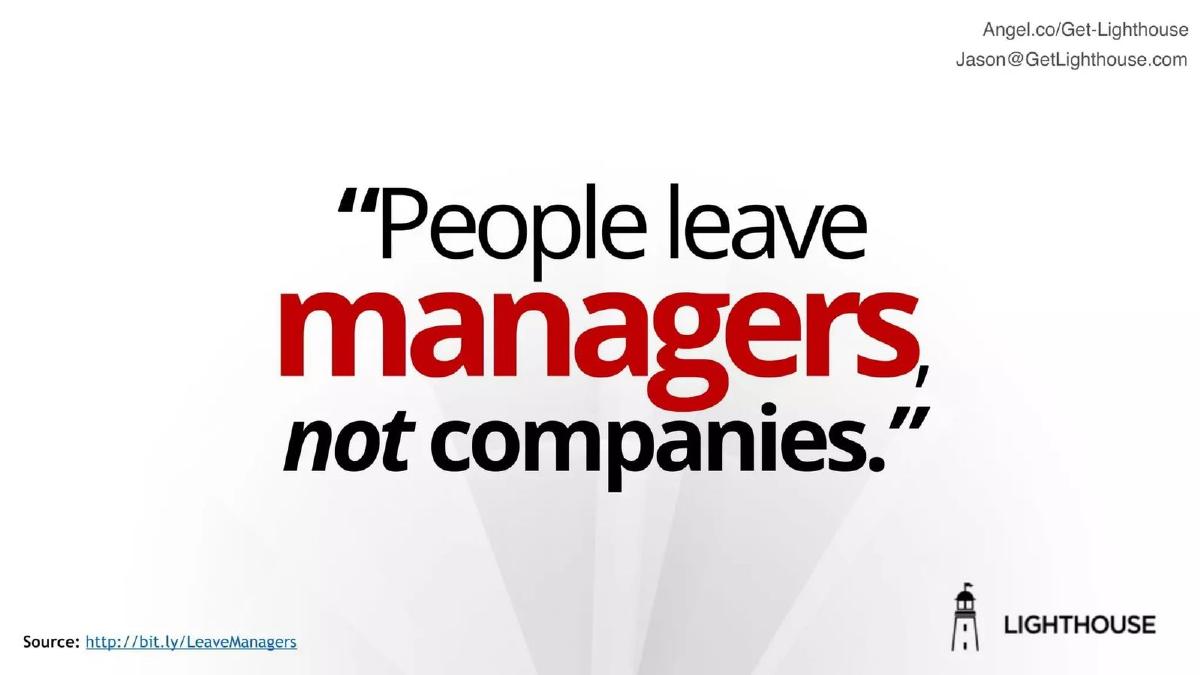
- It utilizes a powerful emotional hook on slide 3: 'People leave managers, not companies.'
- Traction is demonstrated on slide 7 with a specific count of 'Over 395 paying managers.'
- The deck uses a 'category comparison' strategy on slide 9, aligning with Salesforce, HubSpot, and GitHub.
- The team slide (slide 8) emphasizes past experience at high-growth tech companies like KISSmetrics and Backupify.
- Social proof is established on slide 7 through the inclusion of major tech logos like Zendesk and Hulu.
- The presentation is entirely devoid of product screenshots, focusing instead on the 'why' and the 'who.'
- There is no formal 'Ask' slide or financial roadmap included in the 10-slide sequence.
The Power of a Narrative-Driven Seed Deck
The Get Lighthouse pitch deck is a 10-slide exercise in minimalism. In an era where decks often bloat to 20 or 30 slides filled with complex TAM/SAM/SOM calculations and five-year projections, Lighthouse chose to focus on a singular, painful truth: management is hard, and when it fails, it costs companies a fortune. This teardown examines how a company can raise capital by focusing on a 'System of Record' narrative and early traction logos.
The Hook: Quantifying the Pain (Slides 1-4)
Slide 1: Title The deck opens with a clean blue background, the lighthouse logo, and the tagline: "Software to be a better manager." It is a direct, functional value proposition that requires no explanation.
Slide 2: The $65,000 Number This is a bold tactical choice. Slide 2 contains nothing but the figure "$65,000" in large red text. A source link at the bottom (bit.ly/65kcost) provides credibility. This slide establishes the stakes immediately. Before the investor knows what the product does, they know the size of the hole in the customer's pocket.
Slide 3: The Insight "People leave managers, not companies." This is a well-known management maxim, but placing it immediately after the $65,000 cost figure turns a cliché into a business case. If employees leave because of managers, and each departure costs $65,000, then fixing managers is a high-ROI activity.
Slide 4: The Solution Slide 4 repeats the logo and the phrase "Makes you a better manager." By this point, the deck has established a logical loop: turnover is expensive -> managers cause turnover -> Lighthouse fixes managers. It is a closed-circuit argument that is difficult to dispute.
The Human Element and Social Proof (Slides 5-7)
Slide 5 & 6: The Persona These slides introduce "Anna," a Support Director (Slide 5) who becomes an Operations Director (Slide 6) when paired with Lighthouse. This is a subtle way of showing the product's impact on career progression without showing a single line of code. It suggests that Lighthouse doesn't just help the company; it helps the individual manager succeed and get promoted.
Slide 7: Traction and Logos This is the most important slide for a seed-stage investor. It states the company has "Over 395 paying managers." In 2014, having nearly 400 paying users for a niche management tool was significant proof of concept. The logos on the right—Hulu, LinkedIn, Zendesk, Fletchers Solicitors, and LHV Pank—provide massive enterprise-grade validation. It tells the investor that even though the raise is small ($125k), the product is already inside some of the world's most respected tech organizations.
The Team and the Market Gap (Slides 8-10)
Slide 8: Our Team The team slide is structured to show pedigree. Jason Evanish (CEO) highlights his time at KISSmetrics, a heavy hitter in the analytics space at the time. The engineering and UX leads (Jay Byoun and Julian Nguyen) show experience at Backupify and Sparkcentral. The message is clear: this isn't a first-time founder's hobby; it's a professional team that has seen the inside of successful startups.
Slide 9: The Category Play This is a classic '2x2' or 'Market Landscape' alternative. It lists departments and their definitive software: Sales (Salesforce), Marketers (HubSpot), Engineers (GitHub). Under "Managers," there is a red question mark. This slide argues that management is a massive, underserved category. It positions Lighthouse not as a 'nice-to-have' tool, but as the inevitable 'System of Record' for the management function.
Slide 10: Conclusion The final slide returns to the logo with contact information and an AngelList link. It is a standard closing, though it notably lacks a specific 'Ask' regarding the amount of money being raised or the intended use of funds.
What Works in the Get Lighthouse Deck
1. Extreme Clarity: You can flip through this deck in 30 seconds and understand exactly what the business does and why it matters. The use of large fonts and minimal text ensures the 'big idea' isn't lost in the weeds.
2. Anchoring on Cost: By starting with the $65,000 cost of turnover, the founders move the conversation away from 'features' and toward 'savings.' This makes the software feel like an insurance policy against talent loss rather than an HR expense.
3. High-Quality Social Proof: For a seed round, having logos like Hulu and LinkedIn is an incredible asset. It suggests that the product has 'viral' potential within large organizations, even if it's being bought at the individual manager level first.
What is Missing from the Get Lighthouse Deck
1. Product Visuals: The total absence of screenshots is risky. Investors generally want to see the 'how' after they buy into the 'why.' Without visuals, it's hard to tell if this is a complex dashboard or a simple checklist tool.
2. Business Model: The deck mentions "paying managers," but it doesn't explain the pricing structure. Is it $10/month or $1,000/year? Is it a bottom-up SaaS play or an enterprise top-down sale? This information is crucial for calculating potential scale.
3. The Ask: A pitch deck is a fundraising tool. Omitting the amount being raised, the valuation target, or the milestones the team intends to hit with the capital is a missed opportunity to set the terms of the conversation.
4. Competition: The deck implies there is no software for managers (Slide 9). In reality, the competition is often 'status quo' (spreadsheets and email) or legacy HRIS systems. Acknowledging how managers currently solve this problem would have strengthened the case.
What a Founder Should Copy
The 'System of Record' Comparison: Slide 9 is the strongest conceptual slide in the deck. If you are building a tool for a specific job function, comparing yourself to Salesforce or GitHub is a shortcut to helping investors understand your potential ceiling. It frames your startup as a category-defining necessity.
The Problem-Cost-Solution Sequence: Use the first three slides to build an emotional and financial bridge. State the cost of the problem, give the psychological reason the problem exists, and then present your company as the only logical fix. This narrative flow is much more compelling than starting with a list of features.
Minimalist Design: This deck proves you don't need a professional agency to raise money. Clean lines, consistent colors, and high-contrast text allow the data (like the 395 paying managers) to stand out. If your traction is good, don't hide it behind busy graphics.
Frequently asked questions
- How much did Get Lighthouse raise with this deck?
- According to the catalogue data from pitchdeckhunt.com, Get Lighthouse raised $125,000 in 2014 during their Seed stage. This relatively small amount for a seed round suggests the deck was likely used for an angel or pre-seed bridge, or as part of a larger rolling close.
- Does the deck show the actual software product?
- No. Interestingly, none of the 10 slides contain a screenshot, mockup, or feature list of the Lighthouse software. The deck focuses exclusively on the problem (manager turnover), the solution's value proposition ('Makes you a better manager'), and the traction the team has already achieved.
- What is the 'System of Record' argument used in the deck?
- On slide 9, the deck uses a comparison chart. It shows that Sales has Salesforce, Marketers have HubSpot, and Engineers have GitHub. It places a question mark under 'Managers,' implying that Lighthouse is the definitive system of record for management, just as those giants are for their respective fields.
- Who are the key team members mentioned?
- The team consists of Jason Evanish (CEO), Jay Byoun (Founding Engineer), and Julian Nguyen (UX Engineer). Slide 8 highlights their background at recognizable startups including KISSmetrics, Greenhorn Connect, Breeze, Backupify, Sparkcentral, and Coding Dojo.
- What is the primary problem Lighthouse aims to solve?
- The deck identifies the high cost of employee turnover as the core problem. Slide 2 cites a $65,000 cost per lost employee, and slide 3 identifies the root cause: poor management. The solution is software designed to facilitate better 1-on-1s and career growth to retain talent.