GetAccept’s Series B deck is a masterclass in demonstrating market-fit through efficiency and product-led growth. The company positions itself as the essential layer between a CRM and a closed deal, specifically targeting the 60% of B2B deals that 'go dark.' The narrative is anchored by a highly experienced founding team with previous exits and a management layer featuring veterans from Evernote, Slack, and Spotify. Financially, the deck shines by revealing a 1:1 ratio of ARR to lifetime burn ($6M ARR on $6M burn) and exceptional retention rates (160% Y2 Net Retention). By framing the COVID-1…
Key takeaways
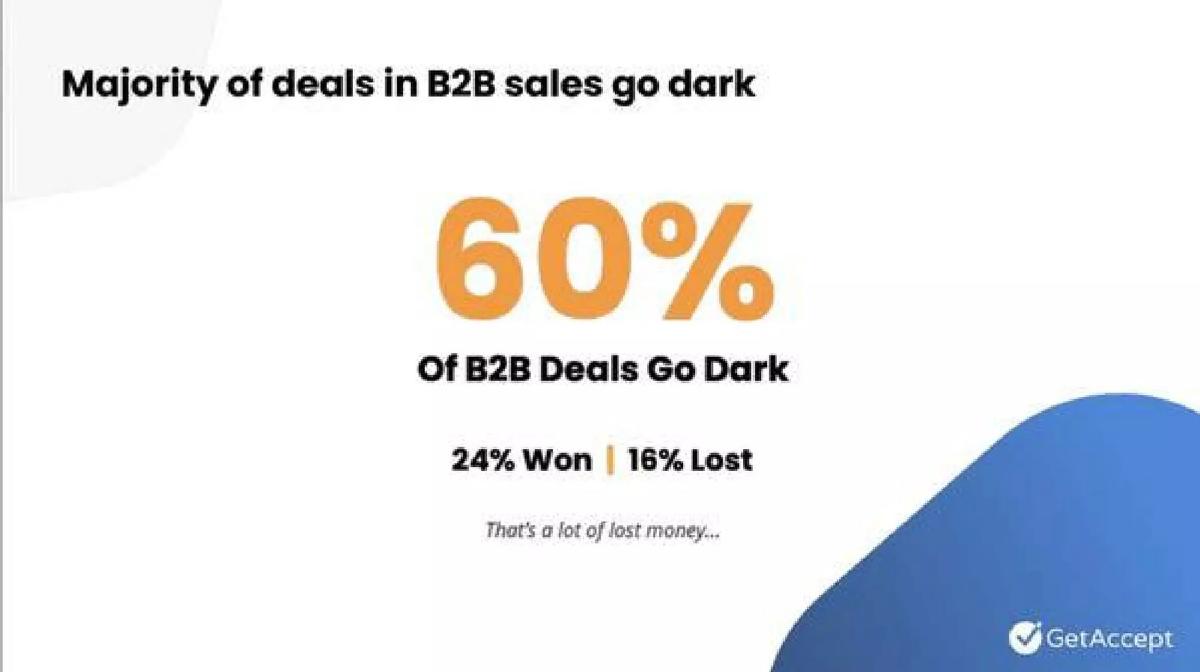
- The deck identifies a massive pain point on slide 4: 60% of B2B deals go dark, representing a significant loss of potential revenue.
- GetAccept positions itself as the 'all-in-one' solution that sits on top of the CRM to handle everything from video engagement to e-signatures (slide 7).
- The company demonstrates exceptional capital efficiency on slide 17, reaching $6M ARR with a total lifetime burn of only $6M.
- Retention metrics are a core strength, with slide 17 reporting Year 2 Net Dollar Retention at 160% and Year 1 Gross Retention at 90%.
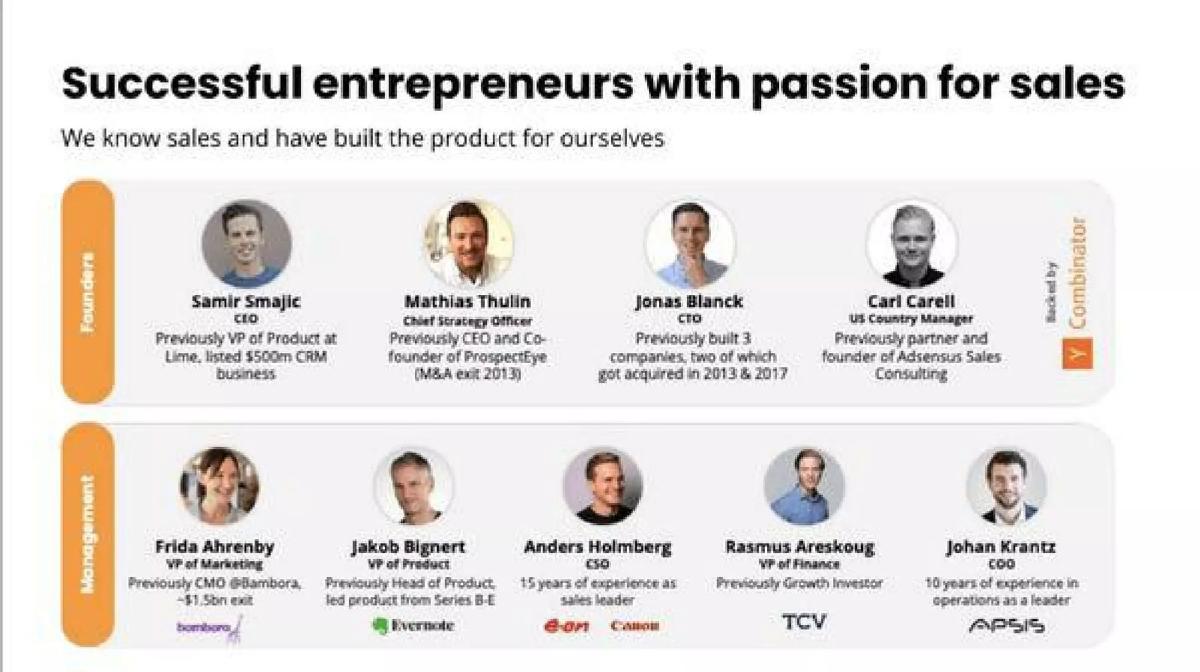
- The team slide (slide 2) highlights deep domain expertise, including a CEO who was previously VP of Product at a $500M CRM business.
- Product virality is quantified on slide 15, showing how 'shared dealrooms' expose multiple stakeholders to the product, driving inbound growth.
- The market opportunity is framed as a $22B+ TAM, with a specific focus on the underserved SMB segment (slides 11 and 12).
- The 'Ask' is clearly defined on slide 16: $20M for US/EU expansion and accelerating the product-led growth roadmap.
The Narrative: Bridging the Gap Between CRM and Contract
GetAccept’s Series B deck is built on a clear, logical progression: the world of sales has moved online, existing tools are fragmented, and deals are dying in the 'dark' space between a lead and a signature. By the time an investor reaches the final slide, the company has presented a compelling case that they own the most critical part of the modern sales stack for SMBs.
Slides 1-3: The Team and the 'Why'
The deck opens with a strong emphasis on the Founding Team . Slide 2, titled "Successful entrepreneurs with passion for sales," highlights that the product was built by salespeople for salespeople. This isn't just a platitude; the credentials back it up. CEO Samir Smajic’s background at a $500M CRM business (Lime) provides immediate sector authority. The inclusion of Y Combinator backing and a management team with experience at Evernote, Slack, and TCV signals that this is a high-growth, venture-scale operation.
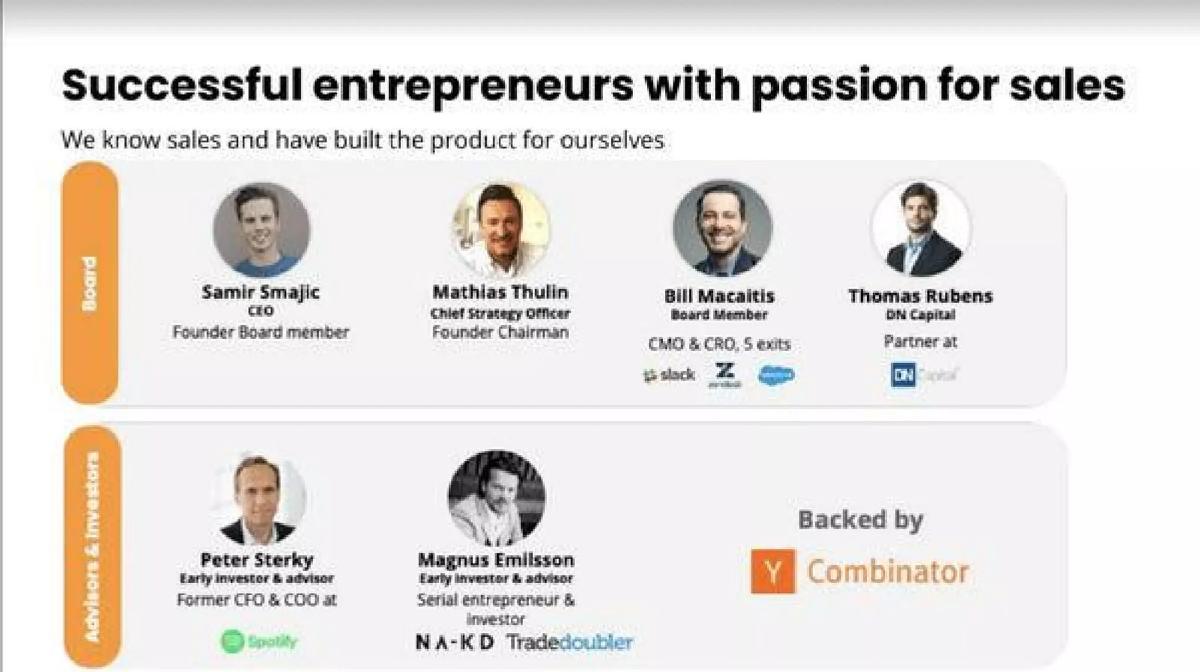
Slide 3 reinforces this by showcasing a heavy-hitting Board and Advisor group. Featuring Bill Macaitis (former CMO/CRO at Slack, Zendesk, and Salesforce) is a strategic move to show that industry leaders in the sales-tech space are betting on GetAccept’s vision.
Slides 4-6: Defining the Problem and the Legacy Gap
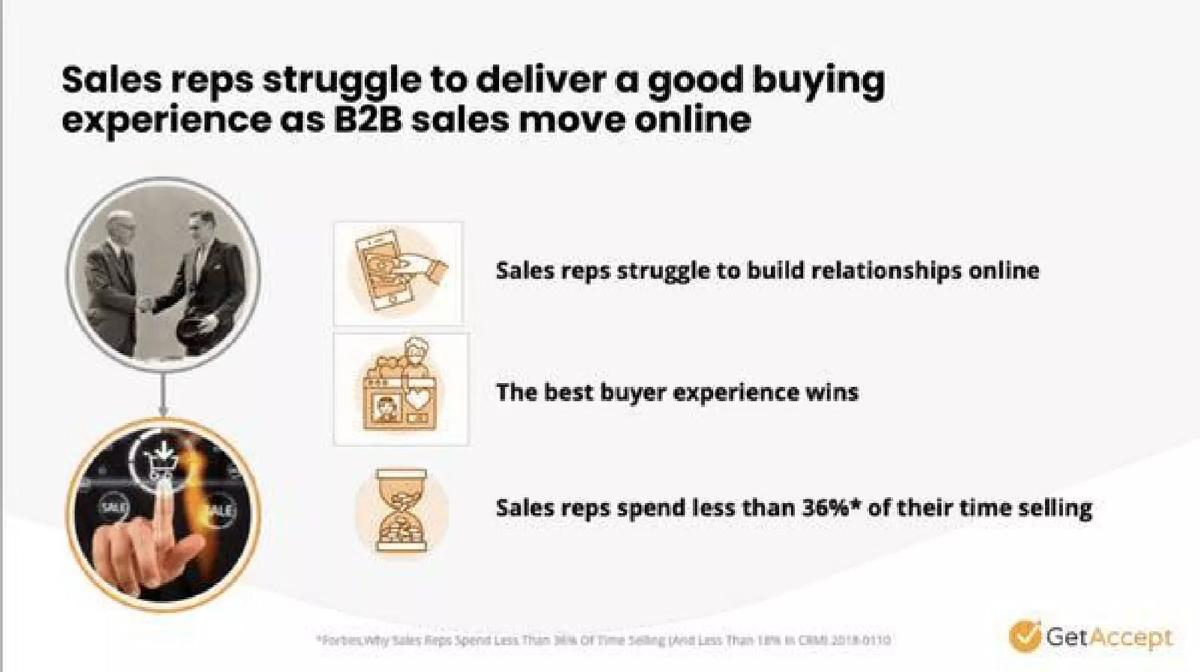
Slide 4 presents the 'hook': 60% of B2B deals go dark . This is a visceral pain point for any sales leader. The deck argues that while 24% of deals are won and 16% are lost, the majority of potential revenue is simply vanishing due to lack of engagement. Slide 5 attributes this to the struggle of building relationships online, noting that sales reps spend less than 36% of their time actually selling.
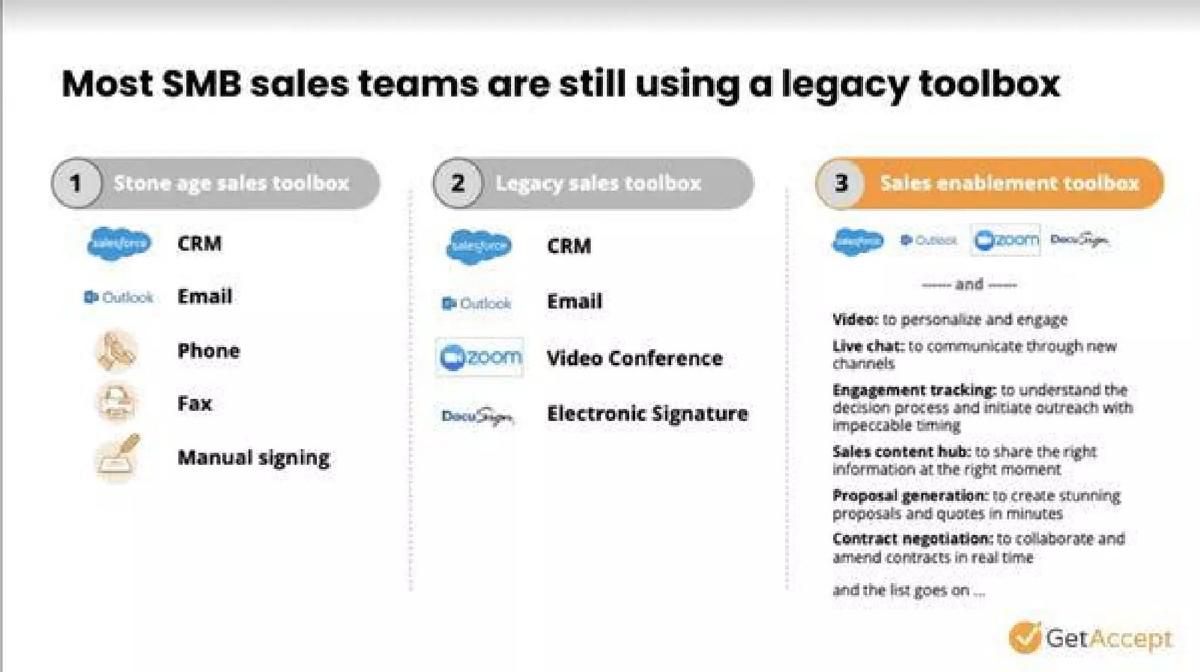
Slide 6 is a classic 'Evolution' slide. It categorizes the market into three stages: the "Stone age" (Fax/Manual signing), the "Legacy" (Zoom/DocuSign as disconnected tools), and the "Sales enablement toolbox" (GetAccept). This slide effectively frames competitors not as specific companies, but as the inefficiency of using multiple disconnected point solutions .
Slides 7-9: The All-in-One Solution
Slide 7 introduces the product as the "all-in-one solution to sell online." It lists eight core features, including Sales Video Engagement, AI-driven AE Coaching, and Proposal Generation . The central message is that GetAccept is the single layer that sits on top of the CRM (Salesforce, HubSpot, etc.) to handle the entire 'Opportunity to Customer' journey.
Slide 8 visualizes this integration, showing GetAccept as the bridge in the sales process. Slide 9 provides the social proof, claiming "high, quick and tangible ROI" with testimonials mentioning 10% higher win rates and shorter sales cycles. Notably, the slide lists major logos like Samsung, Siemens, and Chargebee , proving the product scales beyond micro-SMBs.
Slides 10-12: Traction and Market Opportunity
While Slide 10 is a placeholder for retention metrics in the public version, the headers "Best-in-class retention for SMB" set the stage for the specific figures revealed later in the deck. Slide 11 addresses the TAM (Total Addressable Market) , valued at $22B+. It uses the COVID-19 pandemic as a pivot point, describing 2020 as a "Market Inflection Point" where remote sales became the permanent paradigm.
Slide 12 identifies the competitive white space. It maps the market on two axes: Point Solutions vs. All-in-One, and Enterprise vs. Micro SMB. GetAccept claims the top-right quadrant for the Mid/SMB segment, supported by G2 Crowd 'Leader' badges.
Slides 13-15: Efficiency and Virality
Slide 13 and 14 focus on Capital Efficient Growth . The bar charts show a consistent upward trajectory in ARR and inbound bookings. Slide 14 is particularly important for a Series B investor, as it demonstrates that the company has found a repeatable, low-cost acquisition channel, with a significant percentage of ARR coming from "free sources" and "direct traffic."
Slide 15 explains why the growth is efficient: Inherent Product Virality . By using a formula (Shared dealrooms x Stakeholders per deal), GetAccept shows how every user naturally exposes the product to new potential customers. They compare this viral loop to the early days of Evernote and Slack, again leaning on their team's experience at those companies to validate the claim.
Slides 16-18: The Ask and Summary
Slide 16 contains the 'Ask': ~$20M Series B . The funds are earmarked for US/EU expansion and accelerating the product roadmap toward a "bottoms-up distribution model." This is a standard but well-justified request for a company at this stage.
Slide 17 is the most data-dense and impressive slide in the deck. It summarizes the highlights: $6M ARR with $6M lifetime burn (a rare 1:1 ratio), 90% YoY growth, and staggering retention numbers: 120% Net Retention in Year 1, growing to 160% in Year 2 . These metrics are the 'smoking gun' that proves the business model is working at scale.
What Works
The Efficiency Narrative: In a venture landscape that often rewards growth at all costs, GetAccept’s 1:1 ARR-to-burn ratio (Slide 17) is an incredibly strong signal of a disciplined, high-quality business. · The 'Dark Deal' Hook: By focusing on the 60% of deals that go dark (Slide 4), they aren't just selling a tool; they are selling a solution to a specific, quantified revenue leak. · Strategic Team Placement: They don't just list names; they explain why those names matter. Mentioning that the Head of Product led Evernote from Series B to E (Slide 2) directly addresses the investor's question: "Can this team scale?" · Clarity of the Stack: Slide 8 clearly shows where GetAccept fits in the existing tech stack. It doesn't try to replace the CRM; it makes the CRM more valuable. This reduces the perceived friction of adoption.
What is Missing
Unit Economics: While the deck mentions capital efficiency and retention, it omits specific CAC (Customer Acquisition Cost) and LTV (Lifetime Value) figures. Investors at Series B usually want to see the exact payback period for their marketing spend. · Competitive Landscape Details: Slide 12 is a high-level positioning map, but it doesn't name specific competitors (like PandaDoc or DocuSign). A more detailed slide on how they win against specific incumbent point solutions would have added depth. · Detailed Financial Projections: The deck shows historical growth but lacks a forward-looking forecast. While often handled in a separate data room, a high-level 'Plan to $50M ARR' slide is common in Series B decks.
What a Founder Should Copy
The 'Evolution' Slide: Use Slide 6 as a template. Categorizing the current market as "Stone Age" or "Legacy" is a powerful way to make your solution feel like an inevitable upgrade. · Quantified Virality: If your product has a viral component, don't just say it's 'viral.' Copy the logic on Slide 15—show the math of how one user leads to X stakeholders being exposed to the brand. · Highlighting Retention Expansion: Most decks show a single retention number. GetAccept shows expansion over time (120% to 160%). This proves that the longer a customer stays, the more valuable they become. · The Summary Highlight Slide: Slide 17 is a perfect 'closer.' It gathers all the 'mic-drop' stats into one place, ensuring the investor leaves the presentation with the most important numbers fresh in their mind.
Frequently asked questions
- What is the primary problem GetAccept solves?
- According to slide 4, the primary problem is that 60% of B2B deals 'go dark'—meaning they neither close nor are officially lost, but simply stall. GetAccept solves this by providing tools for engagement tracking, personalized video, and real-time collaboration to keep buyers engaged throughout the sales cycle after the initial CRM opportunity is created.
- How does GetAccept differentiate itself from competitors?
- GetAccept differentiates itself by being an 'all-in-one' platform rather than a point solution. Slide 6 contrasts 'Legacy' toolboxes (using separate tools for Zoom, DocuSign, and Email) with their integrated 'Sales Enablement Toolbox.' Slide 12 further positions them as the only all-in-one solution specifically targeting the underserved SMB and Mid-market segments.
- What are the key financial metrics mentioned in the deck?
- The deck highlights several high-performance SaaS metrics on slide 17. These include $6M in ARR, a 90% year-over-year growth rate, and a 1:1 ARR-to-burn ratio. Most notably, they report a Year 1 Net Dollar Retention of 120% which expands to 160% by Year 2, indicating strong expansion within their existing customer base.
- Who is on the GetAccept founding and management team?
- The team is highly experienced, as shown on slides 2 and 3. CEO Samir Smajic was previously VP of Product at Lime (a $500M CRM). The management team includes veterans from Evernote (Jakob Bignert), Slack (Bill Macaitis), and Spotify (Peter Sterky). This 'seen the movie before' experience is used to validate their ability to scale a viral product.
- What is the intended use of the Series B funds?
- As stated on slide 16, the $20M Series B is intended for two main pillars: Go-to-Market and R&D. Specifically, they plan to scale their GTM organization in the USA and Europe and invest in R&D to implement a 'Product-Led Growth' strategy and build out a bottoms-up distribution model.