Geodesic.Life presents a compelling case for sustainable, prefabricated dome homes, specifically targeting rural development. The deck effectively uses visual evidence of past prototypes (Gen.1 in 2019 and Gen.2 in 2021) to establish credibility. By leveraging materials like hempcrete and cross-laminated timber, they claim a 71% reduction in CO2 footprint compared to traditional construction. Their strategy focuses on a beachhead market in the Stockholm area, valued at EUR 560 million, before expanding globally. While the deck is strong on product and impact metrics, it lacks specific financi…
Key takeaways
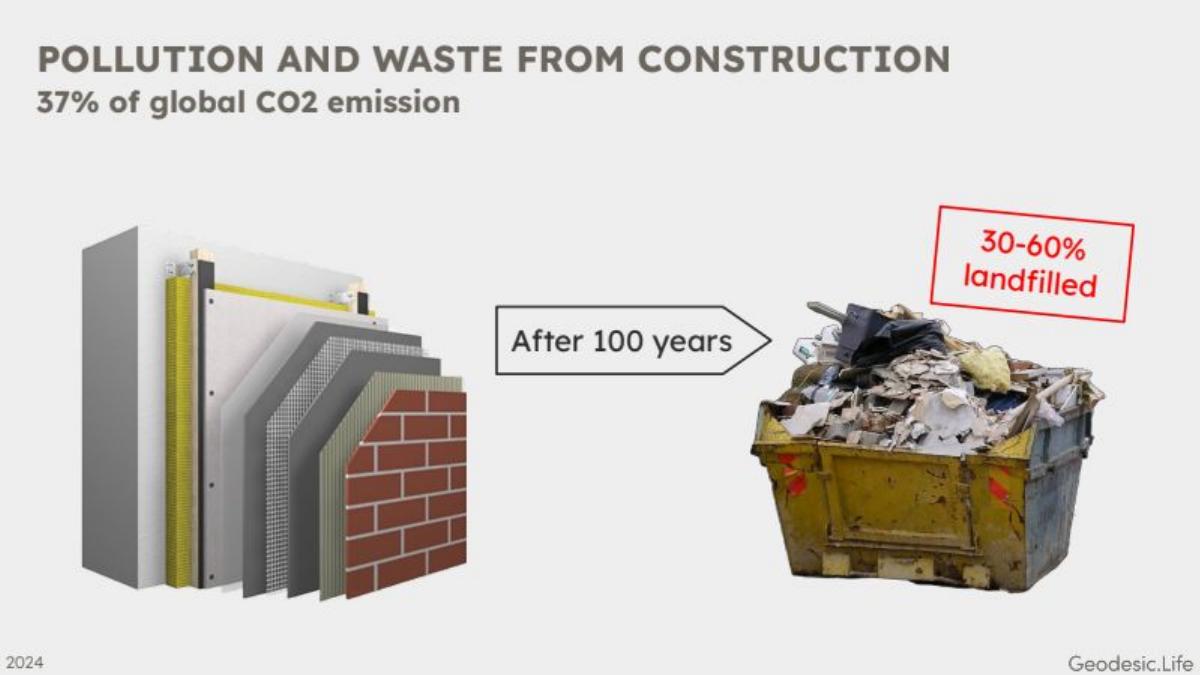
- Construction accounts for 37% of global CO2 emissions, with 30-60% of materials landfilled after 100 years (Slide 2).
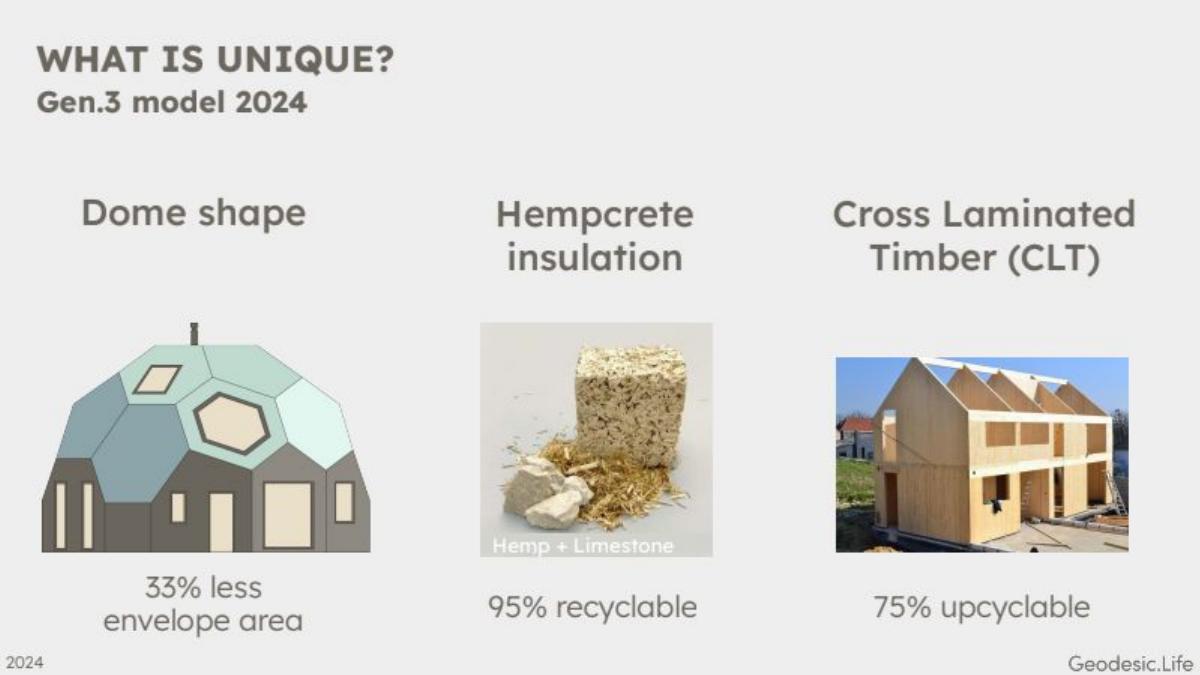
- The dome shape provides 33% less envelope area, improving thermal efficiency and reducing material use (Slide 6).
- Geodesic.Life homes achieve a 71% reduction in CO2 footprint using 95% recyclable hempcrete and 75% upcyclable CLT (Slide 6, 7).
- The business model involves selling design, prefab kits, and consultancy to real estate partners who then provide turn-key houses to families (Slide 8).
- The initial beachhead market is the Stockholm area, part of a EUR 5.4 billion Scandinavian market (Slide 9).
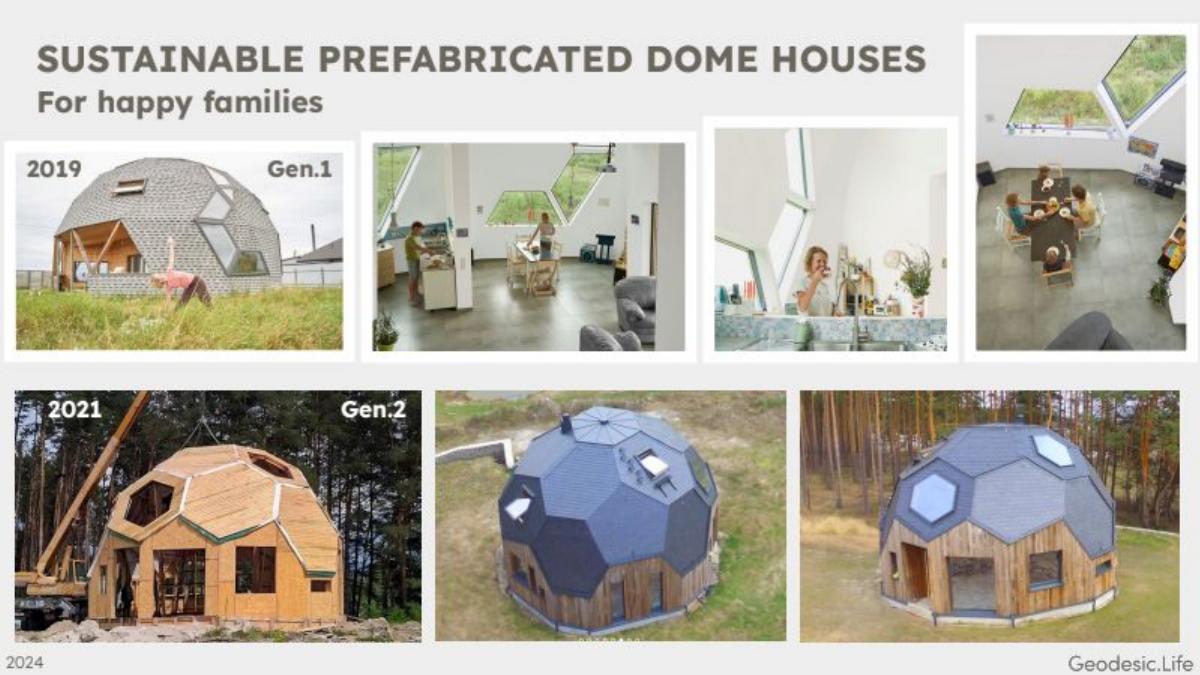
- The company has progressed through multiple iterations, with Gen.1 built in 2019 and Gen.2 in 2021 (Slide 5).
- The deck identifies competitors like Geoship and EasyDomes but differentiates through the use of CLT and hempcrete (Slide 10, 11).
- The team includes two founders, a BIM architect, a designer, and three mentors from architecture, impact, and finance (Slide 13).
Executive Summary: A Sustainable Vision for Rural Living
Geodesic.Life enters the market at a time when the construction industry is under intense scrutiny for its environmental impact. Their pitch deck, dated 2024, outlines a vision for "Sustainable Prefabricated Dome Houses for Rural Development." By combining ancient geometric principles with modern materials like hempcrete and Cross Laminated Timber (CLT), the company claims to offer a housing solution that is both ecologically responsible and economically viable for rural areas. The deck focuses heavily on the product's environmental credentials and the team's ability to execute, evidenced by multiple generations of prototypes.
Slide 1: Title and Mission
The opening slide introduces the brand name, Geodesic.Life, accompanied by a logo featuring a stylized dome house inside a globe. The subtitle, "Sustainable Prefabricated Dome Houses for Rural Development," immediately defines the product and the target market. It is a clean, professional start that sets a clear expectation for the slides to follow.
Slide 2: The Environmental Problem
Slide 2 establishes the "Why" behind the company. It cites that construction is responsible for 37% of global CO2 emissions. A graphic shows a cross-section of a traditional wall transitioning into a dumpster, with a red stamp stating "30-60% landfilled" after 100 years. This slide effectively frames traditional construction as wasteful and high-emission, creating a logical opening for a sustainable alternative.
Slide 3: The Socio-Economic Problem
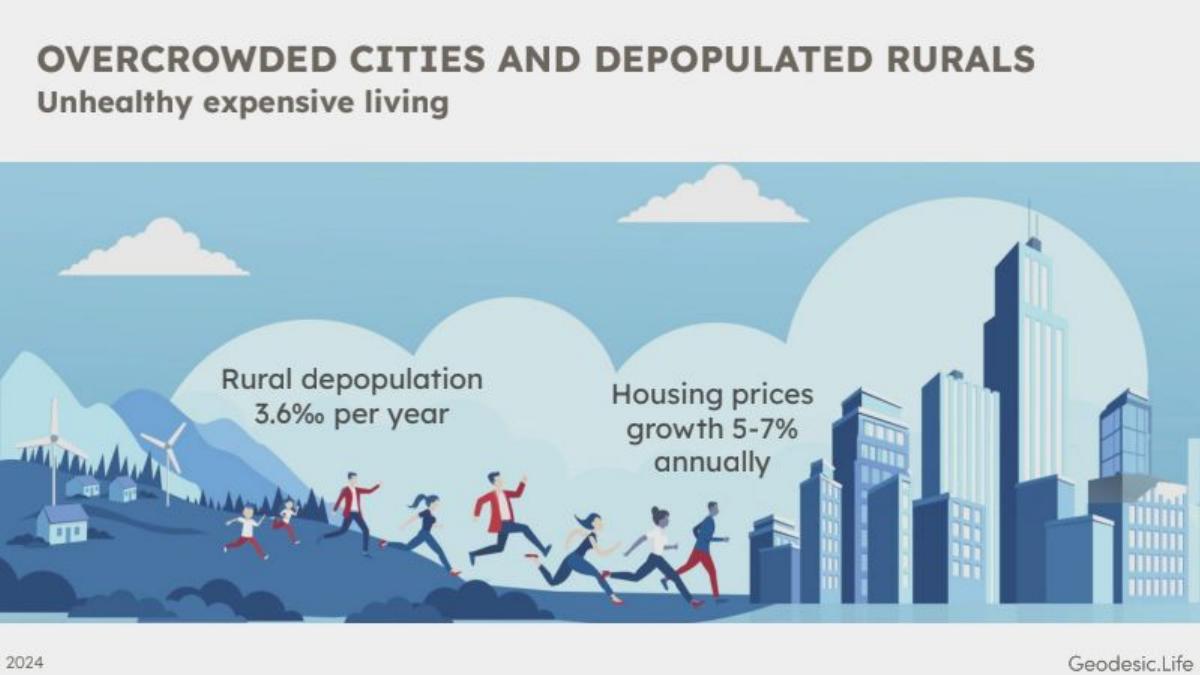
Moving beyond carbon, Slide 3 addresses the human element. It highlights "Overcrowded cities and depopulated rurals," describing this as "Unhealthy expensive living." The slide provides two key metrics: rural depopulation at 3.6% per year and housing price growth of 5-7% annually. The illustration shows people fleeing a dense city toward a wind-powered rural landscape, positioning the company's product as a solution to urban congestion and rural decline.
Slide 4: Product Reveal
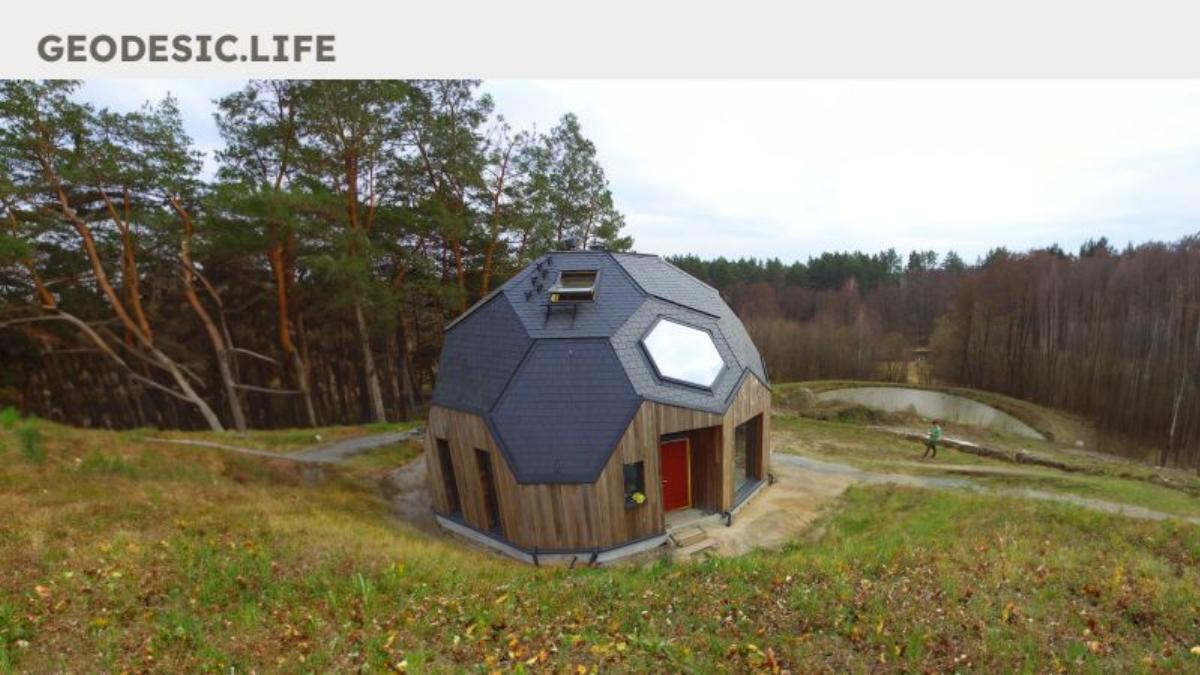
Slide 4 is a full-page high-resolution photograph of a completed dome house in a rural, wooded setting. The house features a dark shingled exterior, large hexagonal windows, and natural wood siding on the lower level. This slide serves as proof of concept, showing that the product is not just a render but a physical reality that integrates aesthetically into nature.
Slide 5: Development History and Traction
This slide is crucial for building founder credibility. It shows the evolution of the product through photos of "Gen.1" in 2019 and "Gen.2" in 2021. The images include interior shots of families living in the domes and construction photos showing a crane lifting a dome shell. By documenting a five-year history of development, the founders demonstrate that they have already navigated the initial technical hurdles of dome construction.
Slide 6: Technical Uniqueness
Slide 6 breaks down the "Gen.3 model 2024" into three unique selling points: Dome shape (33% less envelope area), Hempcrete insulation (95% recyclable), and Cross Laminated Timber (75% upcyclable). This slide bridges the gap between the "green" mission and the engineering required to achieve it. The 33% reduction in surface area is a powerful efficiency metric that appeals to both sustainability and cost-reduction interests.
Slide 7: Impact Metrics
Titled "Designed to Make an Impact," this slide quantifies the environmental benefits. It claims a -71% CO2 footprint and provides a pie chart of material composition: Limestone (33.9%), Wood (25.6%), Hemp (24.6%), Concrete (9.4%), Clay (5.9%), and trace amounts of Steel and Glass. A cutaway render of a two-story dome interior helps the viewer visualize the living space, showing a kitchen, living area, and upstairs bedroom.
Slide 8: The Business Model (The Deal)
Slide 8 uses a hexagonal flow chart to explain the ecosystem. Geodesic.Life provides the house design, prefab kit, and consultancy to Real Estate Partners . These partners, in turn, provide turn-key houses and services to Families . Rural Municipalities are included as stakeholders who benefit from new citizens and a "creative economy." The flow of currency is indicated by Euro symbols, showing a B2B2C revenue model where the startup sells to developers rather than individual homeowners directly.
Slide 9: Market Analysis
The deck identifies the "Stockholm area" in Sweden as the beachhead market. It uses a funnel graphic to break down the opportunity: Scandinavia (EUR 5.4 bln), Sweden (EUR 2.8 bln), Stockholm area (EUR 560 mln), and Turn-key prefab (EUR 390 mln). A separate bubble chart shows the global market at EUR 91.2 bln. The slide justifies the focus on Scandinavia by noting a 23% supply-demand gap and the region's high sustainability ranking.
Slide 10 & 11: Competitive Landscape
These two slides provide a detailed comparison table. Geodesic.Life is compared to Compass by VELUX, Geoship, EasyDomes, Domir, and SmartLog by KONTIO. The table compares structure, insulation, community solutions, company size, and market readiness. Geodesic.Life positions itself as a "Pilot" stage company (XS/S size) that is unique in its combination of CLT and Hempcrete, whereas most competitors use timber frames or bio-ceramics.
Slide 12: Vision for Scaling
Titled "New Age of Rurals," this slide shows an illustration of a community of domes, including larger structures for "schools & community hubs." This expands the company's scope from single-family homes to entire village developments, suggesting a much larger total addressable market through master-planned sustainable communities.
Slide 13: Team and Mentors
The team slide features two founders: Eugene Kuzmenko (Engineer) and Asya Syvolob (Marketer). They are supported by a BIM Architect and a Designer. Notably, the slide includes three mentors specializing in architecture, impact business, and finance. The bottom of the slide lists recognitions from the New European Bauhaus, PREFAB 2030, and EIT Manufacturing, which adds significant institutional weight to the startup.
Slide 14: Conclusion
The final slide is a standard closing slide with the company logo and website. It lacks a call to action or contact information for specific team members, which is a minor but common oversight in early-stage decks.
What Geodesic.Life Does Well
The deck excels at visual storytelling. By showing actual built prototypes from 2019 and 2021, the founders immediately differentiate themselves from the hundreds of "paper-only" sustainable housing startups. The technical breakdown of the materials (Hempcrete and CLT) is specific and provides a clear rationale for their sustainability claims. Furthermore, the choice of a specific beachhead market (Stockholm) shows a level of strategic focus that is often missing in pre-seed decks, which tend to target "the world" from day one.
What is Missing from the Deck
The most glaring omission is the Investment Ask . While the catalogue listing indicates a $500K raise, the deck itself does not mention how much capital is needed or what milestones that capital will achieve. There is also a complete lack of Financial Projections . Investors need to see the projected cost of goods sold (COGS) and the expected margins for the prefab kits. Finally, the Roadmap is vague; while we see the past (2019-2021), we don't see a clear 18-24 month plan for manufacturing scale-up or specific partner acquisitions.
Founder's Guide: What to Copy
The Material Breakdown: Slide 7's pie chart of materials is an excellent way to prove sustainability claims with data rather than just adjectives. · The Evolution Slide: Showing "Gen.1" and "Gen.2" (Slide 5) is the best way to demonstrate grit and technical progress. It shows the team has been working on this for years, not weeks. · The Beachhead Funnel: Slide 9's method of narrowing a massive global market down to a specific, serviceable area (Stockholm prefab) makes the business plan feel attainable. · Mentor Inclusion: For a young team, including mentors with specific titles (Financial Mentor, Impact Mentor) helps mitigate perceived gaps in experience.
Founder's Guide: What to Avoid
Omitting the Ask: Never send a deck to an investor without a slide stating how much you are raising and what you will do with the money. · Missing Unit Economics: In hardware and construction, the cost to produce is everything. The deck should have included a basic breakdown of the price point for a standard dome kit. · Vague Competitive Advantage: While the table in Slide 10 is good, it doesn't explicitly state why CLT and Hempcrete are better than the competitors' choices in a way that translates to a business advantage (e.g., faster assembly, lower cost, or higher durability).
Frequently asked questions
- What is the core problem Geodesic.Life is trying to solve?
- Geodesic.Life addresses two primary issues: the environmental impact of traditional construction and the housing crisis. Slide 2 notes that construction causes 37% of global CO2 emissions, while Slide 3 highlights rural depopulation (3.6% per year) and rising urban housing prices (5-7% annually). They aim to provide sustainable, affordable housing in rural areas to counteract these trends.
- How does the dome design contribute to sustainability?
- According to Slide 6, the dome shape results in 33% less envelope area compared to traditional rectangular buildings. This reduces the amount of material needed for the exterior shell and improves energy efficiency. Furthermore, Slide 7 shows that 73% of the materials used—including hemp, wood, and clay—are designed to be upcycled, leading to a total CO2 footprint reduction of 71%.
- What is the company's go-to-market strategy?
- The company is targeting Scandinavia as its beachhead, specifically the Stockholm area. Slide 9 justifies this choice by citing a 23% gap between housing demand and supply, a high preference for turn-key solutions, and the region's top ranking in global sustainability. They operate a B2B2C model, partnering with real estate developers and rural municipalities to deliver homes to families.
- Who are the main competitors identified in the deck?
- Slides 10 and 11 compare Geodesic.Life to several competitors, including Geoship (US), EasyDomes (Denmark), and Domir (Poland). The deck differentiates Geodesic.Life by its use of Cross Laminated Timber (CLT) and hempcrete insulation, whereas others use bio-ceramics, timber frames, or mineral wool. They also emphasize their 'community solution' capability for larger rural developments.
- What information is missing from the pitch deck?
- The deck is notably missing a 'The Ask' slide. While the catalogue listing mentions a $500K pre-seed round, the slides themselves do not state the amount being raised, the valuation, or how the funds will be allocated. Additionally, there are no financial projections, unit economics (cost to build vs. sale price), or a specific timeline for scaling from pilot to mass production.