GeoAccel is a real estate fintech concept designed to address the housing affordability crisis in Toronto, where 1.1M+ residents spend over half their income on rent. The company proposes a 'Georgist Acceleration' model that allows renters to build equity via Real Estate Investment Trusts (REITs) while continuing to rent. The business model relies on a 0.3% annual management fee and finder's fees on loans. While the deck provides a clear operational roadmap—including a 365 sq. ft. office in downtown Toronto—it lacks specific details on the underlying technology and the regulatory hurdles of m…
Key takeaways
- The problem focuses on 1.1M+ Torontonians spending more than 50% of their income on rent (Slide 2).
- The solution utilizes REITs to allow renters to build equity without the commitment of direct ownership (Slide 2).
- Revenue is generated through a 0.3% annual management fee and finder's fees on loans (Slide 3 and 4).
- The team slide features Cyril Joy Mangalan but uses generic stock photos and titles for the Financial Planner and Real Estate Sales Lead (Slide 6).
- Operations are localized to a 365 sq. ft. office in Downtown Toronto (Slide 7).
- The roadmap includes five milestones, moving from hiring to implementing growth strategies (Slide 8).
- Financial projections or historicals cite $1.7M in revenue against $248k in expenses (Slide 9).
- Funding sources listed include a $40k BDC loan, $20k Futurpreneur loan, $20k owner contribution, and $10k from angel investors (Slide 9).
Executive Summary: The Renter's Equity Gap
GeoAccel, presented by Cyril Joy Mangalan, addresses a specific pain point in the Canadian real estate market: the inability of renters to build wealth. The deck, created as part of a 'Business Plan Creation' project, outlines a fintech solution that leverages Real Estate Investment Trusts (REITs) to provide a middle ground between traditional renting and home ownership. The deck is structured as a 10-slide introductory presentation, focusing heavily on the Toronto market and a 'Georgist' economic philosophy.
Slide 1: Title and Context
The cover slide introduces GeoAccel and the presenter, Cyril Joy Mangalan. It includes a George Brown College email address and notes the presentation is for 'Business Plan Creation' under Peter Sirois. This suggests the deck may have originated as an academic or incubator project rather than a late-stage professional fundraising document. The branding uses a purple and lime green color palette with abstract organic shapes.
Slide 2: Problem and Solution
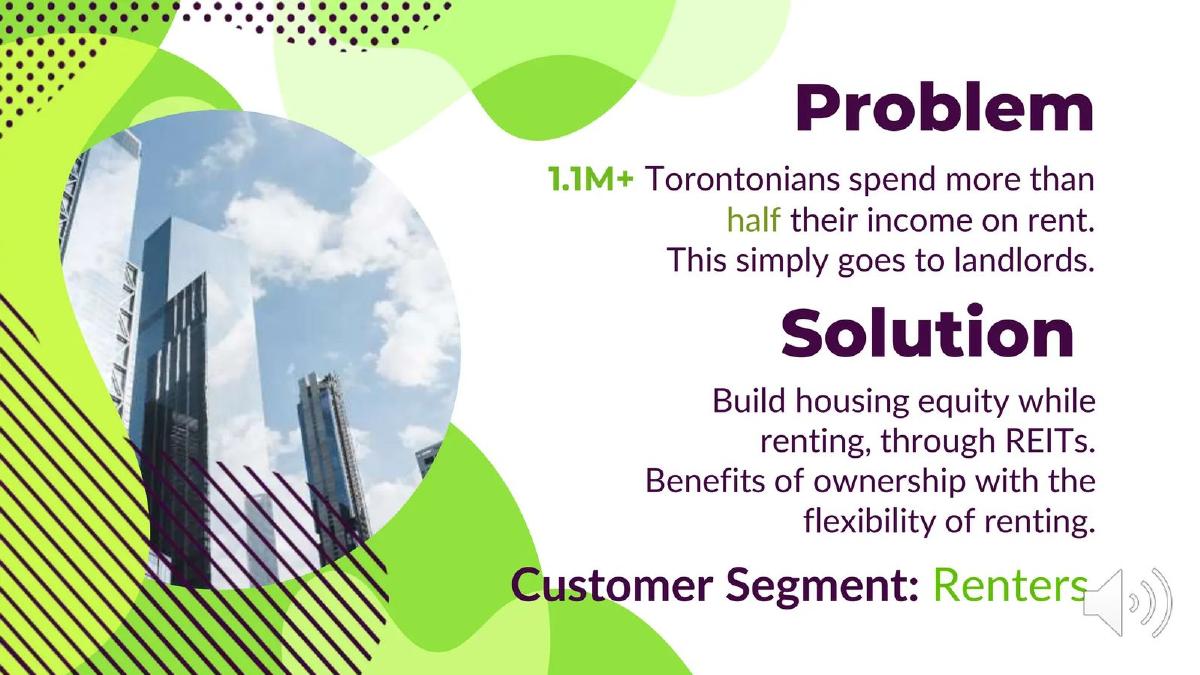
The problem is quantified specifically for the Toronto market. According to Slide 2, "1.1M+ Torontonians spend more than half their income on rent." The slide argues that this capital simply 'goes to landlords,' creating a wealth gap. The proposed solution is to "Build housing equity while renting, through REITs." This aims to provide the "Benefits of ownership with the flexibility of renting." The customer segment is explicitly defined as 'Renters.'
Slide 3: The Business Model Flowchart
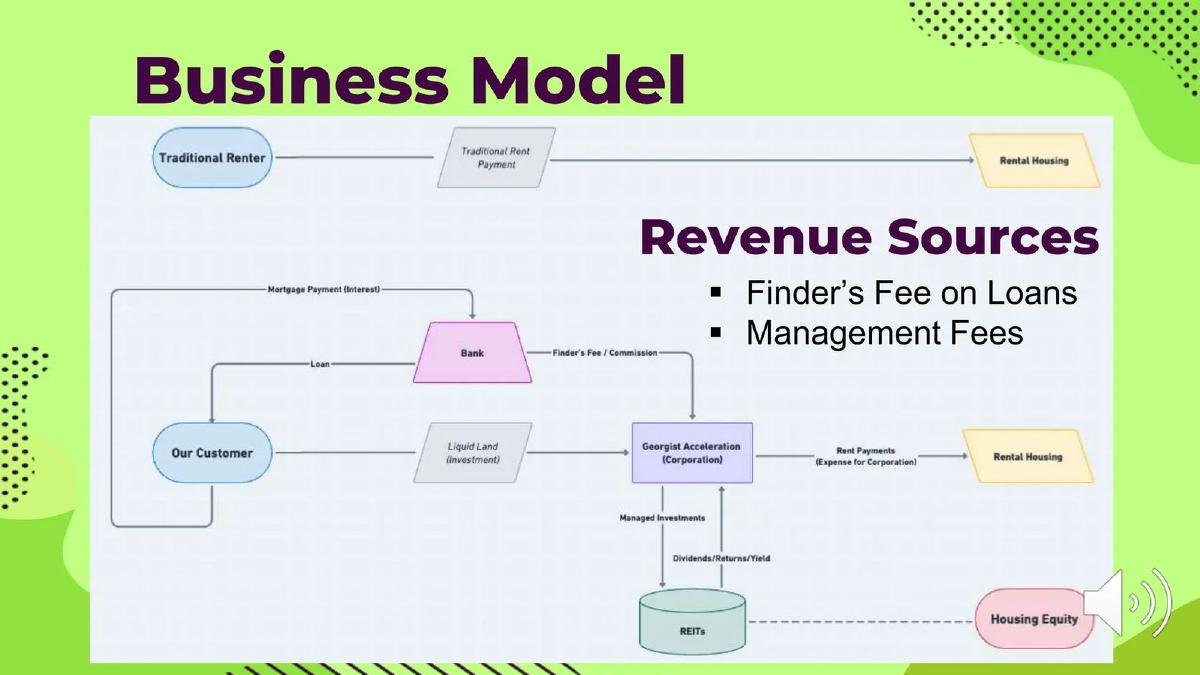
Slide 3 provides a complex diagram comparing a 'Traditional Renter' to a 'GeoAccel Customer.' In the GeoAccel model, the customer takes a loan from a bank, which is then invested into 'Liquid Land' (REITs) managed by the 'Georgist Acceleration' corporation. The corporation pays rent to the rental housing provider, while the customer receives dividends/returns/yield from the REITs to build 'Housing Equity.' The revenue sources for the company are listed as Finder's Fee on Loans and Management Fees .
Slide 4: Marketing and Sales Strategy
The marketing plan is divided into four stages of the customer relationship: Awareness (Social media), Acquisition (Seminars on Finance & Real Estate), Retention (Omnichannel Experience), and Loyalty (Mission-driven branding). The slide sets a clear pricing anchor: a Management Fee of 0.3% per annum . The stated objective is to 'Create Brand Awareness, Gain Leads, Close.'
Slide 5: Competition and SWOT Analysis
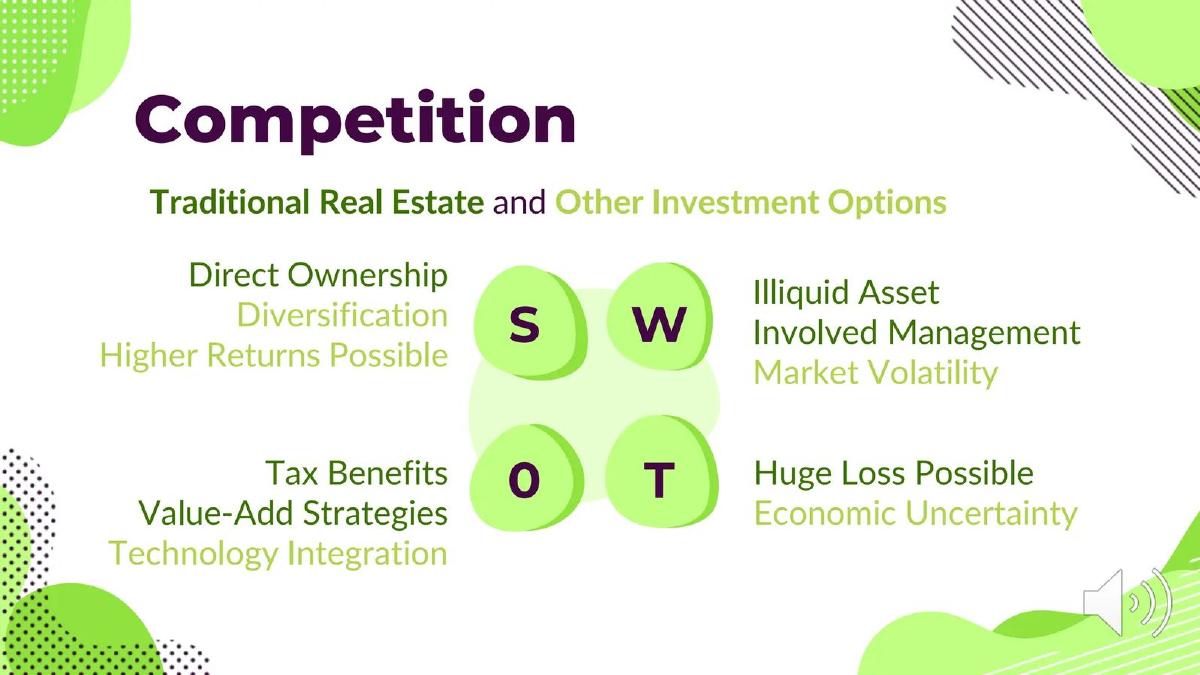
Instead of a traditional competitor matrix, Slide 5 uses a SWOT (Strengths, Weaknesses, Opportunities, Threats) analysis to compare GeoAccel against 'Traditional Real Estate and Other Investment Options.' Strengths include direct ownership and diversification. Weaknesses highlight illiquid assets and involved management . Threats are listed as "Huge Loss Possible" and "Economic Uncertainty." This slide is unusually candid about the risks involved in real estate investment.
Slide 6: The Team
The team slide features three roles. Cyril Joy Mangalan is credited with 'Technology & Business Expertise.' The other two positions, Financial Planner (CFP certification) and Real Estate Sales Lead , use generic titles and stock photos. This indicates that the company is likely in the pre-seed stage and looking to recruit these key functions or that these are placeholders for a theoretical business plan.
Slide 7: Operations
Slide 7 outlines the logistical footprint of the company. It specifies the legal entity as a Private Corporation and identifies a physical location: a 365 ft² Office in Downtown Toronto . The primary activity is REIT management. The scaling strategy involves moving toward an "Online Self-Service Platform," suggesting the initial phase may be more service-heavy and manual.
Slide 8: Milestones
The roadmap is presented as a five-step linear timeline: 1. Hire the Team, 2. Develop Prototype, 3. Launch / Market Validation, 4. Iterate to Product-Market Fit, and 5. Implement Growth Strategies. The timeline lacks specific dates or years, serving more as a sequence of events than a time-bound execution plan.
Slide 9: Finances
This slide presents a mix of projected outcomes and current funding. It lists $1.7M in Revenue against $248k in Expenses , resulting in a $1.1M Net Profit after tax . It also notes a Debt-to-Equity Ratio of 2 . Below these figures, it lists capital sources: $40k BDC Loan , $20k Futurpreneur Loan , $20k Owner's contribution , and $10k Angel Investors . It is unclear if these profit figures are year-one projections or long-term goals, as $1.7M in revenue on a 0.3% management fee would require roughly $566M in Assets Under Management (AUM).
Slide 10: Why Invest?
The final slide summarizes the pitch with three points: the product is innovative in a stagnant market, the business model is "Similar to SaaS," and the mission is to "Positively change renting for humanity." The slide features a background image of modern architecture but lacks a final call to action or contact information beyond what was on the title slide.
What GeoAccel Does Well
The deck excels at identifying a massive, localized problem. By focusing specifically on the 1.1 million renters in Toronto who are 'rent-burdened,' the founders create an immediate sense of market urgency. The use of a flowchart to explain the 'Georgist Acceleration' model is also helpful, as it visualizes how capital flows between the bank, the customer, the REIT, and the rental housing provider. This clarity is essential for a business model that deviates from traditional real estate transactions.
What is Missing from the Deck
The most significant omission is a clear Investment Ask . While Slide 9 lists existing loans and a small angel contribution, it does not state how much the company is currently raising or what that money will be used for. Furthermore, the Technology aspect is vague; for a company claiming a 'SaaS-like' model, there are no screenshots of the platform or details on how the 'Online Self-Service' portal functions. The Regulatory landscape is also ignored; managing REITs and providing financial advice in Canada requires significant licensing and compliance, which is not addressed in the operations or team slides.
Founder Takeaways: What to Copy
Specific Problem Quantifying: Use local data (like the 1.1M Torontonians figure on Slide 2) to make the problem feel tangible and solvable. · Visualizing Complex Flows: If your business model involves multiple stakeholders (banks, REITs, renters), a flowchart is superior to a wall of text. · Candid Risk Assessment: Including 'Huge Loss Possible' in a SWOT analysis shows a level of realism that can build trust with sophisticated investors, provided you have a plan to mitigate those risks. · Operational Specificity: Listing the exact size of the office (365 sq. ft.) and the specific loan types (BDC, Futurpreneur) adds a layer of grounded reality to the deck.
Frequently asked questions
- What is the core value proposition of GeoAccel?
- GeoAccel aims to bridge the gap between renting and owning. By allowing renters to invest in REITs through their platform, the company enables users to build housing equity while maintaining the flexibility of a rental lifestyle. This targets the 'rent trap' where income is lost to landlords without any long-term asset accumulation.
- How does GeoAccel plan to generate revenue?
- The company identifies two primary revenue streams. First, a 0.3% annual management fee charged to users for managing their REIT investments. Second, 'Finder’s Fees' or commissions earned from banks when customers take out loans to facilitate their investments within the GeoAccel ecosystem.
- What is the current status of the team?
- The deck lists Cyril Joy Mangalan as the lead for Technology and Business Expertise. However, the other two key roles—Financial Planner and Real Estate Sales Lead—are represented by generic descriptions and what appear to be stock photography, suggesting these roles may not yet be filled by specific individuals.
- What are the primary operational risks identified?
- In the SWOT analysis on Slide 5, the company acknowledges weaknesses such as illiquid assets, involved management requirements, and market volatility. Threats include the possibility of significant financial loss and broader economic uncertainty, which are inherent to the real estate and investment sectors.
- Is there a clear investment 'Ask' in the deck?
- No. While Slide 9 lists various funding sources like BDC and Futurpreneur loans, the deck does not explicitly state how much money the company is currently seeking from new investors, the valuation, or the specific use of proceeds for the next round of funding.