Gensyn’s 2022 Seed deck is a masterclass in identifying a massive macroeconomic tailwind—the exponential growth of AI compute demand—and positioning a highly technical, decentralized solution as the only viable path forward. By highlighting that AI computational complexity doubles every three months (Slide 2) while hardware supply lags, Gensyn creates an urgent problem-solution narrative. The deck leans heavily on technical differentiation, specifically their 'trustless' verification mechanism which they claim is 1,350% faster than existing competition (Slide 6). While the deck is light on tr…
Key takeaways
- The deck identifies a $181bn market opportunity by 2031 driven by AI compute demand (Slide 2).
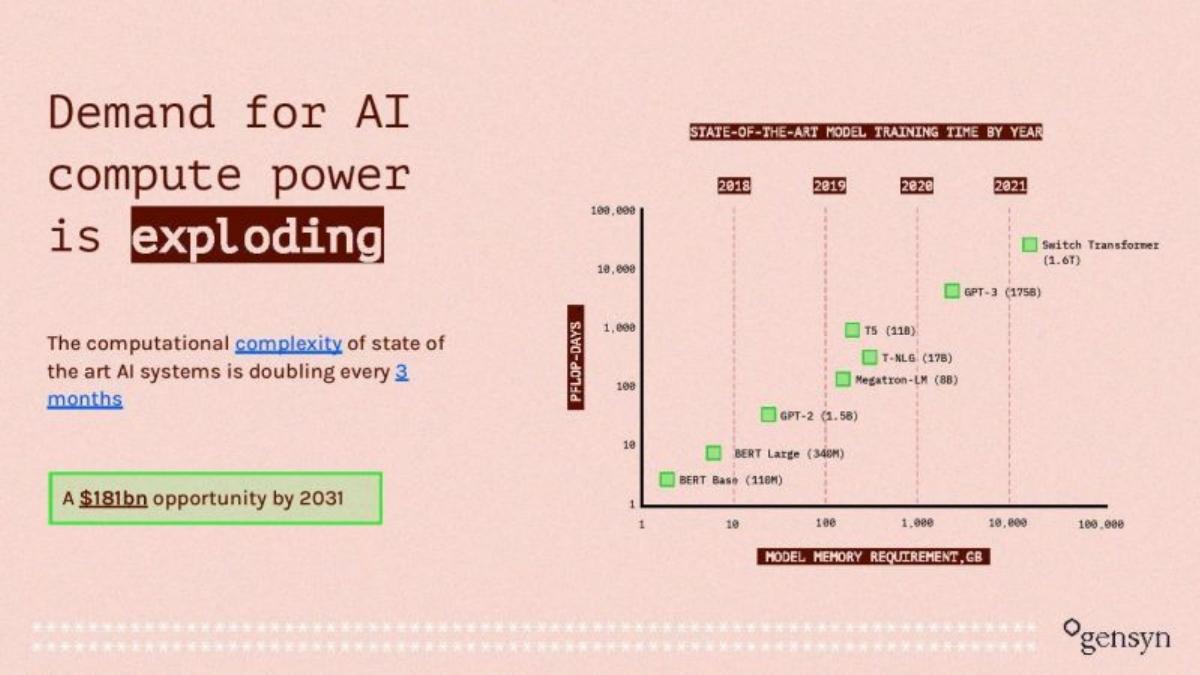
- Computational complexity for state-of-the-art AI systems is stated to be doubling every three months (Slide 2).
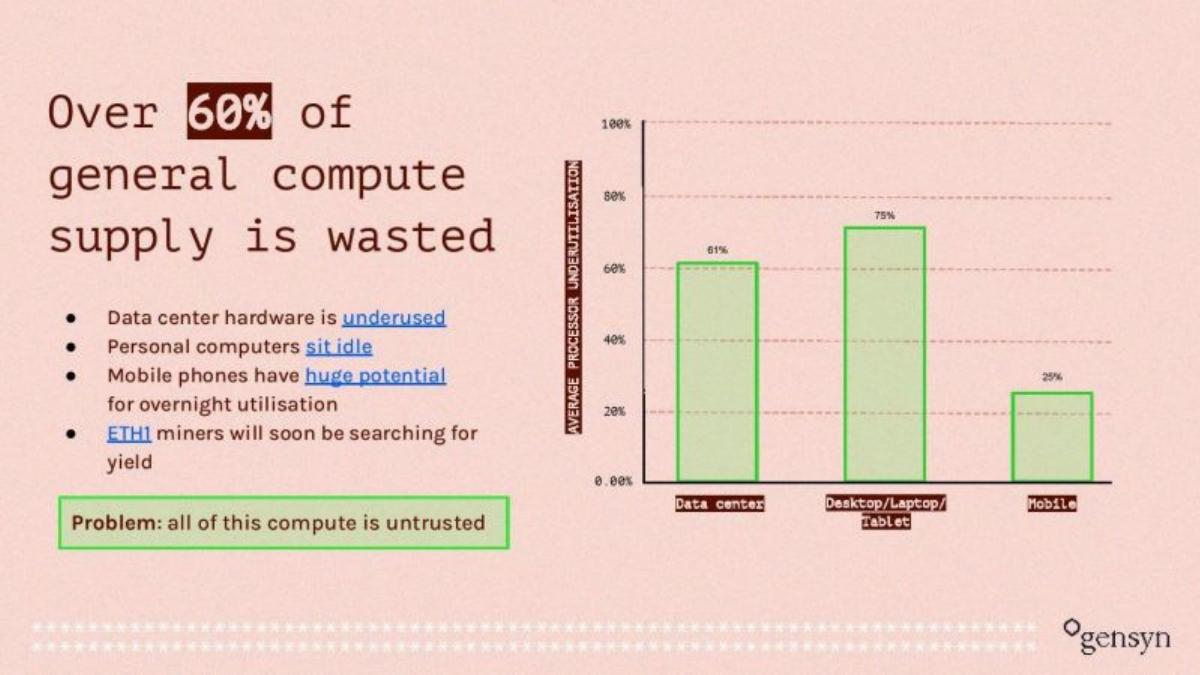
- Gensyn claims that over 60% of general compute supply is currently wasted across data centers, PCs, and mobile devices (Slide 4).
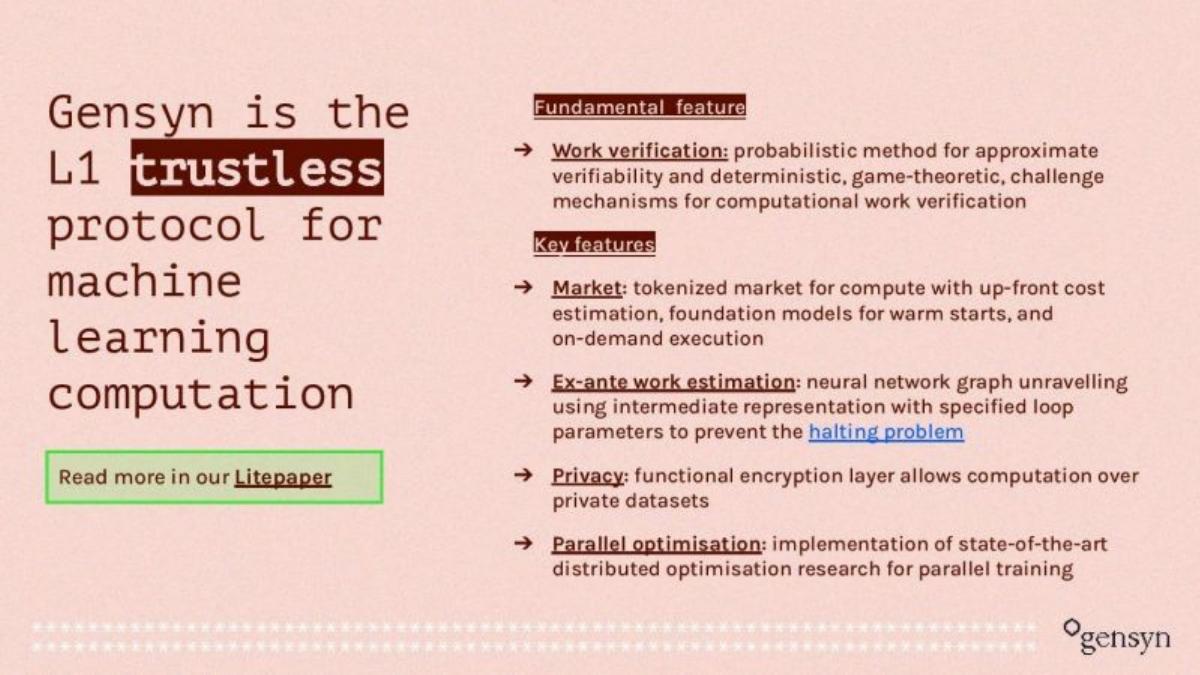
- The core product is defined as a 'Layer 1 trustless protocol' for machine learning computation (Slide 5).
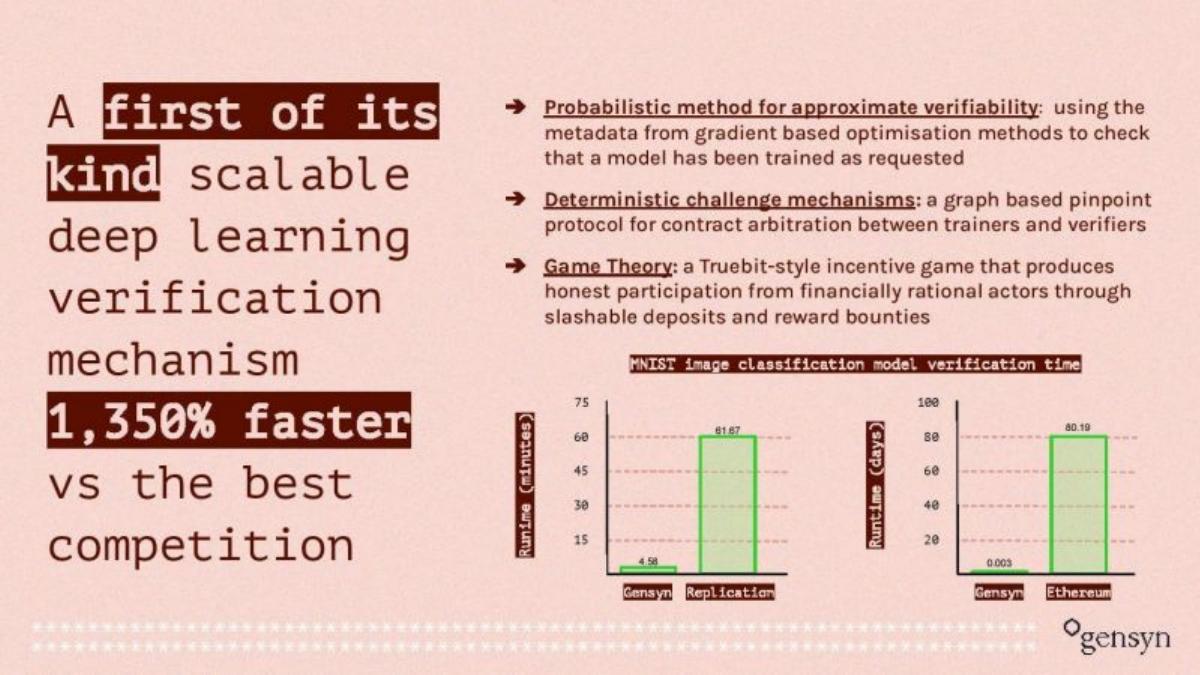
- Technical superiority is highlighted by a verification mechanism that is 1,350% faster than the 'best competition' (Slide 6).
- The go-to-market strategy is split into three phases: Early Adopters, Foundation Models, and Ecosystem (Slide 8).
- The team includes a PhD in ML optimization and a former Head of Data Research at an ML startup (Slide 10).
- Pre-seed investors include 7percent Ventures, Counterview Capital, and id4 ventures (Slide 10).
The Macro Thesis: AI Demand vs. Hardware Supply
Slides 1-2: The Hook and the Market Opportunity
Gensyn opens with a minimalist cover slide (Slide 1) featuring the tagline: "Compute for the frontiers of artificial intelligence." This immediately positions the company as an infrastructure play for the most advanced segment of the tech industry. Slide 2 establishes the 'Why Now' by showing a logarithmic chart of state-of-the-art model training time by year. It notes that computational complexity is "doubling every 3 months," citing models like GPT-3 (175B parameters) and Switch Transformer (1.6T parameters). The slide concludes with a massive market claim: "A $181bn opportunity by 2031."
Slides 3-4: The Supply Gap and Wasted Resources
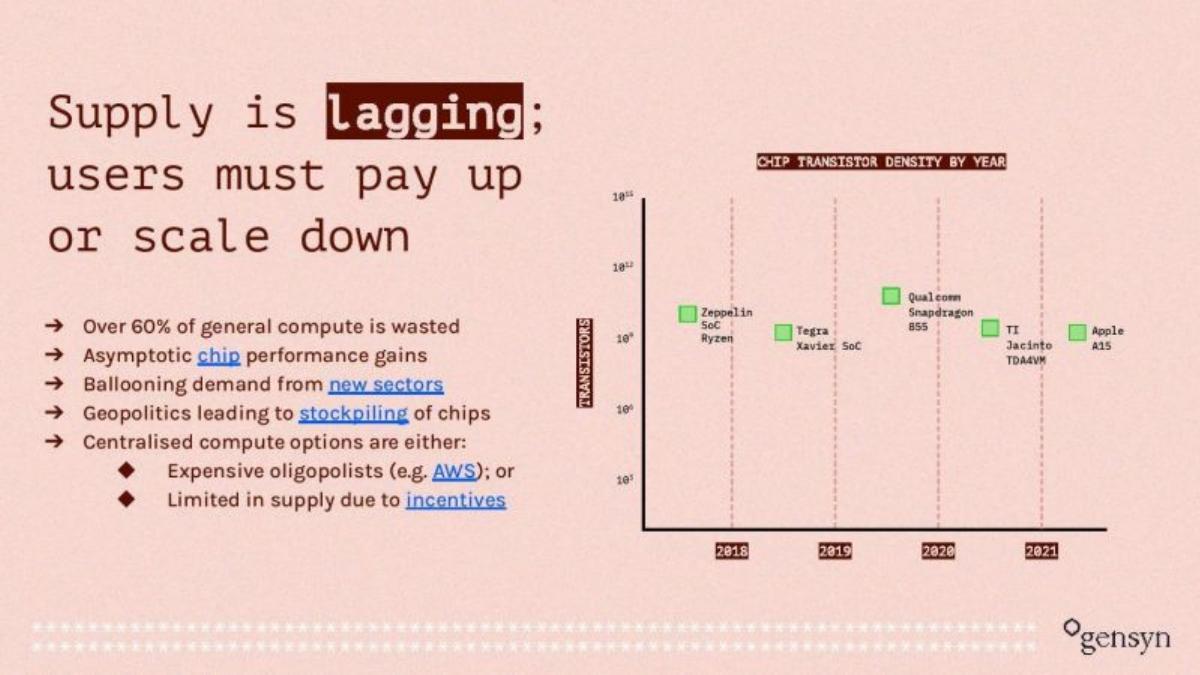
Slide 3 shifts to the supply side, stating that "Supply is lagging; users must pay up or scale down." It highlights that chip performance gains are becoming asymptotic and that geopolitics are leading to the stockpiling of chips. Crucially, it labels centralized providers like AWS as "Expensive oligopolists." Slide 4 quantifies the inefficiency in the current system, claiming "Over 60% of general compute supply is wasted." A bar chart shows underutilization rates: 61% for Data centers, 75% for Desktop/Laptop/Tablet, and 25% for Mobile. The core problem identified is that "all of this compute is untrusted," which prevents it from being used for machine learning.
The Technical Solution: A Trustless Protocol
Slide 5: Defining the Gensyn Protocol
Slide 5 introduces the solution: "Gensyn is the L1 trustless protocol for machine learning computation." The slide breaks down the product into a 'Fundamental feature' (Work verification) and several 'Key features.' These include a "tokenized market for compute," "Ex-ante work estimation" to prevent the halting problem, and a "functional encryption layer" for privacy over private datasets. This slide is dense and clearly intended for technical investors who understand the limitations of current distributed computing.
Slide 6: The Performance Moat
Slide 6 provides the 'killer metric.' It claims their deep learning verification mechanism is "1,350% faster vs the best competition." Two bar charts compare 'Gensyn' against 'Replication' and 'Ethereum' for MNIST image classification verification time. Gensyn is shown at 4.58 minutes compared to 61.67 minutes for replication, and 0.003 days compared to 80.19 days for Ethereum. This slide uses "Game Theory" and "slashable deposits" as the explanation for how they ensure honest participation from rational actors.
Slide 7: The Competitive Landscape (Redacted)
Slide 7 is a standard 2x2 matrix with axes for "AI Compute Scale" and "Cost Efficiency." However, the central content of the slide is "REDACTED." In a public teardown, this usually indicates sensitive competitive positioning or proprietary benchmarking that the founders chose not to share outside of private meetings. Even with the redaction, the axes tell us that Gensyn views its primary value proposition as the intersection of massive scale and low cost.
Go-To-Market and Vision
Slide 8: The Three-Phase Roadmap
Slide 8 outlines the execution plan. Phase 1 (Early Adopters) involves user research with ">150 ML researchers" and a Discord community of "50 early adopters." Phase 2 (Foundation Models) targets researchers fine-tuning models like BERT and DALL-E. Phase 3 (Ecosystem) envisions software engineers using "AutoML Dapps" on the network. This shows a logical progression from high-touch research use cases to a broad, developer-friendly ecosystem.
Slide 9: The AGI Vision
Slide 9 returns to the $181bn market cap figure but ties it to the advancement of "Artificial General Intelligence (AGI)." It lists five benefits of the protocol: AGI advancement, cost-effectiveness, environmental sustainability (moving away from Proof of Work), dApp enablement, and censorship resistance. The slide includes a call to action to "Read more in our Token Valuation Model," signaling that the company's economics are tied to a crypto-economic framework.
The Team and The Absence of an Ask
Slide 10: Founder Credibility
The team slide (Slide 10) focuses heavily on academic and industry pedigree. Founder Ben is described as having a "PhD in ML optimisation" and being an "ex founder of anonymous digital identity startup." Founder Harry is an "ex Head of Data Research at ML risk-pricing startup." The slide also lists pre-seed investors like 7percent Ventures and Counterview Capital , and angels from DeepMind and Draper Esprit . This level of backing from DeepMind insiders is a significant signal for an AI infrastructure company.
Slides 11-12: The Conclusion
Slide 11 is a simple contact slide with an email address: founders@gensyn.ai . Notably, there is no 'Ask' slide in this deck. There is no mention of the $6.5M raise mentioned in the catalogue facts, nor is there a breakdown of how the team plans to hire or what technical milestones the next round of funding will support. Slide 12 is a promotional slide for the hosting platform and not part of the Gensyn deck itself.
What Gensyn Does Well
1. Macro-Trend Alignment: The deck does an excellent job of riding the AI wave. By showing that compute demand is growing exponentially faster than hardware supply, they make a decentralized solution feel like an inevitability rather than a luxury. 2. Technical Authority: The founders don't shy away from complex terms like "probabilistic method for approximate verifiability" or "functional encryption layer." For a Seed round in deep tech, this builds confidence that the team can actually build the protocol they are describing. 3. Clear Benchmarking: The 1,350% speed improvement claim on Slide 6 is a powerful anchor. Even if an investor doesn't understand the underlying math, the magnitude of the improvement over 'Replication' and 'Ethereum' is easy to grasp.
What is Missing from the Deck
1. The Financial Ask: As noted, the deck lacks a slide detailing how much money they are looking for and what they will do with it. This is a common omission in decks that are used as 'teasers' or for companies that are already in the middle of a hot, oversubscribed round. 2. Competitive Names: While they compare themselves to 'Ethereum,' they don't name other decentralized compute projects (like Akash or Render) that were active in 2022. This might be a strategic choice to avoid being lumped in with 'crypto' projects rather than 'AI' projects. 3. Unit Economics: There is no mention of how the tokenized market actually functions for a buyer. How much cheaper is a unit of compute on Gensyn versus AWS? While Slide 9 mentions 'cost-effective,' it doesn't provide a specific price-per-flop comparison.
Founder Takeaways
Lead with the 'Why Now': If your industry is undergoing a massive shift (like the AI compute explosion), make that the first thing the investor sees. Use logarithmic scales to show the true speed of change. · Quantify the Waste: If your solution relies on utilizing idle resources, you must prove those resources exist. Gensyn's use of the "60% wasted compute" stat (Slide 4) provides the 'fuel' for their decentralized engine. · Pedigree Matters in Deep Tech: If you are building a new Layer 1 protocol, your academic background is a feature, not a footnote. Highlighting a PhD in the specific field of 'ML optimization' (Slide 10) is a massive trust signal. · Phased GTM: Don't try to boil the ocean. Gensyn's three-phase roadmap (Slide 8) shows they understand that they need to win over researchers before they can build a mass-market ecosystem.
Frequently asked questions
- What is the primary problem Gensyn is solving?
- Gensyn addresses the 'compute crisis' in artificial intelligence. According to Slide 2, demand for AI compute is exploding, with model complexity doubling every three months, while hardware supply (transistor density) is lagging. They also point out that centralized options like AWS are expensive oligopolies and that 60% of global compute power is currently wasted because it is 'untrusted' for sensitive ML tasks.
- How does Gensyn's technology work?
- Gensyn is a Layer 1 protocol that enables decentralized machine learning. Its 'fundamental feature' is work verification—a probabilistic method for checking that a model was trained correctly without needing to re-run the entire computation. Slide 5 details key features including a tokenized market for compute, functional encryption for privacy, and parallel optimization for distributed training.
- What is the market size for decentralized AI compute?
- The deck cites a $181 billion market opportunity by 2031 (Slide 2 and Slide 9). They argue that decentralizing the market not only makes compute more cost-effective by moving prices closer to the cost of processor operations but also accelerates the path to Artificial General Intelligence (AGI) by enabling collaborative foundation models.
- Who is the target user for the Gensyn protocol?
- The go-to-market strategy (Slide 8) targets three distinct groups over time. Phase 1 focuses on ML researchers and engineers in academia and startups (Series B or earlier). Phase 2 targets users fine-tuning large foundation models like GPT-3 or DALL-E. Phase 3 aims for a broader ecosystem where software engineers use 'AutoML Dapps' built on top of the protocol.
- What is missing from the Gensyn pitch deck?
- The deck is notably missing a specific 'Ask' slide. While the catalogue facts state they raised $6.5M, the slides do not mention a target amount or a breakdown of how funds will be spent. Additionally, there are no financial projections, unit economics, or detailed competitor names (competitors are referred to generally as 'Replication' or 'Ethereum' on Slide 6).