Not Boring Capital’s Fund II pitch is a masterclass in 'Media-as-a-Service' venture capital. Eschewing traditional slides for a 15-page long-form memo, founder Packy McCormick argues that his 90,000-subscriber newsletter (at the time of writing) provides an unfair advantage in deal discovery and allocation. The fund targets a $25 million raise to invest across stages, with a heavy emphasis on web3 and fintech. The memo is exceptionally transparent, listing every Fund I investment, check size, and valuation range. It positions the solo GP model not as a limitation, but as a collaborative asset…
Key takeaways
- The fund targets a $25 million raise for Fund II, as stated on slide 14.
- The newsletter serves as the primary 'unfair advantage,' boasting 90,000 subscribers on slide 1 and growing to 98,000 by slide 3.
- Fund I deployed $9.9 million in just over six months, significantly faster than the original 12-month projection (slide 1).
- The investment strategy follows a 'barbell' approach: 1/3 in Pre-Seed/Seed, 1/3 in Series A, and 1/3 in Series B+ (slide 3).
- Web3 is a major focus, with the fund planning to exceed Fund I's 11% allocation in the sector (slide 3).
- The fund operates as a solo GP model that does not lead deals or take board seats, positioning itself as a 'friend to all' other VCs (slide 6).
- Transparency is high, with slides 9 and 10 providing a line-by-line spreadsheet of 79 portfolio companies including exact investment dates and sizes.
- The memo cites a 13.9x return on Braintrust within months as a key early proof of the web3 thesis (slide 11).
The Memo Format: A Departure from the Pitch Deck
Not Boring Capital’s Fund II pitch is not a deck in the traditional sense. It is a 15-page investment memo. This format choice is intentional; it mirrors the product the founder, Packy McCormick, is known for: the Not Boring newsletter. By using a text-heavy, narrative-driven document, McCormick demonstrates his core competency—storytelling—while providing the level of detail typically reserved for institutional LP due diligence. The document is structured to address the 'why' before the 'what,' leaning heavily on the personal brand and distribution power of the author.
Slide 1: The Hook and the Fund I Retrospective
The memo opens with a direct address: 'Hi friends.' It immediately establishes the founder's credentials, citing a newsletter with 90,000 subscribers. The primary 'ask' is stated clearly: $30 million for Not Boring Capital Fund II (though later slides and catalogue facts suggest the final target or raise was $25 million). McCormick is candid about Fund I, noting he raised $9.9 million—nearly double his $5-7 million target—and deployed it in six months rather than the projected twelve. This slide sets the tone of 'learning in public,' a hallmark of the Not Boring brand. He identifies three pillars for success: Picking, Allocation, and Helping.
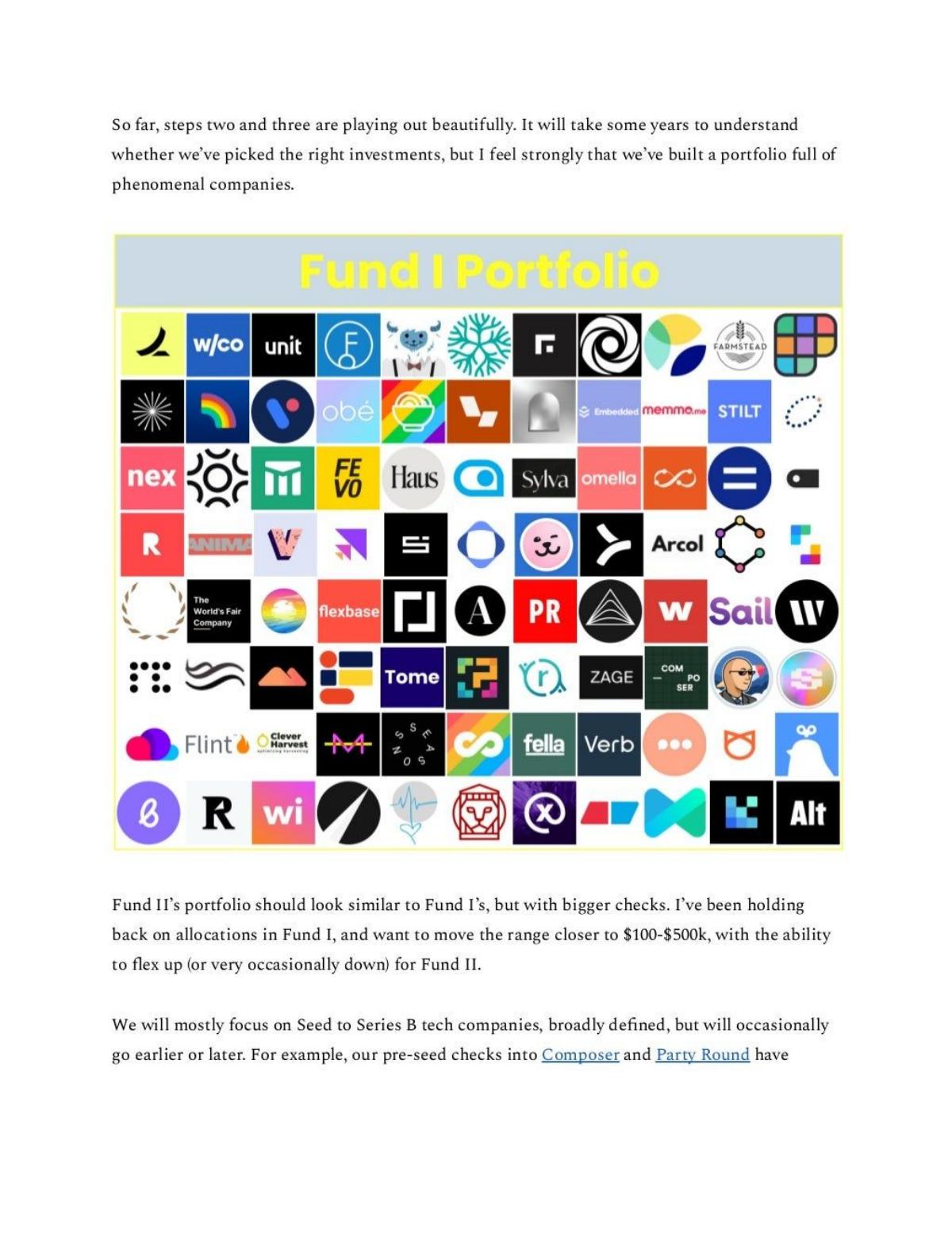
Slide 2: The Fund I Portfolio Visualized
Slide 2 provides a visual 'logo wall' of the Fund I portfolio. It is a dense grid of over 60 logos, including recognizable names like Unit, Farmstead, and Stilt. The text below the graphic clarifies the strategy for Fund II: bigger checks ($100k-$500k) and a focus on Seed to Series B, while maintaining the flexibility to go earlier (Composer, Party Round) or later (Ramp, Scale). This slide serves as proof of 'Allocation'—the ability of a solo GP to get into rounds alongside major firms.
Slide 3: Web3 and the Barbell Strategy
McCormick outlines a stage-agnostic 'barbell' approach: 1/3 in Pre-Seed/Seed, 1/3 in Series A, and 1/3 in Series B+. He introduces a significant shift for Fund II: a deeper dive into web3 projects and protocols . He notes that Fund I was 11% web3 and expects Fund II to be higher. This slide also introduces the '20% non-qualifying investment cap' for token deals, explaining how he will use SPVs via AngelList or Syndicate to bypass these limits if necessary. This shows a sophisticated understanding of fund structure and regulatory constraints.
Slide 4: The Distribution Engine
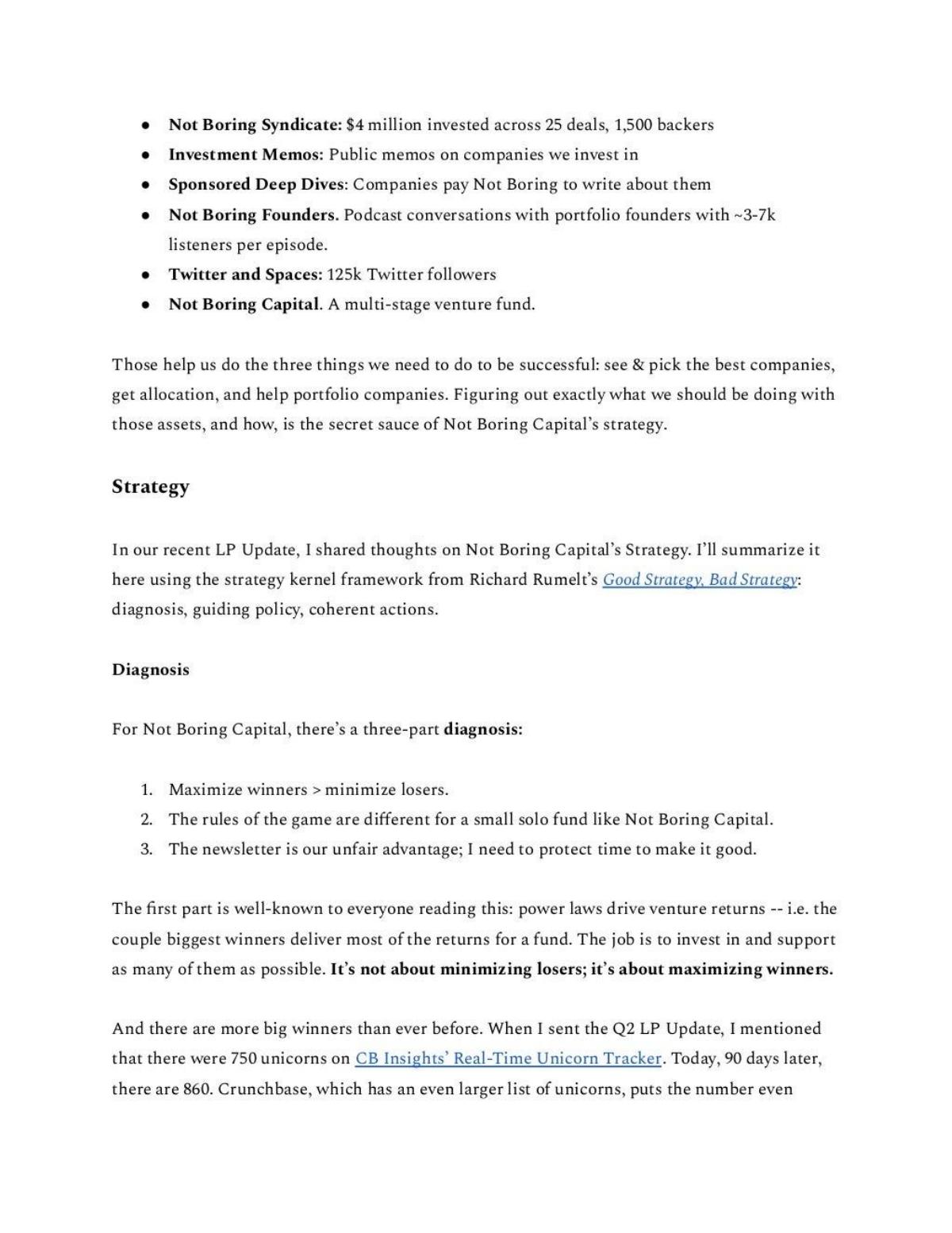
This slide lists the 'assets' of Not Boring Capital. It’s a list of media properties: a twice-weekly newsletter (now 98k subscribers), a syndicate with $4 million invested, public investment memos, sponsored deep dives, a podcast with 3-7k listeners per episode, and 125k Twitter followers. The argument is that these assets solve the three problems of venture: seeing deals, winning allocations, and helping founders. He uses the 'Strategy Kernel' framework from Richard Rumelt’s Good Strategy, Bad Strategy to frame his approach.
Slide 5 & 6: Market Diagnosis and the 'Unfair Advantage'
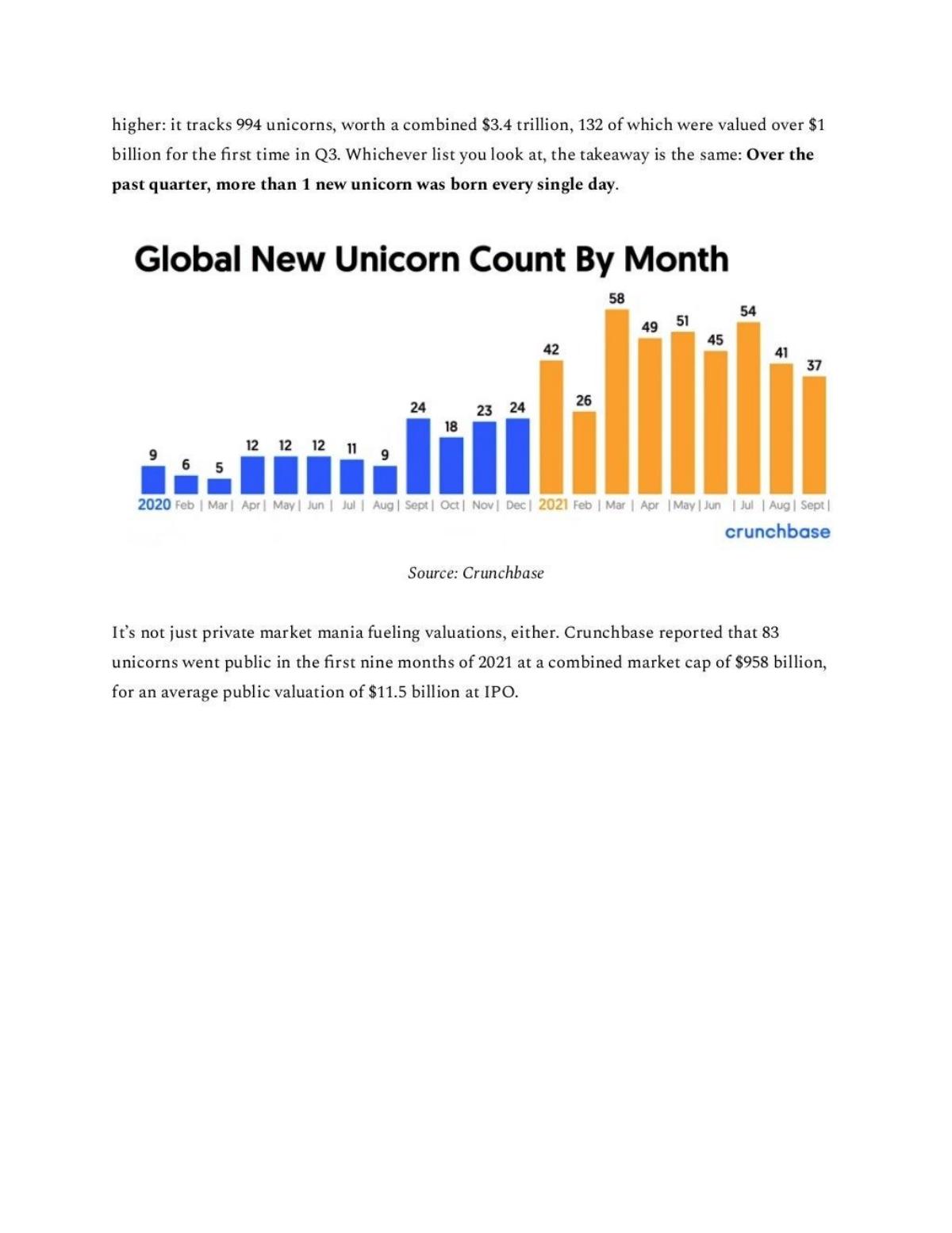
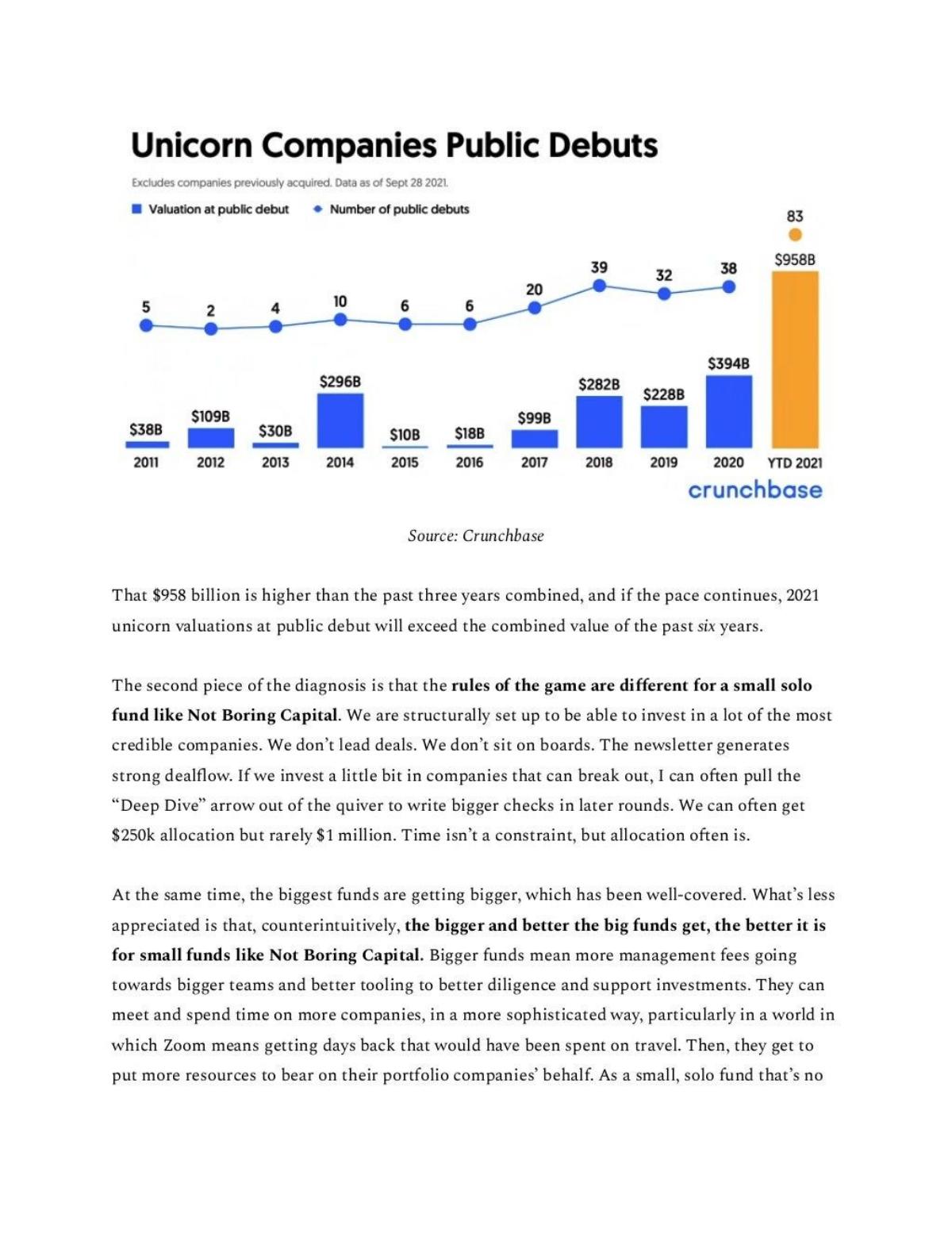
McCormick diagnoses the current market (2021-2022) using Crunchbase data, showing a chart of Global New Unicorn Count By Month , peaking at 58 in March 2021. He argues that in a world where a new unicorn is born every day, the 'power law' is more relevant than ever. On Slide 6, he makes a counterintuitive claim: the bigger and better large funds get, the better it is for a solo fund like Not Boring. He positions himself as a 'friend to all' who doesn't compete for lead spots or board seats, allowing him to 'piggyback' on the diligence of giants like Sequoia or a16z.
Slide 7 & 8: Guiding Policy and Coherent Actions
Continuing the Rumelt framework, McCormick defines his guiding policy: maximize dealflow while protecting time to write. On Slide 8, he lists 'Coherent Actions,' which are the tactical rules he follows. These include: writing about spaces to send a 'bat signal,' sharing deals with other solo GPs, and not worrying about ownership percentage (stating he'd rather own 0.25% of a 1000x company than 0%). He also lists risks, such as 'investing in a lot of companies and still missing the winners' or the 'inability to raise future funds.'
Slide 9 & 10: Extreme Transparency - The Portfolio Spreadsheet
These slides are perhaps the most valuable for a potential LP. They contain a line-by-line export of the Fund I portfolio. It includes the company name, round, investment date, investment size , and a brief description. We see checks ranging from $20,000 (Syndicate Protocol) to $250,000 (SecurityPal, WithCo). This level of transparency is rare in pitch decks and serves to build trust by showing exactly how the GP behaves when he has capital in hand.
Slide 11: Early Wins and the Braintrust Case Study
McCormick highlights early signs of progress, specifically the Braintrust (BTRST) token launch . He includes a screenshot of the BTRST price at $9.20, claiming a 13.9x return in a couple of months and a $2.3 billion valuation. He acknowledges the volatility of the crypto market but uses this as a 'proof of concept' for his web3 thesis and his ability to identify projects that can successfully launch tokens.
Slide 12 & 13: Stage and Vertical Mix
Slide 12 breaks down the $7.8 million invested in Fund I by stage. The largest buckets are Seed (31.8%) and Series A (20.3%). Slide 13 provides a vertical breakdown, showing Fintech as the leader ($1.36M across 13 deals) followed by Web3 ($1.01M across 12 deals). Other categories include SaaS, Health & Fitness, and AI/ML. This data-heavy section proves that while the fund is 'generalist,' it has clear clusters of expertise and interest.
Slide 14 & 15: Fund Terms and the Syndicate
The memo concludes with the 'Summary of Terms.' The fund size is listed as $25 million . Key terms include: 10% reserves, 2% management fee for four years (then 0%), 20% carry, and a $500,000 GP commitment. Slide 15 explains the relationship between the Fund and the Syndicate, noting that the Syndicate will be used for 'Bigger Allocations' (over $250k) and 'Special Situations.' It ends with a call to action to 'submit your interest here.'
What Not Boring Capital Does Well
The 'Media-as-a-Service' model is perfectly articulated. Most VCs claim to add value; McCormick proves it by showing the platform he has built and how it integrates into the investment lifecycle. The transparency regarding Fund I's performance and specific check sizes is a significant trust-builder. By using a memo format, he also filters for LPs who are willing to read and engage with his thought process, which is exactly what he wants from his investors.
What is Missing
The memo lacks a traditional 'Team' slide. While Not Boring Capital is a solo GP fund, there is no mention of back-office support, venture partners, or advisors who might assist with the legal and operational complexities of managing 79+ investments. Additionally, while early markups like Braintrust are mentioned, there is no formal 'Net IRR' or 'TVPI' calculation for Fund I, likely because the fund was less than a year old at the time of the memo.
What Founders and GPs Should Copy
The 'Strategy Kernel': Using a recognized framework (Diagnosis, Guiding Policy, Coherent Actions) makes a complex strategy feel logical and inevitable. · Extreme Transparency: Listing every deal and check size from a previous fund eliminates the 'cherry-picking' suspicion that LPs often have. · The 'Friend to All' Positioning: For solo GPs or small funds, positioning yourself as a non-threatening, value-add partner to lead VCs is a winning strategy for getting into competitive rounds. · Narrative Over Bullets: If your strength is writing, write. Don't force a narrative into a 10-word-per-slide PowerPoint if a memo better conveys your edge.
Frequently asked questions
- What is the primary investment thesis of Not Boring Capital?
- The thesis is built on 'Media-as-a-Service.' As a solo GP, Packy McCormick uses his newsletter and social reach to help companies tell their stories. This visibility helps him 'Pick the Right Investments,' 'Get Allocations' in competitive rounds where founders want his audience, and 'Help Portfolio Companies Succeed' through public deep dives and amplification.
- How does the fund handle follow-on investments?
- According to the memo, the fund maintains a 10% reserve for follow-ons. However, larger follow-on opportunities or allocations exceeding $250,000 are typically handled through Special Purpose Vehicles (SPVs) via AngelList or Syndicate, giving Fund LPs direct co-investment opportunities.
- What is the stage and sector focus for Fund II?
- It is a generalist, multi-stage fund. While it targets a 1/3 split between early, mid, and late stages, Fund I data shows a lean toward early stage, with 84% of dollars in Pre-Seed through Series A. Top sectors include Fintech ($1.36M invested) and Web3 ($1.01M invested).
- How does Not Boring Capital differentiate itself from larger VC firms?
- The memo argues that the larger and more sophisticated big funds get, the better it is for Not Boring. Because McCormick doesn't lead deals, sit on boards, or require high ownership percentages, he can 'piggyback' on the diligence and resources of lead investors while providing unique marketing value.
- What are the specific terms of the $25 million fund?
- The fund carries a 2% management fee for four years, 20% carried interest, and a $500,000 GP commitment. The minimum investment for LPs is $25,000, and the fund administration is handled by AngelList. Capital calls are split 50% upfront and 50% when called.