Nourish Ingredients raised $28.6M in 2022 for its biotech approach to alternative proteins. The deck centers on a single thesis: plant-based meat fails because it lacks the specific fat molecules found in animals. By using precision fermentation to 'brew' these molecules, Nourish claims to unlock a $36.8B market that currently struggles with repeat purchases from carnivores. The deck is visually driven, relying on high-quality photography and minimalist diagrams to explain complex synthetic biology. While it successfully establishes the 'why' and the 'how' of their technology, the provided sl…
Key takeaways
- The company identifies a $36.8B alternative protein market that is currently failing to entice carnivores due to poor taste and sustainability issues (Slide 12).
- Nourish positions itself as a leader in SynBio and precision fermentation with an Australia-based team of over 40 people (Slide 6).
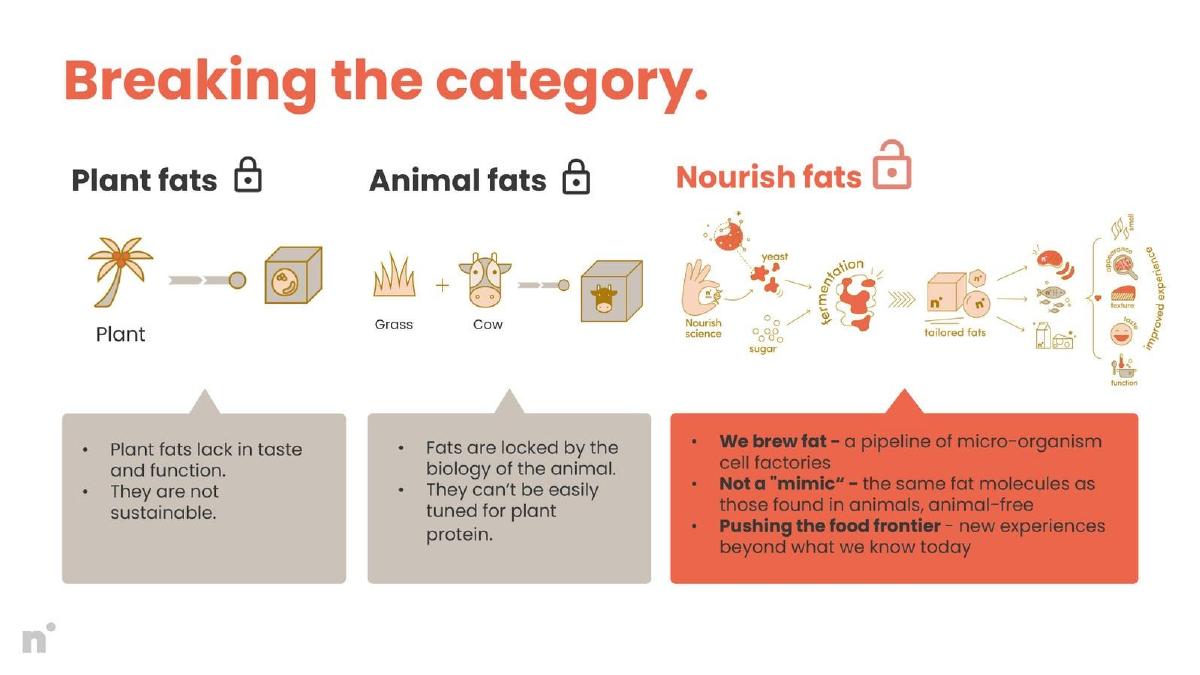
- The core technical differentiator is that they do not 'mimic' fats but produce the exact same fat molecules found in animals using yeast (Slide 8).
- The deck highlights 'scaling and deregulation' as the primary current focus for the Series A stage (Slide 6).
- Visual evidence of the product's efficacy is presented through a side-by-side comparison of raw and cooked meat, labeled simply as 'Solved' (Slide 7).
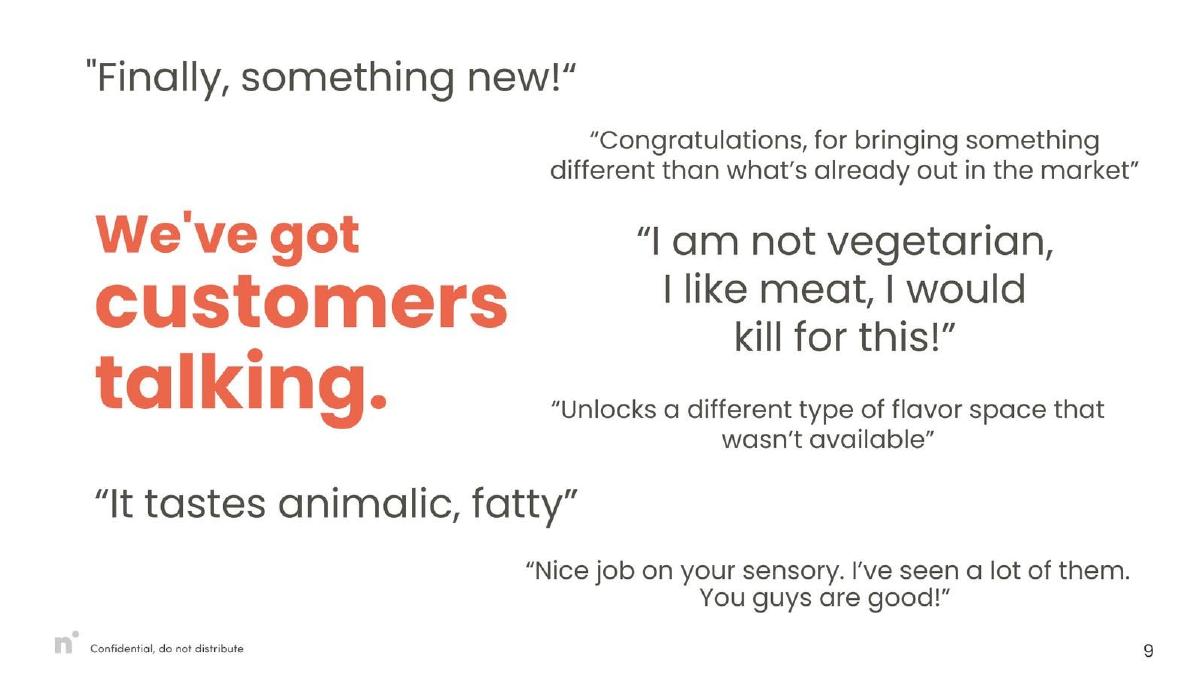
- Customer validation is presented via qualitative sensory feedback, with quotes emphasizing that the product tastes 'animalic' and 'fatty' (Slide 9).
- The deck omits a traditional 'Ask' slide detailing the specific use of the $28.6M raised in the Series A round.
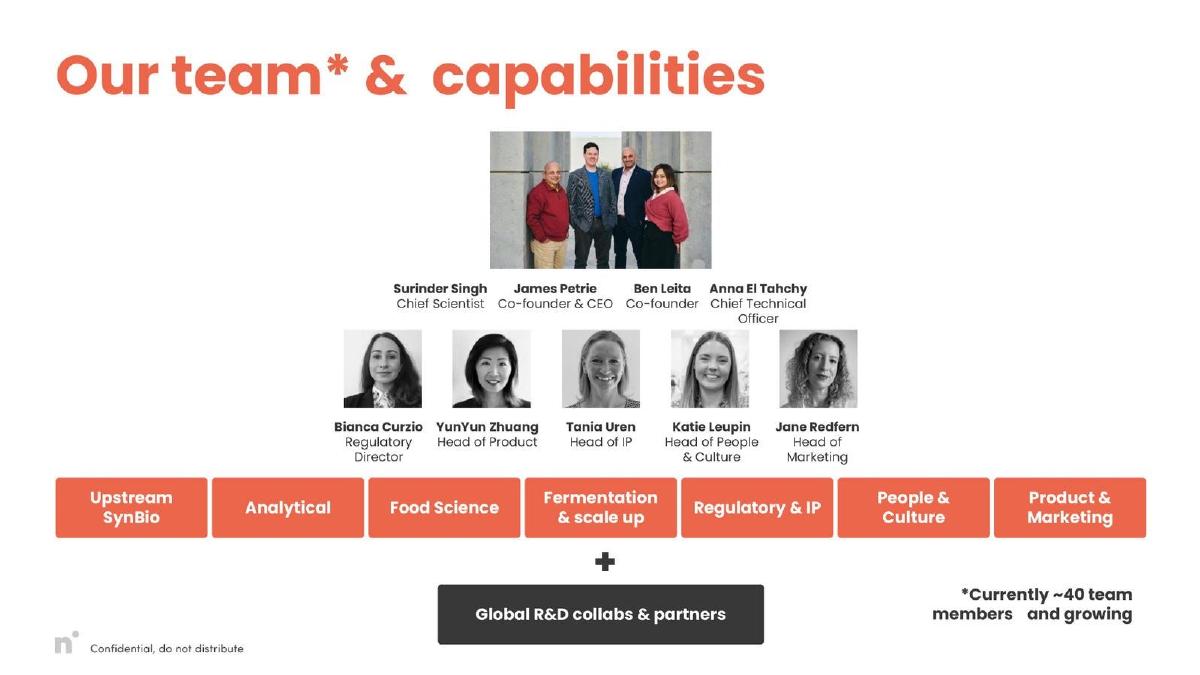
- There is no dedicated team slide in the provided 13-slide sequence, leaving the specific expertise of the 40+ staff members to be inferred from lab photography (Slide 6).
Nourish Ingredients: The Series A Visual Narrative
Nourish Ingredients, an Australian biotech firm, raised $28.6M in 2022 to change how the world thinks about plant-based fats. Their Series A deck is a masterclass in minimalist, high-impact visual storytelling. Rather than overwhelming investors with dense spreadsheets, the deck focuses on the sensory experience of food and the biological 'unlock' that their technology provides. The following teardown examines the 13-slide deck, focusing on how they framed a complex SynBio solution as a simple fix for a multi-billion dollar taste problem.
Slides 1-5: The Branding Foundation
The first five slides of the deck serve as a repetitive branding exercise. Slides 1, 3, 4, and 5 are identical title cards reading 'Nourish Ingredients Series A pitch deck.' Slides 2 and 6 feature the company logo on a solid coral background. While this may seem redundant in a digital format, it establishes a strong visual identity and ensures the 'Nourish' brand is the first thing an investor sees. In a live pitch environment, these often serve as placeholders during introductions.
Slide 6: The Company Snapshot
Slide 6 provides the first meat of the presentation. It defines Nourish Ingredients as 'Leaders in SynBio food tech and precision fermentation.' This slide is crucial for establishing the company's operational footprint. It notes an 'Australia HQ' and a team of '40+ people.' By including photos of scientists in a lab setting, the company visually reinforces its technical credibility. The bullet point 'Scaling and deregulation' signals to Series A investors exactly where the capital will be deployed: moving from the lab to the market and navigating the complex regulatory hurdles of novel food ingredients.
Slide 7: The 'Solved' Provocation
Slide 7 is perhaps the most aggressive slide in the deck. It features a high-resolution image of a raw ribeye steak next to a perfectly seared, grilled steak. The only text is the word 'Solved.' followed by a period. This is a bold claim. It suggests that the primary barrier to plant-based meat—the inability to replicate the cooking experience and flavor of animal fat—has been overcome by Nourish. It appeals to the investor's stomach as much as their wallet, framing the company's output as the missing link in the food supply chain.
Slide 8: Breaking the Category
This slide is the technical heart of the deck. It uses a 'Lock and Key' metaphor to explain their competitive advantage. It categorizes the market into three segments: Plant fats (locked because they lack taste and are unsustainable), Animal fats (locked by the biology of the animal and difficult to tune), and Nourish fats (unlocked). The slide explains their process: 'We brew fat - a pipeline of micro-organism cell factories.' Crucially, it clarifies that their product is 'Not a "mimic"' but contains the 'same fat molecules as those found in animals.' This distinction is vital for a biotech play; they aren't just making a better margarine; they are bio-manufacturing animal fat without the animal.
Slide 9: Qualitative Traction
Slide 9, titled 'We've got customers talking,' relies on qualitative social proof. Instead of a list of logos (which might be under NDA), they use quotes to validate the sensory experience. Quotes like 'It tastes animalic, fatty' and 'I am not vegetarian, I like meat, I would kill for this!' are designed to prove that the product passes the 'carnivore test.' For a Series A company in the biotech space, where commercial revenue might still be distant, these sensory validations serve as a proxy for future market demand.
Slide 10-11: Visual Reinforcement
Slides 10 and 11 continue the branding and visual theme. Slide 10 repeats the logo, while Slide 11 (not provided as an image but noted in the sequence) likely served as a transition or a visual break. The consistency of the coral color palette and the 'n' logo mark throughout the deck suggests a highly polished, professional approach to the fundraise.
Slide 12: The Market Opportunity
Slide 12 connects the technology back to the macro-economic opportunity. It identifies 'Today's $36.8B alternative protein market' and lists two major failings: it is not 'animal-like enough' to entice carnivores and it is 'environmentally unsustainable.' The visual shows a grocery store aisle with a 'lock' icon being opened, with an arrow pointing upward toward 'market explosion.' The logic is simple: the current market is capped by poor taste; Nourish removes that cap, allowing the market to expand into the much larger traditional meat-eating demographic.
Slide 13: The Closing
The final slide is a standard contact page featuring the company website (nourishing.io) and a 2022 copyright notice. It maintains the minimalist aesthetic of the rest of the deck, leaving the investor with the brand name and a clear path to follow up.
What Nourish Ingredients Does Well
The Nourish Ingredients deck excels at simplifying complex science . Precision fermentation and synthetic biology are difficult concepts to explain to generalist investors. By using the 'brewing' analogy and the 'lock and key' visual, they make the technology accessible. They also focus heavily on the sensory outcome . In the food industry, taste is the only metric that ultimately matters for consumer adoption. By centering the deck around the 'animalic' taste and the 'Solved' steak imagery, they keep the focus on the value proposition rather than getting lost in the weeds of yeast strains and bioreactor yields.
What Is Missing From the Deck
Despite raising a significant $28.6M, the provided slides are missing several standard Series A components. First, there is no detailed team slide . While Slide 6 mentions 40+ people, it does not highlight the founders' backgrounds or the specific scientific pedigree of the leadership team. Second, there is a lack of unit economics . Investors at the Series A level typically want to see the 'path to parity'—how the cost of fermented fat compares to the cost of palm oil or animal lard at scale. Finally, there is no explicit 'Ask' or 'Use of Funds' slide . While the publisher reports the $28.6M figure, the deck itself does not state how much they are raising or how that capital will be allocated across R&D, manufacturing, and regulatory compliance.
Founder Takeaways: Copy the Clarity, Add the Data
Founders in the 'Deep Tech' or 'Hard Tech' space should study how Nourish uses visual metaphors to explain their moat. The 'Not a mimic' distinction on Slide 8 is a powerful way to position against competitors who are simply blending plant oils. However, founders should be cautious about omitting the data. While Nourish was successful, most Series A decks require a more robust look at the 'Go-to-Market' strategy. If you are using this deck as a template, ensure you add slides for Regulatory Roadmap , Manufacturing Partnerships , and a detailed 18-24 month milestone plan to complement the high-level vision presented here.
Frequently asked questions
- What is the primary problem Nourish Ingredients is solving?
- According to Slide 8 and Slide 12, the problem is that plant-based fats lack the taste and function of animal fats, and current alternative proteins are not 'animal-like enough' to drive repeat purchases from meat-eaters. Nourish aims to solve this by creating identical fat molecules through fermentation.
- How does the technology work according to the deck?
- Slide 8 illustrates a process where 'Nourish science' combines yeast and sugar through fermentation to create 'tailored fats.' These are described as 'micro-organism cell factories' that produce real fat molecules rather than plant-based mimics like palm or coconut oil.
- What market size does Nourish Ingredients target?
- Slide 12 cites the 'today's' alternative protein market at $36.8B. The deck suggests that by solving the taste issue, they can trigger a 'market explosion' beyond this current figure by capturing the carnivore demographic.
- What is the current scale of the company?
- As of the Series A deck (Slide 6), the company is headquartered in Australia with a team of over 40 people. Their stated strategic priorities are scaling their production and navigating the deregulation process.
- Does the deck include financial projections or a specific funding ask?
- No. The provided slides focus on the problem, the technology, and qualitative traction. There are no slides detailing revenue targets, burn rate, or the specific dollar amount requested for the Series A round.