Novoflow’s pitch deck is a masterclass in aggressive positioning, explicitly stating a goal to "replace the EHR" by 2035. The company targets the $260B inefficiency in claim requests by deploying "AI employees" that automate scheduling, billing, and RX fulfillment. The deck highlights a significant technical advantage: reducing EHR integration time from three weeks to three hours. With five paying medical practices and $280k in projected ARR upon full deployment, the founders demonstrate early traction and a clear three-phase roadmap. The narrative moves from specific task automation to a lon…
Key takeaways
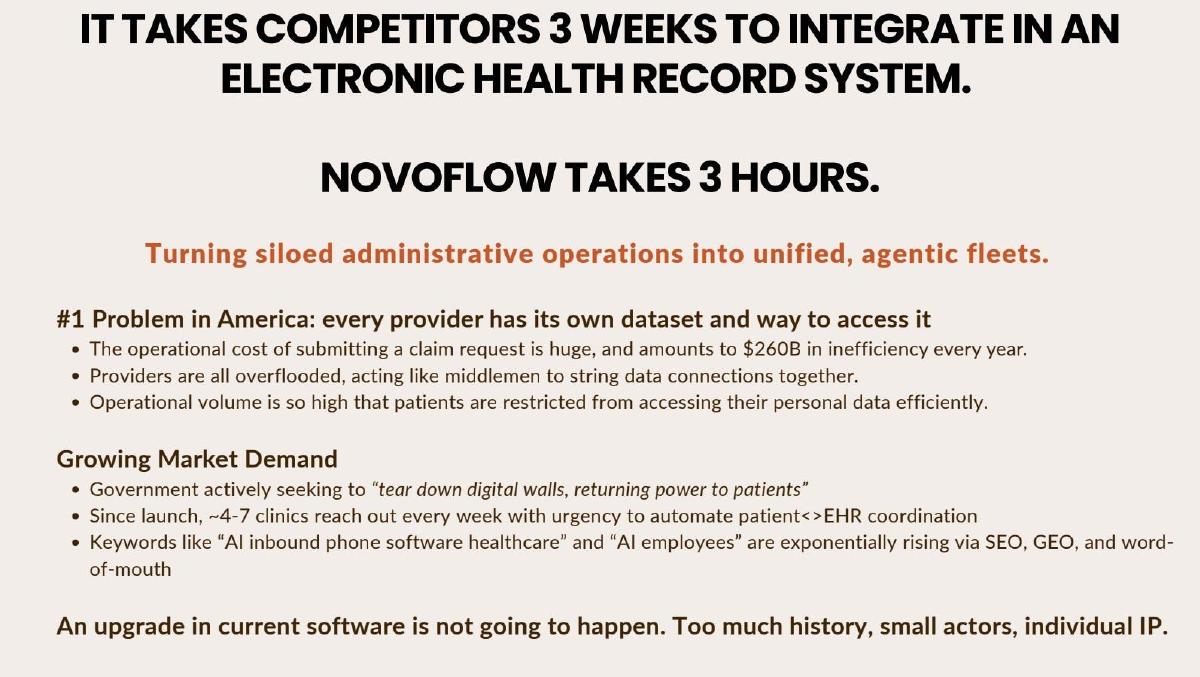
- Novoflow claims to reduce Electronic Health Record (EHR) integration time from 3 weeks to 3 hours (Slide 2).
- The company identifies a $260B annual inefficiency in the operational cost of submitting healthcare claims (Slide 2).
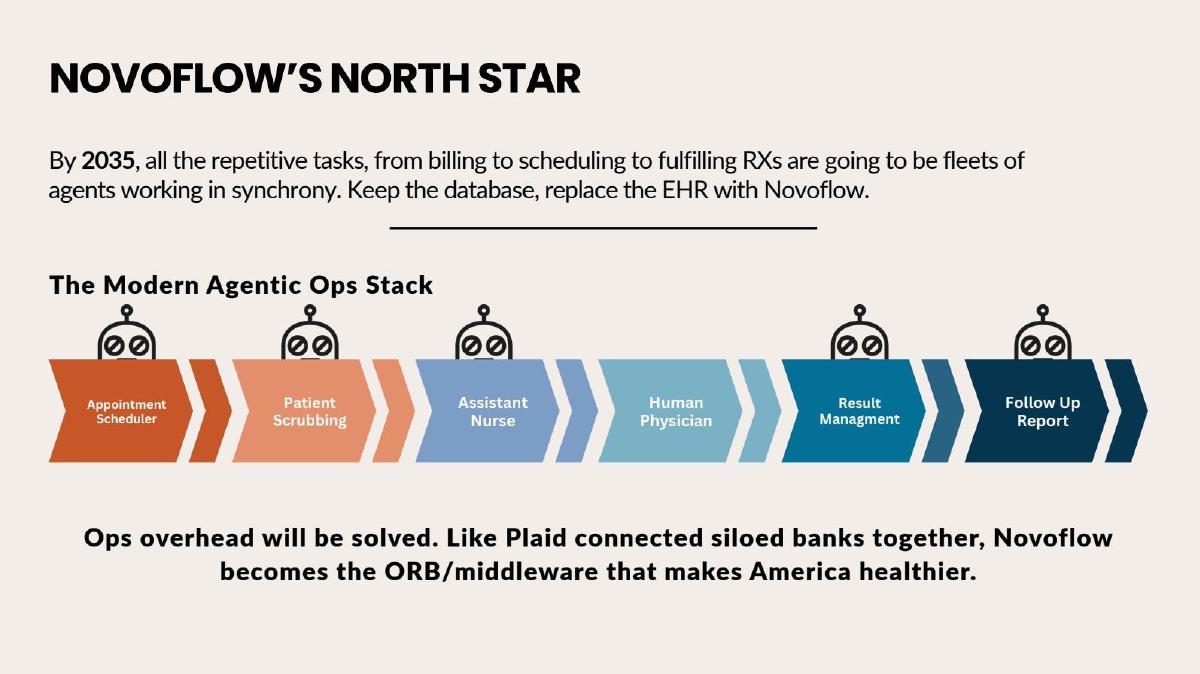
- The 'North Star' vision is to replace the EHR with Novoflow by 2035, acting as the middleware for all repetitive tasks (Slide 4).
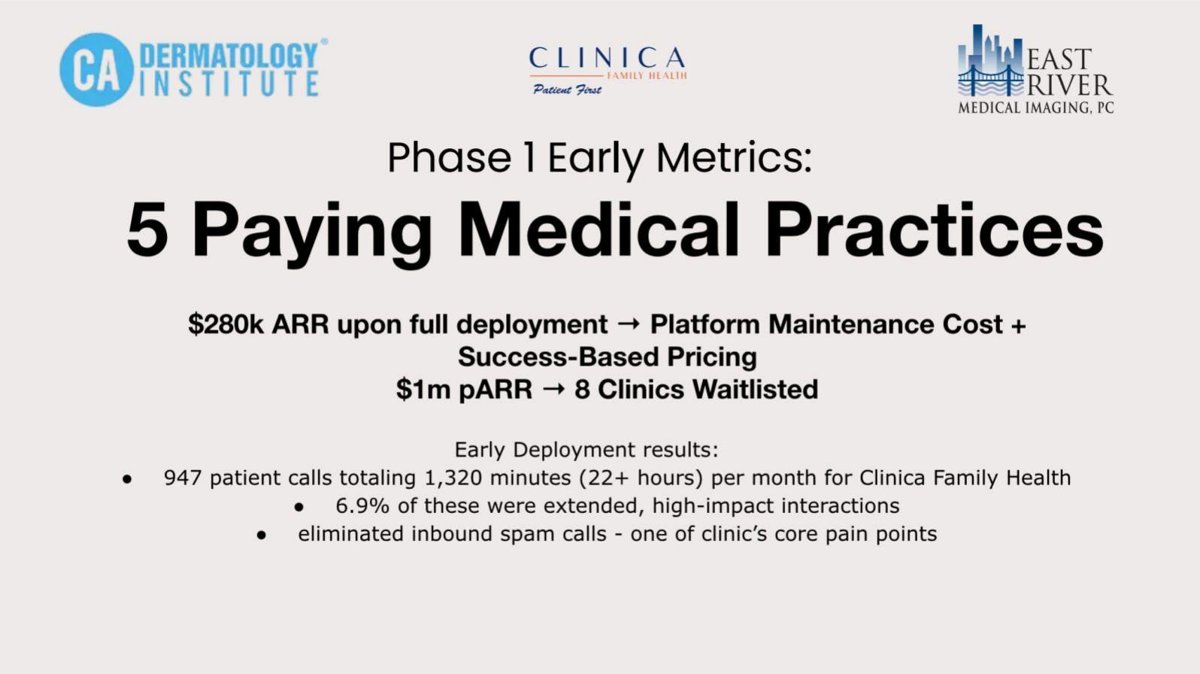
- Early traction includes 5 paying medical practices and 8 clinics on a waitlist (Slide 6).
- Novoflow projects $280k ARR upon full deployment of current clients, with a goal of reaching $35M in recurring revenue by Year 2 (Slides 6 and 7).
- The product roadmap includes a 'Phase 3' plan to acquire a clinic and build a physician-only practice fully maintained by AI (Slide 8).
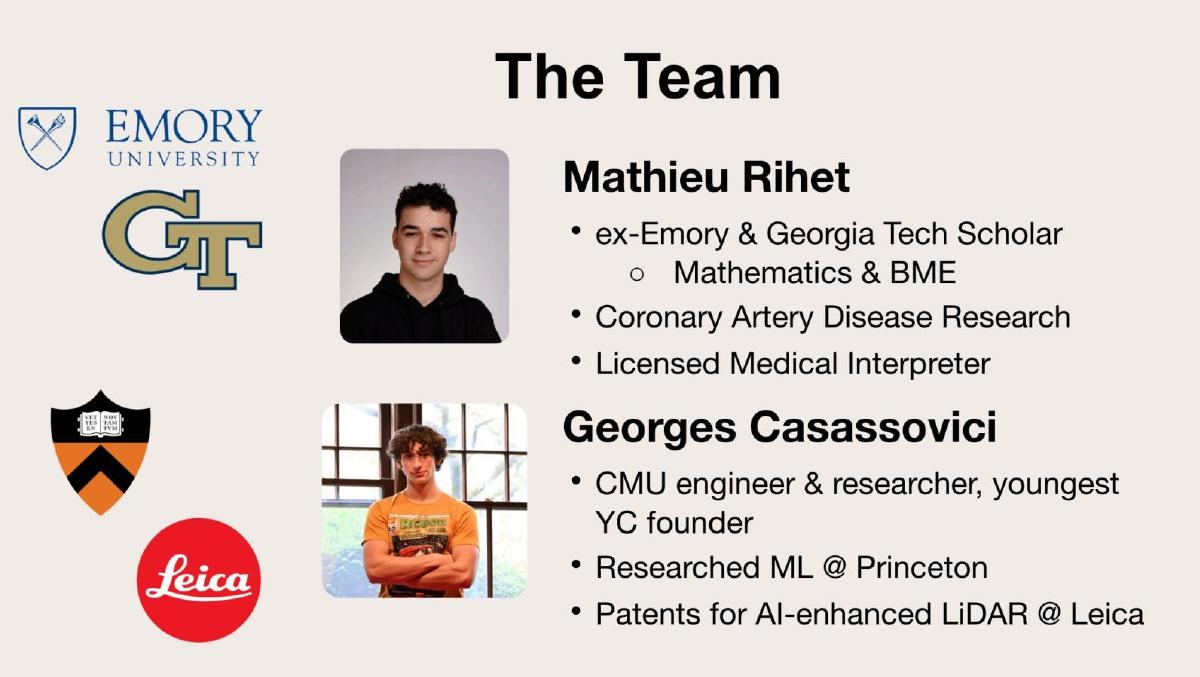
- The founders leverage high-pedigree backgrounds, including CMU engineering, Y Combinator experience, and patents for AI-enhanced LiDAR (Slide 3).
- The fundraising ask was $3M to hire a team of 8-9 people, including engineers and account executives with a 30k doctor contact rolodex (Slide 9).
The 9-Slide Strategy: Replacing the Healthcare Backbone
Novoflow’s pitch deck, used to raise a $3.1M Seed round in 2025, is a lean, 9-slide document that prioritizes speed of execution and a radical long-term vision. While many healthcare startups attempt to work within the existing Electronic Health Record (EHR) framework, Novoflow explicitly states its intent to replace the EHR operations stack entirely. The deck is structured around a three-phase growth plan, moving from simple task automation to the creation of fully autonomous medical clinics.
Slide 1: Title and Positioning
The cover slide introduces the company name and the tagline: "Healthcare Run by Agents." It lists the founders, Mathieu Rihet and Georges Casassovici, and provides the URL. The branding is clean, using a gradient logo that suggests fluidity and movement, consistent with the "flow" in the company name. The focus is immediately placed on "Agents," signaling that this is an AI-native approach to healthcare operations rather than a legacy software upgrade.
Slide 2: The Efficiency Gap
Slide 2 serves as both the problem and the competitive advantage slide. It leads with a bold comparison: "IT TAKES COMPETITORS 3 WEEKS TO INTEGRATE IN AN ELECTRONIC HEALTH RECORD SYSTEM. NOVOFLOW TAKES 3 HOURS." This 168x speed improvement is the core hook of the deck. The slide identifies the "#1 Problem in America" as siloed datasets, noting that the operational cost of submitting claims results in $260B in annual inefficiency. It also highlights market demand, stating that 4-7 clinics reach out every week with urgency to automate coordination. The slide concludes with a dismissive note on legacy software: "An upgrade in current software is not going to happen. Too much history, small actors, individual IP."
Slide 3: The Team
The team slide emphasizes technical pedigree and industry-specific experience. Mathieu Rihet is highlighted as an ex-Emory and Georgia Tech scholar with experience in medical interpretation and research. Georges Casassovici is positioned as a high-potential technical lead, noted as a CMU engineer, the "youngest YC founder," and a patent holder for AI-enhanced LiDAR at Leica. The inclusion of logos from Princeton, CMU, Georgia Tech, and Leica serves as social proof for their ability to build complex AI systems.
Slide 4: The North Star Vision
Slide 4 outlines the company's long-term goal for 2035: "Keep the database, replace the EHR with Novoflow." It visualizes a "Modern Agentic Ops Stack" where an Appointment Scheduler, Patient Scrubbing agent, Assistant Nurse, Result Management agent, and Follow Up Report agent work in synchrony around a human physician. The slide uses a "Plaid for Healthcare" analogy, suggesting Novoflow will become the middleware that connects siloed data to make the system functional.
Slide 5: Phase 1 Product and Validation
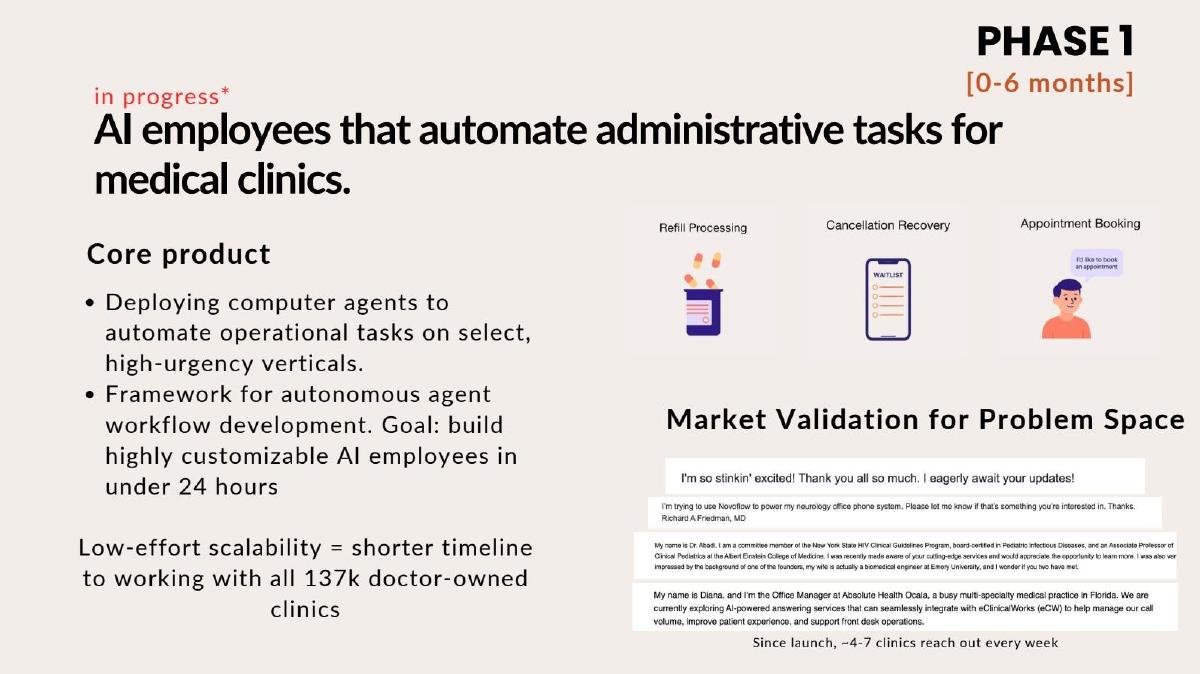
This slide details the current state of the product (0-6 months). It defines the core product as "AI employees" that automate tasks in high-urgency verticals. A key technical claim is a framework that allows the team to build highly customizable AI employees in under 24 hours. The slide includes screenshots of testimonials from medical professionals, including an MD and an Office Manager, to validate the demand. It reiterates the inbound interest of 4-7 clinics per week.
Slide 6: Early Metrics and Traction
Slide 6 provides hard numbers to back up the claims. It lists 5 paying medical practices, including CA Dermatology Institute and East River Medical Imaging. The financial projection is "$280k ARR upon full deployment," with a "pARR" (potential ARR) of $1M when including the 8 clinics currently on the waitlist. The slide also shares specific deployment results for Clinica Family Health: 947 patient calls handled per month (22+ hours of work), with 6.9% being high-impact interactions. It also notes the elimination of inbound spam calls, solving a core clinic pain point.
Slide 7: Phase 2 Scalability
Looking at the 6-24 month horizon, Slide 7 discusses "Highly Scalable Agent Infrastructure." The goal is to move from building 15 custom AI employees a week to hundreds. Two growth levers are identified: Pharma Contracts (connecting to 1000+ locations each for drug trials) and "AI FDEs (Field Deployment Engineers) for Integrations," which are agents designed to tune other agents. The growth trajectory targets a jump from 10 clinics to 2,500 and a revenue increase from $500k to $35M, representing a market capture of 1.8%.
Slide 8: Phase 3 The Ecosystem
The final vision slide (2-4 years) describes an "Agent-First Ops Ecosystem." It introduces the concept of the "Agentic Clinic," where Novoflow intends to acquire a clinic and strip all human operations to showcase a physician-only practice maintained by AI. The slide emphasizes a "Library of Agents" that covers every operational task, aiming for 100% connectivity where Novoflow replaces human "ORBs" (operational bottlenecks).
Slide 9: The Fundraising Ask
The deck concludes with a fundraising slide. It states a target of "Raising $3M" (though publisher reports indicate they closed $3.1M). The funds are earmarked for a specific hiring plan: 3 remote engineers, 2-3 founding engineers, 2 account executives (specifically those with a 30k doctor contact rolodex), and 1 customer success manager. A simple diagram shows Novoflow sitting between EHR/EMRs and Providers, acting as the bidirectional bridge.
What Works in the Novoflow Deck
The Speed Hook: Leading with the 3-week vs. 3-hour integration comparison is a powerful way to differentiate from legacy incumbents. In healthcare IT, integration is the primary friction point; by claiming to solve it, Novoflow addresses the investor's biggest technical concern immediately.
Specific Traction Metrics: Slide 6 doesn't just say they have users; it breaks down the number of calls, the minutes saved, and the percentage of high-impact interactions. This level of granularity makes the "AI employee" concept feel tangible rather than theoretical.
Phased Roadmap: The deck does an excellent job of balancing the immediate (Phase 1: automating tasks) with the visionary (Phase 3: the Agentic Clinic). This allows investors to see a path to a massive exit without ignoring the necessity of early-stage revenue.
What is Missing from the Novoflow Deck
Unit Economics: While the deck mentions "Success-Based Pricing," it does not provide details on the cost to acquire a clinic (CAC) or the lifetime value (LTV). For a Seed round, investors usually want to see the math behind the $35M revenue projection.
Regulatory and Compliance: In healthcare, HIPAA compliance and data security are paramount. The deck does not explicitly mention how the agents handle sensitive patient data or how they navigate the regulatory hurdles of replacing EHR functions.
Competitive Landscape: The deck assumes that all competitors are slow legacy systems. It ignores the surge of other AI-agent startups entering the healthcare space. A slide addressing why Novoflow’s "Agentic Infrastructure" is superior to other LLM-based wrappers would have strengthened the moat argument.
Founder's Playbook: What to Copy
The 'North Star' Slide: Founders should copy the way Novoflow uses Slide 4 to define a new category. They don't just say they are an add-on; they say they are the new middleware. Defining your company as the "Plaid of [Industry]" is a proven way to communicate complex infrastructure plays.
Hiring Specificity: On the fundraising slide, Novoflow doesn't just ask for money for "growth." They specify the exact roles and, more importantly, the specific assets those roles should bring (e.g., an account executive with a 30k doctor rolodex). This shows a high level of operational maturity.
Validation through Testimonials: Using raw, unedited-looking feedback from doctors (Slide 5) is often more effective than polished marketing copy. It proves that the problem is painful enough that users are "stinkin' excited" to find a solution.
Frequently asked questions
- What is Novoflow's core value proposition for clinics?
- Novoflow provides 'AI employees' that automate administrative tasks like appointment booking, refill processing, and cancellation recovery. The primary selling point is speed; they claim to integrate with existing EHR systems in 3 hours, whereas competitors take 3 weeks. This allows clinics to reduce operational overhead without replacing their existing databases immediately.
- How does Novoflow plan to scale its revenue?
- The company uses a hybrid pricing model consisting of a platform maintenance cost plus success-based pricing. They project growing from 10 clinics under management to 2,500 within two years, aiming for a jump from $500k to $35M in recurring revenue by capturing 1.8% of the market.
- What is the long-term vision for the 'Agentic Clinic'?
- In Phase 3 (2-4 years), Novoflow intends to acquire a physical medical clinic. They plan to strip all human-led operations and build a 'physician-only' practice where every administrative and operational task is handled by AI agents, serving as a case study for high-efficiency healthcare.
- Who are the founders and what is their background?
- The team consists of Mathieu Rihet, an ex-Emory and Georgia Tech scholar with a background in medical interpretation and coronary artery disease research, and Georges Casassovici, a CMU engineer and the youngest YC founder who holds patents for AI-enhanced LiDAR at Leica.
- What specific tasks do the AI agents handle?
- Currently, the agents focus on high-urgency verticals including appointment scheduling, patient scrubbing, assistant nursing, result management, and follow-up reporting. The goal is to build a 'Library of Agents' that can be deployed in under 24 hours to handle any repetitive clinic task.