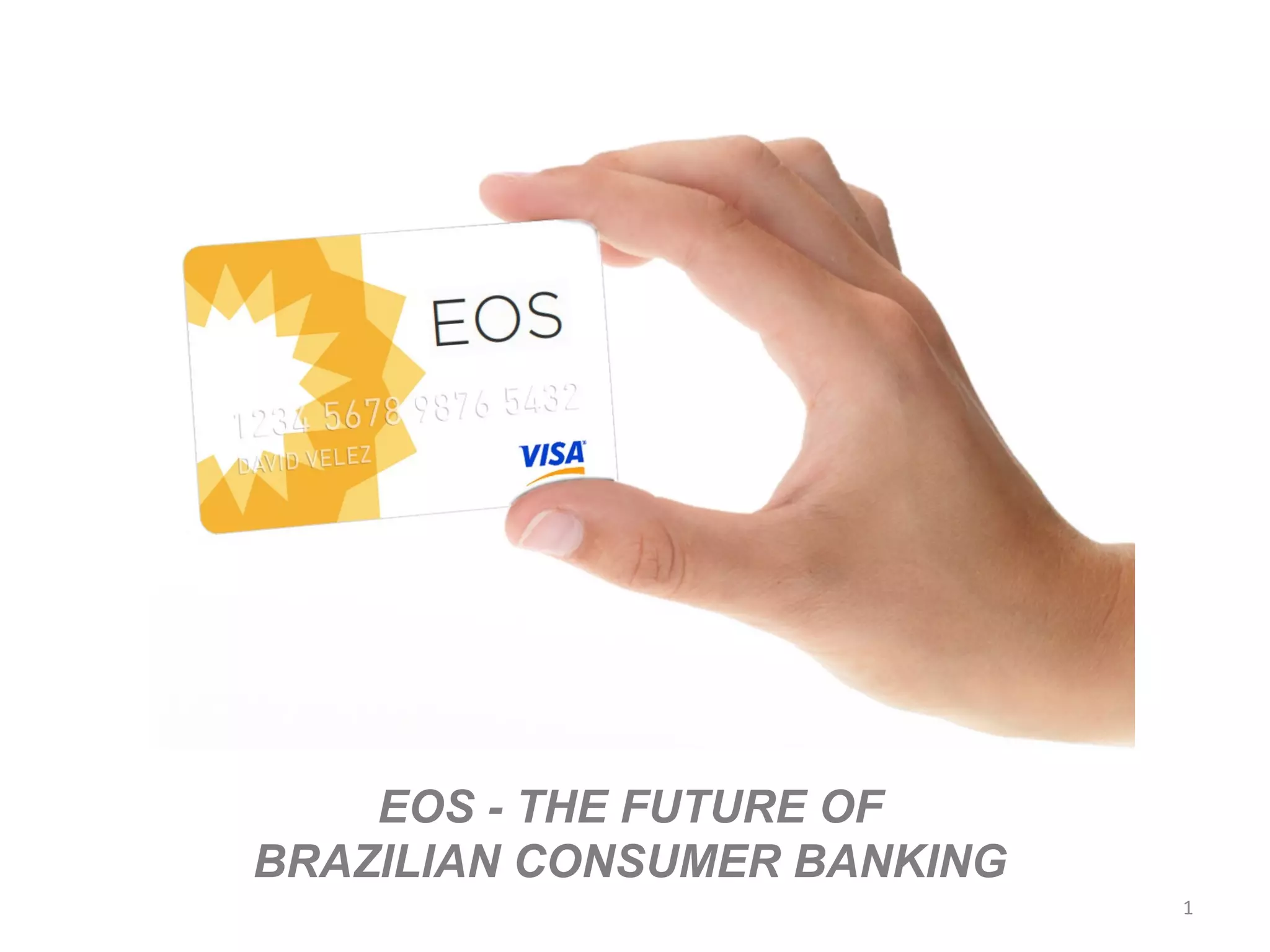
The early Nubank deck, operating under the project name 'EOS,' is a masterclass in positioning a startup as the 'anti-incumbent.' The presentation focuses heavily on the cultural and operational chasm between traditional Brazilian banks and a modern technology company. By highlighting the inefficiency of 12-24 month development cycles in legacy banking versus the 12-24 day cycles proposed by EOS, the founders make a compelling case for structural disruption. While the provided slides are missing specific financial projections and team biographies, the strategic framing of the 'Main Risk'—inte…
Key takeaways
- The company initially branded itself as 'EOS - The Future of Brazilian Consumer Banking' (Slide 1).
- The core value proposition is built on being a 'Technology company' rather than a 'Bank' (Slide 3).
- EOS claims an agility advantage with 12-24 day development cycles compared to 12-24 months for incumbents (Slide 3).
- The deck explicitly targets 'Smart, technology-savvy consumers' rather than the general mass market (Slide 3).
- The organizational structure is defined as 'Lean, flat, fast-iteration, agile' (Slide 3).
- A significant portion of the deck uses placeholder transition slides for 'Solution,' 'Why Now?,' and 'Business Model' (Slides 5, 7, 9).
- The 'Main Risk' identified is that 60-80% of credit card transactions in Brazil are interest-free installments (Slide 11).
- The strategy includes an 'Upside case' of decreasing revolving interest rates to incentivize global consumer behavior (Slide 11).
The Foundational Vision of a Neobank Giant
The early pitch deck for Nubank, presented here under the working title EOS , provides a rare look at the strategic scaffolding of one of the world's most successful fintechs. At this stage, the pitch is less about a specific app interface and more about a fundamental shift in how a financial institution should be built. The deck is structured to highlight the terminal flaws of the Brazilian banking status quo and present a technology-first alternative.
Slide 1: Title and Brand Identity
The cover slide introduces EOS . The visual centerpiece is a hand holding a white credit card with a yellow geometric sunburst logo. The name 'David Velez' is printed on the card, identifying the founder's role. The subtitle, 'EOS - THE FUTURE OF BRAZILIAN CONSUMER BANKING,' immediately establishes the geographic focus and the scale of the ambition. It is a clean, minimalist start that signals a departure from the ornate, heavy branding typical of traditional retail banks.
Slide 3: The 'Anti-Bank' Comparison
This is the most content-dense slide in the provided set and serves as the strategic heart of the pitch. It uses a side-by-side table to contrast 'Brazilian Banks Today' with 'EOS.' The distinctions are sharp:
Ethos: Traditional players are 'Banks'; EOS is a 'Technology company.' · Culture: Incumbents leverage 'complexity to confound,' while EOS leverages 'simplicity to create loyalty.' · IT Organization: This is the most striking metric. Traditional banks have 12-24 month development cycles and launch 2-3 products per year. EOS claims 12-24 day development cycles and the ability to test 2-3 new products per day. · Organization: Legacy banks are described as 'Bureaucratic, Hierarchical, rigid,' whereas EOS is 'Lean, flat, fast-iteration, agile.'
By framing the competition this way, EOS isn't just promising a better credit card; they are promising a superior operating system for finance.
Slides 5, 7, and 9: The Structural Gaps
Slides 5, 7, and 9 are simple transition slides labeled 'SOLUTION,' 'WHY NOW?,' and 'BUSINESS MODEL' respectively. In a full presentation, these would be followed by detailed data. In this teardown, their presence confirms that the deck follows a standard venture capital narrative arc, even if the specific details of the 'Solution' (the app features) and the 'Business Model' (interchange fees, interest rates, etc.) are omitted from this specific selection of slides.
Slide 11: Addressing the 'Main Risk'
Slide 11 demonstrates a high degree of founder maturity by directly addressing the primary headwind in the Brazilian market. It notes that '60 – 80% of credit card transactions are for interest-free installment payments.' This is a cultural staple in Brazil that limits the immediate profitability of credit card issuers who rely on revolving interest.
'Base case': Operating with a similar portfolio of credit card loans (60-80% installments). · 'Upside case': Decreasing interest rates on revolving credit to provide an incentive for consumers to 'revolve' their debt, similar to global consumer behavior.
This slide is crucial because it shows investors that the founders are not just importing a US model (like Capital One) blindly; they are building for the specific realities of the Brazilian consumer.
Slide 13: The Conclusion
The final slide is a simple 'THANK YOU' featuring the EOS logo. It maintains the minimalist aesthetic established on the title slide, reinforcing the brand's commitment to simplicity.
What Works in This Deck
The Dichotomy Strategy: The comparison on Slide 3 is incredibly effective. It doesn't just say 'we are better'; it explains why the incumbents are structurally incapable of competing with a technology-first firm. The focus on development speed (days vs. months) is a metric that any VC can understand and value.
Localized Risk Assessment: Many international founders fail to account for local market quirks. By highlighting the 'interest-free installment' culture on Slide 11, the founders prove they have deep local market expertise, which de-risks the investment for international VCs who might not be familiar with Brazilian consumer habits.
Market Positioning: By explicitly stating they are targeting the 'Smart, technology-savvy consumer' (Slide 3), they avoid the trap of trying to be everything to everyone on day one. This suggests a low-cost, high-efficiency customer acquisition strategy.
What Is Missing
The Team: In the provided slides, there is no mention of the founding team's pedigree. For a fintech startup, especially one aiming to disrupt a banking oligopoly, the regulatory and technical background of the founders is paramount. (Note: While not in these slides, the source listing identifies David Velez, whose name appears on the card in Slide 1).
Unit Economics: While the 'Business Model' transition slide exists, the actual mechanics of how EOS plans to make money—given the high cost of capital in Brazil and the prevalence of interest-free installments—are not shown. Investors would need to see the projected Lifetime Value (LTV) vs. Customer Acquisition Cost (CAC).
Regulatory Path: Banking in Brazil is highly regulated. The deck does not show the plan for obtaining a banking license or partnering with a fronting bank, which is a significant hurdle for any neobank.
Founder's Playbook: What to Copy
Sell the 'Why,' not the 'What': This deck spends more time explaining the philosophy of the company (Technology vs. Bank) than the features of the app. Founders in crowded markets should copy this approach to differentiate themselves at a structural level.
Use Comparative Metrics: Don't just say you are 'fast.' Use a table like Slide 3 to show your speed relative to the industry standard. Quantifying your agility (e.g., '12-24 day cycles') makes a vague claim feel like a tangible competitive advantage.
Own Your Risks: Don't hide the biggest market challenge. By putting the 'Main Risk' on a slide, you control the narrative and can present your 'Base case' and 'Upside case' solutions before the investor even asks the question.
Frequently asked questions
- What was Nubank's original name according to this deck?
- The deck refers to the company as 'EOS.' The cover slide (Slide 1) features a credit card mockup with the EOS logo and the tagline 'The Future of Brazilian Consumer Banking.' This suggests the Nubank brand was developed later in the pre-launch or launch phase.
- How does the deck define the competitive landscape?
- Instead of naming specific competitors, Slide 3 creates a categorical dichotomy between 'Brazilian Banks Today' and 'EOS.' It characterizes incumbents as having 'inertia,' 'complexity,' and 'bureaucratic' structures, while positioning EOS as 'contrarian,' 'simple,' and 'agile.'
- What is the specific target market mentioned?
- On Slide 3, under the 'Market' row, the deck specifies its target as the 'Smart, technology-savvy consumer.' This contrasts with traditional banks that attempt to serve 'Everybody, everywhere,' suggesting a focused entry strategy.
- What unique Brazilian market factor does the deck address?
- Slide 11 addresses the prevalence of interest-free installments, noting they account for 60-80% of credit card transactions. This is a critical localized risk, as it affects how a credit card issuer generates interest income compared to other global markets.
- Is there a clear product roadmap in these slides?
- No. The provided slides focus on ethos, organizational structure, and market risk. While there are transition slides for 'Solution' and 'Business Model,' the specific product features and revenue mechanics are not detailed in the visible pages.