Numina’s 2014 pitch deck is a lean, visual-first presentation that prioritizes the 'Why' over the 'How Much.' Spanning just 11 slides, the deck uses a stark visual contrast between inefficient manual data collection (clipboards and expensive tablets) and its own automated sensing hardware. The company positions itself not just as a hardware manufacturer, but as a data provider, explicitly stating 'Our product is data' on slide 4. By leaning heavily on logos from the Knight Foundation and Clinton Foundation, Numina bypasses traditional traction metrics to establish authority in the complex mun…
Key takeaways
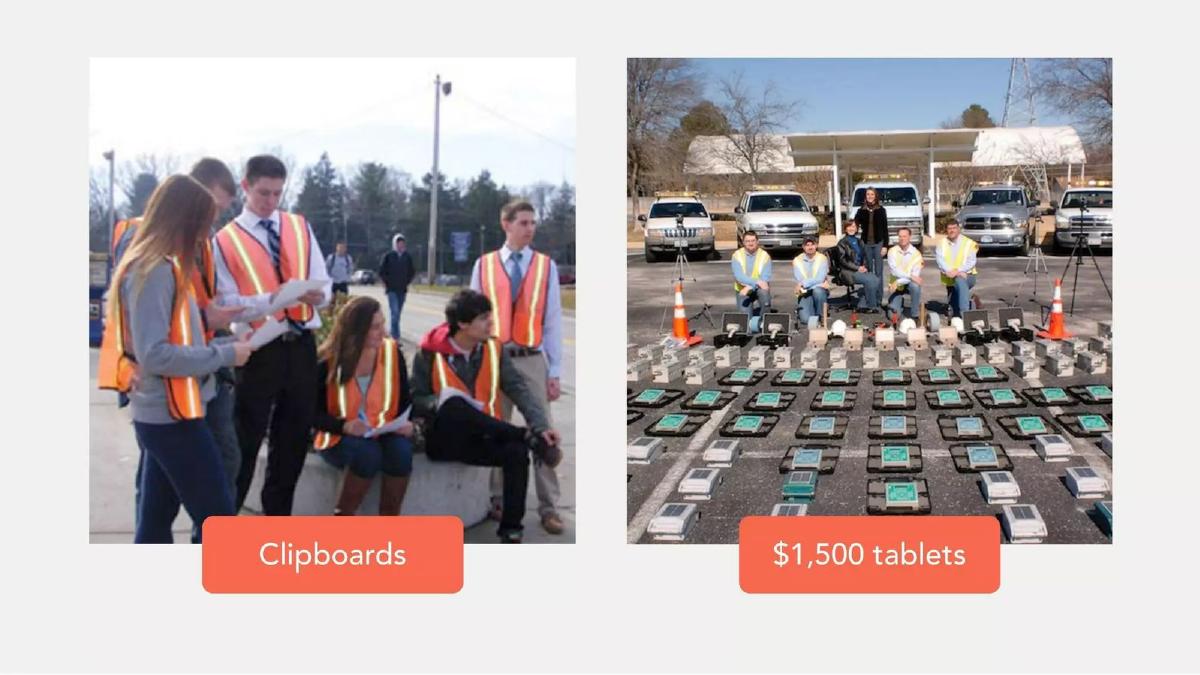
- The deck uses a two-slide visual sequence to highlight the inefficiency of current methods, specifically calling out '$1,500 tablets' as a pain point on slide 2.
- Numina explicitly defines its business model as a data play rather than a hardware play, stating 'Our product is data' on slide 4.
- Institutional credibility is front-loaded, featuring logos from the Knight Foundation, Robert Wood Johnson Foundation, and Clinton Foundation on slide 6.
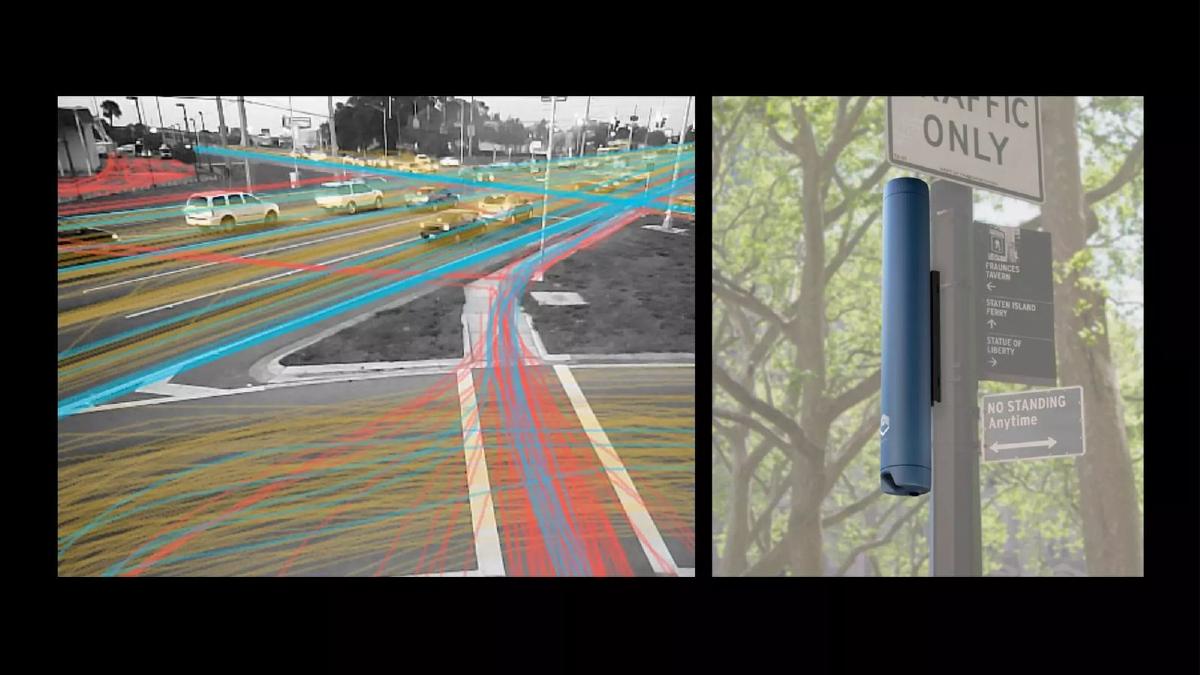
- The product visualization on slide 5 effectively shows both the hardware form factor and the resulting computer vision data output in a single view.
- The team slide (slide 9) leverages massive brand equity, citing experience from Google, Boeing, Lockheed Martin, and Mercedes-Benz.
- Geographic expansion is shown through a simple 'Now' vs. 'Summer 2017' map progression on slides 7 and 8, indicating a move from two to four major hubs.
- The deck completely omits a financial slide, missing revenue figures, burn rate, and unit economics.
- There is no 'Ask' slide; the deck ends with a generic 'Join us' call to action on slide 10 without specifying a dollar amount or valuation.
The Visual Narrative of Numina
Numina’s pitch deck is a study in minimalism. In an era where decks often reach 20 or 30 slides filled with dense charts, Numina opts for a high-impact, low-text approach. The deck, dating back to roughly 2014-2017 based on the timeline slides, focuses on the transition from manual labor to automated intelligence in the urban planning sector. It is designed to be presented, not just read, relying on the speaker to fill in the gaps left by its sparse text.
Slides 0-2: The Problem of Manual Labor
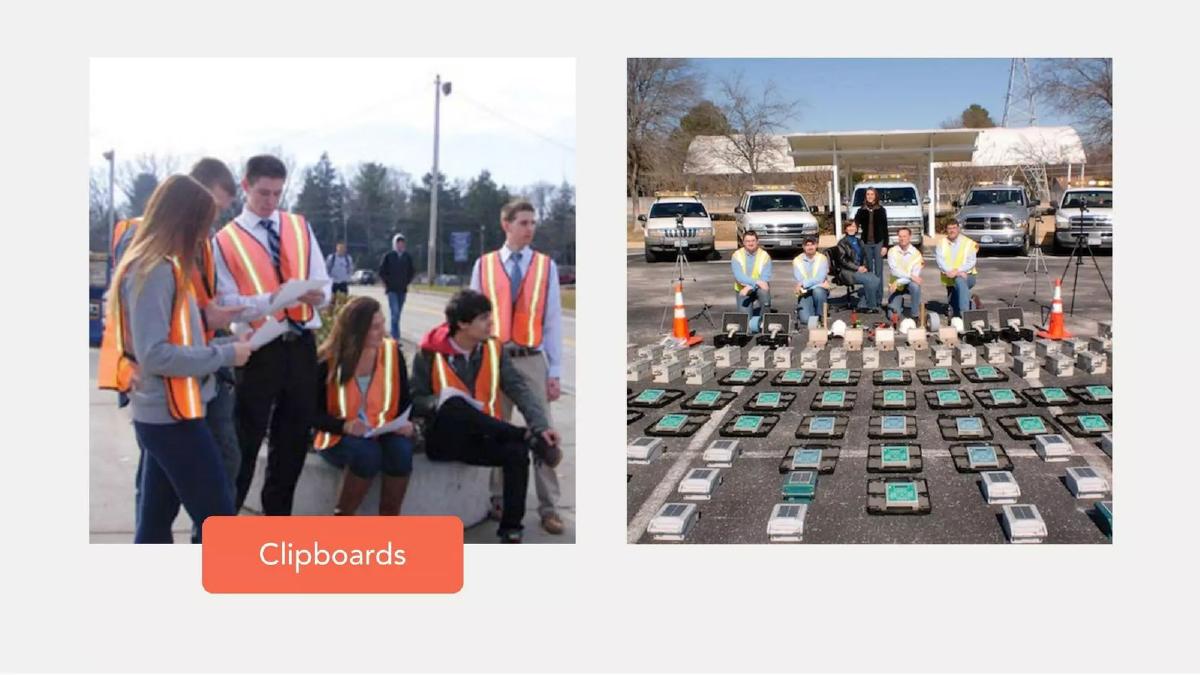
The deck opens with a clean title slide (Slide 0) that establishes the brand: "Real-time insights from streets." This is a clear, jargon-free value proposition. It immediately moves into the problem space using two nearly identical slides (Slides 1 and 2). This is a classic 'reveal' technique. Slide 1 shows two images: one of people with clipboards and another of a large array of hardware. Slide 2 adds the captions "Clipboards" and "$1,500 tablets."
By highlighting the $1,500 price tag of existing hardware, Numina is not just attacking the inefficiency of manual counting; they are attacking the CAPEX (capital expenditure) burden of current solutions. This sets up the expectation that Numina will be both more efficient and more cost-effective.
Slides 3-5: The Solution and Product Definition
Slide 3 introduces "A Better Way: Automated sensing." Slide 4 contains perhaps the most important strategic statement in the deck: "Our product is data." This is a critical pivot for a hardware-enabled startup. By explicitly stating that the product is data, Numina signals to investors that they are looking for software-style margins and recurring revenue, rather than the one-off sales cycles associated with traditional hardware vendors.
Slide 5 provides the visual proof. It is a split-screen image showing the data output on the left and the hardware form factor on the right. The left side shows a busy intersection with multi-colored 'heat maps' or path-tracking lines, demonstrating the computer vision's ability to differentiate between pedestrians, cyclists, and vehicles. The right side shows a sleek, blue, cylindrical sensor mounted to a street sign. This slide effectively answers "What is it?" and "What does it do?" without a single bullet point.
Slide 6: Institutional Social Proof
Selling to cities is notoriously difficult due to long procurement cycles and political hurdles. Numina addresses this head-on in Slide 6, titled "Why cities love us." Instead of listing revenue or user growth, they list "trusted channel partners." The presence of the Knight Foundation, Robert Wood Johnson Foundation, and the Clinton Foundation serves as a massive trust signal. For a startup in the 'Other' or 'Smart City' sector, these logos act as a proxy for market validation, suggesting that the company has already cleared the high bar of institutional scrutiny.
Slides 7-8: Traction and Timeline
Slides 7 and 8 use a geographic map to show growth. Slide 7 ("NOW") shows two green dots—one in the Midwest (St. Louis) and one in the Southeast (Florida). Slide 8 ("SUMMER 2017") adds two more dots in the Northeast (New York) and the West Coast (California). While this shows geographic diversity, it is a relatively weak way to show traction. It doesn't specify how many sensors are deployed or what the contract values are. It merely shows that they have a presence in four regions.
Slide 9: Team and Advisors
The team slide is exceptionally strong in terms of pedigree. CEO Tara Pham is positioned as the domain expert in "urban design," while CTO Martin McGreal is the technical anchor with "18 years in Fortune 100 innovation offices." The "Team of 7" is represented by a cloud of high-profile logos including Google, Boeing, Lockheed Martin, and Mercedes-Benz. This communicates that despite being a small team, they have the 'DNA' of major engineering and technology firms.
The advisor section further bolsters their technical and industry credibility. Mentioning Robert Pless, PhD (Chair of Computer Science at GWU) for computer vision and Gabe Klein (CityFi) for transportation shows that they have access to both the academic cutting edge and the practical realities of city government.
Slide 10: The Missing Conclusion
The deck ends abruptly on Slide 10 with the Numina logo and the phrase "Join us." There is no mention of how much money they are raising, what the terms are, or what the specific milestones for the next 18 months will be. This is a significant omission for a fundraising deck.
What Works in the Numina Deck
Visual Contrast: The use of the "Clipboards" vs. "Automated Sensing" imagery is a powerful way to illustrate the 'Old Way' vs. 'New Way.' · Strategic Clarity: Stating "Our product is data" prevents the company from being pigeonholed as a low-margin hardware manufacturer. · Pedigree: The team slide uses logos effectively to borrow authority from established tech and aerospace giants. · Foundation Support: Leveraging non-profit foundations as 'channel partners' is a smart way to navigate the difficult municipal sales landscape.
What is Missing from the Numina Deck
The Ask: There is no slide detailing the funding requirement. Investors need to know if the company is looking for $500k or $5M. · Business Model: While they say the product is data, they don't explain how they sell it. Is it a subscription? A per-project fee? A licensing model? · Financials: There are no mentions of current revenue, burn rate, or projected growth. · Competition: The deck assumes a vacuum. It doesn't address how Numina compares to existing traffic camera companies or other computer vision startups. · Unit Economics: For a hardware-enabled business, the cost to build, install, and maintain a sensor versus the lifetime value (LTV) of the data it produces is a vital metric that is absent here.
What a Founder Should Copy
The 'Reveal' Slide: Use a two-step slide process to highlight a specific, painful cost in the current market (like the $1,500 tablets). · Logo Clouds for Small Teams: If you have a small team with impressive backgrounds, use the logos of their former employers to build instant credibility. · Clear Product Visualization: Show the hardware and the software output in the same frame so the investor can immediately visualize the end-to-end solution. · Minimalist Design: Keep the text to a minimum. Use bold statements (like Slide 4) to anchor the narrative while letting the images do the heavy lifting.
Frequently asked questions
- What is Numina's core value proposition according to the deck?
- Numina positions itself as an automated sensing platform that replaces manual urban data collection. By using computer vision to track how people and objects move through public spaces, they provide 'real-time insights from streets' (Slide 0). Crucially, they emphasize that while they deploy hardware, their actual product is the resulting data stream, which helps cities design better infrastructure.
- How does the deck handle the 'Problem' section?
- The deck uses a 'Show, Don't Tell' approach. Slides 1 and 2 feature photos of workers in high-visibility vests using clipboards and expensive, bulky hardware. By labeling a photo with '$1,500 tablets,' they immediately signal that the current market solutions are cost-prohibitive and labor-intensive, setting the stage for their automated, scalable alternative.
- Who are the key partners mentioned in the deck?
- Numina relies heavily on non-profit and foundation partnerships to validate their market fit. Slide 6 lists the Knight Foundation, Robert Wood Johnson Foundation, and the Clinton Foundation as 'trusted channel partners.' This strategy suggests a focus on the 'Public-Private Partnership' model, which is often essential for startups selling into municipal governments.
- What technical expertise does the founding team possess?
- The team slide (Slide 9) highlights a balance between domain expertise and technical depth. CEO Tara Pham is credited with an 'urban design' background (public health and urban planning), while CTO Martin McGreal brings 'machine learning' expertise with 18 years in Fortune 100 innovation offices. This pairing addresses both the 'what' (urban planning) and the 'how' (AI/ML).
- What is missing from this deck that an investor would typically require?
- This is a high-level vision deck. It lacks a 'Business Model' slide explaining how they charge (SaaS vs. per-sensor), a 'Competition' slide, and any form of 'Financials.' Most importantly, it lacks an 'Ask' slide. An investor would not know how much capital Numina is seeking or how that capital would be deployed to achieve specific milestones.