NutriPride presents a logistics-heavy solution to a social problem: the quality and cost of school meals in Africa. The deck identifies two primary pain points on slide 2—unbalanced meals and inefficient market-based sourcing—and proposes a digital MVP that automates meal planning and delivery via third-party partners like Kadi. The company demonstrates strong attention to unit economics, showing a meal cost of 1.28 GHS per child per day (slide 6), which is competitive against mid-to-high income schools. With a total addressable market in Ghana estimated at $181 million (slide 22) and a globa…
Key takeaways
- The problem is defined by both nutritional deficiency (80% rice and oil in rural Ghana) and logistical crowding at open markets (slide 2).
- The MVP uses a three-step digital process: meal plan selection, automated volume calculation by age group, and AI-optimized delivery (slide 4).
- NutriPride achieves a meal cost of 1.28 GHS per child per day, which is lower than the 1.49 GHS spent by mid/high-income schools (slide 6).
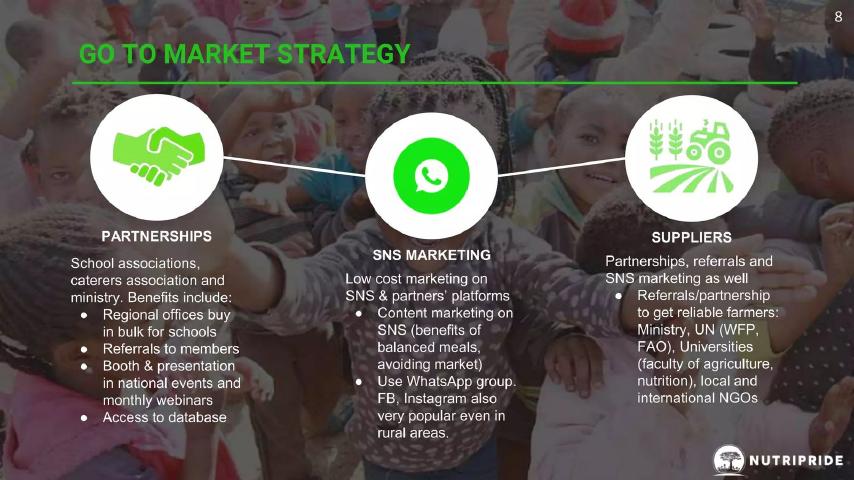
- The go-to-market strategy relies on regional school associations for bulk buying and WhatsApp for low-cost marketing in rural areas (slide 8).
- The company estimates impacting nearly 1 million children cumulatively by 2025 across 1,980 schools (slide 21).
- The total addressable market for school feeding in Ghana is calculated at $181,228,087, with private schools representing $133 million of that opportunity (slide 22).
- The global school feeding market size is estimated at $11.4 billion, providing a long-term scale narrative (slide 23).
- The funding ask is $180,000, with 75.4% of funds allocated to Sales and Marketing to hire staff (slide 14).
NutriPride Pitch Deck Analysis
NutriPride is a logistics and nutrition startup focused on the African school system, specifically starting in Ghana. The deck, dated 2020, outlines a plan to digitize the procurement of school meals to improve nutritional outcomes and reduce costs through supply chain optimization. The following teardown examines the 14 slides provided from the 28-slide deck.
Slide 1: Title and Mission
The cover slide establishes the company name, NutriPride, and a clear mission statement: "Improving school meals for the children in Africa." The branding includes a logo featuring a baobab-style tree and silhouettes of children, signaling a social impact focus. The copyright notice identifies the entity as NutriPride Foods Africa Inc.
Slide 2: The Problem Statement
NutriPride identifies two distinct problems. First, "Unbalanced School Meals," noting that in rural Ghana, meals can consist of 80% rice and oil, leading to low immunity. Second, "Inefficient Food Sourcing @ Market," which involves crowded, manual procurement processes. By linking these to "COVID risk," the deck attempts to create urgency around the need for a more sanitary and efficient supply chain.
Slide 4: Product and MVP Workflow
This slide explains the digital solution in three steps. Users "Select Meal Plan" based on regional availability. The "Volume Calculated" step shows a software interface where student counts for Kindergarten, Primary, and Junior High are entered to generate a cost (e.g., GH¢ 2.94). Finally, the "Delivery" step shows an integration with Kadi, a logistics partner that uses AI to optimize routes. This demonstrates that NutriPride is a platform layer rather than a full-stack trucking company.
Slide 6: Nutritional and Cost Comparison
This is a data-heavy slide comparing NutriPride to mid/high-income and low-income schools. A bar chart shows NutriPride meeting nearly 50% of the RDI for vitamins and protein, significantly outperforming the alternatives. The cost is listed at 1.28 GHS per day per child, positioned as a middle ground that offers superior nutrition for a price lower than what high-income schools currently pay (1.49 GHS).
Slide 8: Go-To-Market Strategy
The strategy is split into three pillars: Partnerships, SNS Marketing, and Suppliers. They aim to work with regional offices for bulk buying and use WhatsApp for rural outreach. Interestingly, they list the UN (WFP, FAO) and universities as potential referral partners to find reliable farmers, suggesting a focus on building a trusted supplier network from the ground up.
Slide 10: Market Diversification
Titled "Pandemic Proof - Other Markets," this slide suggests that NutriPride can serve hospitals, universities, corporations, and street vendors. They estimate these secondary markets could account for 30% of total sales. This slide serves as a hedge against school closures, which were a significant risk during the 2020 publication of this deck.
Slide 12: Competitive Landscape
The competition slide uses a standard checkmark grid. NutriPride compares itself to Frikmat, Twiga, UCOOK, and Oh So Nutrition. The key differentiators claimed are the focus on schools, the inclusion of a dietitian, and a low-cost model specifically for Sub-Saharan Africa. The deck notes that while digital B2B marketplaces exist, they generally do not target the school sector.
Slide 14: The Ask and Use of Funds
The funding request is $180,000, down from a previous figure of $210,000. The breakdown shows that $30,000 is self-funded. The use of funds is heavily weighted toward Sales and Marketing (75.4%), with the specific goal of hiring sales and supply chain management staff. They also mention receiving a $1,000 Audience Choice Award from Sight and Life.
Slide 16: Contact and Partners
This slide serves as the "Thank You" and contact page for CEO Yutaro Ryan Oka. It features a row of logos representing partners or affiliations, including the Founder Institute, Kadi, and various agricultural foundations. While it provides a face to the company, it does not detail the professional backgrounds of the broader team, which is a notable omission in the provided slides.
Slide 18: Testimonial
A simple slide featuring a photo of a student giving a thumbs-up while eating. While it adds a human element, it lacks a written quote or specific data point regarding student satisfaction or health improvements.
Slide 21: Impact Projections
This table forecasts growth from 2021 to 2025. It starts with 656 schools and 95,120 children in 2021, scaling to 1,980 schools and a cumulative total of 987,450 children by 2025. The projections assume a constant average of 145 pupils per school, a figure attributed to the Ministry of Education.
Slide 22 & 23: Market Size Estimation
Slide 22 breaks down the Ghana market, identifying a Total Addressable Market (TAM) of $181.2 million. It highlights private schools as a $133 million opportunity due to higher spending per child ($0.25 vs $0.20 in public schools). Slide 23 expands this to a global scale, estimating the African school feeding market at $1.6 billion and the global market at $11.4 billion, using 2019 data from the WFP.
Slide 27: Financial Breakdown
The final slide in the set provides a "pessimistic case" for cash needs. It shows a requirement of $27,119 for 2020 and $185,739 for 2021. After accounting for $33,359 in self-funding and raised capital, the total remaining need is cited as $179,499, which aligns with the $180,000 ask on slide 14.
What Works in the NutriPride Deck
Granular Unit Economics: Slide 6 is the strongest in the deck. It doesn't just claim to be better; it compares specific RDI percentages and daily costs in local currency (GHS). This level of detail builds credibility with investors who understand the thin margins of the food industry. · Clear Problem/Solution Fit: The deck identifies a logistical bottleneck (open market sourcing) and a health outcome (low immunity) and addresses both with a single platform. · Market Segmentation: By separating public and private schools in the TAM calculation (slide 22), the founders show they understand that the sales cycle and revenue potential differ significantly between these two segments.
What is Missing from the NutriPride Deck
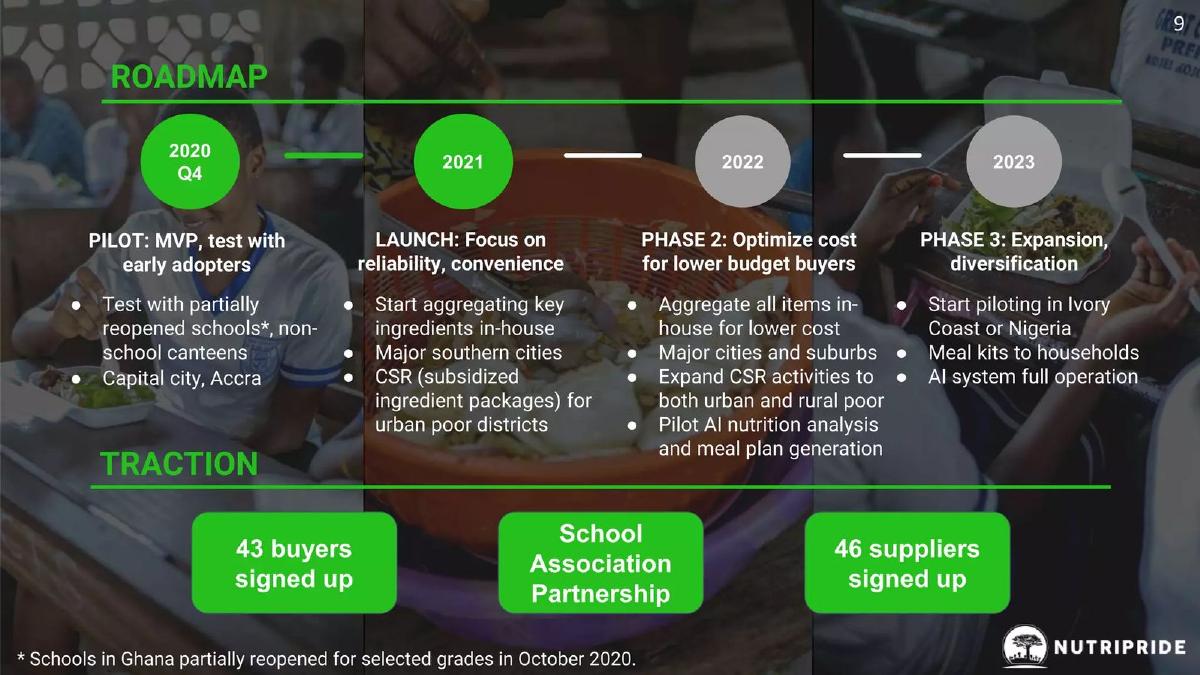
Team Background: While the CEO is pictured on slide 16, there is no information about his experience in logistics, nutrition, or the Ghanaian market. Furthermore, there is no mention of co-founders or key advisors, which is a significant red flag for an early-stage investment. · Traction Data: The deck focuses on projections (slide 21) and the MVP workflow (slide 4) but does not state how many schools are currently using the platform or if any pilot programs have been completed. · Logistics Risk Mitigation: The model relies entirely on a partner (Kadi) for delivery. The deck does not explain the terms of this partnership or what happens if the partner fails to scale alongside NutriPride.
Founder's Guide: What to Copy
The Comparison Chart: Use the format of slide 6 to compare your product against both the high-end and low-end of the market. Showing that you provide high-end value at a mid-range price is a compelling narrative. · Bottom-Up Market Sizing: Slide 22 is an excellent example of bottom-up TAM. It starts with the number of schools, multiplies by pupils, days per year, and spend per day. This is far more persuasive than simply quoting a large industry report. · Visualizing the Workflow: Slide 4 does a good job of taking a complex logistics process and boiling it down to three simple steps. This helps non-technical investors quickly grasp the value proposition.
Frequently asked questions
- What is the core product NutriPride is offering?
- NutriPride is a digital B2B platform for schools. It allows administrators to select regional meal plans, automatically calculates the necessary food volume based on the number of students in different age groups (Kindergarten to Senior High), and coordinates delivery through an AI-optimized logistics partner called Kadi. The goal is to replace manual, inefficient market sourcing with a data-driven supply chain.
- How does the company plan to compete with existing food marketplaces?
- According to slide 12, NutriPride differentiates itself by focusing specifically on the school sector, which other digital B2B marketplaces in Africa reportedly ignore. They also emphasize the inclusion of a dietitian to ensure nutritional variety and a low-cost model tailored for Sub-Saharan Africa, whereas competitors like UCOOK or Oh So Nutrition target wealthy households with meal kits.
- What are the specific unit economics for the meals?
- Slide 6 provides a detailed breakdown. NutriPride's meal costs 1.28 GHS per child per day. This is compared to 1.49 GHS for mid/high-income schools and 0.80 GHS for low-income schools. NutriPride claims their meal provides significantly higher percentages of RDI for vitamins, minerals, and protein compared to both income brackets, while keeping added sugar and sodium lower.
- What is the primary use of the $180,000 investment?
- The majority of the capital (75.4%) is earmarked for Sales and Marketing. Slide 14 explicitly states that the funds will be used for hiring sales and supply chain management staff. Smaller portions are allocated to SG&A (21.6%), R&D (1.7%), and the initial setup in Ghana (1.4%).
- How does NutriPride plan to reach rural schools?
- The go-to-market strategy on slide 8 highlights the use of 'SNS Marketing,' specifically mentioning WhatsApp groups, Facebook, and Instagram as popular tools even in rural areas. They also plan to leverage partnerships with school and caterer associations to gain access to databases and present at national events and monthly webinars.