Numeral's 2021 Seed deck is a textbook example of how to pitch complex financial infrastructure. By positioning themselves as the 'API-first payment automation platform,' they addressed a massive $200 trillion B2B payment market. The deck successfully balances high-level market opportunity with granular technical details, including API code snippets and a specific 2022 bank integration roadmap. While the deck lacks traditional traction metrics or a specific 'Ask' slide, the strength of the founding team—hailing from iBanFirst and Qonto—and the backing of eFounders provided the necessary credi…
Key takeaways
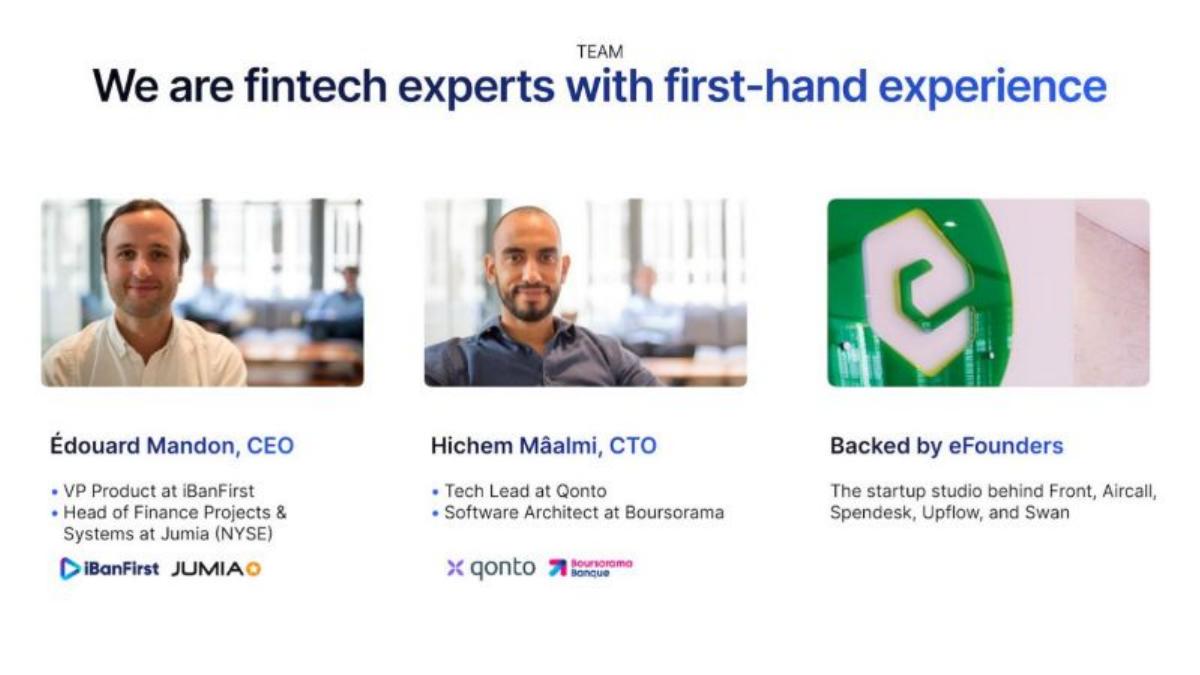
- The founding team highlights deep domain expertise from iBanFirst, Jumia, Qonto, and Boursorama on slide 2.
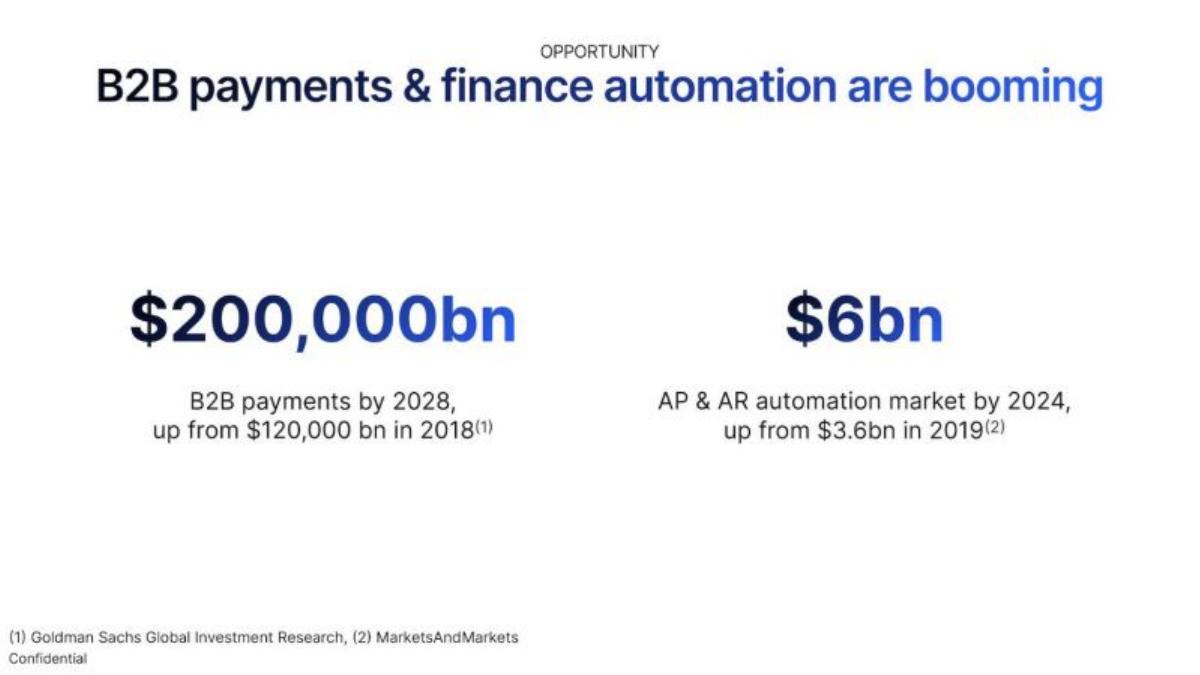
- B2B payments are projected to reach $200,000bn by 2028, up from $120,000bn in 2018, according to slide 4.
- The platform targets a $6bn AP & AR automation market, which is growing from a $3.6bn base in 2019 as shown on slide 4.
- Numeral positions itself as a bridge between internal systems (ERP, CRM) and the banking system via a single API on slide 8.
- The technical infrastructure claims 99.9% availability and ISO 27001 certification on slide 8.
- A detailed 2022 roadmap on slide 12 specifies expansion into the UK, France, Germany, Spain, and Italy with specific bank partners like Barclays and Deutsche Bank.
- The distribution strategy relies on three pillars: direct sales, bank partnerships, and software partnerships as detailed on slide 13.
- Competitive positioning on slide 14 places Numeral in the top-right quadrant, defined by 'API-first' and 'Technology provider' attributes.
Introduction: The Infrastructure Play
Numeral’s 2021 Seed deck represents a shift in fintech fundraising toward infrastructure. Rather than building a new bank, Numeral built the plumbing to connect businesses to existing banks. The deck is clean, professional, and highly focused on the technical 'how' and the 'who.' With a $14.6M result, this teardown explores how a team with high pedigree can raise significant capital by focusing on a massive, underserved niche in B2B payments.
Slide 1: Title Slide
The deck opens with a minimalist blue slide featuring the Numeral logo and the tagline: "Payment automation API." It is a functional start that immediately categorizes the company as a developer-focused tool rather than a consumer app.
Slide 2: The Team
Numeral puts its team slide second, a common tactic for founders with significant 'exit' or 'scale' experience. Édouard Mandon (CEO) brings experience from iBanFirst and Jumia (NYSE) , while Hichem Mâalmi (CTO) brings engineering leadership from Qonto and Boursorama . The slide also highlights that they are "Backed by eFounders," the startup studio responsible for successful companies like Front, Aircall, and Spendesk. This immediately establishes a high level of trust and reduces the perceived risk for investors.
Slide 3-4: The Opportunity and Market Size
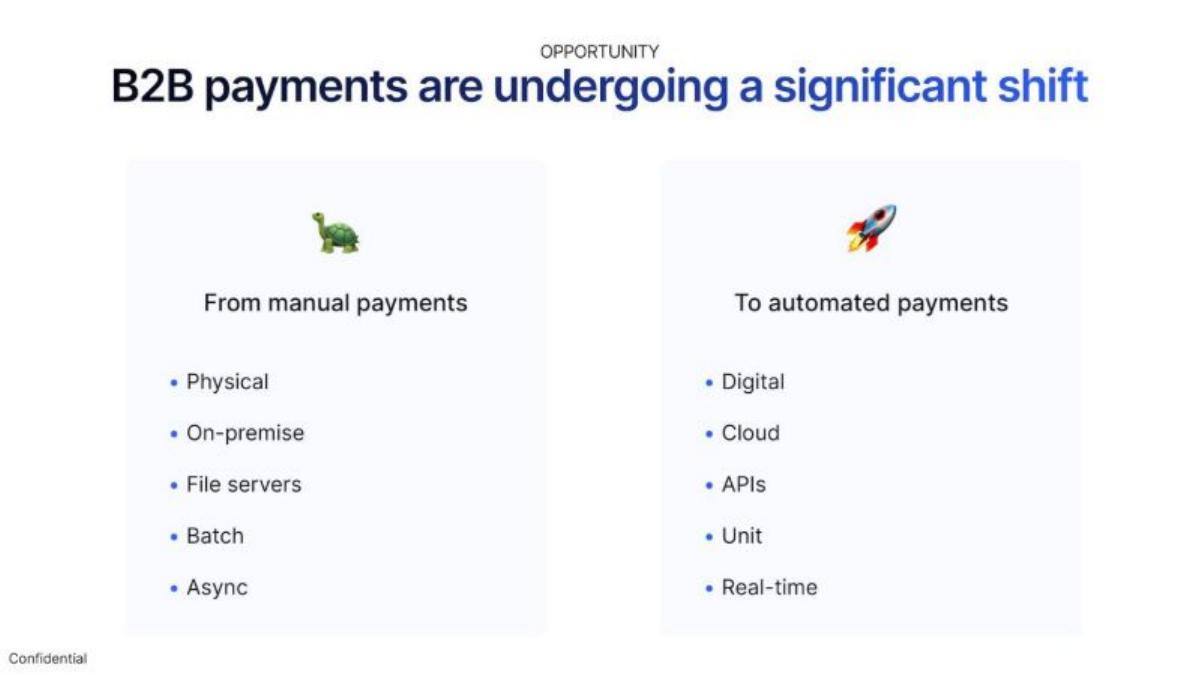
Slide 3 uses emojis to contrast the 'turtle' of manual payments (physical, on-premise, batch) with the 'rocket' of automated payments (digital, cloud, real-time). This is a simple but effective visual shorthand for the digital transformation narrative. Slide 4 backs this up with massive figures: a $200,000bn B2B payment market by 2028 (up from $120,000bn in 2018) and a $6bn AP & AR automation market by 2024 . By citing Goldman Sachs and MarketsAndMarkets, they anchor their potential in credible third-party data.
Slide 5-6: Mission and Problem
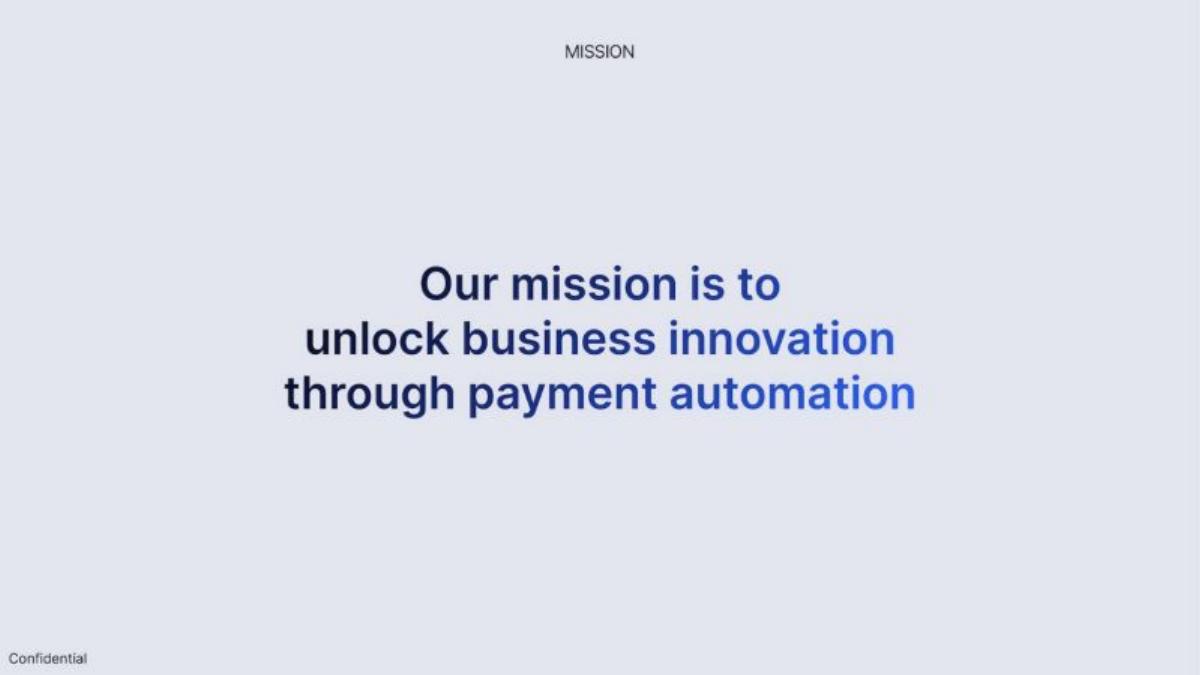
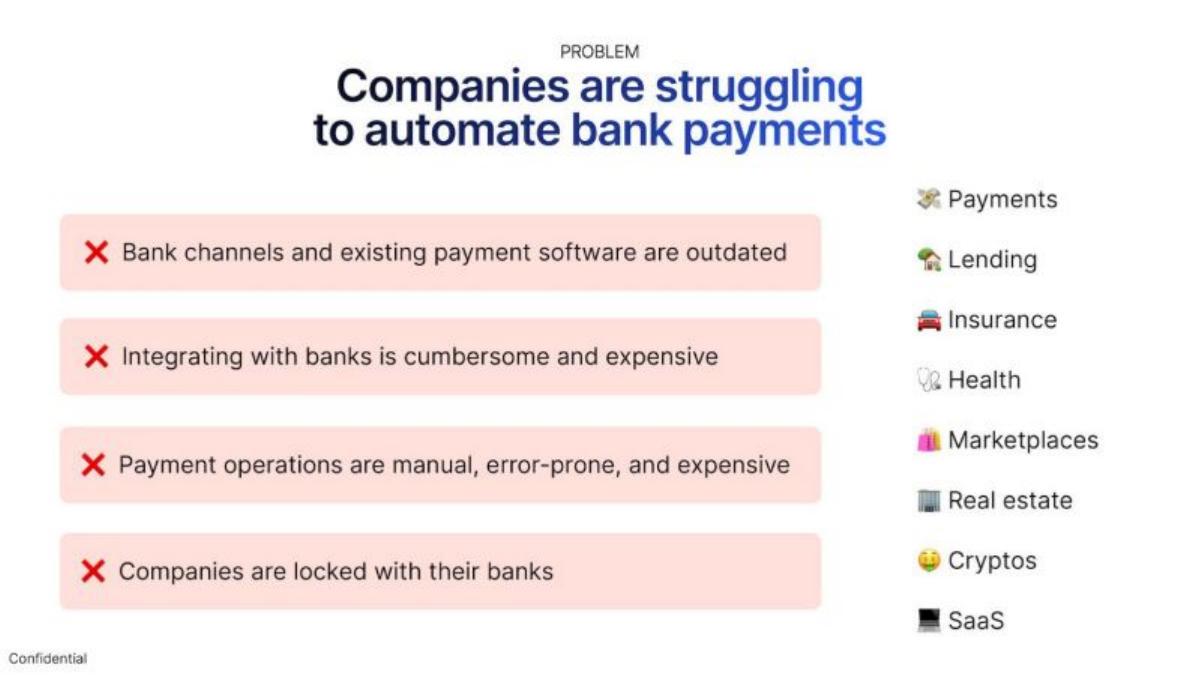
The mission is stated as "to unlock business innovation through payment automation." Slide 6 then breaks down the friction points: bank channels are outdated, integrations are cumbersome/expensive, and companies are 'locked' with their banks. The slide lists industries affected, including Lending, Insurance, Marketplaces, and Cryptos , suggesting a horizontal application for their vertical solution.
Slide 7-9: The Solution and Technical Depth
Slide 7 introduces the product as an "API-first payment automation platform." Crucially, it includes a code snippet. For an API company, showing the code is the equivalent of a product demo. It signals to technical investors that the product is real and developer-friendly. Slide 8 provides a system architecture diagram showing Numeral as the bridge between a company's Core banking, Back-office, CRM, and Accounting systems and the external banking network. They also list 'Enterprise-ready' credentials: ISO 27001, GDPR compliant, and 99.9% availability . Slide 9 lists specific features like "Returns & return requests" and "Events & webhooks," proving they understand the nuances of payment lifecycles.
Slide 10: Value Proposition
This slide translates technical features into business outcomes. The four pillars are: adding new payment methods quickly, expanding partner bank networks without new development, combining unit and batch processing, and scaling finance teams without increasing headcount. This addresses both the CTO (speed of development) and the CFO (operational efficiency).
Slide 11-12: Market Expansion and Roadmap
Slide 11 shows a clear 'land and expand' strategy, moving from Fintech companies to Tech companies and finally to Corporates . This demonstrates a path to a larger TAM. Slide 12 is perhaps the most important slide for a Seed round: the 2022 bank integration roadmap . It maps out specific countries (UK, France, Germany, Spain, Italy) and specific banks (Barclays, HSBC, Deutsche Bank, etc.). This gives investors a concrete set of milestones to track progress against.
Slide 13: Distribution
Numeral outlines a three-pronged distribution strategy: Direct sales for high-value fintechs, Bank partnerships to acquire customers at scale, and Software partnerships to embed payments into other SaaS tools. This shows a sophisticated understanding of B2B customer acquisition beyond just 'hiring a sales team.'
Slide 14: Competitive Positioning
The standard 2x2 matrix places Numeral in the top-right quadrant. The axes are Legacy tech vs. API-first and Financial services vs. Technology provider . They position themselves against legacy players like Citigroup and BNP Paribas and newer 'banking-as-a-service' players like Treezor and Swan , arguing that Numeral is a pure technology provider rather than a licensed financial service provider.
Slide 15-16: Conclusion
The deck ends with a contact slide for the CEO. Notably, there is no 'Ask' slide detailing the round size or use of funds, which suggests this deck was used as a teaser or in a highly competitive environment where the founders preferred to discuss terms live.
What Numeral Does Well
1. Credibility First: By leading with a high-pedigree team and the eFounders backing, Numeral bypasses the 'can they build it?' question that plagues many Seed startups. 2. Technical Specificity: Including code snippets and a detailed bank integration roadmap proves that the product is more than just a slide deck. It demonstrates deep domain knowledge. 3. Clear Differentiation: The competitive matrix clearly separates Numeral from 'Banking-as-a-Service' (BaaS) players. They aren't a bank; they are the software that talks to banks. This is a crucial distinction for their business model and regulatory profile.
What is Missing
1. The Ask: There is no mention of how much money they are raising or what they will do with it. While this can be a strategic choice in a 'hot' round, it leaves a gap in the narrative for a standard pitch. 2. Traction Metrics: There are no figures regarding current transaction volume, number of pilot customers, or revenue. For a $14.6M Seed, one would expect at least some early validation data. 3. Unit Economics: The deck explains the 'Customer Model' in the listing, but the slides don't touch on how they charge (e.g., per transaction, per integration, or SaaS fee). Investors usually want to see the revenue engine's mechanics.
Founder's Playbook: What to Copy
1. Use the 'Turtle vs. Rocket' Analogy: If you are disrupting a legacy industry, use simple visuals to contrast the old way with the new way. It sticks in an investor's mind better than a list of bullet points. 2. Show the Roadmap: Don't just say you will expand; show a map with specific dates and names. Numeral’s slide 12 is a masterclass in showing geographic and technical intent. 3. The 'Enterprise-Ready' Checklist: If you are selling to big companies or financial institutions, include a small list of certifications (ISO, GDPR, Uptime). It signals that you are ready for the long sales cycles and security audits of enterprise sales.
Frequently asked questions
- How much did Numeral raise with this deck?
- According to the catalogue listing, Numeral raised $14.6M in a Seed round in 2021. The deck itself does not state the amount being raised or the valuation, which is common for decks used in the early stages of a high-profile studio-backed raise where terms may be fluid.
- Who are the founders of Numeral?
- As shown on slide 2, the company was founded by Édouard Mandon (CEO), formerly VP Product at iBanFirst and Head of Finance Projects at Jumia, and Hichem Mâalmi (CTO), formerly Tech Lead at Qonto and Software Architect at Boursorama. Their background in established fintechs is a core part of the pitch.
- What is Numeral's core product?
- Numeral is an API-first payment automation platform. As described on slides 7 and 8, it allows tech companies and financial institutions to connect to existing partner banks to automate payments and reconciliations through a single integration, replacing manual bank portal uploads and legacy file-based systems.
- Which markets does Numeral target?
- Slide 12 outlines a specific European focus, targeting the United Kingdom, France, Germany, Spain, and Italy. The roadmap includes integrations with major banks such as HSBC, Barclays, BNP Paribas, Société Générale, Deutsche Bank, and Santander.
- What is missing from the Numeral pitch deck?
- The deck lacks several standard components: there is no slide detailing current traction (revenue or user growth), no specific 'Ask' (how much they are raising), and no detailed financial projections. It relies heavily on the market opportunity and the team's ability to execute on a complex technical roadmap.