Nubity's 2013 pitch deck is remarkably lean, consisting of only eight slides. It eschews the traditional deep-dive into technical architecture in favor of a clear, three-step process for cloud management and a compelling financial comparison. The deck relies heavily on traction metrics, specifically citing $1M in ARR and 20% month-over-month growth on slide 4. By positioning its service as a cost-effective alternative to high-priced US-based DevOps engineers—contrasting a $150,000 'Real World' salary against a $50,000 'Nubity Ninja' salary on slide 5—the company presented a clear path to its…
Key takeaways
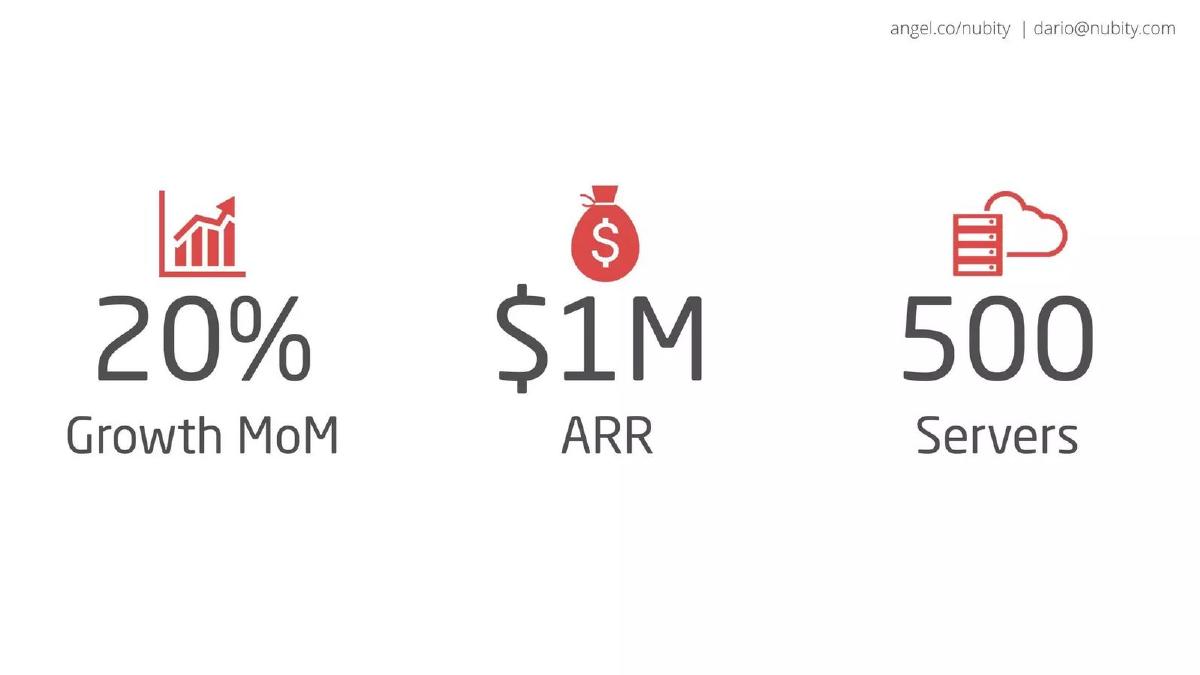
- The deck reports a significant traction milestone of $1M ARR and 20% month-over-month growth on slide 4.
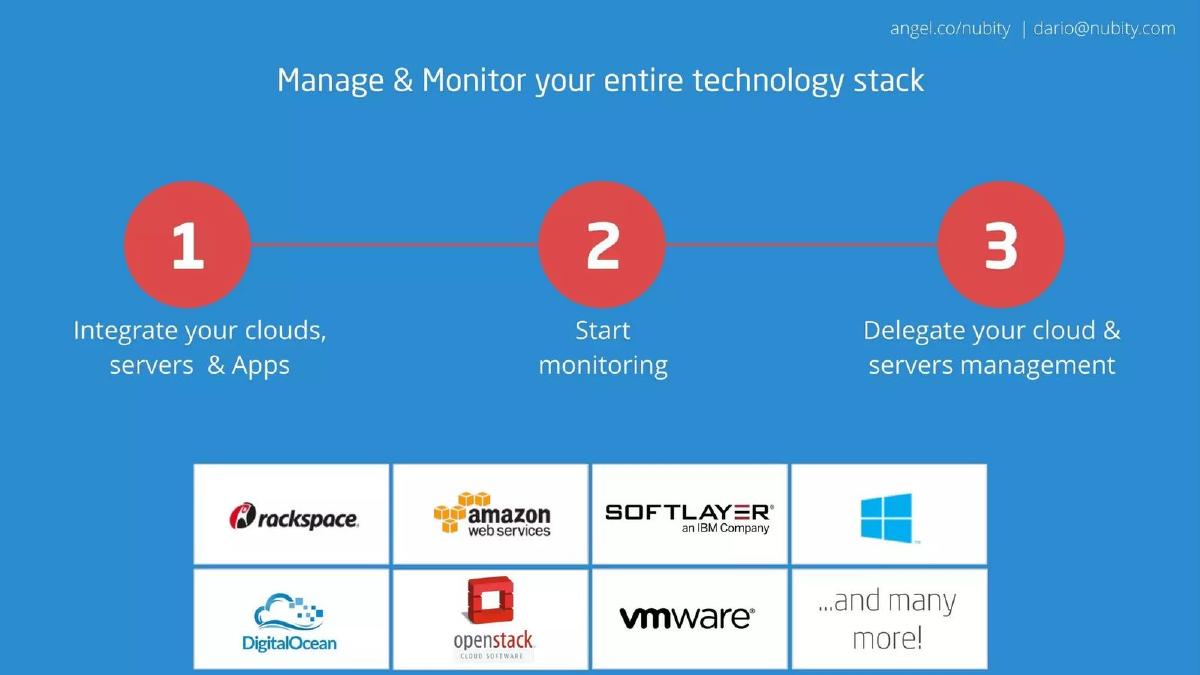
- Nubity defines its service through a simple three-step process: integrate, monitor, and delegate on slide 2.
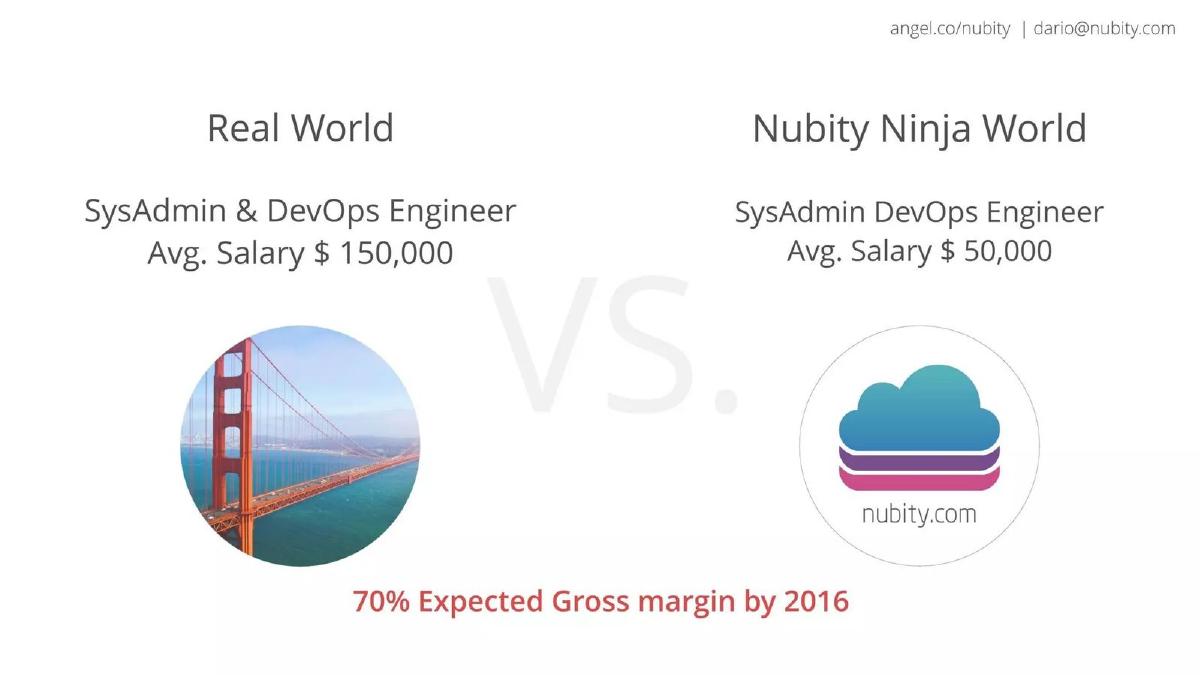
- A direct cost comparison on slide 5 contrasts a $150,000 average DevOps salary with a $50,000 'Nubity Ninja' salary.
- The company projects a 70% gross margin by 2016, as stated on slide 5.
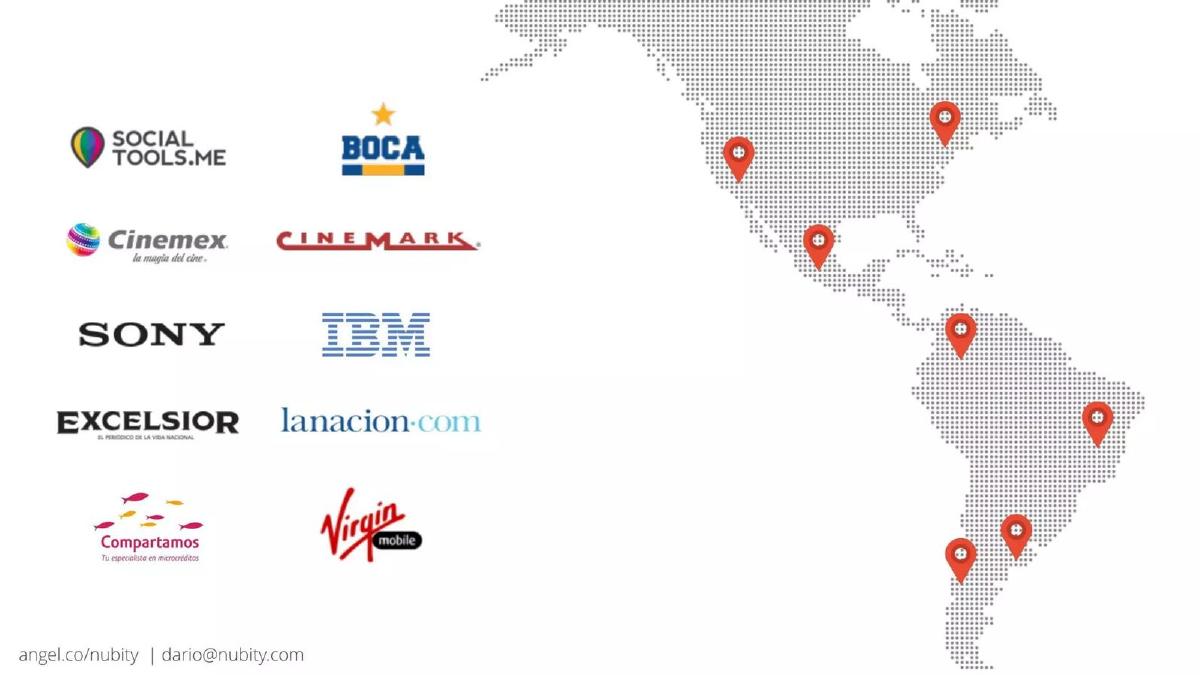
- Slide 6 displays a strong roster of enterprise clients and partners, including Sony, IBM, Cinemark, and Virgin Mobile.
- The deck utilizes a geographic map on slide 6 to show presence across North and South America, including Mexico and Brazil.
- Technical integrations are highlighted on slide 2, featuring logos for AWS, Rackspace, Softlayer, and OpenStack.
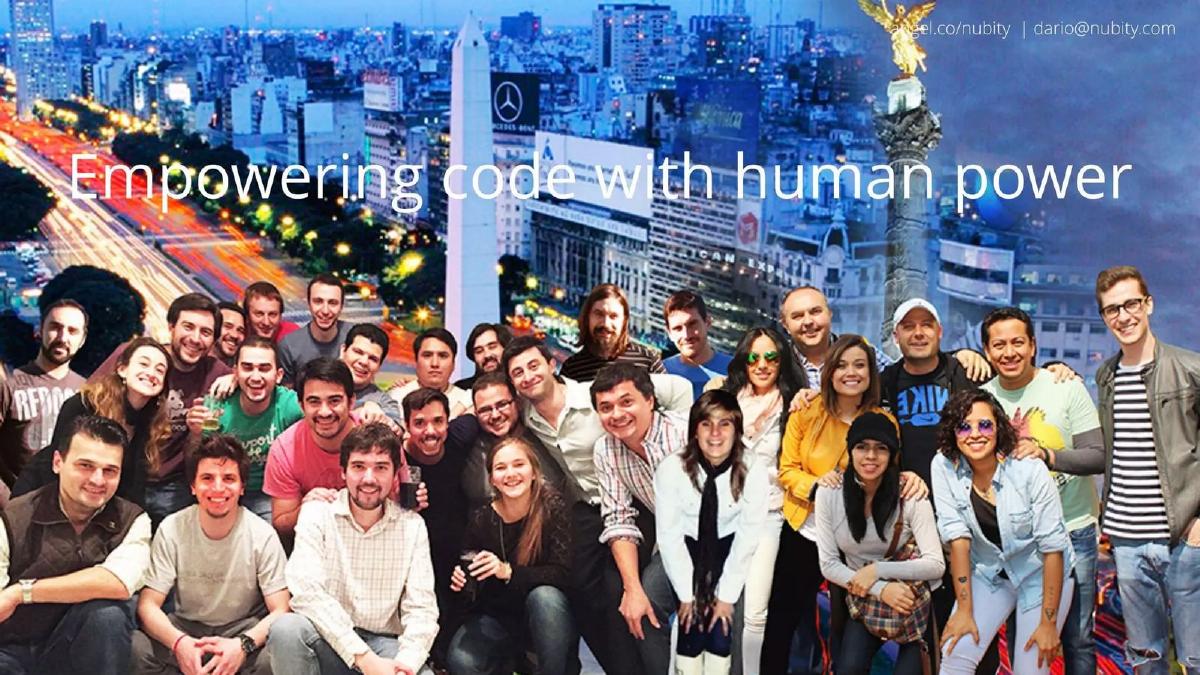
- The deck lacks a dedicated team slide, choosing instead to show a large group photo with the slogan 'Empowering code with human power' on slide 3.
Introduction: The Lean Approach to DevOps Fundraising
The Nubity pitch deck from 2013 is an anomaly in the world of later-stage fundraising. While many companies at this stage produce 20-slide decks filled with complex architecture diagrams and multi-year financial projections, Nubity opted for an 8-slide presentation that focuses almost exclusively on traction and cost-efficiency. According to catalogue data, this deck helped secure $2,700,000 in funding, proving that a clear value proposition can sometimes outweigh volume.
Slide 1: Title and Positioning
The deck opens with a clean, blue title slide. It identifies Nubity as a Monitoring Platform & DevOps as a Service . The inclusion of the website URL and contact information for Dario Peña in the header establishes immediate professional accessibility. The branding is consistent, featuring a cloud-based logo that hints at the company's technical focus without being overly complex.
Slide 2: The Three-Step Process
Slide 2 attempts to simplify a complex technical service into a three-step workflow. The steps are listed as: 1. Integrate your clouds, servers & Apps , 2. Start monitoring , and 3. Delegate your cloud & servers management . Below this process, the slide displays logos for major infrastructure providers, including Rackspace, Amazon Web Services, Softlayer (an IBM Company), DigitalOcean, OpenStack, and VMware . This slide serves two purposes: it explains the user journey and establishes credibility through association with industry giants.
Slide 3: The Human Element
Instead of a traditional team slide with headshots and resumes, slide 3 features a large group photo of approximately 30 people. The headline reads Empowering code with human power . While this conveys the scale of the operation, it fails to provide the specific credentials of the leadership team. Investors typically look for the 'why us' in a team slide, which is missing here, replaced by a general sense of company culture and headcount.
Slide 4: Traction and Growth Metrics
This is the most critical slide in the deck. It presents three key figures: 20% Growth MoM , $1M ARR , and 500 Servers . By leading with a million-dollar revenue run rate and high double-digit monthly growth, Nubity answers the most important question for later-stage investors: is the business working? The simplicity of the icons (a growth chart, a money bag, and a server rack) ensures the metrics are the focal point.
Slide 5: The Economic Advantage
Slide 5 presents the company's core financial thesis through a 'Real World' vs. 'Nubity Ninja World' comparison. It states that a SysAdmin & DevOps Engineer in the real world (represented by an image of the Golden Gate Bridge, implying San Francisco) costs an Avg. Salary of $150,000 . In contrast, a Nubity Ninja costs an Avg. Salary of $50,000 . The slide concludes with a bold claim: 70% Expected Gross margin by 2016 . This slide clearly articulates the cost-arbitrage model that drives the company's profitability.
Slide 6: Market Presence and Social Proof
This slide combines a logo wall with a geographic map. The logos include Sony, IBM, Cinemark, Cinemex, Virgin Mobile, and La Nacion . The map shows red pins across North and South America, specifically highlighting locations in the United States, Mexico, Colombia, Brazil, Chile, and Argentina. This demonstrates that Nubity is not just a local player but has successfully scaled its 'DevOps as a Service' model across the hemisphere.
Slide 7: The Problem Visualized
Slide 7 is a stylistic choice, showing a browser window with a 404-style 'Oops!!!' error message . The text reads: Sorry, it appears there has been an internal server error with the page you've requested. We're working to solve the problem! This slide visually represents the pain point Nubity solves—downtime and server errors—without using bullet points. It acts as a transition to the final call to action.
Slide 8: The Call to Action
The final slide uses a play on the 'Keep Calm' meme, stating KEEP CALM AND SIGN UP FOR NUBITY . Like the rest of the deck, it is minimalist. However, it lacks a specific 'Ask' for investors, such as the amount of money being raised or what the funds will be used for. It functions more as a closing brand statement than a fundraising conclusion.
What Works in the Nubity Pitch Deck
The primary strength of this deck is its clarity of metrics . By placing the $1M ARR and 20% growth figures on a single, uncluttered slide, the founders ensure that no investor can miss the company's momentum. The cost-arbitrage comparison on slide 5 is also highly effective. It takes a complex service and boils it down to a simple mathematical advantage: providing the same technical expertise for one-third of the price. Finally, the logo wall on slide 6 is impressive for a 2013 startup, featuring global brands like Sony and IBM, which immediately validates the enterprise-grade nature of their monitoring platform.
What is Missing from the Nubity Pitch Deck
The most glaring omission is a detailed team slide . While the group photo shows scale, it doesn't highlight the specific expertise of the founders, Dario Peña and Juan Ozino Caligaris. Investors at the $2.7M level generally require proof of technical and operational leadership. Additionally, there is no competitive analysis . The cloud monitoring space in 2013 was already becoming crowded with players like New Relic and Datadog; failing to mention how Nubity differentiates itself from these tools (other than through human service) is a missed opportunity. Finally, the deck lacks a financial 'Ask' . There is no mention of the $2.7M target or how that capital would be deployed to increase the server count or ARR.
What a Founder Should Copy
Founders should emulate Nubity's minimalist design philosophy . Each slide focuses on one single idea, which prevents 'cognitive overload' during a pitch. The use of social proof through logos is also a best practice; if you have big-name clients, they should be front and center. Most importantly, founders should copy the directness of the traction slide . If your metrics are strong, you don't need to hide them behind paragraphs of text. Nubity's ability to summarize their entire value proposition into a three-step process (Slide 2) is also a highly effective way to explain a technical product to non-technical investors.
Conclusion
Nubity's deck is a product of its time, leaning heavily on the burgeoning 'as-a-service' trend and the geographic cost advantages of the era. While it breaks many 'rules' of pitch deck construction—most notably the omission of a team bio and a clear ask—its focus on undeniable traction and a high-margin business model proved sufficient to close a significant round. It serves as a reminder that for many investors, the numbers on the traction slide are the only ones that truly matter.
Frequently asked questions
- What is Nubity's core business model according to the deck?
- Nubity positions itself as a 'Monitoring Platform & DevOps as a Service' (Slide 1). The model focuses on allowing companies to delegate their cloud and server management to Nubity's team. This is supported by a cost-arbitrage strategy where they provide DevOps expertise at a significantly lower cost ($50,000) than the market average of $150,000, aiming for 70% gross margins (Slide 5).
- How much traction did Nubity have at the time of this deck?
- According to slide 4, Nubity had reached $1 million in Annual Recurring Revenue (ARR). The company was also experiencing 20% month-over-month growth and was managing 500 servers. This high level of traction for a later-stage deck likely compensated for the lack of detailed technical or financial slides.
- Which major companies were using Nubity in 2013?
- Slide 6 lists several high-profile clients and partners, including Sony, IBM, Cinemark, Cinemex, and Virgin Mobile. The slide also features regional players like La Nacion, Compartamos, and SocialTools.me, demonstrating a broad market reach across various industries and geographies in the Americas.
- What is the 'Nubity Ninja' concept mentioned in the deck?
- The 'Nubity Ninja' refers to the company's internal DevOps engineers. On slide 5, Nubity compares the 'Real World' cost of a SysAdmin/DevOps Engineer ($150,000) to the 'Nubity Ninja World' cost ($50,000). This suggests the company leverages lower-cost labor markets (likely Mexico, given their HQ) to provide high-value technical services at a competitive price point.
- What essential pitch deck elements are missing from this presentation?
- This deck is missing several standard components: a dedicated team slide with bios, a detailed problem/solution breakdown, a competitive landscape analysis, a specific financial 'Ask,' and a roadmap for future product development. It relies almost entirely on current traction and a simplified value proposition to tell the story.