Novo’s 2021 Series A deck is a concise 13-slide presentation that successfully raised $40.7M by leaning heavily on massive traction and a clear market segmentation. The company identifies the 'Mainstream Online Small Business' as an underserved middle ground between gig-economy apps and high-end enterprise banking. The deck shines by showing an 18x increase in annual revenue run rate and a 41x increase in total deposits since January 2020. While it lacks a traditional team slide or detailed financial projections, it compensates with a strong technical argument: that true innovation in banking…
Key takeaways
- Novo claims the #1 problem for small businesses is cash flow on slide 1.
- The company reports having over 65,000 small businesses using the platform as of slide 4.
- Since January 2020, Novo achieved an 18x annual revenue run rate growth and 41x total deposit growth (slide 4).
- Gross Transaction Volume reached $1.2B by the time of the Series A raise (slide 4).
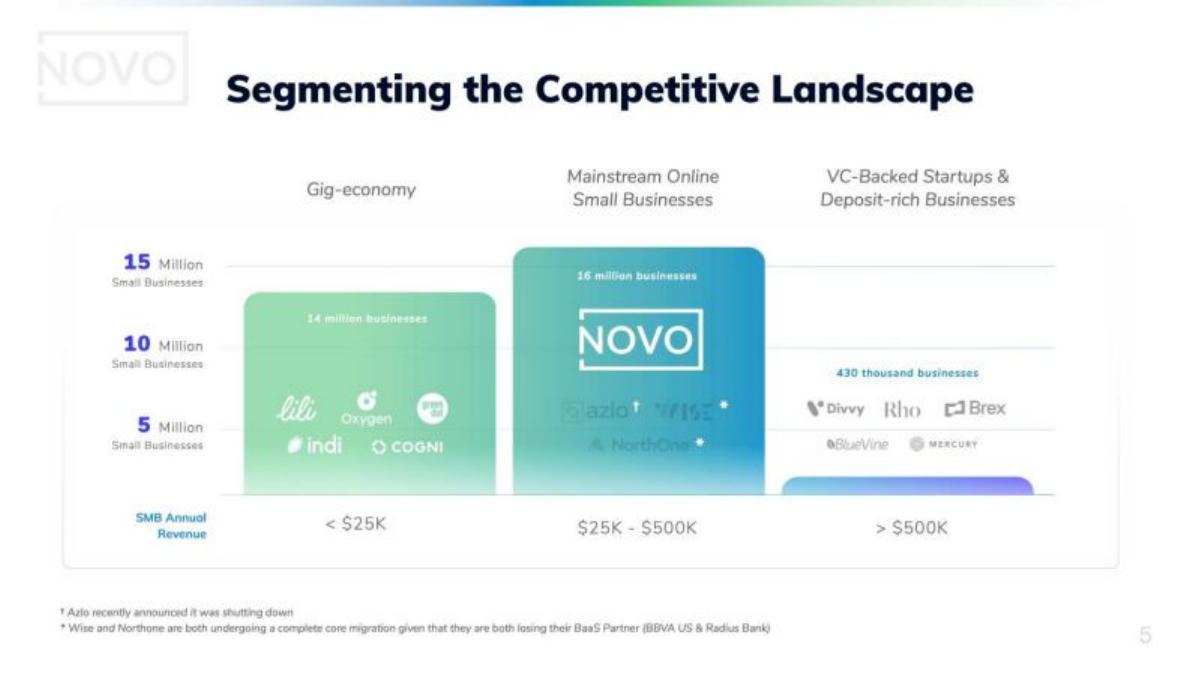
- Novo targets the 'Mainstream Online Small Business' segment, defined as businesses with $25K to $500K in annual revenue (slide 5).
- The deck identifies 16 million businesses in their target segment, which is larger than the 430,000 businesses targeted by competitors like Brex or Mercury (slide 5).
- Novo utilizes a proprietary infrastructure layer that sits on top of existing bank partners like Middlesex Federal (slide 9).
- The platform maintains high user ratings with a 4.8 on the iOS App Store and 4.6 on the Google Play Store (slide 10).
The Narrative: Infrastructure as a Competitive Moat
Novo’s Series A deck is built on a single, powerful thesis: that banking for small businesses is fundamentally broken because most fintechs don't control the underlying plumbing. By the time this deck was circulated in 2021, the 'neobank' space was crowded, but Novo used its 13 slides to prove they weren't just another interface on top of a legacy bank. They presented themselves as a technology company that had successfully built a proprietary 'value-layer' to solve the cash flow problems of 16 million mainstream online businesses.
Slides 1-3: The Problem and the 'Secret'
The deck opens with a bold, minimalist aesthetic. Slide 1 identifies the primary pain point: "The #1 problem Small Businesses face is Cash Flow." This is a classic 'hair on fire' problem that immediately resonates with investors. Slide 2 moves to the structural hurdle, claiming that "The only way you can change anything in banking is by controlling the infrastructure."
Slide 3 introduces "Novo's Secret." The company claims they have already achieved this infrastructure control and used it as a "perfect wedge" for small online businesses. This section is designed to create intrigue. It moves quickly from a universal problem to a specific, technical solution without getting bogged down in jargon early on.
Slide 4: The Traction 'Mic Drop'
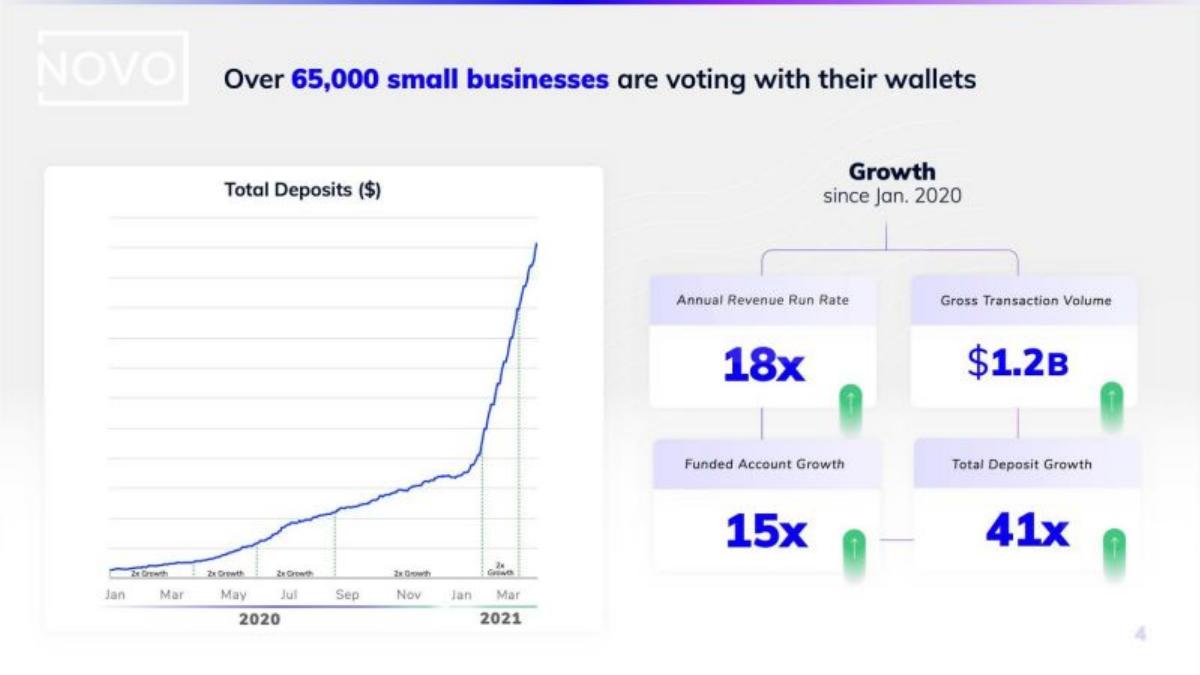
If the first three slides were the setup, Slide 4 is the punchline. This is arguably the most important slide in the deck. It features a steep 'J-curve' graph of Total Deposits ($) from January 2020 to March 2021. The annotations on the graph show consistent "2x Growth" intervals, culminating in a massive spike in early 2021. The slide lists four staggering figures:
Annual Revenue Run Rate: 18x growth. · Gross Transaction Volume: $1.2B. · Funded Account Growth: 15x. · Total Deposit Growth: 41x.
By stating that "Over 65,000 small businesses are voting with their wallets," Novo shifts the conversation from 'what we might do' to 'what we are already doing at scale.'
Slide 5: Market Segmentation and Competitive Positioning
Slide 5 is a sophisticated take on the standard 'competitor matrix.' Instead of a simple 2x2 grid, Novo segments the landscape by SMB Annual Revenue. They divide the market into three buckets:
Gig-economy ( Served by Lili, Oxygen, and Green Dot. · Mainstream Online Small Businesses ($25K - $500K revenue): This is Novo's target, with 16 million businesses. They list NorthOne and Wise as competitors here but include footnotes noting that these competitors are undergoing "complete core migrations" due to losing their BaaS partners. · VC-Backed Startups & Deposit-rich Businesses (>$500K revenue): Served by Brex, Mercury, and Rho.
This slide is brilliant because it shows that Novo is targeting a massive, underserved middle market (16M businesses) rather than fighting over the smaller startup niche (430K businesses) or the low-margin gig economy.
Slides 6-8: The Product Solution
Slide 6 uses social proof to validate the 'broken' state of traditional banking. It features a collage of frustrated tweets from users of Chase, Citibank, and Bank of America. It attributes these failures to "Overwhelming Fees & Obsolete Technology," "Siloed Data," and a "Slow-moving Financial System."
Slide 7 introduces "Novo Banking" as the antidote, promising easy banking, streamlined data, and faster cash flow. Slide 8 provides product visuals, highlighting "Fast Onboarding," "Virtual & Physical Debit Cards," "Deep Integrations," and an "App Store." This slide emphasizes that the product is already a comprehensive ecosystem, not just a checking account.
Slide 9: The Technical Architecture
Slide 9 returns to the infrastructure theme introduced on Slide 2. It compares "Business Banking 101" (where fintechs are at the mercy of banking platforms and partner banks) with "Novo Banking." Novo shows their "Extendable value-layer" sitting directly on top of existing bank infrastructure. This allows them to "plug in" future lending, bank, and payment partners. It specifically names Middlesex Federal as a current partner, illustrating how their proprietary tech allows for end-to-end control.
Slide 10: Social Proof and Validation
Slide 10 focuses on external validation. It displays high app store ratings (4.8 on iOS with 2.7K reviews; 4.6 on Google Play with 595 reviews). It also lists accolades from Money, CNBC, American Banker, and Visa, where they were the "Overall Winner of the Visa Everywhere Initiative." This slide serves to de-risk the investment by showing that both users and industry experts have vetted the product.
Slides 11-13: Closing and Omissions
Slide 11 is a simple 'Thank You' slide. Notably, it includes the names and email addresses of the founders, Michael Rangel and Tyler McIntyre, but it does not include a dedicated team slide with biographies or past successes. Slide 12 and Slide 13 are promotional slides for the platform where the deck was hosted (bestpitchdeck.com) and do not contain company information.
What Novo Does Well
Traction-First Approach: By putting the 41x deposit growth on Slide 4, Novo makes it impossible for an investor to ignore the momentum. · Clear Market Gap: Slide 5 identifies a specific 'Goldilocks' zone—businesses that are too big for gig-economy apps but too small/traditional for Brex—and quantifies it at 16 million businesses. · Strategic Moat: They don't just say they have a better app; they explain why (infrastructure control), which suggests long-term defensibility. · Social Proof: The use of both raw user complaints (Twitter) and high ratings (App Store) creates a compelling 'before and after' narrative.
What is Missing from the Novo Deck
Team Slide: While the founders' names are at the end, there is no detail on their backgrounds. In a Series A, investors usually want to see the 'why us' for the leadership team. · Financial Projections: The deck shows historical growth but offers no forward-looking projections or a path to profitability. · The Ask: There is no slide detailing how much capital they are raising or how they intend to spend it (e.g., marketing, hiring, R&D). · Unit Economics: There is no mention of Customer Acquisition Cost (CAC) or Lifetime Value (LTV), which are critical for evaluating the scalability of a fintech business.
Founder's Guide: What to Copy
The 'Secret' Slide: Every founder should have a 'Secret' or 'Insight' slide that explains the non-obvious reason why their solution works where others have failed. · Competitive Segmentation: Instead of a standard checkmark grid, use Novo's approach of segmenting by customer size and revenue. It shows a much deeper understanding of market dynamics. · Annotated Growth Charts: Don't just show a line going up. Annotate it with milestones (like Novo's "2x Growth" markers) to show the pace and consistency of the climb.
Frequently asked questions
- How much did Novo raise with this deck?
- According to the catalogue facts, Novo raised $40.7M in a Series A round in 2021. The deck itself focuses on the traction and infrastructure that justified this valuation, though the specific 'ask' amount is not printed on the slides.
- What is Novo's 'secret' mentioned in the deck?
- On slide 3, Novo states their secret is controlling the banking infrastructure. They argue that this control is the only way to change anything in banking and that they have leveraged this into a 'perfect wedge' for small online businesses.
- Who are Novo's primary competitors according to the deck?
- Slide 5 segments the market. Competitors for smaller businesses (<$25K revenue) include Lili and Oxygen. Competitors for larger businesses (>$500K revenue) include Brex, Mercury, and Rho. Novo positions itself in the middle, competing with NorthOne and Wise.
- What specific growth metrics did Novo highlight?
- On slide 4, Novo highlights four key metrics since January 2020: 18x Annual Revenue Run Rate growth, $1.2B in Gross Transaction Volume, 15x Funded Account Growth, and 41x Total Deposit Growth.
- What is missing from the Novo pitch deck?
- The 13-slide deck is missing several standard elements, including a team slide (though founders' emails are on the final slide), a roadmap, a detailed breakdown of unit economics (LTV/CAC), and a specific 'use of funds' slide.