Noto’s Seed deck is a masterclass in vertical SaaS positioning. By drawing direct parallels to industry giants like Toast and ServiceTitan, the company establishes a clear 'winner-take-all' narrative for the fragmented lesson-based business market. The deck identifies a specific, high-friction niche—tutoring, music, and dance schools—where 55% of the market still relies on spreadsheets and sticky notes. Noto’s strategy focuses on replacing legacy, private-equity-owned software with a modern system of record that integrates billing, payroll, and CRM. The inclusion of AI as a '10x value driver'…
Key takeaways
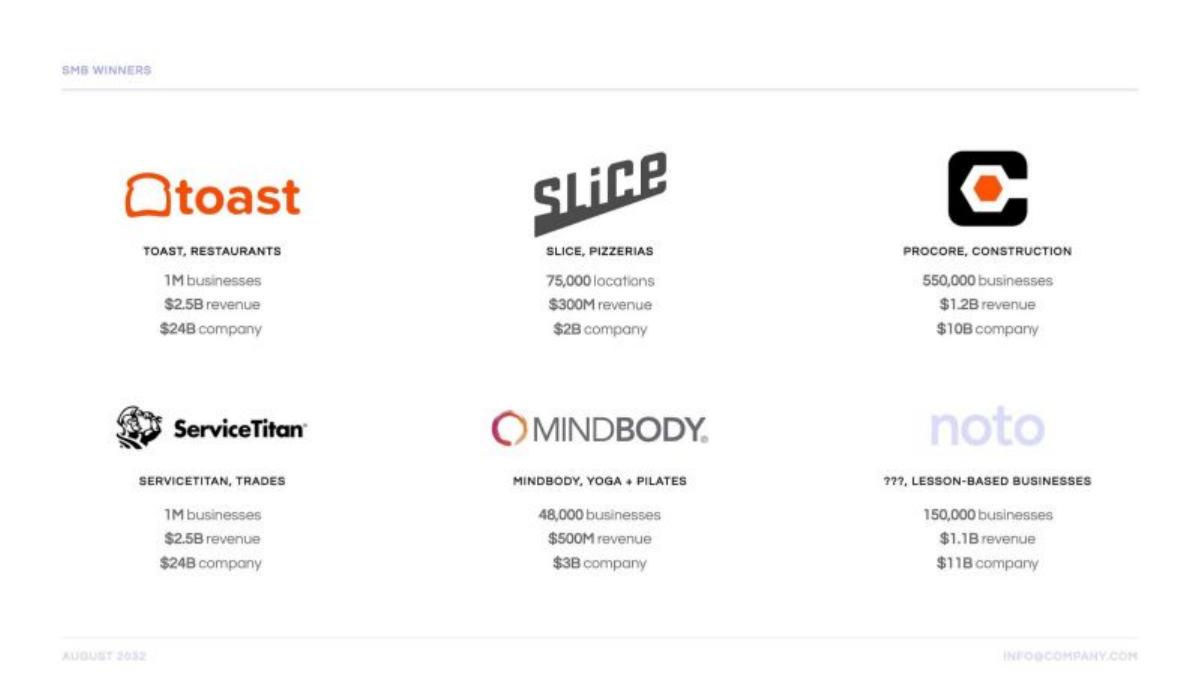
- Noto positions itself alongside 'SMB Winners' like Toast ($24B) and ServiceTitan ($24B) to anchor its potential valuation (Slide 2).
- The company identifies a total market of 150,000 businesses with a projected $1.1B in revenue and $11B company valuation (Slide 2).
- Market fragmentation is a core thesis, with 55% of the market using spreadsheets and 45% using legacy software over a decade old (Slide 8).
- The product strategy involves building a 'system of record' first, then using embedded APIs for payroll and billing (Slide 12).
- Noto targets a $100/month price point for its integrated CRM, positioning it as a replacement for HubSpot or Monday.com (Slide 13).
- AI is framed as a solution to the 'main growth bottleneck': customer onboarding and data migration (Slide 14).
- Distribution leverages curriculum networks like Yamaha and Suzuki to achieve rapid scaling through word-of-mouth (Slide 16).
- The fundraising ask focuses on hiring two full-stack engineers to automate migration and one bizops generalist (Slide 18).
The Vertical SaaS Playbook: Noto’s $3.8M Seed Deck
Noto’s pitch deck is a clinical example of how to pitch vertical SaaS in 2024. It moves quickly from market validation to product specificity, using the 'Operating System' narrative that has become the gold standard for industry-specific software. By focusing on 'lesson-based businesses'—a category that includes everything from SAT tutoring to ballet classes—Noto identifies a niche that is large enough to be lucrative but fragmented enough to lack a dominant modern incumbent.
Slide 1: Title Slide
The deck opens with a minimalist blue brand identity. The tagline is clear: 'The AI Native Operating System for Lesson-Based Businesses.' It sets the stage for a product that isn't just a tool, but the central infrastructure for a business. The date on the slide is January 2025, though the catalogue facts indicate the round was raised in 2024.
Slide 2: The SMB Winners Benchmark
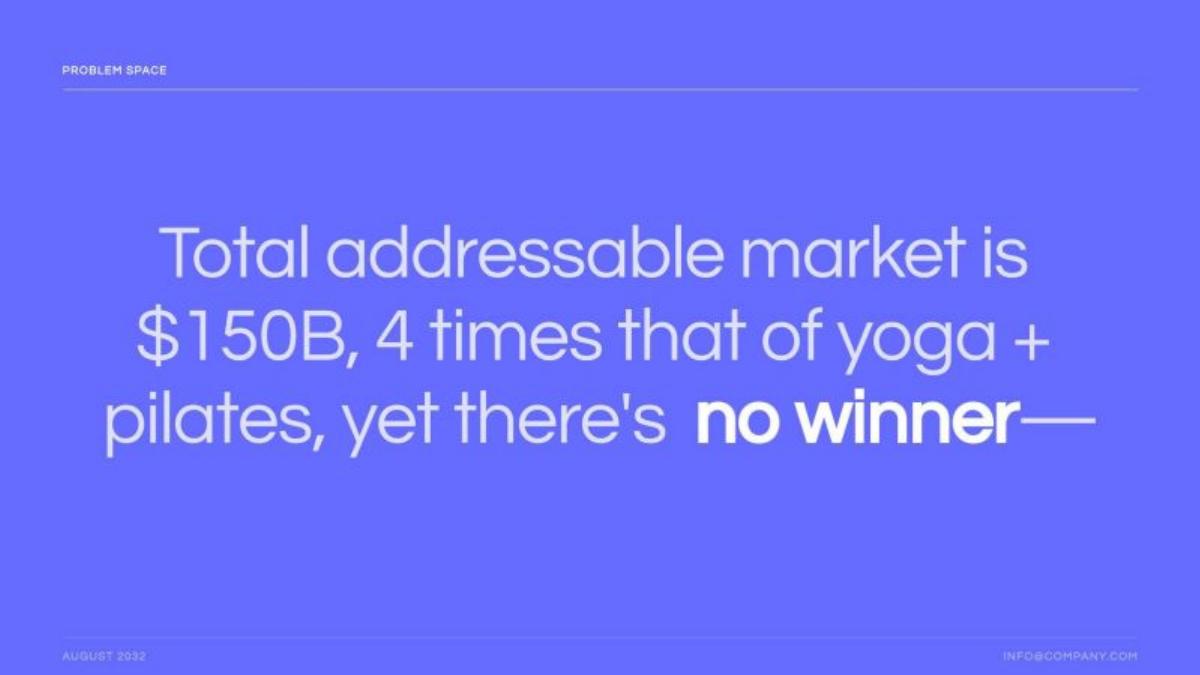
This is perhaps the most important slide for establishing Noto's 'ceiling.' They compare themselves to Toast (Restaurants), Slice (Pizzerias), Procore (Construction), ServiceTitan (Trades), and Mindbody (Yoga + Pilates). By listing the valuations of these companies (ranging from $2B to $24B), Noto is telling investors: 'This is the path we are on.' They project their own future at 150,000 businesses, $1.1B in revenue, and an $11B valuation.
Slide 3: Defining the Market
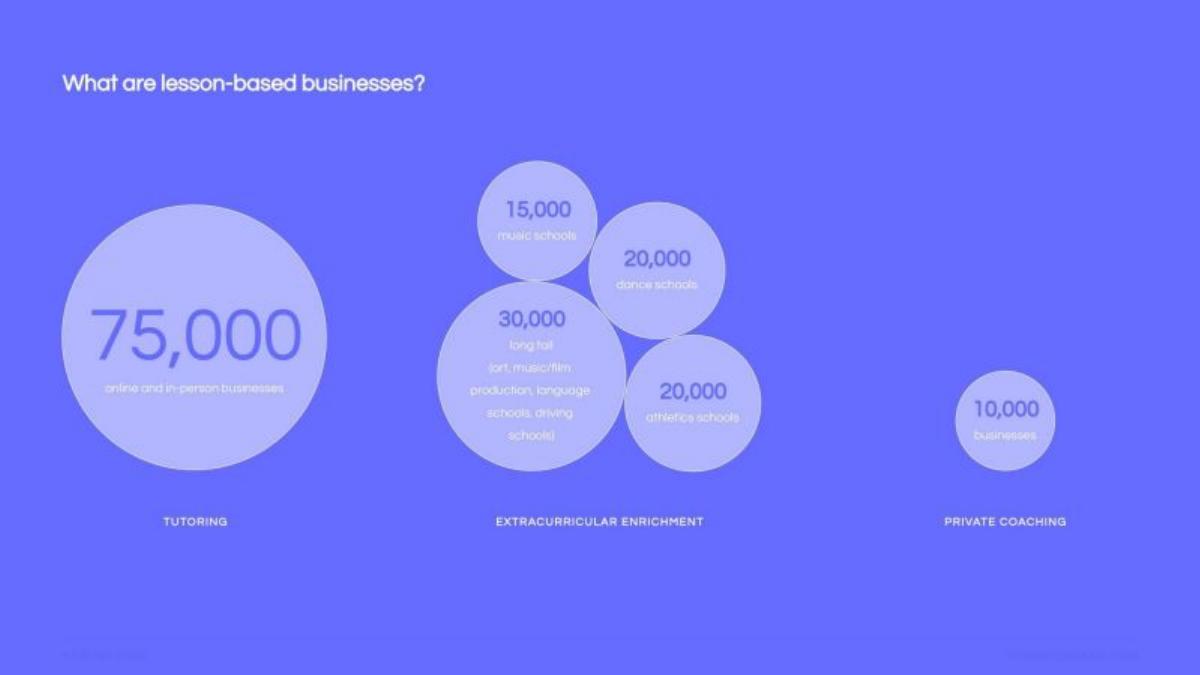
Slide 3 breaks down the 'lesson-based' category into three buckets: Tutoring (75,000 businesses), Extracurricular Enrichment (85,000 businesses across music, dance, athletics, and language), and Private Coaching (10,000 businesses). This visualization helps investors understand that 'lesson-based' isn't just a small niche, but a massive, multi-vertical opportunity.
Slide 4-7: The Problem and The Opportunity
Slide 4 asks what is unique about these businesses. Slide 5 provides the answer through a customer quote from 'Carrie, The Practice Room.' The pain points are constant rescheduling, invoicing, and the 'nonsense' of parent communication via email. Slide 6 and 7 frame the opportunity: achieving higher ACVs by decreasing labor costs and providing '10x value through AI on top of the system of record.' The emphasis here is on text-based communication, which is the lifeblood of these relationship-driven businesses.
Slide 8: The Competitive Landscape
Noto identifies two main competitors: 'spreadsheets and sticky notes' (55% of the market) and 'sluggish private equity owned legacy software' (45% of the market). They explicitly state that legacies don't monetize on payments like Noto does, which is a key revenue driver for modern vertical SaaS.
Slide 9: Product Overview
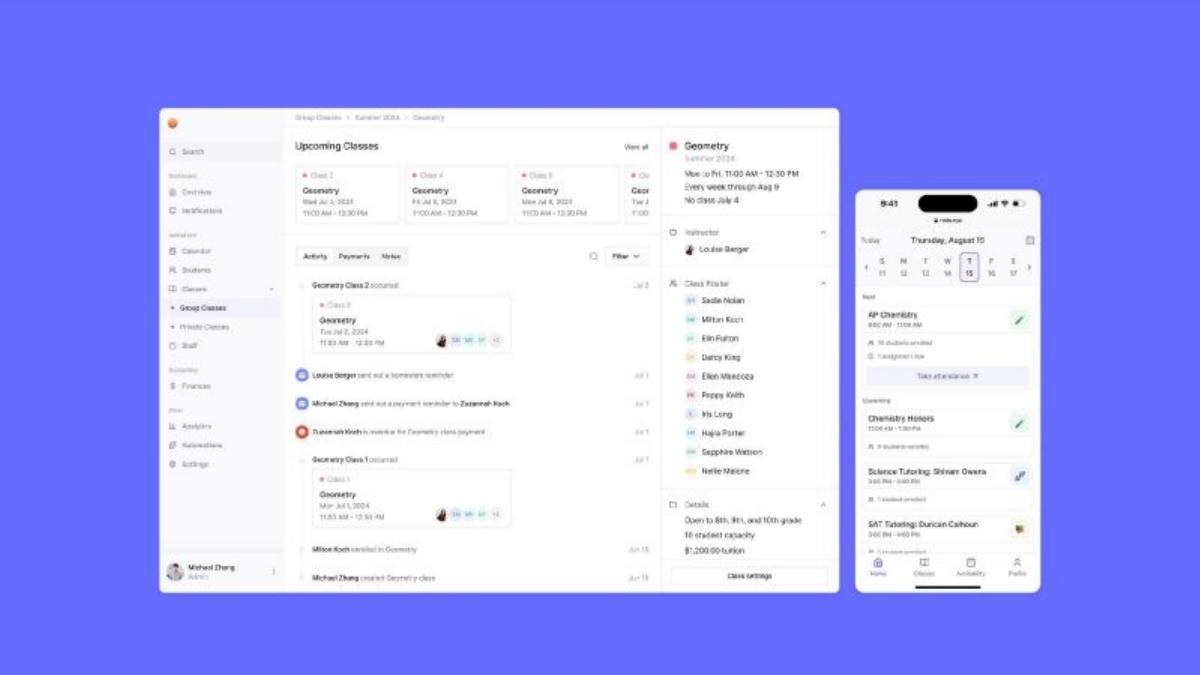
This slide shows a clean, modern dashboard. It highlights a calendar view with staff and room management. The copy emphasizes 'at a glance' operations and a modernized system that extends to owners, staff, and clients. It looks like a consumer-grade experience applied to a B2B problem.
Slide 10-11: Founder Background and Ground Game
Slide 11 provides a personal 'why.' The founder, AJ, saw his father (a former software engineer turned tennis coach) struggle to manage his business. It then highlights Noto’s 'ground game': in June 2024, the team walked the streets of NYC for two weeks, interviewing over 100 brick-and-mortar SMBs. This demonstrates a level of customer empathy and 'unscalable' work that investors love to see at the Seed stage.
Slide 12: The Strategy - System of Record
Noto’s strategy is to build a 'system of record' that folds in point solutions. They show integrations with Gusto, Stripe, and Check, using 'modern embedded APIs' to accelerate product development. This is a classic 'wedge' strategy: start with the core workflow and expand into payroll and fintech.
Slide 13: Replacing Generalist Tools
Slide 13 shows the CRM functionality. Noto positions itself as a replacement for 'expensive HubSpot or Monday.com subscriptions.' By offering a vertical-specific CRM for $100/month, they provide a more integrated and cost-effective solution for a small business owner.
Slide 14-15: The AI Value Driver
Slide 14 addresses the 'main growth bottleneck': onboarding and data migration. They argue that specialized AI agents can handle these tasks, reducing CAC. They also hint at higher pricing ($35K ACV) for AI features, citing companies like Decagon and Sierra as successful examples of AI-driven scaling. Slide 15 reinforces that AI can reduce 'communication-based work,' potentially replacing a full-time administrator.
Slide 16: Go-To-Market and Distribution
Noto’s GTM strategy is clever. Instead of just cold calling, they leverage 'curriculum networks' like Suzuki, Kaplan, and Yamaha. They also mention that ACH payments save customers $1,000+/month in fees, making the software an 'easy sell.' A map shows their current footprint across the US, with a notable concentration in the Northeast and California.
Slide 17-18: Traction and Fundraising
Slide 17 is a simple transition: 'Customers love us.' Slide 18 gets into the mechanics of the fundraise. They identify the current bottleneck: onboarding takes 2 to 3 weeks. The funding will enable 'strategic hires': 2 full-stack engineers to automate migration and 1 bizops generalist. This is a very specific and disciplined use of capital.
Slide 19-21: Conclusion
The deck ends with a series of high-level summary slides. They reiterate that lesson-based businesses are underserved and that Noto is building a future with 'minimal administrative burden.' Slide 21 is a standard 'Thank you!' slide.
Slide 22: Appendix / Walkthrough
The final slide is a product walkthrough screenshot showing a Kanban board for lead management (Prospect, Trial, Enrolled). It reinforces the CRM capabilities mentioned earlier in the deck.
What Noto Does Well
1. Benchmarking: By comparing themselves to Toast and ServiceTitan on Slide 2, Noto immediately frames the scale of the opportunity. It moves the conversation from 'a tool for music teachers' to 'a multi-billion dollar vertical SaaS play.'
2. Identifying the Bottleneck: Most decks gloss over the difficulties of scaling. Noto leans into it on Slide 14 and 18, identifying data migration as their biggest hurdle and explaining exactly how they will use AI and new hires to solve it.
3. Distribution Strategy: Leveraging existing curriculum networks (Yamaha, Suzuki) is a highly efficient way to acquire customers in a fragmented market. It shows they understand the 'watering holes' where their customers gather.
What is Missing from the Deck
1. Unit Economics: While they mention a $100/month price point and potential $35K ACVs, the deck lacks specific data on LTV (Lifetime Value) or current CAC (Customer Acquisition Cost). Investors would want to see the efficiency of those 'NYC street walks' translated into numbers.
2. Team Slide: The 22 slides provided do not include a traditional 'Team' slide with logos of former employers or schools. While Slide 11 gives a personal background for AJ, the broader team's technical and operational pedigree is not detailed in this selection.
3. Financial Projections: There is no slide showing a 3-5 year revenue forecast. While common in Seed decks to be light on these, the 'SMB Winners' slide sets a high bar that isn't backed up by a year-by-year growth plan in this version of the deck.
Founder Takeaways: What to Copy
1. The 'Ground Game' Narrative: If you have done the unscalable work of interviewing 100+ customers in person, put it in the deck. It proves you aren't just building in a vacuum and that you have a deep understanding of the user's daily life.
2. Vertical Positioning: Don't just say you are a CRM. Say you are a CRM that replaces HubSpot and Monday.com for your specific niche. Showing how you replace generalist tools is a powerful way to justify your pricing and existence.
3. Use AI as a Utility, Not a Gimmick: Noto doesn't just say 'we use AI.' They say they use AI to solve a specific business problem: the 2-3 week onboarding delay caused by data migration. This makes the AI story credible and grounded in operational reality.
Frequently asked questions
- What exactly are 'lesson-based businesses' according to Noto?
- Noto defines this segment as a mix of tutoring (75,000 businesses), extracurricular enrichment (including 15,000 music schools, 20,000 dance schools, and 20,000 athletics schools), and private coaching (10,000 businesses). As shown on Slide 3, they are targeting a total of approximately 150,000 online and in-person businesses that rely on recurring, scheduled instruction.
- How does Noto plan to differentiate itself from legacy competitors?
- The deck argues that 45% of the market uses 'sluggish private equity owned legacy software' that is over a decade old. Noto’s advantage lies in its modern tech stack, its ability to monetize through payments (which legacies supposedly don't do), and its 'AI-native' approach to automating the heavy administrative burden of rescheduling and parent communication (Slide 8, Slide 16).
- What is the primary business model and pricing mentioned?
- Noto operates as a B2B SaaS platform. Slide 13 explicitly mentions a $100/month price point for its tightly integrated CRM. Additionally, Slide 14 suggests that AI features could enable much higher pricing, targeting a $35K Annual Contract Value (ACV) for larger clients, while Slide 16 notes they save customers money on ACH payment fees.
- Who are the lead investors in Noto's Seed round?
- According to the catalogue facts, Noto raised $3.8M in 2024. The round was led by Base10 Partners, with participation from South Park Commons. This institutional backing supports their goal of scaling beyond the traditional $10M-$50M ARR ceiling often seen in smaller vertical SaaS niches (Slide 14).
- What is Noto's 'main growth bottleneck' and how do they solve it?
- Slide 14 and Slide 18 identify customer onboarding—specifically data migration—as the primary bottleneck. Currently, it takes 2 to 3 weeks and a full engineering day to migrate a new customer. Noto plans to use the Seed funding to build specialized AI agents that can handle these migrations automatically, significantly reducing Customer Acquisition Costs (CAC).