Not Boring Capital Fund II is a $25 million venture fund managed by Packy McCormick, following a $9.9 million Fund I. The deck, presented as a long-form memo, argues that a massive media reach (90,000+ newsletter subscribers) creates a structural advantage in a crowded VC market. By focusing on 'companies with stories to tell,' McCormick positions himself as a non-threatening partner to lead investors, trading narrative amplification for allocation in competitive rounds. The fund targets a mix of Seed to Series B tech companies, with a growing emphasis on web3. The memo provides extreme trans…
Key takeaways
- The fund seeks to raise $25 million for its second vehicle, as stated on slide 14.
- The manager leverages a newsletter with 90,000 subscribers to generate deal flow and provide portfolio support (slide 1).
- Fund I deployed $9.9 million in just over six months, significantly faster than the anticipated 12-month timeline (slide 1).
- The investment strategy targets a 1/3 split across Pre-Seed/Seed, Series A, and Series B+ stages (slide 3).
- A core competitive advantage is the 'Deep Dive' sponsored essay, which helps later-stage companies attract customers and employees (slide 8).
- The deck includes a complete list of 79 portfolio companies from Fund I, including specific check sizes ranging from $20,000 to $250,000 (slides 9-11).
- Fintech is the largest vertical by capital invested ($1.36 million), followed closely by web3 ($1.01 million) as of slide 14.
- Management fees are set at 2% for four years, then 0%, with a 20% carried interest (slide 14).
The Memo as a Pitch Deck
Not Boring Capital Fund II does not use a traditional slide deck. Instead, Packy McCormick presents a 15-page memo. This format is a deliberate choice that mirrors the product itself: a newsletter. For a venture fund built on the power of narrative and writing, a text-heavy document serves as a proof of concept. It demonstrates the manager's ability to synthesize complex information and communicate a clear thesis—the exact skills he promises to use for his portfolio companies.
Slide 1: Introduction and Fund I Retrospective
The memo opens with a direct address: "Hi friends." It immediately establishes the manager's platform, citing a newsletter with 90,000 subscribers . The primary ask is stated clearly: $30 million for Not Boring Capital Fund II (though this figure is later adjusted to $25 million in the terms section on slide 14). McCormick admits that Fund I, raised in April 2021, outperformed his own expectations, raising $9.9M instead of the planned $5-7M and deploying it in six months rather than twelve. He identifies three pillars for success: Picking the right investments, getting allocations, and helping portfolio companies succeed.
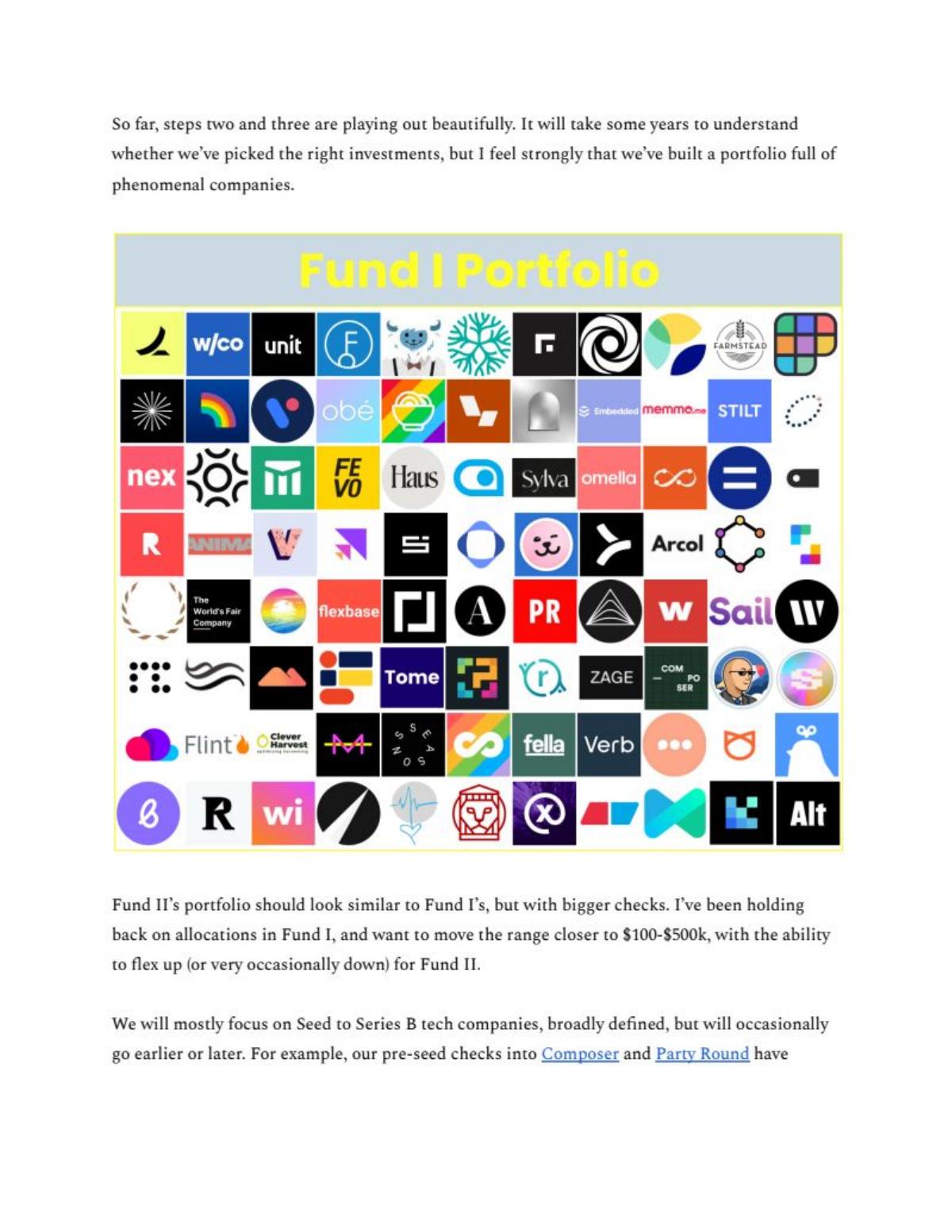
Slide 2: The Portfolio Visualized
Slide 2 provides a visual grid of the Fund I portfolio. It is a dense collection of logos, signaling a high-velocity investment strategy. McCormick notes that Fund II will feature bigger checks , moving the range from the smaller Fund I allocations to $100k-$500k . This slide sets the stage for a fund that is moving from a 'micro-VC' experimentation phase into a more institutionalized, though still solo-led, operation.
Slide 3: Stage Strategy and the Web3 Pivot
McCormick outlines a 1/3, 1/3, 1/3 split across Pre-Seed/Seed, Series A, and Series B+. He explicitly mentions backing winners like Ramp, Sky Mavis, Modern Treasury, and Scale . A significant strategic shift is highlighted here: an increased focus on web3 . While Fund I was 11% web3, McCormick expresses a 'bullish' stance, noting that these projects specifically need help telling clear stories, which aligns with his core competency.
Slide 4: The Not Boring Ecosystem
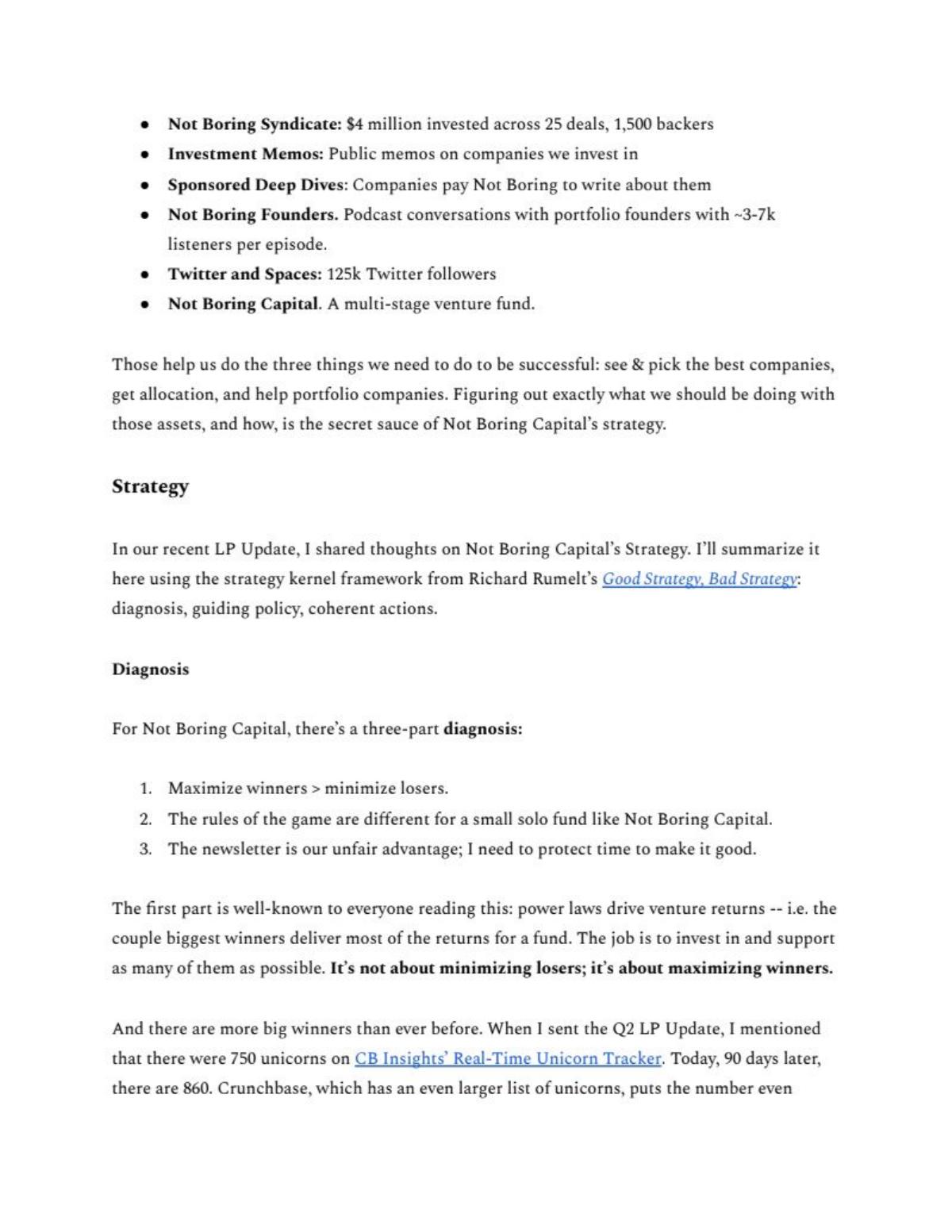
This slide lists the assets that support the venture fund. It includes the twice-weekly newsletter (98k subscribers) , the Not Boring Syndicate ($4 million invested across 25 deals) , public investment memos, and a podcast with 3-7k listeners per episode. This is the 'unfair advantage' slide. It argues that the fund isn't just a pool of capital but a distribution engine for startups.
Slides 5-7: Market Diagnosis and Strategy Kernel
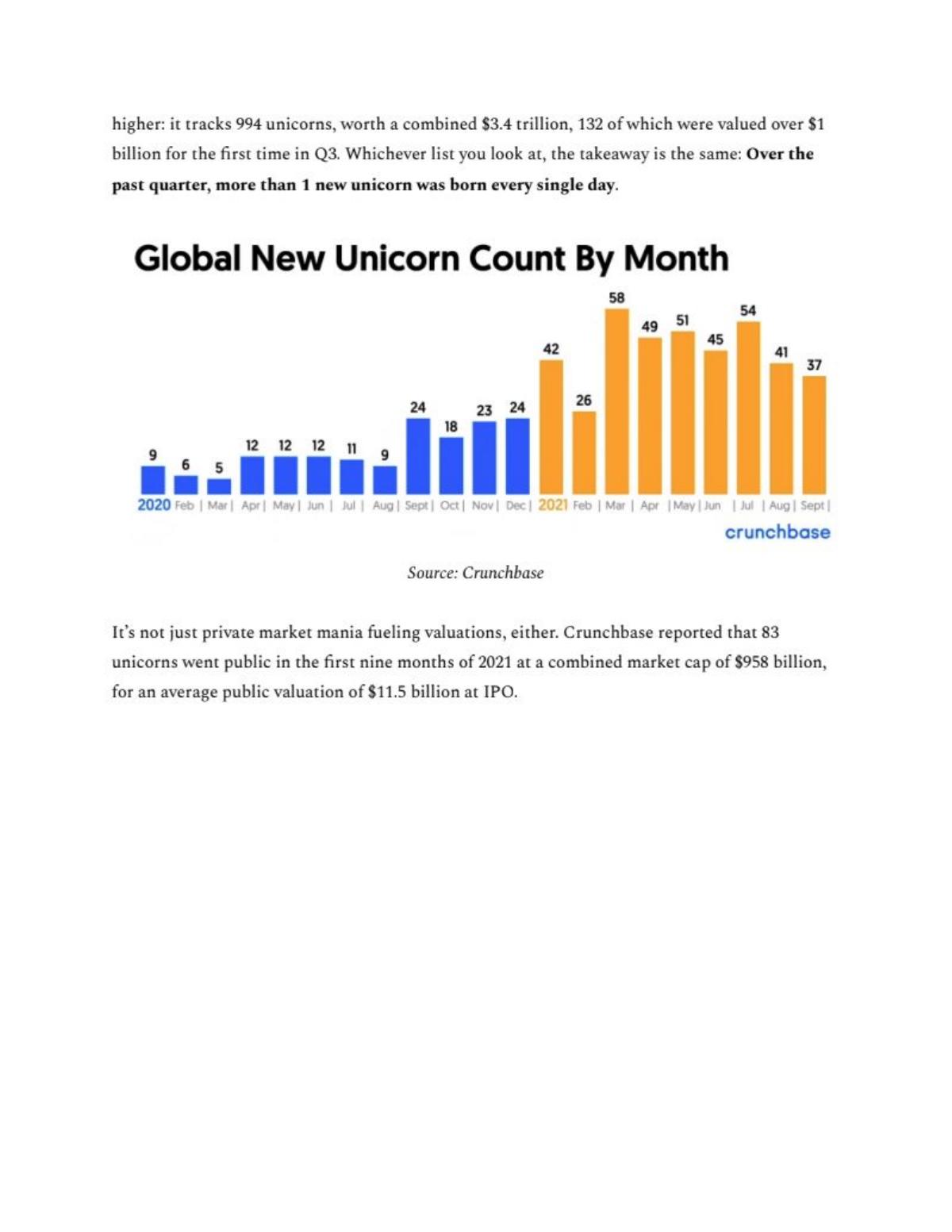
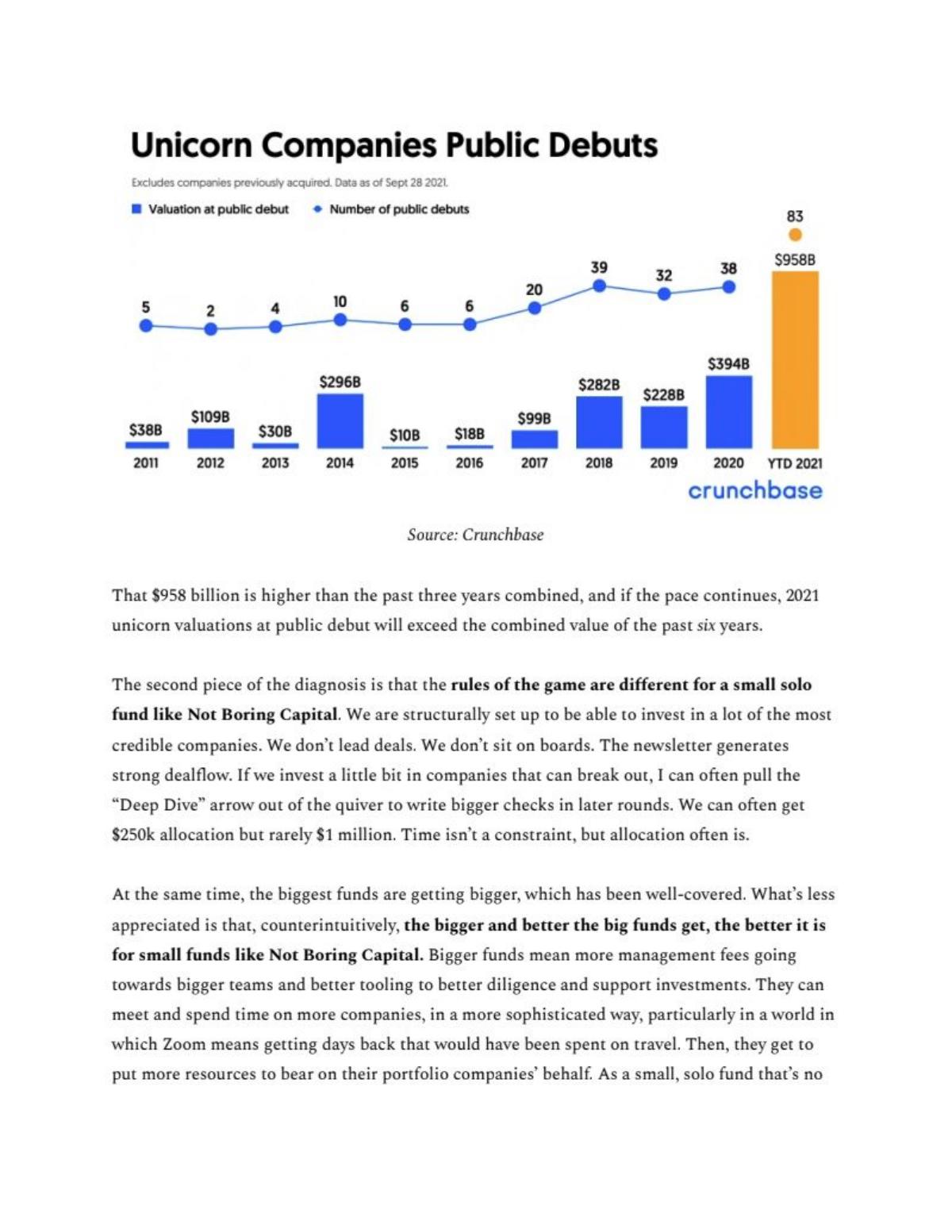
Using Richard Rumelt’s "Good Strategy, Bad Strategy" framework, McCormick diagnoses the current venture market. He cites Crunchbase data showing that in 2021, more than one new unicorn was born every single day. Slide 6 features a chart showing 83 unicorn public debuts in the first nine months of 2021, totaling $958 billion in market cap. His conclusion is that the 'rules of the game' favor small solo funds that can piggyback on the diligence of larger firms while providing unique value through media reach.
Slide 8: Coherent Actions and Risk Factors
McCormick lists specific actions he takes to execute his strategy, such as writing about spaces he wants to invest in (the "bat signal") and sharing deals with other solo GPs. He also includes a rare 'Risk' section, acknowledging the possibility of missing winners despite a high volume of deals and the potential for reputational damage if he cannot be helpful to a large number of portfolio companies.
Slides 9-11: Full Transparency - The Portfolio Ledger
These slides are perhaps the most valuable for a potential LP. They provide a complete, line-item list of every investment made in Fund I. It includes the company name, round, investment date, check size, and a brief description. Check sizes range from $20,000 (Syndicate Protocol) to $250,000 (SecurityPal) . This level of transparency is uncommon in pitch decks and serves to build trust through data.
Slides 12-13: Performance and Stage Mix
Slide 12 highlights Braintrust (BTRST) , noting a 13.9x return in a couple of months following a token sale, with the project valued at $2.3 billion . Slide 13 breaks down the fund's stage mix by valuation. It shows that 31.8% of the fund is in Seed ($15-50M valuation) and 20.3% is in Series A ($100-250M valuation). A colorful pie chart visualizes this distribution, surrounded by the logos of the companies in each segment.
Slides 14-15: The Terms
The final slides detail the fund's mechanics. The Fund Size is $25 million . Reserves are low at 10% , as follow-ons are intended for SPVs. The GP Commitment is $500k . The minimum investment is $25,000 , which is relatively low for a venture fund, likely aimed at capturing his newsletter audience. The deployment timeline is estimated at 9-12 months .
What Not Boring Capital Fund II Does Well
The memo format is a masterclass in alignment. Because the fund's value proposition is "narrative as a service," the deck itself must be a compelling narrative. It succeeds by being highly specific. Rather than speaking in generalities about "value-add," McCormick points to 98,000 subscribers and specific "Deep Dive" essays that have helped companies like Braintrust.
The transparency regarding Fund I is also a significant strength. By listing every check size and valuation, McCormick removes the 'black box' element of venture capital. It allows LPs to see exactly how he behaves in the market—specifically, his willingness to take small allocations in competitive rounds where his media reach provides the edge.
What is Missing from the Deck
Traditional Team Slide: As a solo GP fund, there is no team slide. While McCormick is the face of the brand, there is no mention of back-office support, analysts, or the legal/compliance infrastructure beyond a mention of AngelList for administration. For a $25M fund, LPs might look for more detail on how a single person manages 79+ relationships.
Detailed Unit Economics: While the Braintrust markup is highlighted, there is no comprehensive IRR (Internal Rate of Return) or TVPI (Total Value to Paid-In Capital) for the entire Fund I. McCormick notes it is "very early" (average investment is 73 days old), but a more formal reporting of the fund's overall carrying value would be standard for an institutional pitch.
Exit Strategy: The deck focuses heavily on entry and allocation but says little about the exit strategy for a portfolio of this size. With nearly 100 companies, the management of exits, secondary sales, and token distributions (for web3 projects) will be a significant operational burden that isn't addressed.
Founder Takeaways: What to Copy
Own the Narrative: If your company's strength is a specific skill (like marketing, engineering, or design), your pitch deck should be a showcase of that skill. McCormick’s memo is a showcase of his writing.
Data Transparency: Founders often hide their 'small' wins. McCormick lists $20k checks alongside $250k checks. This honesty builds a profile of a manager who is active and opportunistic, rather than one who only highlights the outliers.
The Strategy Kernel: Using a recognized framework (like Rumelt's) to explain your business strategy helps investors follow your logic. It moves the conversation from "what we do" to "why we will win structurally."
Frequently asked questions
- What is the primary investment thesis of Not Boring Capital?
- The fund invests in companies with 'stories to tell' and uses its media platform to help tell them. It operates as a multi-stage generalist fund, primarily focusing on Seed to Series B tech companies. The strategy relies on a 'strategy kernel' of maximizing winners, leveraging a solo-GP structure that doesn't compete for board seats, and using a newsletter as a primary source of deal flow and diligence.
- How does the fund handle follow-on investments?
- Fund II reserves are relatively low at 10%. Most follow-on investments are intended to be executed through Special Purpose Vehicles (SPVs) via AngelList or Syndicate, giving Fund II LPs direct access to additional allocation. This allows the main fund to remain lean while still supporting breakout winners in subsequent rounds.
- What is the 'Deep Dive' mentioned in the memo?
- A 'Deep Dive' is a sponsored, long-form essay written by Packy McCormick about a specific company. For later-stage companies that do not necessarily need capital, these essays serve as a marketing and recruitment tool. This service acts as a 'bat signal' for deal flow and a tangible value-add that helps the fund secure allocations in competitive rounds.
- What are the specific terms for Limited Partners in Fund II?
- Fund II has a $25 million target with a $25,000 minimum investment. The management fee is 2% for the first four years, dropping to 0% thereafter. It carries a 20% performance fee (carried interest). Capital calls are structured as 50% upfront and 50% when called, with fund administration handled by AngelList.
- How does the fund define its stage and vertical mix?
- While labeled a generalist fund, it leans heavily into Fintech (13 investments) and web3 (12 investments). By valuation, the fund is weighted toward early stages: 84% of dollars in Fund I went to companies valued under $250 million (Pre-Seed through Series A), though it maintains the flexibility to write checks into Series E+ companies like Scale AI.