Not Boring Capital Fund I represents the 'solo capitalist' movement, where a single GP leverages a massive content audience to secure deal access. The 11-slide memo (presented as a long-form document) outlines a $5 million fund targeting Seed to Series B tech companies. The core thesis relies on a 'flywheel' where newsletter writing attracts founders, provides value through storytelling, and generates proprietary dealflow. McCormick highlights a track record of $2 million invested via a syndicate across 15 companies, including early marks like Pipe at over 10x. The deck is notable for its tra…
Key takeaways
- The fund targets a $5 million raise to invest in 25-40 deals over a 12-18 month deployment period (Slide 10).
- The 'Not Boring Flywheel' connects an audience of 59,000 subscribers to founders and sponsors to create a self-sustaining dealflow engine (Slide 3).
- McCormick plans to invest 1/3 of the fund into Pre-Seed/Seed, 1/3 into Series A, and 1/3 into Series B+ (Slide 2).
- The portfolio includes high-profile names like Ramp, Pipe, and MainStreet, often co-investing with tier-1 firms like a16z and Benchmark (Slide 1).
- The fund offers a 2% management fee for three years and 20% carry, with a $100k GP commitment (Slide 10).
- Investment checks are targeted between $50k and $250k, with the flexibility to flex up or down (Slide 2).
- A detailed portfolio table on Slide 9 lists 30+ investments, including entry valuations and markup co-investors.
- The memo emphasizes 'Narrative Investing,' citing successful public market calls on Spotify, Snap, and Twitter as proof of the GP's ability to identify changing trends (Slide 4).
The Solo Capitalist Memo: A New Era of Fund Pitching
The Not Boring Capital Fund I memo is not a traditional pitch deck. It is a long-form document that reflects the medium through which its founder, Packy McCormick, built his reputation: the newsletter. In 2021, the 'solo capitalist' trend was peaking, and this document serves as a blueprint for how individual creators can institutionalize their influence into a venture capital vehicle. With a target of $5 million, the fund is small by institutional standards but significant for a first-time solo GP.
Slide 1: The Introduction and the $8M Target
The memo opens with a direct address to 'friends,' immediately establishing an informal, community-driven tone. McCormick identifies himself as the writer of Not Boring, a newsletter with 59,000 subscribers. This is the 'proof of work' that anchors the entire fund. Interestingly, while the catalogue facts mention a $5M raise, the text on Slide 1 explicitly states, 'I’m raising $8 million for Not Boring Capital.' This discrepancy often occurs when funds oversubscribe or adjust targets during the fundraising process.
The core value proposition is stated clearly: 'Not Boring Capital invests in companies with stories to tell, and helps tell them.' This is a refreshing departure from generic 'value-add' claims. It identifies a specific, repeatable service (storytelling) that the GP is already performing at scale. McCormick also notes that he has already invested over $2 million in fifteen companies through a syndicate, proving he isn't just a writer, but an active market participant.
Slide 2: Portfolio Strategy and Check Sizes
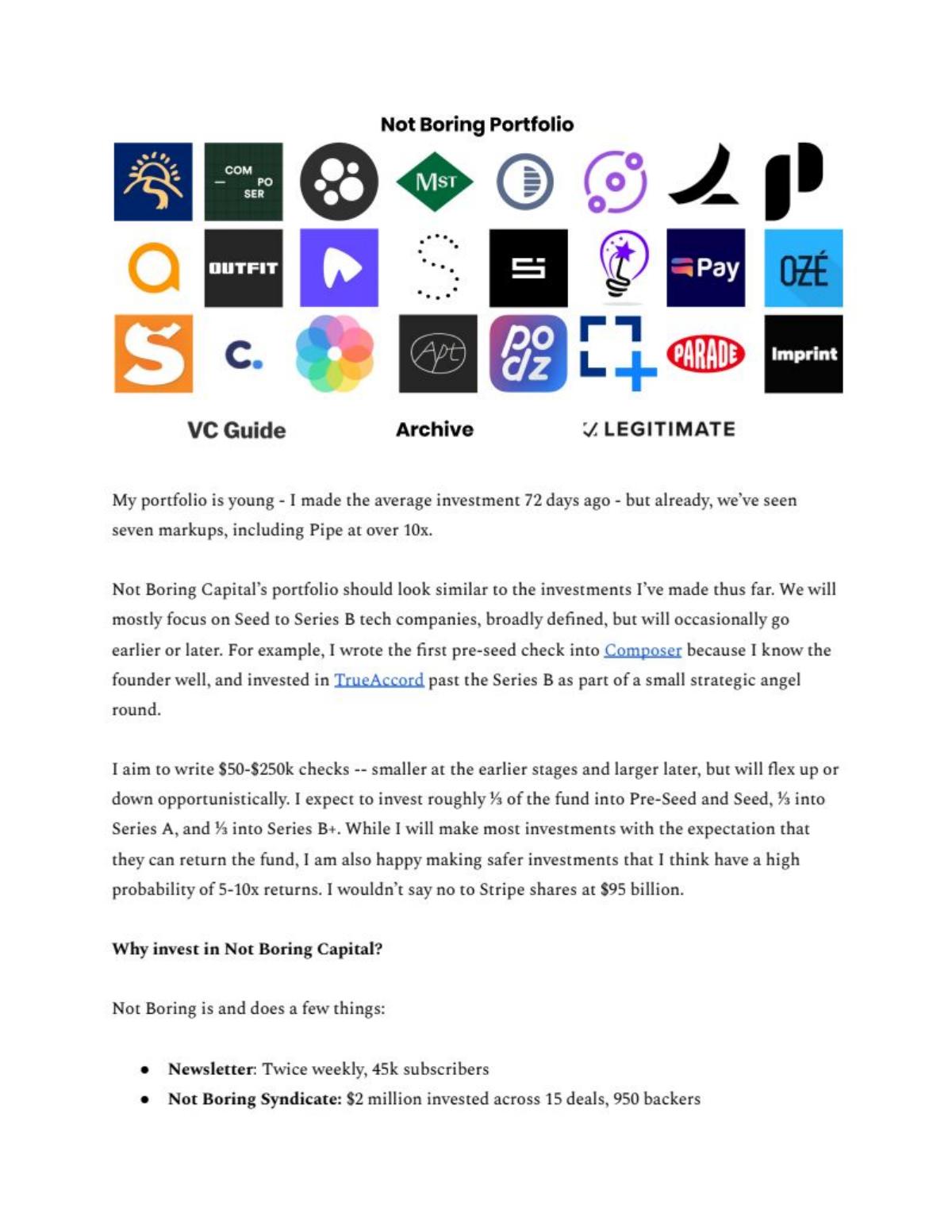
Slide 2 introduces the 'Not Boring Portfolio' through a grid of logos, including companies like Pipe, Ramp, and MainStreet. McCormick is transparent about the 'youth' of the portfolio, noting the average investment was made only 72 days prior. However, he uses this to highlight early momentum, citing seven markups and a 10x increase for Pipe.
The investment strategy is segmented by stage: '1/3 of the fund into Pre-Seed and Seed, 1/3 into Series A, and 1/3 into Series B+.' This balanced approach suggests a desire to capture early-stage upside while maintaining a lower risk profile through later-stage allocations. Check sizes are targeted at $50k-$250k. He also mentions a willingness to invest in 'safer' 5-10x returns, specifically citing Stripe at a $95 billion valuation as an example of a deal he wouldn't refuse.
Slide 3: The Not Boring Flywheel
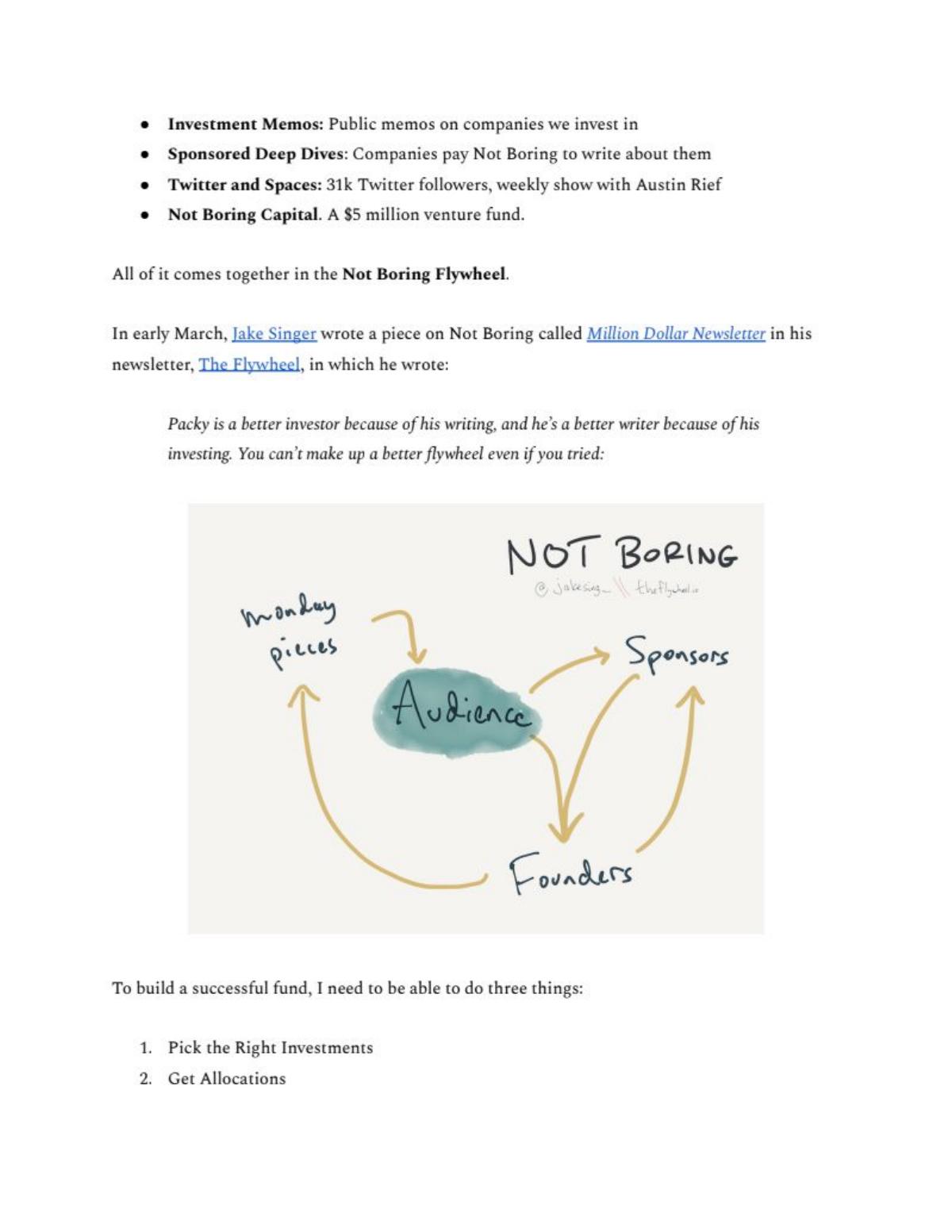
This slide introduces the conceptual heart of the fund: The Flywheel. Using a hand-drawn diagram by Jake Singer, it illustrates the relationship between 'Monday pieces' (content), the 'Audience,' 'Founders,' and 'Sponsors.' The argument is that the GP is a better investor because of his writing, and a better writer because of his investing.
McCormick breaks down the requirements for a successful fund into three pillars: 1. Pick the Right Investments, 2. Get Allocations, and 3. Help Portfolio Companies Succeed. The rest of the memo is structured to prove how the flywheel addresses these three needs.
Slide 4: Picking the Right Investments
To prove his 'picking' ability, McCormick points to his public track record. He mentions 'Narrative Investing' calls on public companies like Spotify, Snap, and Twitter. This is a clever way to show 'alpha' in a transparent, verifiable way. He also links to various investment memos he has written for private companies like Apt, Composer, and On Deck. By stating he puts in '30+ hours of research' per essay, he counters the potential criticism that a newsletter writer might be a 'tourist' investor without deep due diligence habits.
Slide 5: Getting Allocations (The 'Bat Signal')
In a competitive VC market, getting into the best deals is often harder than finding them. McCormick explains how his newsletter acts as a 'bat signal.' He provides specific examples: a piece on APIs led to an investment in Stytch; a piece on remote work led to Teamflow and Panther. He also notes that companies have started 'breaking' their funding announcements in Not Boring (Ramp, MainStreet), which creates a natural entry point for the fund. This slide effectively argues that his 'microphone' is a tool that founders actively want on their cap table.
Slide 6: Helping Portfolio Companies Succeed
This slide focuses on the 'post-investment' value. McCormick claims to be the 'top referrer for multiple portfolio companies, including MainStreet and Composer.' This is a quantifiable metric of value-add that most VCs cannot provide. He also highlights his operational background as the first US employee at Breather and NYC General Manager, managing a team of 150. This balances his 'creator' persona with 'operator' credibility, assuring LPs that he can provide more than just marketing help.
Slide 7: Audience Growth and Social Proof
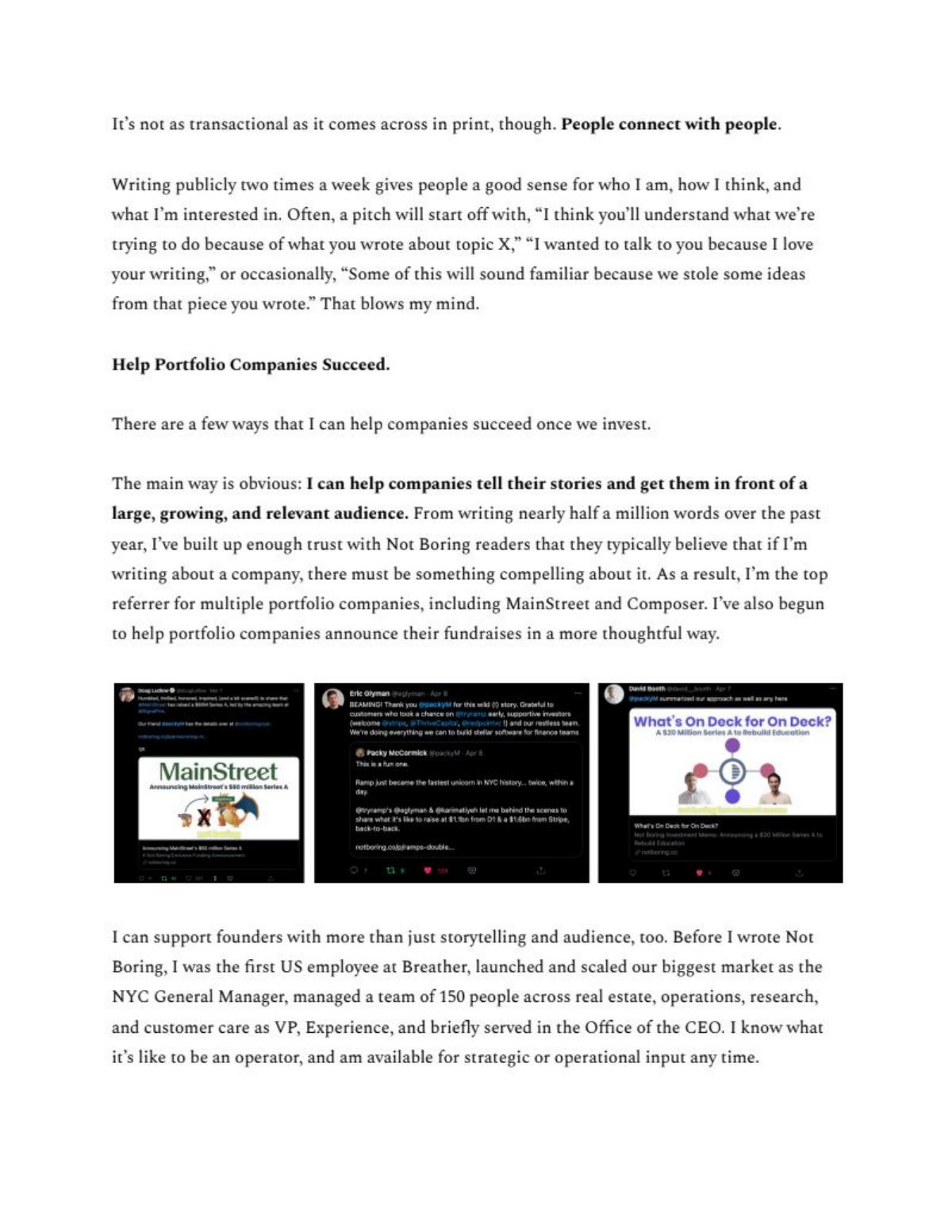
McCormick uses a growth chart of his email list (44,875 at the time of the chart) to show the 'You are here' point of the fund's trajectory. The chart shows exponential growth, implying that the fund's 'microphone' will only get louder over time. He also includes screenshots of tweets from founders (Swaypay, Composer, Outfit) praising his involvement. In the world of venture, founder references are the highest form of social proof, and McCormick uses them effectively here.
Slide 8: New Products and Portfolio Expansion
The memo mentions upcoming initiatives like a weekly Twitter Spaces show and a job board on Pallet. These are presented as additional 'nodes' in the flywheel that will help portfolio companies find hires and customers. This slide reinforces the idea that Not Boring is a platform, not just a fund. It also repeats the portfolio logo grid, ensuring the high-quality names stay top-of-mind for the reader.
Slide 9: The Full Portfolio Table
This is perhaps the most important slide for a serious LP. It is a comprehensive table of every investment McCormick has made, both via the syndicate and personally. It includes: Month Invested, Total Investment, Packy's Personal Investment, Valuation/Cap, Discount, and Markup Co-Investors. Listing co-investors like a16z, Benchmark, Thrive, and Founders Fund provides massive institutional validation. It shows that even though McCormick is a 'solo' GP, he is playing in the same leagues as the world's best firms.
Slide 10: Upcoming Deals and Fund Terms
McCormick lists four 'Upcoming Deals' to show immediate deployment potential, including a 'Men’s telehealth company on $10mm run rate.' This creates a sense of urgency for LPs. The fund terms are then laid out with absolute clarity: $5 million fund size, 2% management fee, 20% carry, and a $100k GP commitment. He also notes that the fund admin is handled by AngelList, which provides a layer of professional oversight for a solo operation.
Slide 11: The Role of the Syndicate
The final slide explains how the fund will coexist with the existing Not Boring Syndicate. The syndicate will be used for 'Bigger Allocations' (over $250k), 'Follow-Ons,' and 'Special Situations.' This is a vital piece of the strategy, as it allows a small $5M fund to effectively 'punch above its weight' by bringing in a larger pool of capital when needed. It also offers LPs the 'opportunity to invest directly in all SPVs,' which is a significant perk for many investors.
What Not Boring Capital Fund I Does Well
The memo excels at defining a unique edge. Most VCs struggle to explain why a founder would take their money over a competitor's. McCormick’s 'storytelling' edge is easy to understand, demonstrably valuable, and hard to replicate. The transparency of the portfolio table is also a high-water mark for the industry; by showing every deal, including the small $1,000 personal checks, he builds immense trust with potential LPs.
The use of a flywheel diagram is a masterstroke in strategic communication. It turns a collection of disparate activities (writing, tweeting, investing, podcasting) into a single, coherent business machine. This reduces the 'key man risk' perception by showing that the GP has a system, not just a hobby.
What is Missing from the Deck
The most glaring omission is a formal risk disclosure section. While this is a memo and not a private placement memorandum (PPM), most fund decks include a slide on the risks of solo GP structures, such as lack of succession planning or time management. Additionally, while the 'storytelling' value-add is clear, there is little discussion on governance or board seats. As a solo GP writing $50k-$250k checks, McCormick is unlikely to take board seats, but a brief mention of how he handles voting rights or major corporate actions would have been beneficial for institutional LPs.
There is also no detailed budget for the 2% management fee. On a $5M fund, a 2% fee is only $100,000 per year. For a solo GP, this is barely enough to cover legal, tax, and basic operations. LPs might wonder if the GP is reliant on newsletter sponsorships to keep the lights on, which creates a potential conflict of interest regarding where his time is spent.
What Founders and GPs Should Copy
Founders and aspiring GPs should copy the 'Value-Add Proof' shown in this deck. Instead of saying 'I help with marketing,' McCormick shows a chart of his audience growth and screenshots of founders thanking him for specific referrals. This 'show, don't tell' approach is far more persuasive than bullet points.
The transparency of the portfolio table is another best practice. If you have a track record, lay it out in a way that shows the entry valuation and the current markup. It demonstrates a level of professional rigor that is often missing in 'creator-led' funds. Finally, the clarity of terms on Slide 10 is excellent. By putting the management fee, carry, and GP commitment in a simple list, McCormick removes friction from the decision-making process for the LP.
Frequently asked questions
- What is the primary investment thesis of Not Boring Capital?
- The thesis is built on 'storytelling.' McCormick argues that companies with compelling stories attract more customers and investors. By using his newsletter (59k subscribers at the time of the memo) to tell these stories, he provides a 'tangible advantage' to portfolio companies, which in turn helps him win allocations in competitive rounds alongside top-tier VCs.
- How does the fund handle follow-on investments?
- The fund allocates 10% for reserves, but the memo states that most follow-on investments will be handled through Special Purpose Vehicles (SPVs) via the Not Boring Syndicate. This allows the fund to maintain a smaller, more manageable size while still supporting winners. Fund LPs are promised direct access to these SPV opportunities.
- What is the 'Not Boring Flywheel'?
- The flywheel is a strategic loop: Writing 'Monday pieces' builds an audience; that audience attracts founders who want their stories told; telling those stories attracts sponsors and more founders; and the resulting investments provide more material for the newsletter. This cycle is intended to lower the cost of customer (founder) acquisition and increase the GP's value-add.
- What are the specific financial terms for LPs?
- The fund has a $5 million target with a minimum investment of $25,000. It charges a 2% management fee for the first three years (dropping to 0% thereafter) and a 20% carried interest. The GP commits $100,000 of his own capital. Capital calls are structured as 50% upfront and 50% when called.
- How does the GP prove his ability to pick winners?
- McCormick provides a full portfolio table showing 15 syndicate deals and 15 personal angel investments. He highlights seven markups within a short timeframe, specifically mentioning Pipe at a 10x valuation increase. He also lists co-investors like Founders Fund, Stripe, and D1 Capital to provide institutional validation of his deal selection.