Novamind's 20-slide deck from 2020 represents a sophisticated approach to a nascent and highly regulated industry. Rather than focusing solely on drug development, Novamind pitched an infrastructure play, encompassing specialized clinics, clinical research sites (CRO), and a retreat network. The deck successfully navigates the complex history and regulatory landscape of psychedelics while presenting a clear, three-pillar focus: Clinical Care, Research, and Retreats. By highlighting existing revenue-generating assets like Cedar Psychiatry—which had already administered over 3,000 ketamine trea…
Key takeaways
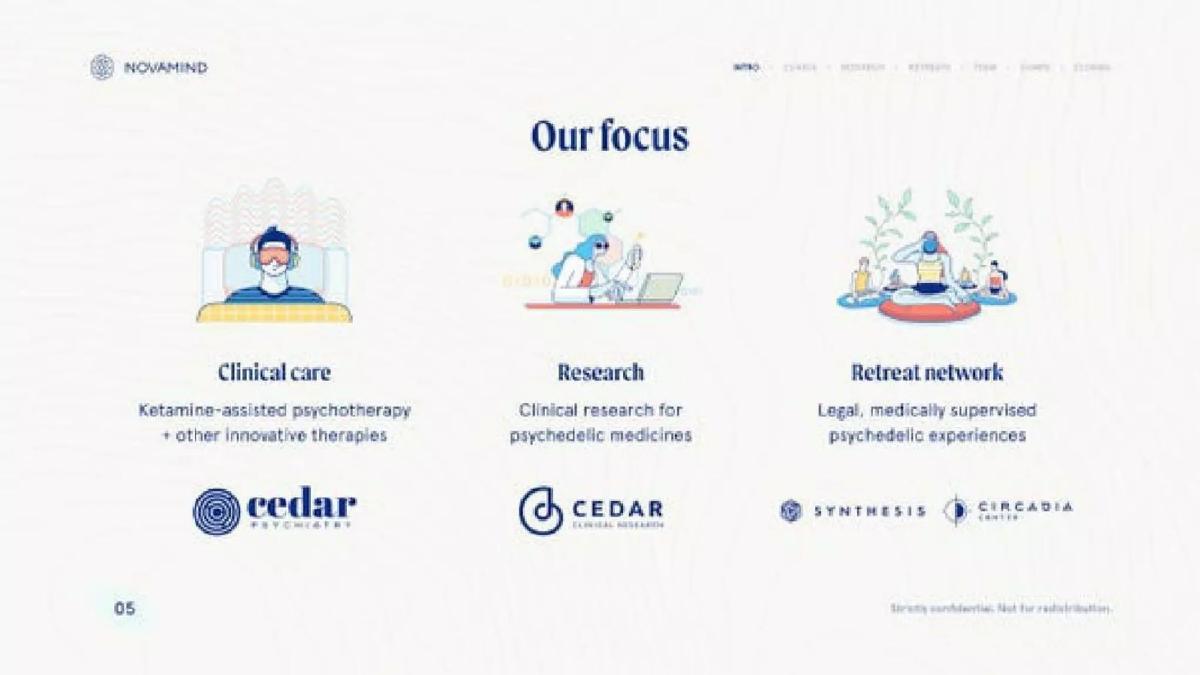
- The deck identifies a three-pillar focus: Clinical care, Research, and a Retreat network (Slide 5).
- Novamind highlights tangible traction through its subsidiary, Cedar Psychiatry, which has administered over 3,000 ketamine treatments (Slide 10).
- The company positions itself as a 'psychedelic CRO' (Contract Research Organization) for clinical phase development (Slide 11).
- A detailed 'Comparable companies' slide lists Novamind's valuation at $33M alongside peers like Compass Pathways and MindMed (Slide 18).
- The deck provides a historical context of psychedelics, categorizing them into three 'waves' to explain the current market timing (Slide 7).
- Clinical data for Ketamine, Spravato, MDMA, and Psilocybin is presented to validate the medical efficacy of their focus areas (Slide 9).
- The team slide emphasizes deep experience in capital markets and neuro-psychiatry, including a co-founder of Canopy Growth (Slides 15, 17).
- Novamind discloses lead investments in international retreat centers: C$1,170,000 in Synthesis (Netherlands) and C$500,000 in Circadia (Costa Rica) (Slide 14).
Introduction and Market Context
The Novamind pitch deck, dated November 2020, serves as a comprehensive guide to a company positioning itself at the center of the 'Third Wave' of psychedelic medicine. Unlike many startups in this space that focus exclusively on drug discovery, Novamind presents an infrastructure-heavy model. The deck is structured to educate investors on the regulatory shift, prove clinical efficacy, and then detail Novamind's specific assets.
Slides 1-3: Formalities and Disclaimers
Slide 1 is a minimalist title slide featuring the Novamind logo and the date 'November 2020'. Slides 2 and 3 are dense legal disclaimers. These are standard for companies operating in highly regulated or 'grey market' industries, covering forward-looking statements and the speculative nature of the investment. The presence of two full slides of legalese signals that the company is preparing for sophisticated investors and potential public listing requirements.
Slides 4-6: The Value Proposition and Global Footprint
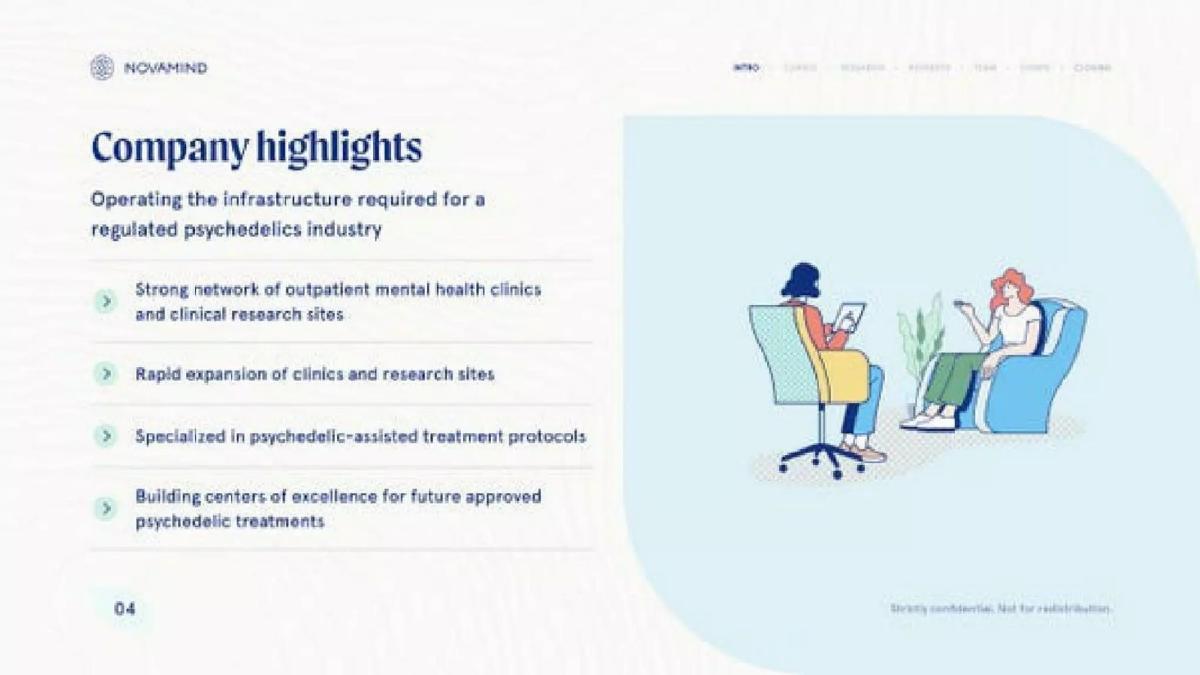
Slide 4 introduces the 'Company highlights,' explicitly stating their mission: 'Operating the infrastructure required for a regulated psychedelics industry.' It lists four key pillars: a network of clinics, rapid expansion, specialized protocols, and building 'centers of excellence.' This slide sets the stage for a business that is about physical locations and operational expertise rather than just intellectual property.
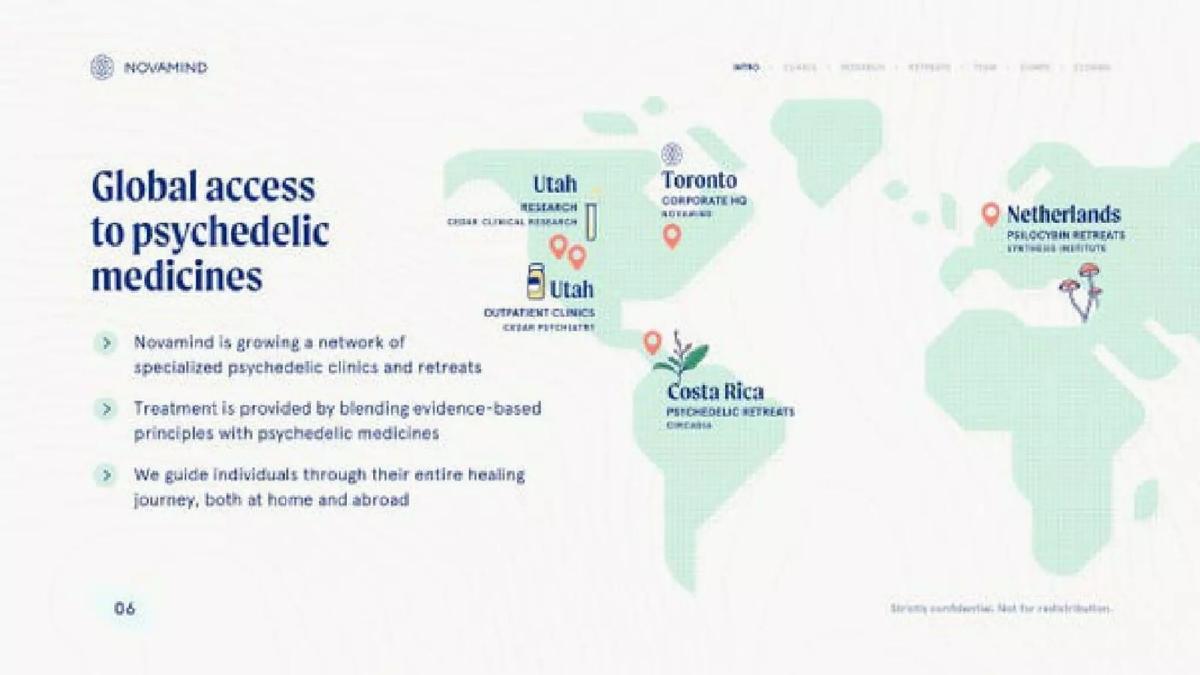
Slide 5 defines the three-pronged focus: Clinical care (Cedar Psychiatry), Research (Cedar Clinical Research), and Retreat network (Synthesis and Circadia). By showing three distinct logos under the Novamind umbrella, the deck communicates a diversified revenue strategy. Slide 6 uses a map to show 'Global access,' highlighting their corporate HQ in Toronto, clinical clusters in Utah, and retreat partnerships in the Netherlands and Costa Rica. This geographic diversity suggests a strategy of operating wherever the regulatory environment is most favorable.
The Macro Argument for Psychedelics
Slides 7-9: History, Media, and Data
Slide 7 provides a 'brief history of psychedelics,' broken into three waves. The 'First wave' covers indigenous use; the 'Second wave' (1950-1990) covers early pharmaceutical research and the subsequent 'War on Drugs'; the 'Third wave' (1990-Present) highlights the FDA granting breakthrough therapy status to esketamine, MDMA, and psilocybin. This historical framing is a common tactic to show that the current moment is a rational evolution rather than a fad.
Slide 8 uses media validation to prove that a 'mental healthcare revolution has begun.' It cites headlines from CBC, The Guardian, and MAPS regarding magic mushrooms for terminal cancer and MDMA for PTSD. Slide 9 is the most critical in this section, presenting 'Compelling clinical data.' It lists four drugs (Ketamine, Spravato, MDMA, Psilocybin) alongside their indications and evidence of efficacy. Notably, it includes a large callout for the market size: US$224B annual spend on mental health services and US$17B on depression and anxiety treatments. This justifies the scale of the opportunity.
Operational Deep Dive
Slides 10-13: Clinics and Research Capabilities
Slide 10 focuses on Cedar Psychiatry, their clinical arm. It provides hard numbers: over 3,000 ketamine treatments and 1,000 Spravato treatments administered. It also lists four operational clinics in Utah and one in development. This is a 'traction' slide that proves the business model is already functioning and generating data. Slide 11 positions Cedar Clinical Research (CCR) as a 'psychedelic CRO.' It mentions leading Spravato trials for Janssen Pharmaceuticals and participating in MAPS trials. This differentiates Novamind as a service provider for other drug developers.
Slide 12 introduces 'Novel psychedelic treatment protocols,' specifically Emotion-Focused Ketamine-Assisted Psychotherapy (EF-KAPI). This suggests the company is developing its own proprietary methods for administering care, which adds a layer of IP to their physical infrastructure. Slide 13 lists specific research studies, both collaborations (with institutions like Imperial College) and internal studies. This slide reinforces the company's scientific credibility.
Slide 14: The Retreat Network
Slide 14 details their investments in the retreat space. It notes a C$1,170,000 investment in Synthesis (Netherlands) and a C$500,000 investment in Circadia (Costa Rica). For Circadia, it explicitly mentions that Novamind has a 'right of first refusal to acquire.' This slide shows how the company uses its capital to secure a foothold in international markets where psychedelic use is already legal in a retreat setting.
Team and Comparables
Slides 15-17: Leadership and Governance
Slide 15 introduces the executive team. CEO Yaron Conforti and CMO Dr. Reid Robison are the anchors. The bios emphasize a mix of capital markets experience and clinical leadership. Slide 16 showcases a 'scientific advisory board' of four MDs from prestigious institutions like Yale and Columbia, which is standard for biotech-adjacent decks to provide 'expert' cover. Slide 17 is the Board of Directors, featuring Chuck Rifici. His background as the founder of Canopy Growth is a major signal to investors, as it draws a direct parallel between the early days of the cannabis industry and the current state of psychedelics.
Slides 18-20: Valuation and Values
Slide 18 is a 'Comparable companies' table. It compares Novamind to Field Trip, Numinus, Cybin, Compass Pathways, MindMed, and ATAI. It lists Novamind's 2019 revenue at $1.9M—notably, most of the other companies listed have 'NIL' or 'N/A' for revenue. This is a strong closing argument: Novamind is valued at $33M (a fraction of Compass Pathways' $1.2B) despite having more locations and actual revenue. Slide 19 lists the company's values (Compassion, Innovation, Stewardship, Respect), and Slide 20 ends with a quote from Stanislav Grof and contact information.
What Works in This Deck
The deck's greatest strength is its clarity of business model . In a space where many founders get lost in the chemistry of molecules, Novamind stays focused on the 'plumbing' of the industry. By highlighting the 3,000+ treatments already administered (Slide 10), they move the conversation from 'what if' to 'how we scale.' The comparable companies slide (Slide 18) is also exceptionally well-executed. It doesn't just list names; it compares business models, number of locations, and revenue, making a data-driven case for why Novamind is undervalued relative to its peers.
What Is Missing
The most glaring omission is a clear 'Use of Funds' or 'Ask' slide . While the catalogue states they raised $4.7 million, the deck itself does not specify how much they are looking for or how that capital will be deployed across the three pillars. Furthermore, there is a lack of unit economics for the clinics. While we see total treatments, we don't see the cost to acquire a patient or the margin per treatment, which would be vital for an infrastructure play. Finally, the deck lacks a timeline or roadmap . It mentions one clinic in development for Q2 2021, but it doesn't show the long-term path to 50 or 100 clinics.
What a Founder Should Copy
The 'Three Waves' Framing: If you are in a nascent industry, use Slide 7's approach to show that your company is the logical conclusion of a long historical process. · The Revenue Contrast: If you have revenue in a sector where your peers don't, use a table like Slide 18 to highlight that you are de-risked compared to the 'pure-play' hype stocks. · Sub-Branding for Clarity: Novamind uses distinct logos for its clinic, research, and retreat arms (Slide 5). This helps investors mentally categorize different parts of a complex business. · Scientific Advisory Board Depth: Slide 16 shows how to present advisors not just as names, but as specific clinical assets with institutional pedigree.
Frequently asked questions
- What is Novamind's primary business model?
- Novamind operates a vertically integrated model focused on the infrastructure of psychedelic medicine. According to slide 5, this includes clinical care (ketamine-assisted psychotherapy), a contract research organization (CRO) for clinical trials, and a network of legal psychedelic retreats. They aim to provide the physical locations and specialized protocols required for these treatments to be administered safely and legally.
- How does Novamind differentiate itself from drug development companies?
- While many competitors focus on patenting new molecules, Novamind positions itself as the 'infrastructure required for a regulated psychedelics industry' (Slide 4). Slide 18 shows that while peers like Compass Pathways are purely in drug development, Novamind generates revenue ($1.9M in 2019) through its 4 operating clinics and research sites, providing a more immediate cash-flow profile.
- What specific treatments does Novamind currently offer?
- As of the deck's publication, the primary clinical offering is ketamine-assisted psychotherapy and Spravato (esketamine) therapy. Slide 10 notes that their Cedar Psychiatry clinics have administered over 3,000 ketamine treatments and 1,000 Spravato treatments. They also host research for MDMA and psilocybin, preparing for future regulatory approvals.
- Who are the key members of the leadership team?
- The team is led by CEO Yaron Conforti, an entrepreneur with investment banking experience, and CMO Dr. Reid Robison, who co-founded Tute Genomics. Notably, the Board of Directors includes Chuck Rifici, the founder of Canopy Growth, bringing significant experience from the regulated cannabis industry to the psychedelic space (Slides 15 and 17).
- What is the geographic footprint of the company?
- Novamind is headquartered in Toronto, Canada. Its clinical operations are centered in Utah, USA, with four clinics in operation (Springville, Orem, Salt Lake City, and Layton). Additionally, they have investment interests in retreat centers located in the Netherlands and Costa Rica (Slides 6 and 10).