Kensho Health's 2021 Seed deck is a masterclass in using 'social proof' and 'supply-side momentum' to tackle a fragmented healthcare niche. By positioning holistic medicine as the fastest-growing global sector (Slide 4) and showcasing a 50% month-over-month provider growth rate (Slide 5), the founders shifted the narrative from 'alternative medicine' to a scalable marketplace. The deck is notably light on specific unit economics or revenue models, instead focusing on the 'Road Ahead' (Slide 9) which transitions from a simple directory to insurance reimbursement and care management. With a hea…
Key takeaways
- The company positions holistic medicine as a $400B global market opportunity on Slide 4.
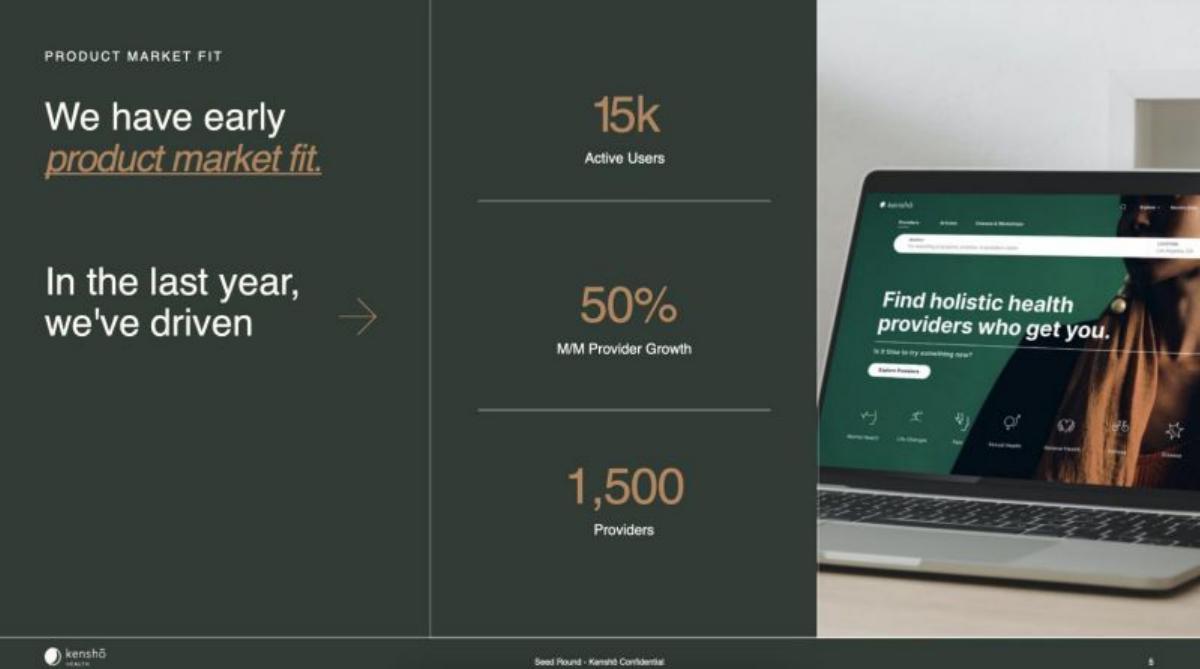
- Kensho claims early product-market fit with 15k active users and 1,500 providers as shown on Slide 5.
- Provider supply growth is a core metric, cited at 50% month-over-month on Slide 5.
- The deck highlights '1M Uniques in 2021' to demonstrate user demand on Slide 6.
- A significant portion of the deck (Slides 10 and 11) is dedicated to eight high-profile advisors rather than internal team members.
- The product roadmap on Slide 9 outlines a transition from a directory (2020) to insurance reimbursement (2022) and international care management (2023).
- Slide 8 uses institutional logos like Wiley and Medicaid to validate the efficacy of holistic treatments like acupuncture.
- The deck omits a specific 'Ask' slide detailing the exact dollar amount or valuation sought for the seed round.
Executive Summary: The Professionalization of Holistic Care
Kensho Health’s seed deck is a study in market positioning. In a sector often dismissed as 'alternative,' the founders use the language of conventional healthcare—'care navigation,' 'evidence-based outcomes,' and 'provider supply'—to build a case for a massive, untapped marketplace. By the time the reader reaches the final slide, the company has successfully reframed holistic medicine from a fringe interest into a $400 billion global sector ripe for digital disruption.
Slide 1: The Team and Mission
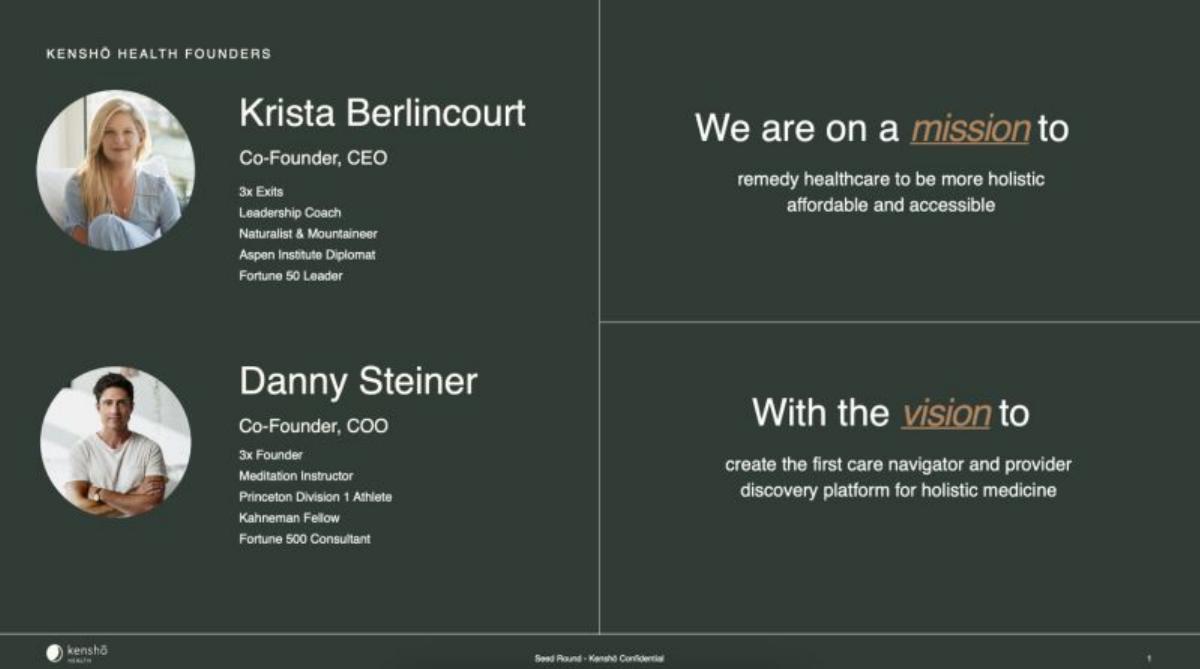
The deck opens with a strong focus on the founders. Krista Berlincourt (CEO) and Danny Steiner (COO) are both presented as experienced entrepreneurs, each claiming '3x' exits or founder roles. The slide establishes a dual-track pedigree: corporate excellence (Fortune 50/500 experience) and wellness authenticity (Leadership Coach, Meditation Instructor). The mission is stated clearly: 'remedy healthcare to be more holistic, affordable and accessible.'
Slide 2: The Problem
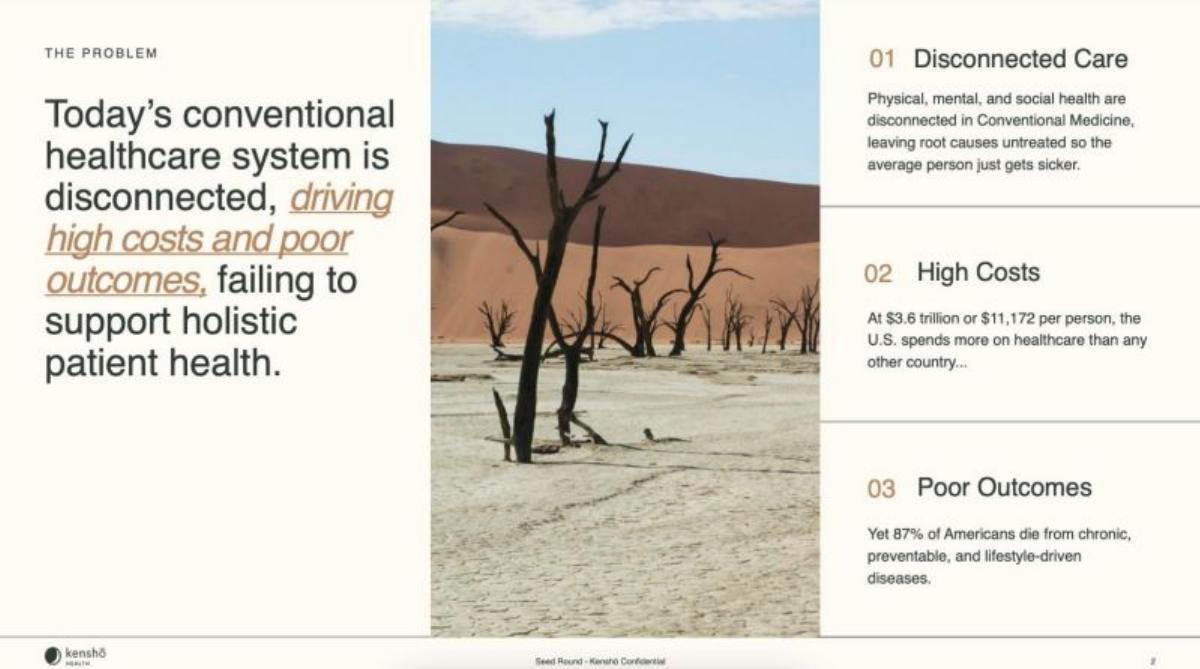
Kensho identifies three pillars of failure in conventional medicine: Disconnected Care , High Costs ($3.6 trillion or $11,172 per person in the U.S.), and Poor Outcomes (87% of Americans dying from chronic, preventable diseases). By framing the problem through the lens of U.S. healthcare spending, they justify the need for a new entry point into the system.
Slide 3: The Solution
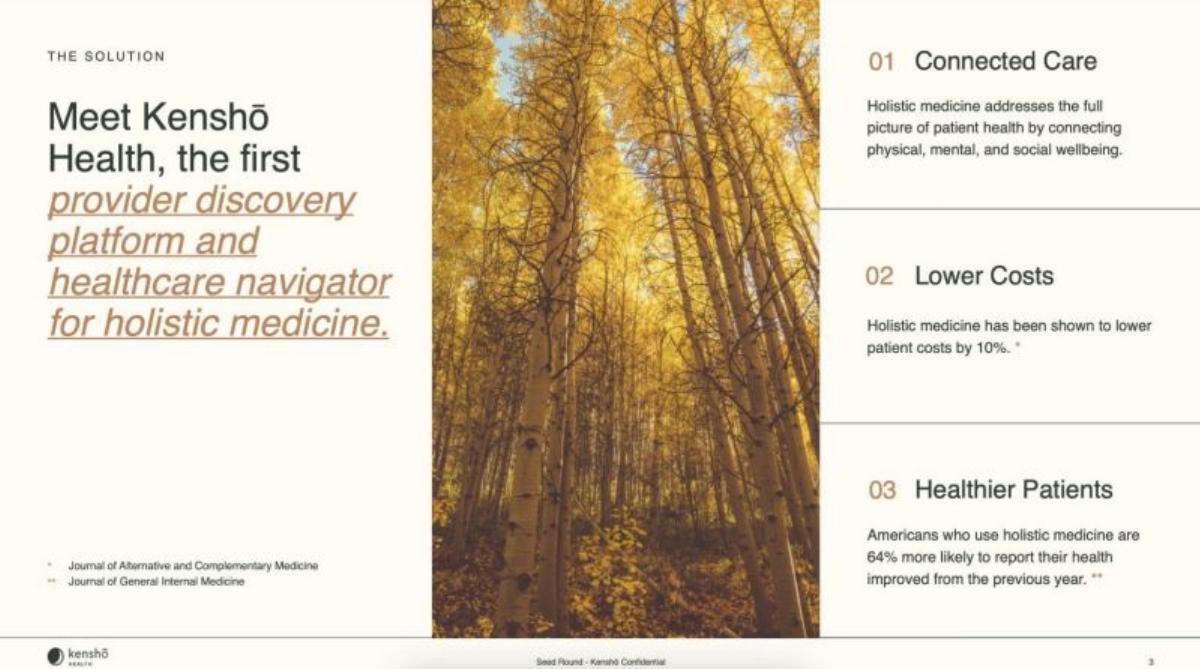
The solution slide introduces Kensho as the 'first provider discovery platform and healthcare navigator for holistic medicine.' It mirrors the problem slide by offering Connected Care , Lower Costs (claiming holistic medicine lowers costs by 10%), and Healthier Patients . The use of citations from the Journal of Alternative and Complementary Medicine adds a layer of scientific authority often missing in wellness pitches.
Slide 4: The Market Opportunity
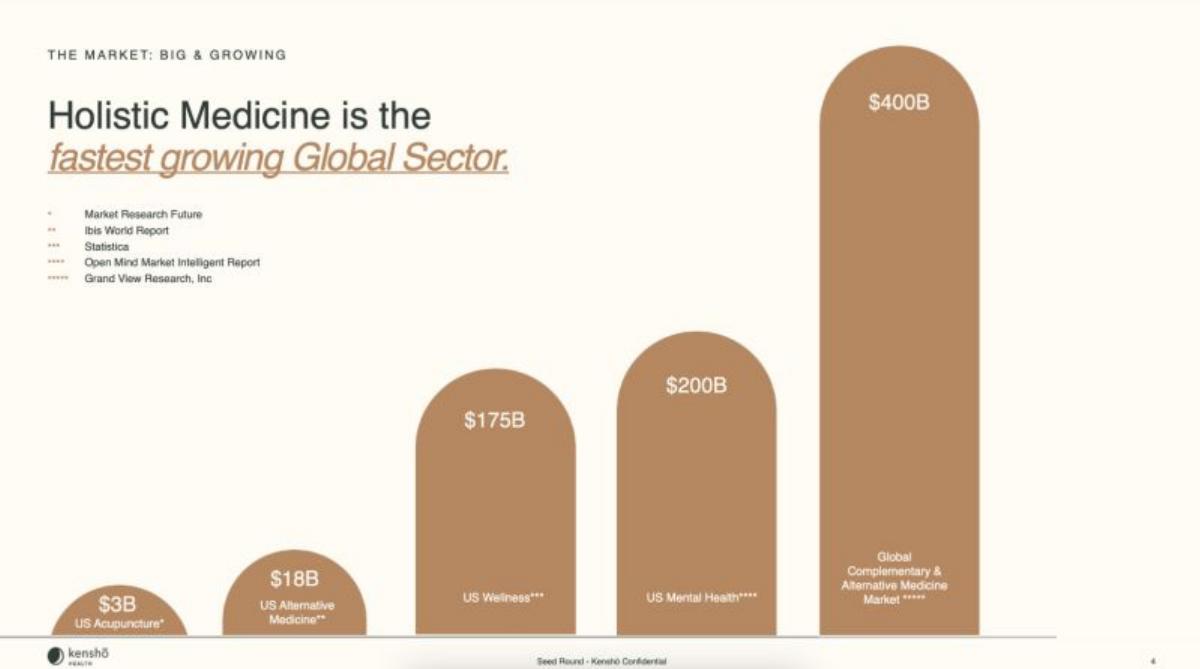
This is a classic 'up and to the right' bar chart. It scales from US Acupuncture ($3B) to US Alternative Medicine ($18B) , US Wellness ($175B) , US Mental Health ($200B) , and finally the Global Complementary & Alternative Medicine Market ($400B) . By including Mental Health and Wellness, Kensho expands its Total Addressable Market (TAM) significantly, positioning itself as a broad-spectrum health platform rather than a niche directory.
Slide 5: Product Market Fit
Kensho moves quickly to traction. They report 15k Active Users and 1,500 Providers . The most aggressive metric here is the 50% M/M Provider Growth . For a marketplace, supply-side growth is often the hardest hurdle; showing this level of momentum suggests a low cost of provider acquisition or a high level of desperation for digital tools among holistic practitioners.
Slide 6: Growth Visualization
Slide 6 provides two bar charts: Provider Supply and User Demand . The supply chart shows a clear inflection point at 'Launch' in February, with steady growth through September. The demand chart is even more ambitious, claiming 1M Uniques in 2021 . The visual representation of these bars suggests exponential growth, though the Y-axis on the demand side is scaled in increments of 250,000, which can make even modest gains look vertical.
Slide 7: The Product Experience
This slide uses mobile mockups to show the user journey: searching the directory, browsing provider profiles, and booking a free consult. It mentions a 'full-feature telemedicine' suite. This indicates that Kensho isn't just a lead-gen tool for providers, but the actual infrastructure where the care takes place.
Slide 8: Evidence-Based Outcomes
To combat skepticism, Slide 8 lists partnerships with Wiley and the Academic Consortium for Integrative Medicine & Health . The most compelling point here is the mention of Medicaid expanding coverage for acupuncture, affecting 120M people . This ties the startup’s success to macro-regulatory shifts in the healthcare industry.
Slide 9: The Road Ahead
The roadmap is divided by year. 2020 was about the directory in LA and NY. 2021 (the year of the deck) focuses on scheduling, telehealth, and referrals in major metros. 2022 marks the transition to 'Insurance Reimbursement' and a 'Series A.' 2023 aims for international expansion and 'Care Management.' This slide is crucial because it shows the path from a simple website to a complex, integrated health tech company.
Slides 10 & 11: The Advisor Network
Kensho spends two full slides on advisors, which is unusual for a 13-slide deck. The Scientific Advisors include the founder of Livongo (Alex Bitoun) and the Director of Innovation at Wiley . The Product Advisors include early employees or leaders from Classpass , Instagram , Airbnb , and Evolve Foundation . This 'borrowed credibility' is a clear signal to investors that while the company is early-stage, it is being guided by the architects of some of the most successful marketplaces and health tech companies of the last decade.
What Works in This Deck
Supply-Side Momentum: The 50% month-over-month provider growth (Slide 5) is the strongest data point in the deck. It proves that the 'supply' is ready and willing to join the platform. · Regulatory Tailwinds: Citing Medicaid's expansion into acupuncture (Slide 8) provides a 'why now' that is grounded in policy rather than just consumer trends. · Advisor Pedigree: The advisor slides (10-11) are exceptionally strong. Having the CTO of Livongo and the founding designer of Instagram as advisors mitigates the risk of the founders' lack of specific deep-tech or medical-billing backgrounds.
What Is Missing
Business Model Specifics: The deck never explains how Kensho makes money. Is it a SaaS fee for providers? A transaction fee on bookings? A subscription for users? This is a major omission for a Seed round. · Unit Economics: There is no mention of Customer Acquisition Cost (CAC) or Lifetime Value (LTV). While '1M Uniques' sounds impressive, the cost to acquire those uniques and their conversion rate to paid bookings is not disclosed. · Competitive Landscape: The deck ignores competitors like Zocdoc (which has moved into wellness) or niche-specific directories. Investors generally want to see how a startup plans to defend its moat. · The Ask: There is no slide detailing how much capital is being raised or how that capital will be allocated across the roadmap.
Founder Takeaways
Use 'Social Proof' to Bridge Gaps: If your team lacks a specific technical or industry-heavy background, fill your advisor board with people who have it. Kensho’s advisor slides are doing a lot of the heavy lifting here. · Frame Your Niche as a Sub-Sector of a Giant: Kensho doesn't just call itself a 'yoga and acupuncture site.' They call themselves a 'healthcare navigator' (Slide 3) and link their market to the $3.6T US healthcare spend. · Visual Consistency: The deck uses a muted, earthy color palette and high-quality nature photography that aligns with the 'holistic' brand without looking 'new age' or unprofessional.
Frequently asked questions
- What is Kensho Health's primary business model according to the deck?
- The deck describes Kensho as a 'provider discovery platform and healthcare navigator' (Slide 3). While it mentions partnering with providers to build practices through telemedicine and referrals (Slide 7), it does not explicitly detail the take-rate, subscription fees, or transaction costs. The roadmap on Slide 9 suggests a future move into insurance reimbursement, implying a shift toward more traditional healthcare revenue streams.
- How does Kensho Health validate the medical efficacy of its providers?
- Kensho addresses the 'trust' issue in holistic medicine by citing evidence-based outcomes on Slide 8. They mention working with Wiley to open-source research and partnering with the Academic Consortium for Integrative Medicine & Health. They specifically point to Medicaid's coverage expansion for acupuncture as proof that these treatments are entering the medical mainstream.
- Who are the founders and what is their background?
- The company was co-founded by Krista Berlincourt (CEO) and Danny Steiner (COO). According to Slide 1, Berlincourt is a '3x Exit' founder and former Fortune 50 leader, while Steiner is a '3x Founder' and former Fortune 500 consultant. Their backgrounds combine corporate leadership with wellness-adjacent roles like leadership coaching and meditation instruction.
- What are the key growth metrics mentioned in the pitch?
- Kensho highlights three primary metrics on Slide 5: 15,000 active users, 1,500 providers, and a 50% month-over-month growth rate in provider sign-ups. Slide 6 further emphasizes demand by showing a bar chart that reaches '1M Uniques in 2021,' though it does not specify if these are monthly or annual unique visitors.
- What is missing from this pitch deck?
- The deck is missing a clear financial slide, including current revenue, burn rate, and unit economics (CAC/LTV). It also lacks a formal 'Ask' slide stating the round size, though catalogue data indicates they raised $3.5M. Furthermore, there is no competitive landscape slide, which is unusual for a marketplace-style platform in the crowded wellness space.