Kibin’s 2011 seed deck is a classic example of an early-stage pitch that prioritizes momentum over polished aesthetics. Raising $400,000, the company focused on a specific pain point: the difficulty students face in finding reliable, affordable proofreading. The deck effectively uses screenshots of competitors and desperate forum posts to prove market demand, then counters with a simple four-step workflow. While the design is dated, the data is compelling, showing 44% week-over-week user growth and 40% growth in papers proofread. By anchoring the pitch in a massive market of 930 million annua…
Key takeaways
- The deck highlights a massive total addressable market of 930 million papers written by 31 million U.S. students annually (Slide 10).
- Traction is the strongest element, showing 44% week-over-week user growth and 40% week-over-week growth in papers proofread (Slide 9).
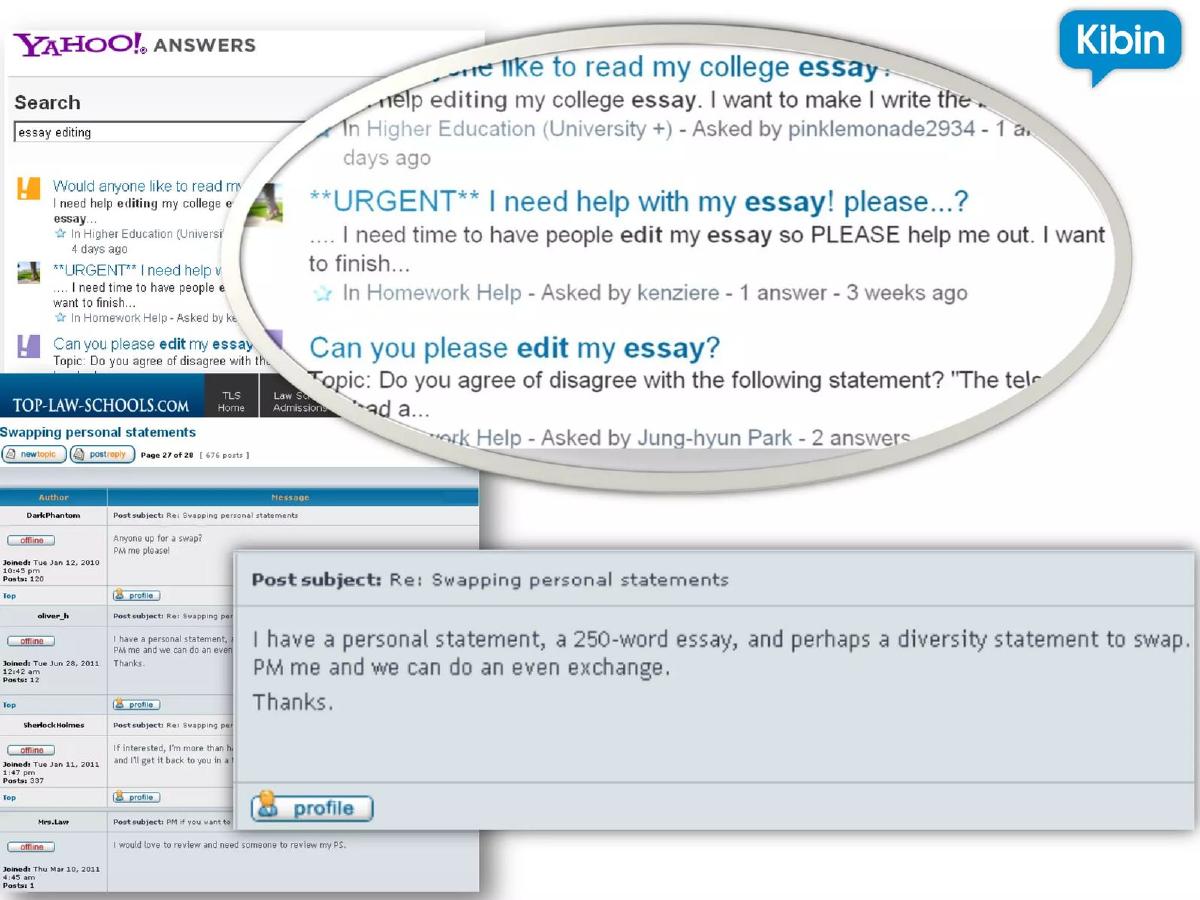
- The problem is validated through screenshots of students begging for help on Yahoo! Answers and Top-Law-Schools.com (Slide 5).
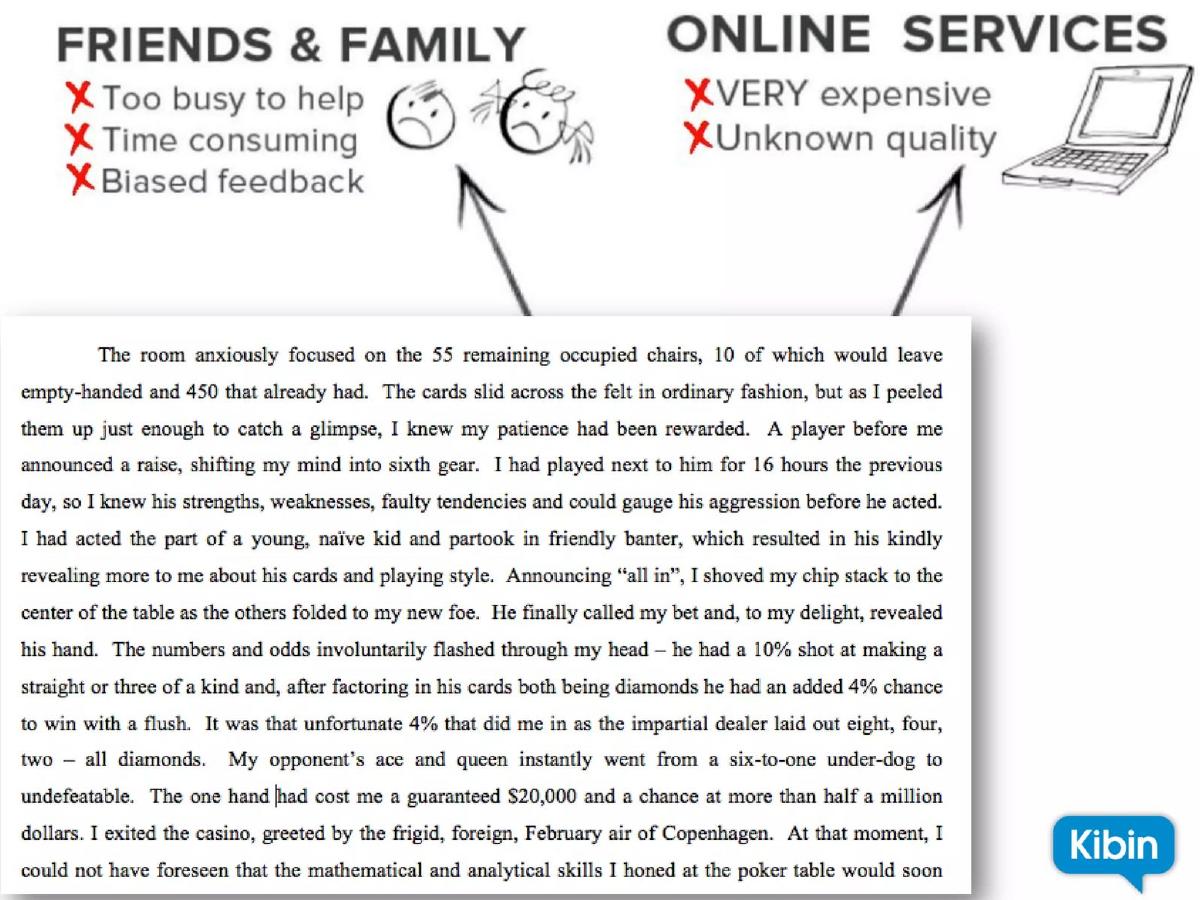
- Kibin identifies a clear gap between unreliable 'Friends & Family' and 'Online Services' that are expensive or have unknown quality (Slide 3).
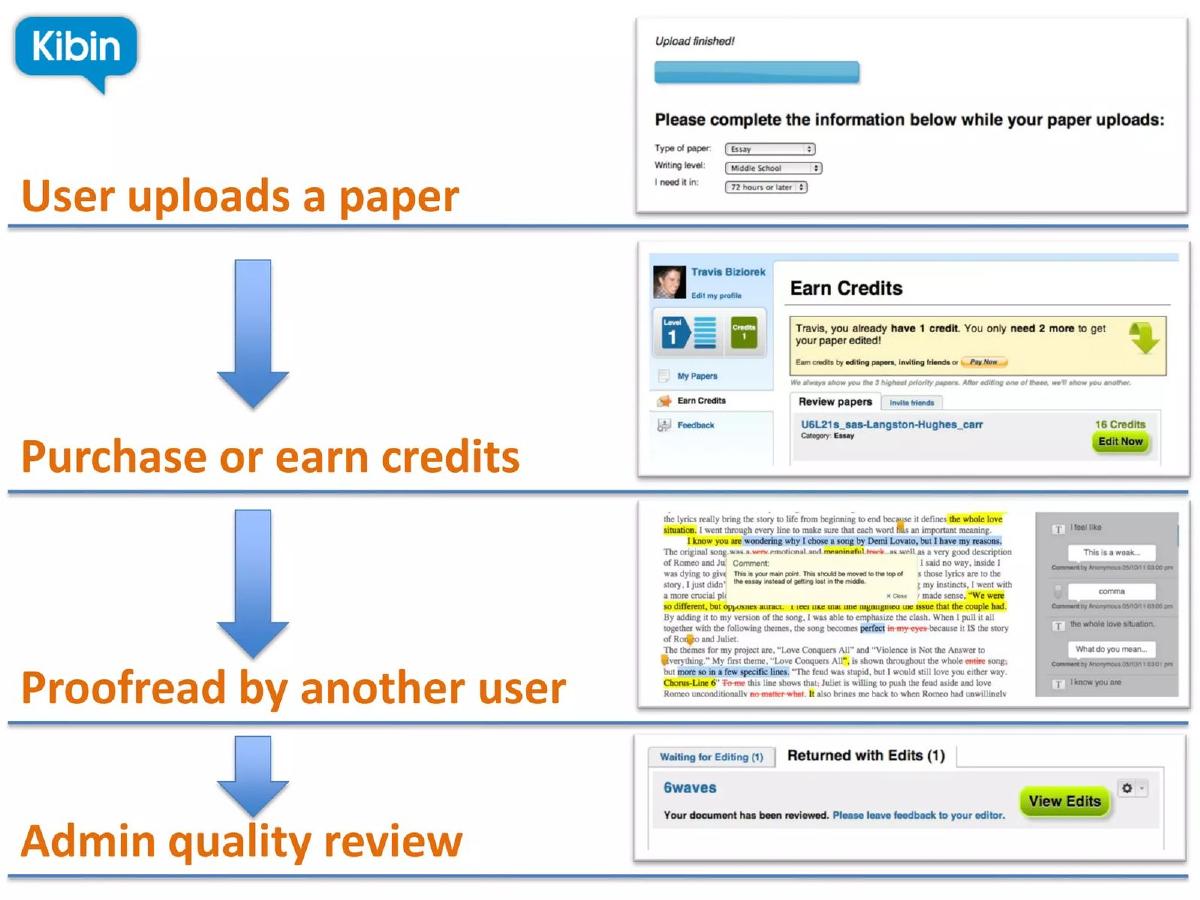
- The product workflow is simplified into four steps: upload, purchase/earn credits, peer proofread, and admin quality review (Slide 6).
- The team slide leverages advisor Rob Angarita, co-founder of Cramster, to provide industry credibility (Slide 11).
- The 'Ask' is explicitly stated as $400k to build the team and double down on student acquisition (Slide 12).
- The deck lacks a formal business model or unit economics slide, though it mentions 'We have paid users!' on the traction slide (Slide 9).
Introduction: The Power of Raw Traction
The Kibin pitch deck from 2011 is a time capsule of early 'Lean Startup' methodology. It is not a beautiful deck by modern design standards, but it is an incredibly effective one. At its core, the deck aims to prove one thing: that students are desperate for a better way to get their papers edited, and Kibin has found the formula to acquire those students rapidly. With a $400,000 raise, the stakes were set for a seed round that prioritized speed and market validation over long-term financial modeling.
Slides 1-3: Defining the Gap
Slide 1: Title The deck opens with a simple logo and the tagline: "Proofreading is Broken. We just Fixed it." The use of a red 'corrected' font style immediately establishes the theme of the business.
Slide 2: The Visual Metaphor This slide is largely decorative, showing a block of text and a scale of justice. It serves as a transition to the problem statement, likely used by the founder to narrate the difficulty of balancing quality and cost in writing.
Slide 3: The Problem Kibin identifies two existing solutions and why they fail. 'Friends & Family' are marked with red X's for being too busy, time-consuming, and biased. 'Online Services' are criticized for being 'VERY expensive' and having 'Unknown quality.' This sets up Kibin as the necessary third option: professional-grade quality at a more accessible, peer-driven price point.
Slides 4-5: Market Validation through Competitor Failure
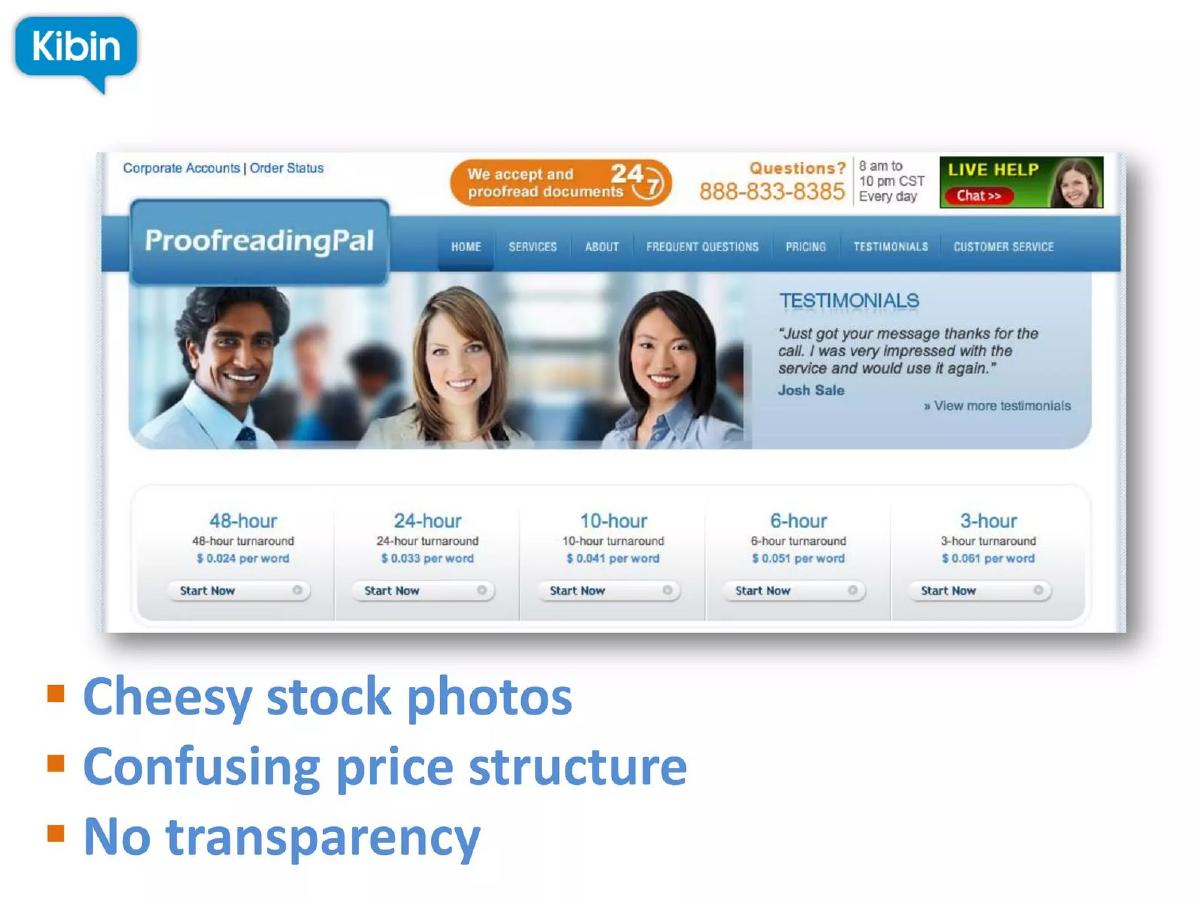
Slide 4: Competitor Critique The deck takes a direct shot at an incumbent, ProofreadingPal. It lists three specific grievances: "Cheesy stock photos," "Confusing price structure," and "No transparency." By highlighting these aesthetic and structural flaws, Kibin suggests that the market is ripe for a modern, user-friendly alternative.
Slide 5: Proof of Demand This is one of the most effective slides in the deck. It features screenshots from Yahoo! Answers and Top-Law-Schools.com showing users begging for essay swaps and urgent editing help. One post from 'kenziere' reads, "URGENT I need help with my essay! please...?" This proves that the problem isn't theoretical; it is a pain point that drives users to seek help in public, unorganized forums.
Slides 6-8: The Product and Workflow
Slide 6: How It Works Kibin outlines a four-step process: 1. User uploads a paper, 2. Purchase or earn credits, 3. Proofread by another user, 4. Admin quality review. This reveals a hybrid model—a peer-to-peer marketplace (earning credits by editing others) combined with a managed service (admin review) to ensure quality.
Slide 7: The Speed Promise A screenshot of a proofread paper (a 'Romeo and Juliet Final Project') is shown with the headline "Proofread paper in Slide 8: The Proprietary Edge Kibin highlights its "Proprietary Application" which "Encourages Comments." The screenshots show a clean interface for inline comments like "I don't think this section is really necessary." This emphasizes that Kibin provides more than just grammar checks; it provides substantive feedback.
Slides 9-10: Traction and Market Size
Slide 9: The 'Money' Slide This is the strongest slide in the deck. It shows a growth chart from April 22 to August 12. The key metrics are "Users Growing 44% W/W" and "Papers Proofread 40% W/W." It also notes that "80% of Users are Students" and explicitly states, "We have paid users!" This level of weekly growth is exactly what seed investors look for to justify a $400k check.
Slide 10: The Opportunity Kibin quantifies the market: 31 Million Students in the U.S. writing 30 papers per year, totaling "930 Million papers need proofreading each year." By showing such a massive volume, they demonstrate that even a small percentage of market capture represents a significant business.
Slides 11-13: Team, Ask, and Closing
Slide 11: Team and Advisors The team consists of Travis Biziorek (Financial analyst, Currency trader, Professional poker) and Jim Nguyen (Developer with experience at Beau-Coup and VSIRC). The inclusion of advisor Rob Angarita, co-founder of Cramster (which sold to Chegg), adds significant 'EdTech' credibility. A quote from Angarita reinforces the founders' ability to "nail it."
Slide 12: The Ask The company is "Raising $400k to build out team." They also plan to "double down on Fall student acquisition" and develop a "Proofreading API for crowd content creators," suggesting a future B2B pivot or expansion.
Slide 13: Contact The deck ends with a Shakespeare illustration and the quote "Be not afraid of greatness," alongside the company's AngelList profile and social handles.
What Works in the Kibin Deck
Aggressive Growth Metrics: Showing 44% week-over-week growth is the ultimate de-risking mechanism for a seed investor. It proves that the product-market fit is already happening. · Visceral Problem Proof: Using screenshots of students begging for help on forums is much more powerful than a generic slide about 'the pain of writing.' · Clear Workflow: The four-step process on Slide 6 makes a complex marketplace operation seem simple and manageable. · Strategic Advisory: Leveraging a successful EdTech founder (Rob Angarita) as an advisor provides the 'adult in the room' validation that young founding teams often need.
What is Missing from the Kibin Deck
Business Model Details: While they mention 'paid users,' the deck never explains the cost per word, the credit conversion rate, or how much the 'admin review' costs the company. · Unit Economics: There is no mention of Customer Acquisition Cost (CAC) or Lifetime Value (LTV). While less common in 2011 seed decks, these are standard today. · Competitive Landscape: Beyond criticizing one competitor's stock photos, there is no analysis of how Kibin stacks up against automated tools (like early Grammarly) or traditional tutoring centers. · Financial Projections: The deck lacks a 'use of funds' breakdown beyond a general 'build out team' statement.
What a Founder Should Copy
The 'Bottom-Up' Market Slide: Don't just show a Gartner report. Show screenshots of your target customers complaining about the status quo on Reddit, Twitter, or industry forums. · Weekly Growth Focus: If you have traction, show it in the smallest increments possible (weekly) to demonstrate momentum. · The Hybrid Marketplace Model: Kibin’s 'earn or buy' credit system is a great way to solve the 'cold start' problem in a marketplace, and the deck explains it clearly. · The Bold Ask: Be specific about the amount you are raising and the immediate next milestone (e.g., "Fall student acquisition").
Frequently asked questions
- How did Kibin demonstrate market demand without a traditional market research slide?
- Instead of relying solely on top-down reports, Kibin used Slide 5 to show 'bottom-up' demand. They included screenshots of actual users on Yahoo! Answers and law school forums asking for urgent essay help. This visual evidence proved that students were actively seeking these services in unorganized channels, making the case for a centralized platform much more visceral and believable for investors.
- What was the core value proposition of Kibin's product compared to competitors?
- Kibin positioned itself as the middle ground between free but unreliable help from friends and expensive, opaque professional services. According to Slide 4, competitors suffered from 'cheesy stock photos,' 'confusing price structures,' and 'no transparency.' Kibin’s solution focused on speed (under 24 hours per Slide 7) and a proprietary application that encouraged detailed comments (Slide 8).
- Is the 44% week-over-week growth sustainable for a seed-stage startup?
- While 44% W/W growth (Slide 9) is exceptionally high and likely reflects a very early launch phase with a small base, it served its purpose in a seed deck: proving immediate resonance. Investors at this stage look for 'hockey stick' potential. Even if the rate slowed, the initial velocity demonstrated that the acquisition strategy was working during the measured period (April to August).
- Why did the founders include professional poker in their team slide?
- On Slide 11, CEO Travis Biziorek lists 'Professional poker' alongside roles at Charles Schwab and Allston Trading. In the context of 2011 startup culture, this was often used to signal a high tolerance for risk, analytical thinking, and the ability to make calculated decisions under pressure—traits highly valued in early-stage founders.
- What is missing from the Kibin deck that a modern founder should include?
- The deck is notably missing a detailed business model slide. While Slide 9 mentions paid users and Slide 6 mentions purchasing credits, there is no information on price points, margins, or Customer Acquisition Cost (CAC). A modern deck would also likely include a slide on the competitive landscape beyond just 'cheesy stock photos,' specifically addressing how they defend against larger incumbents.