Kiddo presents a localized e-commerce solution for the Egyptian market, positioning itself as a one-stop 'online mall' for parents. The deck identifies a clear pain point: the physical and digital fragmentation of the baby products market, requiring parents to visit multiple stores. By aggregating vendors into a single platform, Kiddo seeks to capture a share of Egypt's 54.74 million internet users. While the deck provides strong macro-market data and a clear value proposition regarding product customization and quality assurance, it suffers from significant omissions. There is no team slide,…
Key takeaways
- Kiddo positions itself as the first online mall in Egypt specifically for baby and mommy products (Slide 4).
- The problem statement focuses on the inconvenience of visiting multiple physical stores like pharmacies and toy stores while carrying a baby (Slide 2).
- The platform aims to aggregate multiple vendors into one trusted environment to simplify the shopping process (Slide 3).
- A key competitive edge is the ability for parents to customize specific products, such as baby beds (Slide 5).
- The deck highlights a total Egyptian population of 101.4 million with 54.74 million internet users as the primary market opportunity (Slide 8).
- Market data cites significant e-commerce spending in relevant categories, including $1.07 billion in Fashion and Beauty and $817 million in Furniture and Appliances (Slide 8).
- The deck completely omits a team slide, failing to identify the founders or their relevant experience.
- There is no financial 'Ask' or breakdown of how investment capital would be utilized.
Kiddo Pitch Deck Analysis
Kiddo is an Egyptian startup aiming to centralize the fragmented market for baby and maternity products. The deck is brief, consisting of 9 slides, and focuses heavily on the 'why' and the 'what' rather than the 'who' or the 'how much.' It presents a classic marketplace play: aggregating supply in a niche category to provide a superior user experience for a specific demographic.
Slide 1: Title Slide
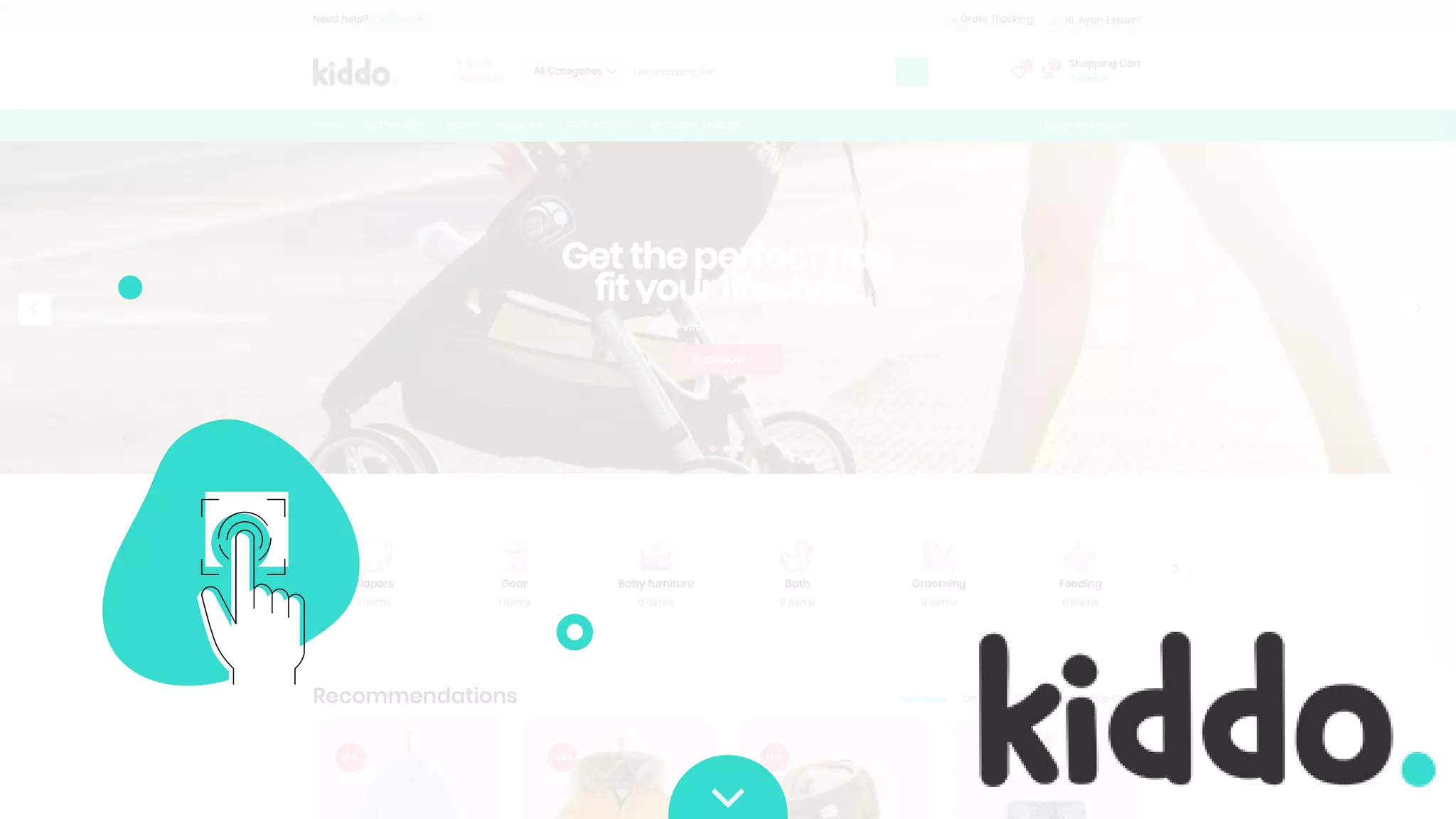
The cover slide features the Kiddo logo and a background image of a web interface showing a stroller. The tagline "Get the perfect ride fit your lifestyle" is visible on the interface mockup. The branding uses a teal and white color palette, establishing a clean, modern aesthetic suitable for a parenting brand. There is a prominent 'click' icon, emphasizing the digital nature of the business.
Slide 2: The Problem
Kiddo identifies three distinct pain points for parents in Egypt. Problem 1 highlights the fragmentation of the market, noting that mothers must visit multiple locations including pharmacies, clothes stores, toy stores, and furniture stores. Problem 2 points to the overwhelming number of brands with varying price scales and quality, leading to decision fatigue. Problem 3 focuses on the physical logistics, stating it is "Time consuming and effort to get your baby new stuff carrying a baby." This slide effectively uses a relatable struggle to justify the need for a centralized solution.
Slide 3: The Solution
The solution is presented as a three-step value proposition. First, gathering multi-vendors into one "trusted platform." Second, allowing consumers to choose among the "best brands online." Third, delivering "organized orders in no time." The emphasis here is on trust and efficiency, aiming to reduce the "extra time or effort" mentioned in the problem slide.
Slide 4: Company Mission
This slide defines Kiddo as the "first online mall in Egypt" for baby and mommy products. It explicitly lists the product categories: clothes, furniture, and home accessories. The core promise is bringing these items "right to your doorstep." By using the term "online mall," Kiddo is attempting to own a specific category in the Egyptian e-commerce landscape.
Slide 5: Competitive Edge
Kiddo lists four differentiators. The first is the first-mover advantage in the Egyptian market for this specific niche. The second is a unique feature: customization . The slide notes that parents can customize products like beds. The third is a focus on gifting through giveaways. Finally, they highlight a quality guarantee system. While these are good starting points, the deck does not explain the mechanics of the quality system or the customization process.
Slide 6: How it Works
This slide showcases the product's UI on both desktop and mobile devices. The text claims the website is "smooth" and that the first phase of the website works as well as a mobile application. It mentions features like brand exploration, wishlists, and ordering. Showing the product exists is a positive step, though these are standard e-commerce features rather than proprietary technology.
Slide 7: The Opportunity
Titled "Oppourtionity," this slide discusses the business potential and marketing strategy. It mentions digital campaigns on social media and Google, as well as offline efforts like billboards and events. The slide argues that the idea has "commercial potential" and can "enhance the trust in online shopping." This slide is somewhat repetitive and lacks specific KPIs or customer acquisition cost (CAC) estimates.
Slide 8: Size the Market
This is the most data-dense slide in the deck. It cites a total population of 101.4 million with 2% annual growth. It identifies 54.74 million internet users (growing at 22%) and 42.0 million social media users . Crucially, it notes that 9.2% of the female internet population makes online transactions. It also provides e-commerce spend figures: $1.07 billion for Fashion and Beauty, $817 million for Furniture and Appliances, and $646 billion (likely a typo for million, given the other figures) for Toys and Hobbies. These figures provide a sense of the Total Addressable Market (TAM) in Egypt.
Slide 9: Stay in Touch
The final slide provides contact information, including the website (www.kiddoegy.com) and an email address. It features a generic illustration of people interacting with a mobile phone. There is no call to action regarding an investment round.
What Kiddo Does Well
Niche Focus: By positioning themselves as an "online mall" for a specific demographic, they avoid competing directly with generalist giants on every front. · Market Context: The inclusion of specific Egyptian population and internet usage stats (Slide 8) helps an investor understand the scale of the regional opportunity. · Relatable Problem: The problem slide (Slide 2) is grounded in the actual daily experience of their target customer, which makes the solution feel necessary.
What is Missing from the Kiddo Deck
The Team: This is the most glaring omission. Investors back people, especially at the early stage. There is no mention of the founders' backgrounds, e-commerce experience, or local market expertise. · Traction: There are no numbers regarding how many vendors are currently on the platform, how many orders have been processed, or what the monthly GMV looks like. Without traction, this is just an idea. · The Ask: The deck does not state how much money is being raised, the terms of the round, or how the funds will be allocated (e.g., 40% marketing, 30% tech, 30% operations). · Business Model Details: While we know it is a marketplace, the deck doesn't specify the take rate (commission) they charge vendors or their delivery logistics model. · Competition: The deck claims to be the "first," but it ignores existing horizontal e-commerce players in Egypt (like Jumia or Amazon/Souq) who also sell baby products.
Founder Recommendations
Add a Team Slide: Even if the team is small, highlight relevant skills. If you have experience in retail, logistics, or the Egyptian tech scene, state it clearly. · Clarify the 'Ask': Never end a pitch deck without telling the investor what you want. Define the funding goal and the milestones that money will help you reach. · Show, Don't Just Tell, Traction: If the site is live (as Slide 6 suggests), include a slide with growth charts showing user acquisition or sales volume over the last 6-12 months. · Proofread: Errors like "Oppourtionity" (Slide 7) and potential typos in market billions vs. millions (Slide 8) can undermine a founder's credibility regarding attention to detail.
Frequently asked questions
- What is Kiddo's primary business model?
- Kiddo operates as a multi-vendor e-commerce marketplace. According to Slide 3 and Slide 4, the company gathers various vendors on a single platform to sell baby clothes, furniture, and home accessories. It positions itself as an 'online mall' that handles the delivery of organized orders to the consumer's doorstep, essentially acting as a specialized aggregator for the parenting niche in Egypt.
- How does Kiddo differentiate itself from general e-commerce platforms?
- Kiddo claims several 'competitive edges' on Slide 5. These include being a first-of-its-kind specialized experience in Egypt, offering a product customization section (specifically for items like beds), providing a gifting/giveaway service for users, and implementing a quality control system to ensure only trusted products are sold on the platform.
- What market data does the deck provide to support the opportunity?
- Slide 8 provides specific macro statistics for Egypt: a population of 101.4 million growing at 2% annually, and 54.74 million internet users growing at 22%. It also notes that 9.2% of the female internet population makes online transactions. Furthermore, it lists e-commerce spending across categories like Fashion ($1.07B) and Toys/Hobbies ($646B).
- What are the most critical elements missing from this pitch deck?
- The deck is missing three pillars of a standard seed-stage pitch: the Team, the Traction, and the Ask. There is no information about who is running the company, no data on current sales or user growth to prove product-market fit, and no mention of how much money they are raising or the valuation they are seeking.
- What is Kiddo's marketing strategy according to the slides?
- On Slide 7, titled 'Oppourtionity' (sic), the company outlines a two-pronged marketing approach. Digitally, they run campaigns across various social media platforms and Google. Offline, their 'on ground' marketing plan includes billboards and events to build brand awareness and enhance trust in the online shopping experience.