Kili Technology’s 2021 Series A deck is a study in brevity and narrative focus. Spanning only 8 slides, the presentation bypasses traditional sections like Team, Financials, and Competition to focus entirely on the '80% blindspot' of AI: data labeling. By positioning training data as the 'DNA' of models and highlighting that 80% of AI projects fail to reach production, Kili creates an urgent need for their industrial-grade management platform. The deck relies heavily on the macro-trend of data-centric AI, citing that a 10% reduction in label accuracy leads to a 2-5% decrease in model performa…
Key takeaways
- The deck identifies an '80% blindspot' where enterprises invest in AI but fail to deploy projects due to unstructured data (Slide 2).
- Kili positions labeling as a non-emerging trend by showing that tech leaders like Google, Facebook, and Uber built internal platforms a decade ago (Slide 3).
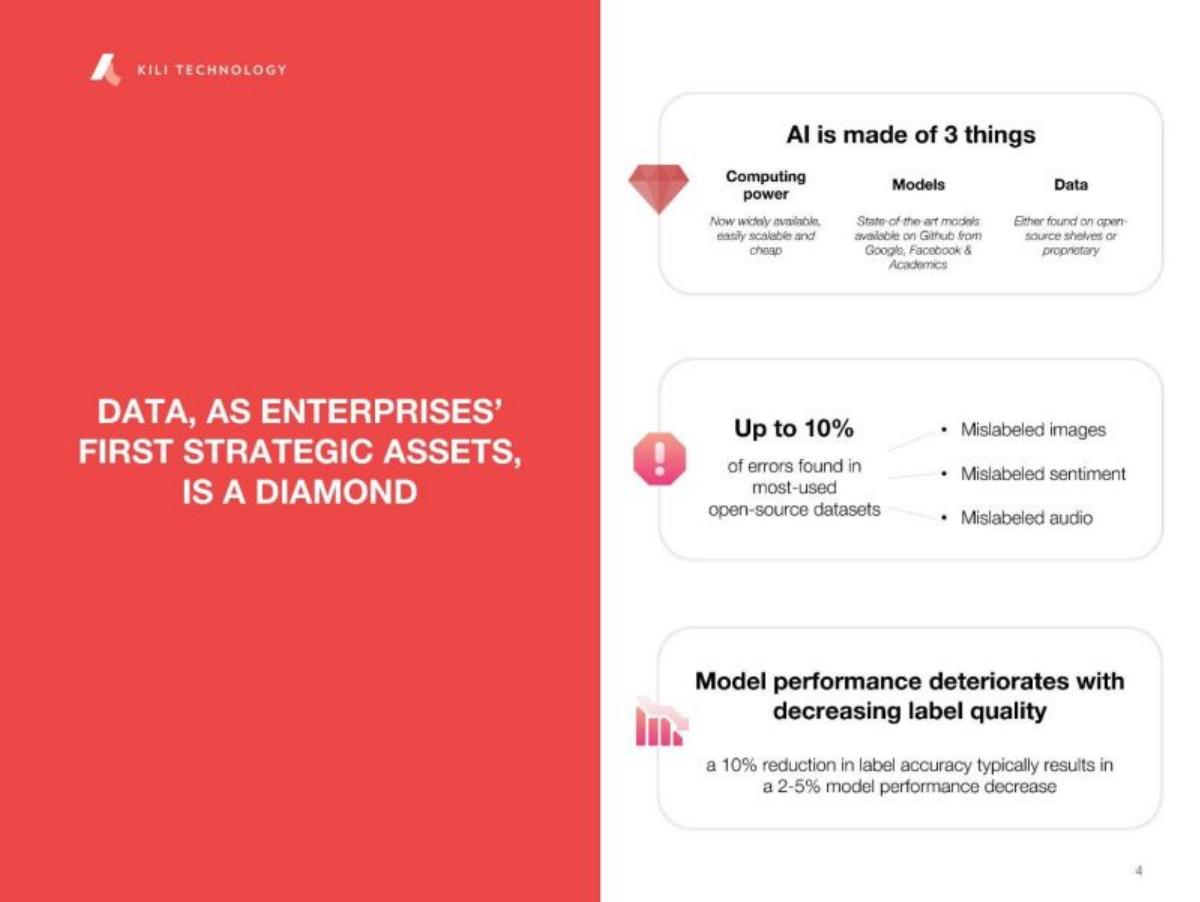
- A critical metric provided is that a 10% reduction in label accuracy results in a 2-5% model performance decrease (Slide 4).
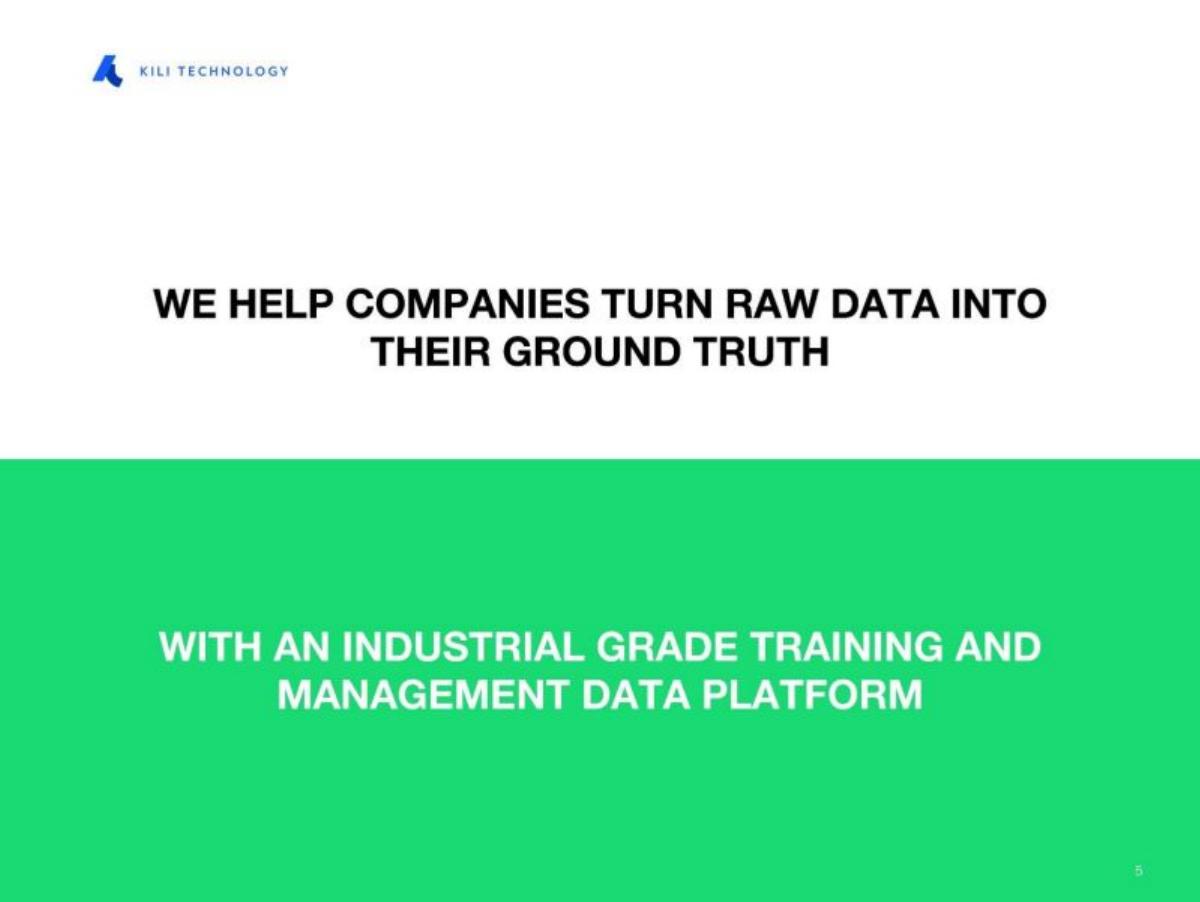
- The platform is described as 'industrial grade' for turning raw data into 'ground truth' (Slide 5).
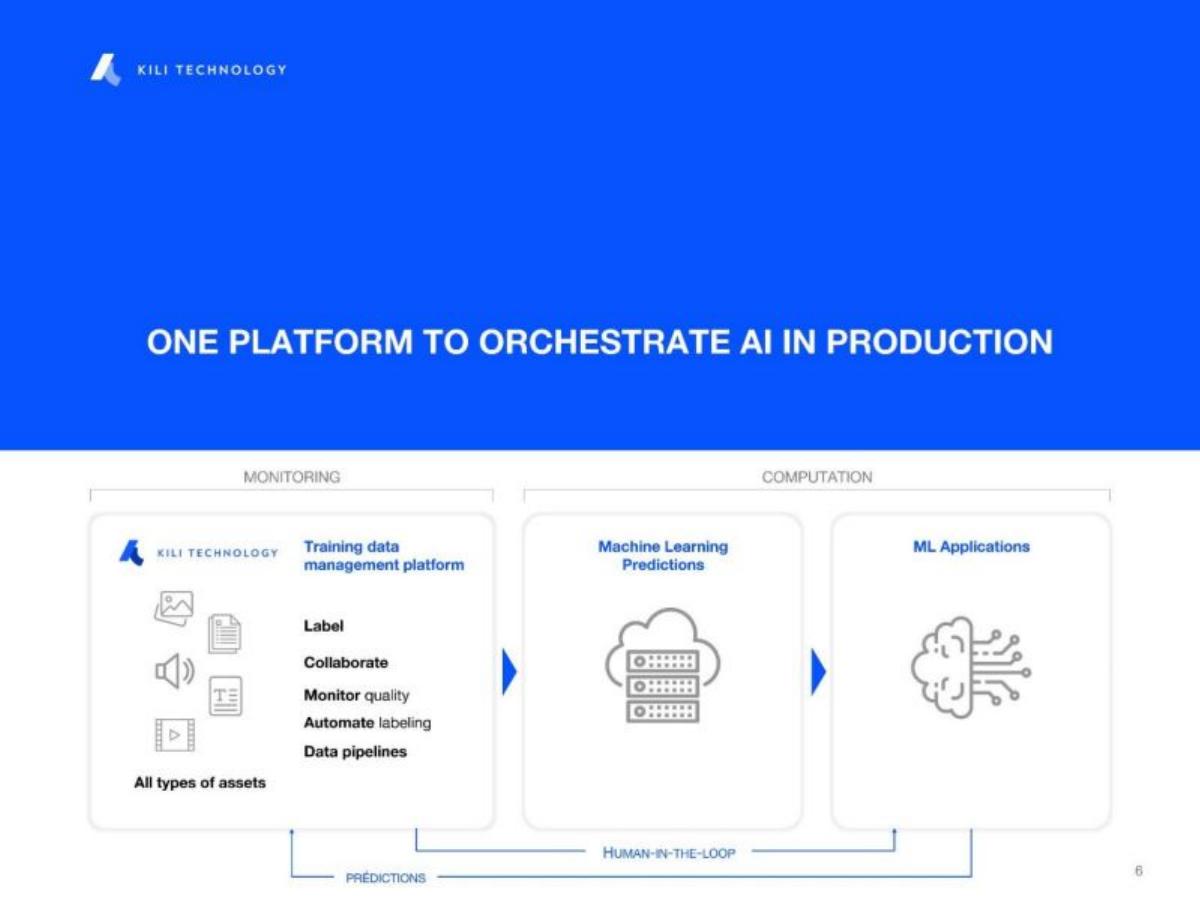
- The product architecture emphasizes a 'human-in-the-loop' system connecting training data to machine learning predictions (Slide 6).
- The deck omits a Team slide, which is highly unusual for a Series A raise of $25M.
- There is no 'Ask' slide detailing how the $25M will be spent or what the specific valuation targets were.
- The deck lacks a competitive landscape, choosing instead to focus on the inadequacy of open-source datasets (Slide 4).
The Power of the Problem-First Narrative
Kili Technology’s Series A deck is a masterclass in identifying a bottleneck. In 2021, the AI hype cycle was shifting from 'model-centric' to 'data-centric.' Kili capitalized on this by spending nearly half of their 8-slide deck explaining why current AI investments were failing. By the time the viewer reaches the product slide, the necessity of a training data management platform feels inevitable. This teardown examines how they used a lean structure to secure a significant $25M round.
Slide 1: The Vision Statement
The cover slide is minimalist, featuring the Kili Technology logo and the tagline: "BUILD AI THAT MATTERS." Below this, they define their category: "THE TRAINING DATA MANAGEMENT PLATFORM FOR DATA-CENTRIC ORGANIZATIONS." This immediately signals that they are not a service provider (a labeling farm) but a software platform (SaaS). The use of the term 'data-centric' aligns them with the industry movement led by figures like Andrew Ng, which was gaining significant traction at the time of the raise.
Slide 2: The 80% Blindspot
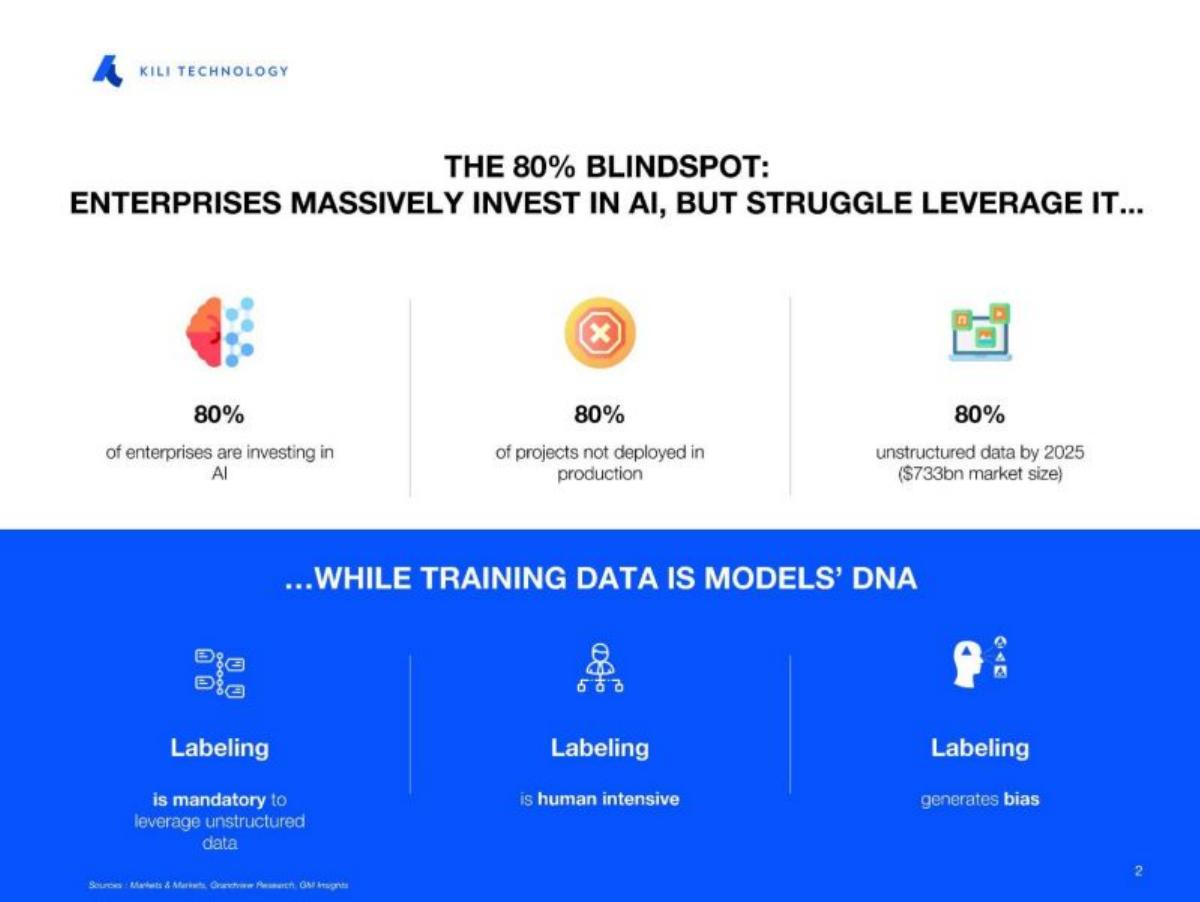
Slide 2 is the 'Problem' slide, and it is exceptionally dense with market validation. It presents three '80%' statistics to frame the crisis in enterprise AI:
80% of enterprises are investing in AI: Establishing the massive demand. · 80% of projects not deployed in production: Establishing the failure rate. · 80% unstructured data by 2025 ($733bn market size): Establishing the scale of the raw material.
The bottom half of the slide explains why this is happening, noting that labeling is mandatory, human-intensive, and generates bias. By calling training data the 'DNA' of models, Kili elevates their product from a utility to a fundamental requirement for success.
Slide 3: Validation Through Precedent
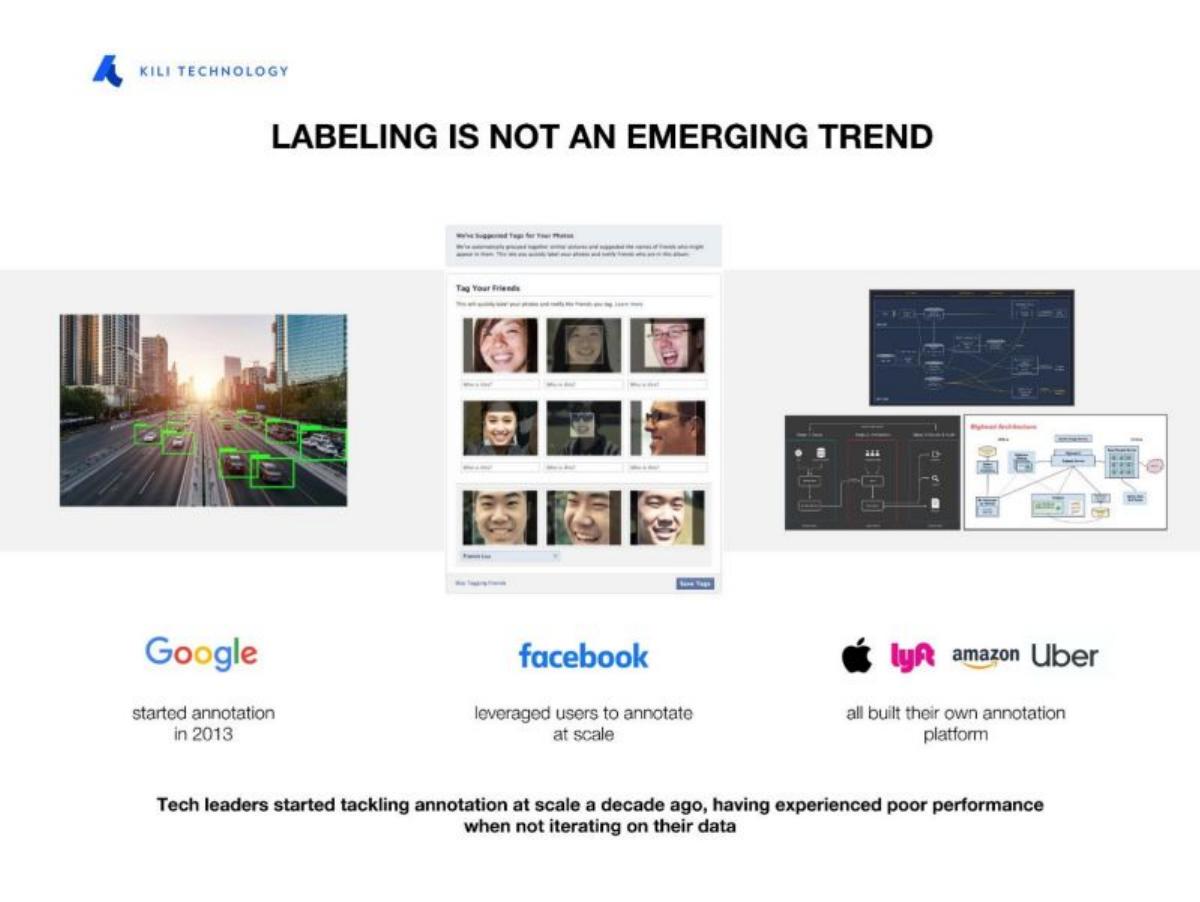
To counter the objection that labeling is a temporary or niche problem, Slide 3 shows that the world's most successful tech companies solved this internally years ago. It cites Google (started annotation in 2013), Facebook (leveraged users to annotate at scale), and Apple, Lyft, Amazon, and Uber (all built their own annotation platforms). The message is clear: if you want to be a tech leader, you need an annotation platform. Kili is offering the 'rest of the world' the same tools the giants built for themselves.
Slide 4: The Cost of Poor Quality
Slide 4 provides the technical 'teeth' for the pitch. It breaks AI down into three components: Computing power (cheap/available), Models (open-source/available), and Data (the 'Diamond'). The slide claims that up to 10% of errors are found in the most-used open-source datasets. Crucially, it quantifies the impact: "a 10% reduction in label accuracy typically results in a 2-5% model performance decrease." This converts a vague quality issue into a measurable business loss, making the purchase of Kili’s software a logical ROI decision.
Slide 5: The Transition
Slide 5 serves as a simple bridge. It states: "WE HELP COMPANIES TURN RAW DATA INTO THEIR GROUND TRUTH WITH AN INDUSTRIAL GRADE TRAINING AND MANAGEMENT DATA PLATFORM." The term 'Ground Truth' is a specific industry term that resonates with data scientists, and 'industrial grade' differentiates them from lightweight, open-source labeling tools.
Slide 6: The Solution Architecture
This is the only product-focused slide in the deck. It illustrates how Kili sits at the center of the AI lifecycle. It lists five key functions: Label, Collaborate, Monitor quality, Automate labeling, and Data pipelines. The diagram shows a flow from 'All types of assets' through the Kili platform, into 'Machine Learning Predictions,' and finally 'ML Applications.' The inclusion of a 'Human-in-the-loop' feedback loop is vital, as it acknowledges that AI training is an iterative process, not a one-time event.
Slide 7 & 8: The Conclusion
Slide 7 is a simple 'THANKS' slide, and Slide 8 is a placeholder for the source library. Notably, there is no team slide, no traction slide (revenue, customer logos, or growth rates), and no 'Ask' slide. While these were almost certainly part of the verbal pitch or a secondary data room, their absence in the core narrative deck shows that Kili was selling a vision of the future where they are the essential infrastructure for the AI era.
What Kili Technology Does Well
Kili excels at problem framing . They don't start with their features; they start with the fact that 80% of AI projects are failing. This creates immediate 'pain' for the investor to solve. They also do an excellent job of quantifying the impact of their solution . By linking label accuracy to model performance (Slide 4), they move the conversation from 'nice to have' to 'mission critical.'
The use of social proof on Slide 3 is also highly effective. By listing FAANG companies, they aren't just saying 'we have customers'; they are saying 'the smartest companies in the world already do what we do, and we are bringing that capability to everyone else.'
What is Missing from the Deck
The Team: For a $25M Series A, the pedigree of the founders is usually a top-three slide. Its absence here is highly unusual. · Traction and Revenue: There is no mention of how many customers Kili has or what their ARR (Annual Recurring Revenue) was at the time. · Competition: The deck ignores competitors like Labelbox or Scale AI, which were already well-funded at the time. · The Ask: There is no slide detailing how much they are raising or what the milestones for the next 18 months are.
Founder Takeaways
Focus on the Bottleneck: If you are building infrastructure, don't just sell your tool; sell the fact that without your tool, the rest of the industry's investment is wasted. Kili’s '80% blindspot' is a perfect example of this.
Quantify the Pain: Don't just say 'bad data is bad.' Say 'a 10% error in data leads to a 5% drop in performance.' Numbers stick in investors' minds far better than adjectives.
Align with Macro Trends: Kili rode the wave of 'Data-Centric AI.' By using the language of the current industry leaders, they made their startup feel like a part of an inevitable shift in technology.
Keep it Lean: You don't need 40 slides to raise $25M. If your narrative is strong enough and your market is hot enough, 8 slides can be enough to get the meeting that leads to the term sheet.
Frequently asked questions
- How did Kili Technology raise $25M with only 8 slides?
- Kili Technology focused on a high-pain problem in a rapidly expanding market: AI training data. By highlighting that 80% of AI projects fail to reach production (Slide 2), they established immediate relevance. The brevity suggests this was likely a supporting deck for a narrative-driven pitch or a follow-up to a more data-heavy technical due diligence process, focusing on the strategic 'why' rather than just the 'what'.
- Why is there no team slide in this deck?
- The absence of a team slide in a Series A deck is rare. It is possible the team slide was removed for public distribution to protect privacy, or the founders were already well-known to the investors. In a standard fundraising environment, omitting the team is generally discouraged as investors at this stage are betting heavily on the founders' ability to execute.
- What is the '80% blindspot' mentioned in the deck?
- Slide 2 defines the '80% blindspot' through three metrics: 80% of enterprises are investing in AI, 80% of projects are not deployed in production, and 80% of data will be unstructured by 2025. This framing suggests that the primary bottleneck to AI ROI is not the models themselves, but the management and labeling of the data that feeds them.
- What specific product features does Kili highlight?
- On Slide 6, Kili outlines five core capabilities of their training data management platform: Labeling, Collaboration, Quality Monitoring, Automated Labeling, and Data Pipelines. They position themselves as the orchestration layer that sits between raw assets (images, audio, text, video) and machine learning predictions, incorporating a 'human-in-the-loop' feedback mechanism.
- How does Kili justify the need for their software over open-source alternatives?
- Slide 4 argues that open-source datasets are unreliable, stating that up to 10% of errors are found in the most-used open-source datasets, including mislabeled images, sentiment, and audio. By linking this 10% error rate to a 2-5% drop in model performance, they make a quantitative case for 'industrial grade' proprietary management tools.