Kinjo's pitch deck focuses on a fundamental tension in parenting: the gap between 'fun' screen time (Roblox, Fortnite) and 'work' screen time (Kumon, IXL). By positioning themselves as a layer that sits on top of existing popular games, Kinjo avoids the high cost of content creation while capturing the massive engagement of the Roblox ecosystem. The deck highlights a leadership team with significant edtech and gaming pedigree, including a Vice President at Roblox as an advisor. Their model uses a 'Kinjo Coin' economy to incentivize kids to choose higher-complexity games, while providing paren…
Key takeaways
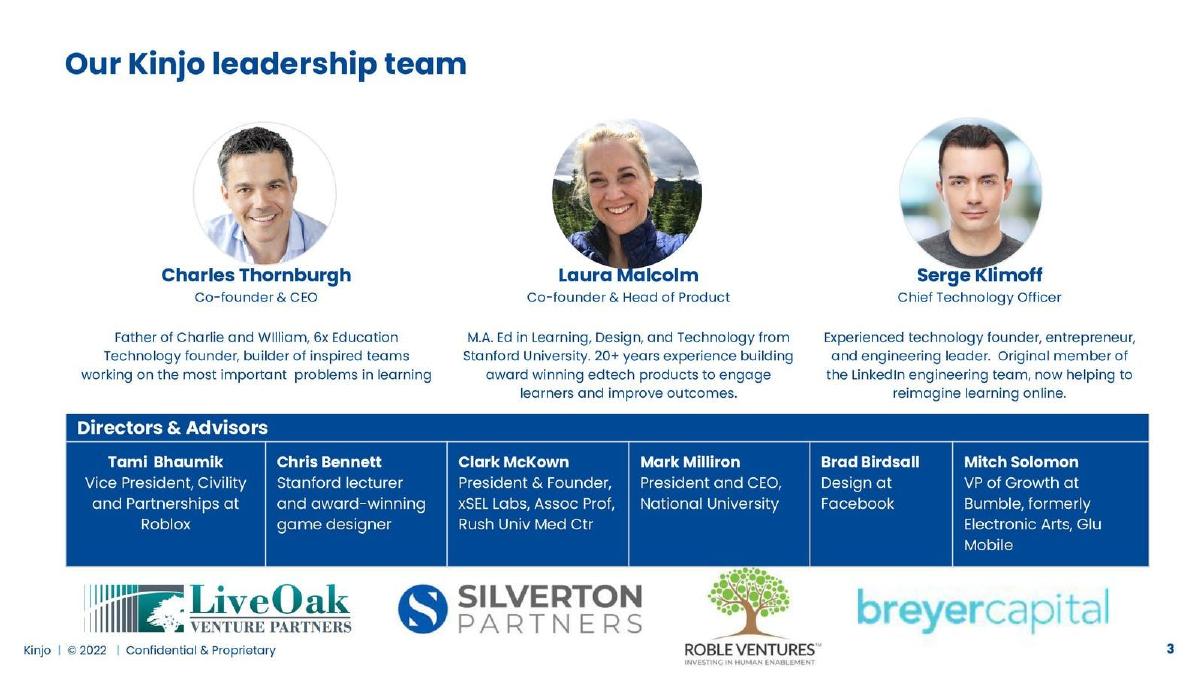
- The team slide (Slide 3) features heavy-hitters including a 6x EdTech founder and a former member of the LinkedIn engineering team.
- Kinjo secures high-level industry validation by listing Tami Bhaumik, VP of Civility and Partnerships at Roblox, as a Director & Advisor (Slide 3).
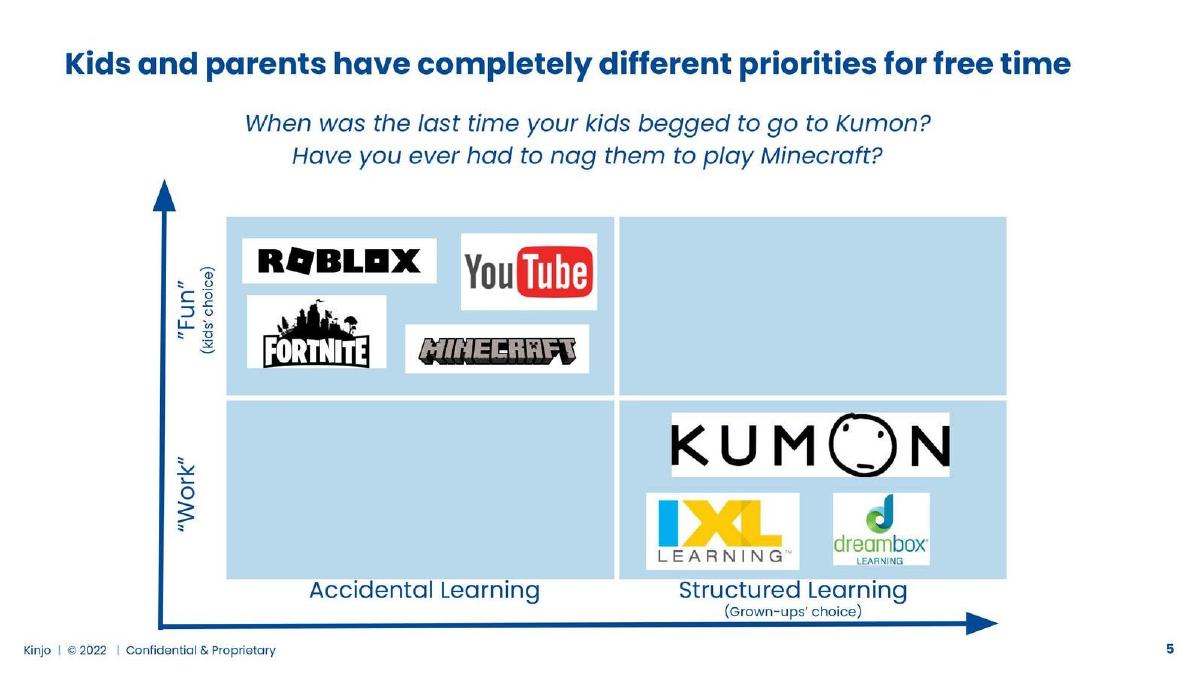
- The problem is framed as a quadrant (Slide 5) showing a void in the 'Fun + Structured Learning' space, currently dominated by 'Accidental Learning' (Roblox) or 'Work' (Kumon).
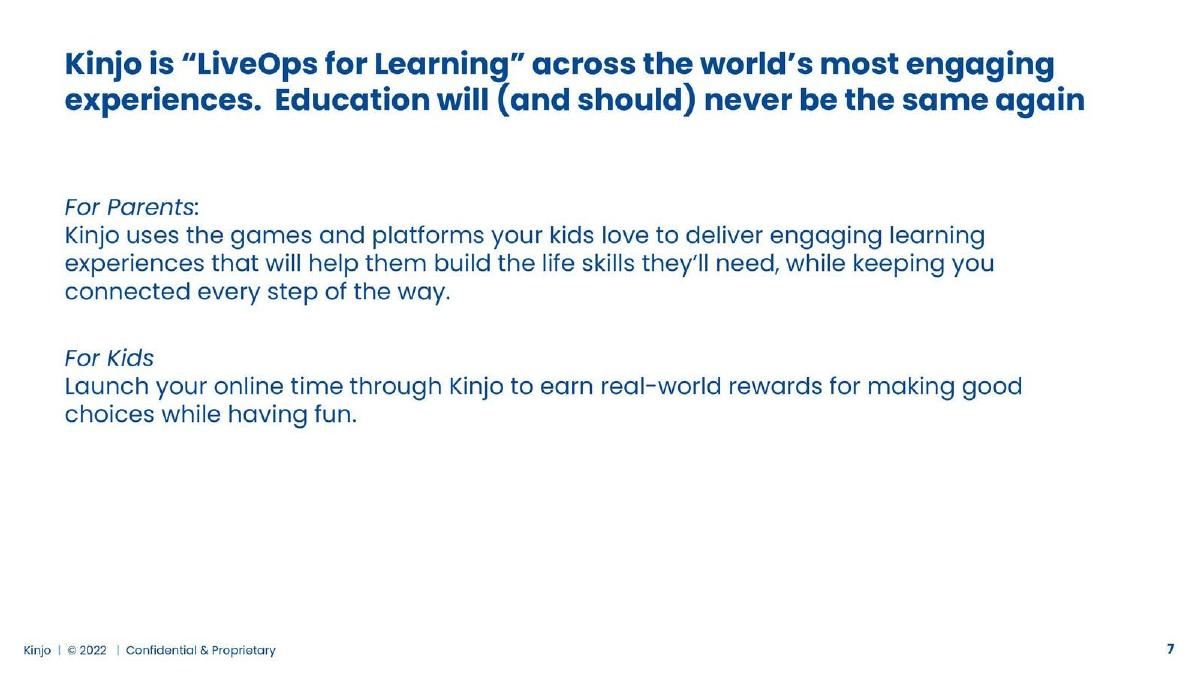
- The product is defined as 'LiveOps for Learning,' a term borrowed from the gaming industry to describe ongoing content management and engagement (Slide 7).
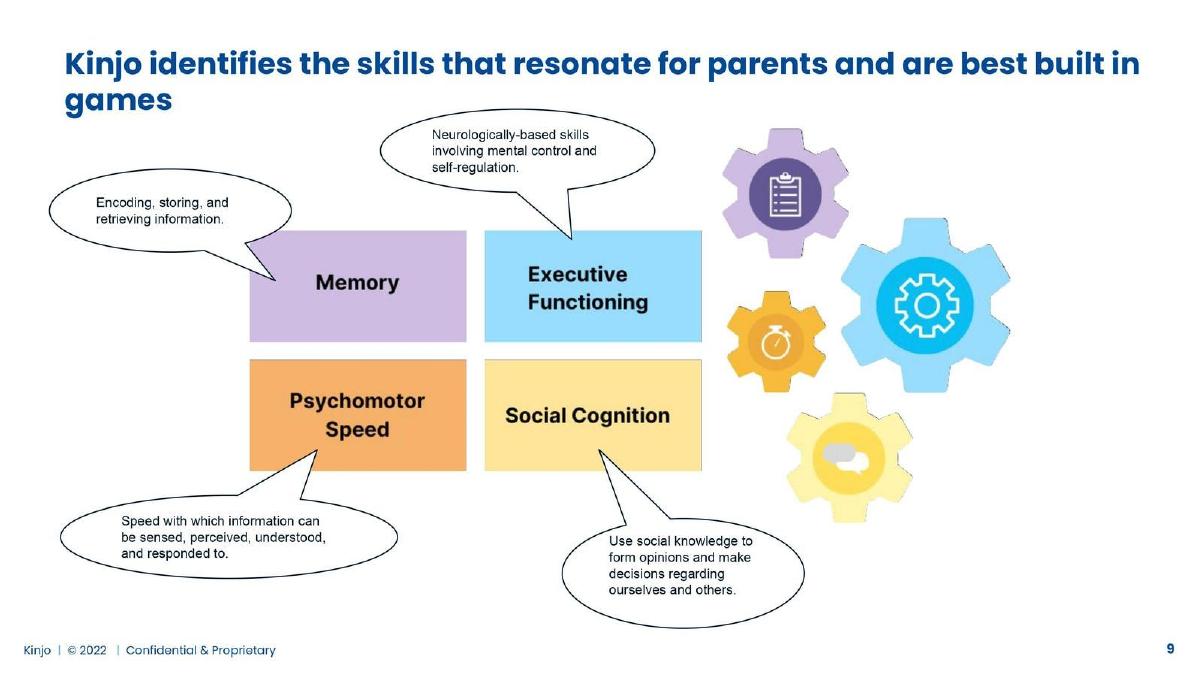
- Kinjo identifies four core cognitive pillars for their scoring system: Memory, Executive Functioning, Psychomotor Speed, and Social Cognition (Slide 9).
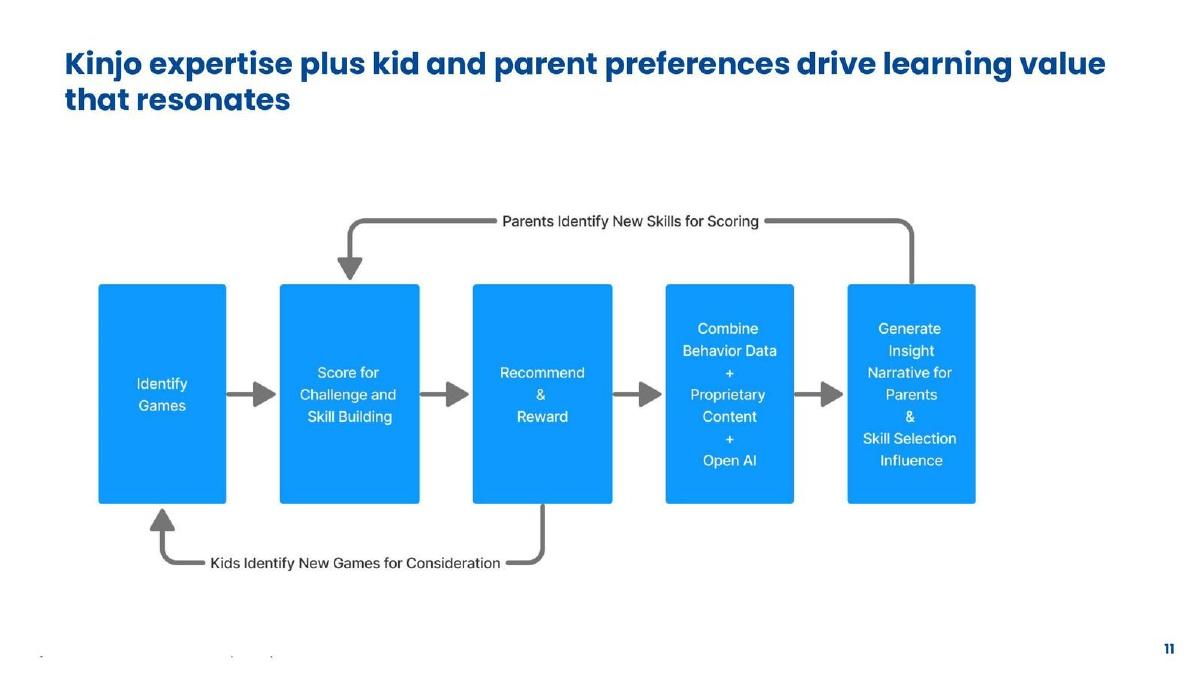
- The technical workflow (Slide 11) integrates proprietary content with OpenAI to generate parent-facing narratives.
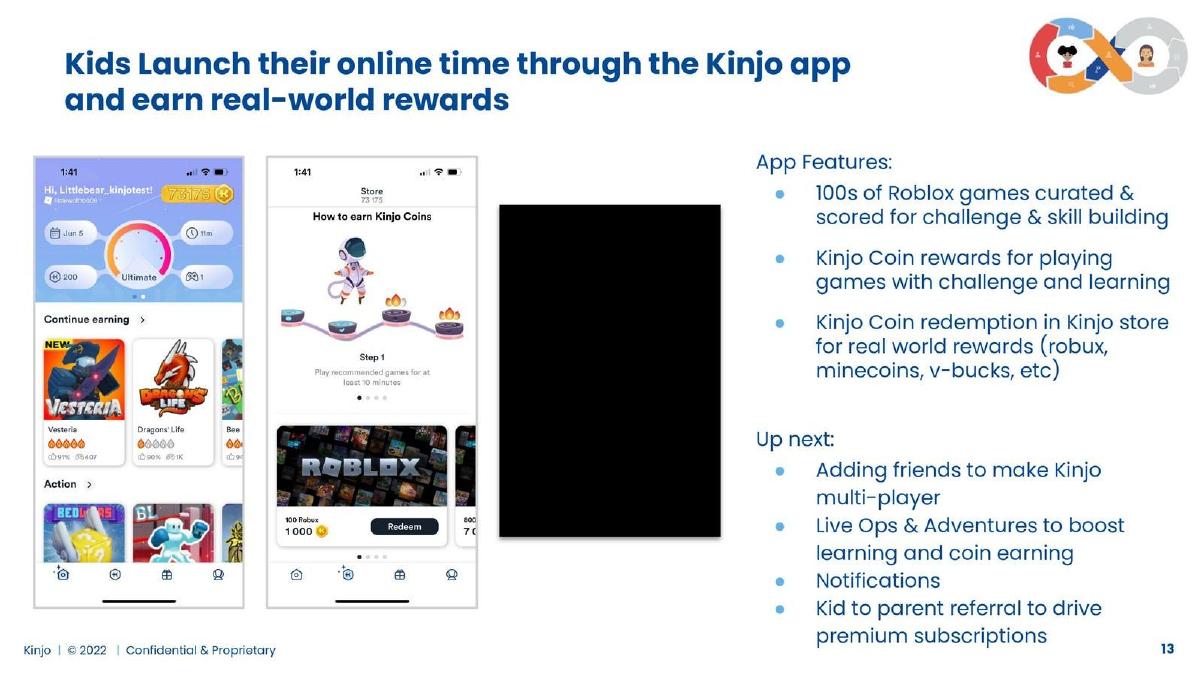
- The business model relies on a dual-sided incentive: kids earn 'Kinjo Coins' for real-world rewards like Robux or V-Bucks, while parents pay for premium insights (Slide 13, 15).
- The deck lacks a specific 'Ask' slide or detailed financial projections, focusing instead on product mechanics and team pedigree.
Kinjo: The Bridge Between Roblox and Cognitive Development
Kinjo’s pitch deck represents a strategic shift in the EdTech sector. Rather than attempting to build the next 'educational game'—a category often dismissed by children as 'chocolate-covered broccoli'—Kinjo positions itself as an infrastructure and incentive layer on top of the world's most popular gaming platforms. With a $6.5M Seed round raised in 2024, the company is betting that parents will pay for visibility and educational outcomes derived from the time their children already spend on Roblox.
Slide 1: Title Slide
The deck opens with a high-resolution lifestyle image of children engaged with tablets, paired with the tagline 'Learning Through Play for a Connected World.' The branding is colorful and child-friendly, but the subtitle signals a sophisticated educational philosophy. There are no metrics or grand claims here, just a clear establishment of the brand identity.
Slide 3: The Leadership Team
This is one of the strongest slides in the deck. Kinjo leads with pedigree. CEO Charles Thornburgh is identified as a 6x EdTech founder, and Head of Product Laura Malcolm brings 20 years of experience in the field. CTO Serge Klimoff is noted as an original member of the LinkedIn engineering team. Below the founders, the 'Directors & Advisors' section is particularly impressive for a seed-stage company, featuring Tami Bhaumik, a Vice President at Roblox. Including a high-ranking executive from the platform you are building on is a massive de-risking signal for investors. The slide also displays logos for LiveOak, Silverton, Roble Ventures, and Breyer Capital, indicating existing institutional support.
Slide 5: The Market Gap
Kinjo uses a classic 2x2 matrix to define the problem. The Y-axis measures 'Fun' (Kids' choice) vs. 'Work,' while the X-axis measures 'Accidental Learning' vs. 'Structured Learning' (Grown-ups' choice). They place Roblox, Fortnite, and YouTube in the 'Fun/Accidental' quadrant and Kumon and IXL in the 'Work/Structured' quadrant. The top-right quadrant—Fun and Structured Learning—is conspicuously empty. This slide effectively communicates that while kids love Roblox, parents view it as 'accidental' at best, and there is a massive opportunity to move those highly engaging experiences into the 'structured' category.
Slide 7: The Value Proposition
Slide 7 introduces the term 'LiveOps for Learning.' In the gaming industry, LiveOps refers to the practice of managing a game as a service to keep players engaged. Kinjo applies this to education. For parents, the value is building life skills through games kids already love. For kids, the value is earning 'real-world rewards' for making 'good choices' in their game selection. This slide establishes the dual-incentive structure necessary for any home-based EdTech product to succeed.
Slide 9: The Cognitive Framework
To move from 'accidental' to 'structured' learning, Kinjo must prove it understands the science. Slide 9 breaks down their focus into four pillars: Memory, Executive Functioning, Psychomotor Speed, and Social Cognition. By using clinical terminology like 'neurologically-based skills' and 'encoding, storing, and retrieving information,' Kinjo signals to investors that their scoring system is rooted in developmental psychology, not just arbitrary game ratings.
Slide 11: The Operational Loop
This slide explains the 'how.' It shows a circular workflow: Kinjo identifies games, scores them for challenge, recommends them to kids, and rewards them for playing. The data from this gameplay is then combined with 'Proprietary Content' and 'Open AI' to generate 'Insight Narratives' for parents. This loop is critical because it shows how the company plans to scale; by using AI to generate the reports, they can support thousands of different games without needing a human to write every single parent update.
Slide 13: Product Interface and Rewards
Slide 13 provides the first look at the app interface. It shows a curated list of Roblox games (like Vesteria and Dragons' Life) with associated 'flame' icons representing challenge levels. The 'Kinjo Coin' system is the centerpiece here. The slide explicitly states that coins can be redeemed for 'robux, minecoins, v-bucks, etc.' This is a crucial detail—Kinjo is using the 'currency' of the gaming world to drive educational behavior. The 'Up next' section mentions multi-player features and 'kid to parent referrals,' suggesting a viral growth strategy.
Slide 15: The Revenue Model
The deck concludes its product section by detailing the 'Parent Subscription' launching in August 2023. The subscription includes the 'Kinjo Insights Email' and a measure of 'cognitive challenge.' By tying the subscription to 'personalized insights' generated by AI, Kinjo is positioning its premium tier as a high-value data product for parents who are anxious about their children's screen time. The mention of 'payment integration' and 'subscription management' indicates the product is moving out of the purely conceptual phase.
What Kinjo Does Well
Platform Synergy: Kinjo doesn't fight the 'Roblox problem'; it solves it. By building on top of a platform with 70+ million daily active users, they bypass the hardest part of EdTech: user acquisition and retention. They are essentially 'taxing' the engagement that already exists on Roblox.
Expertise Signaling: The team and advisor slides are masterclasses in building authority. Having the VP of Civility at Roblox as an advisor isn't just a nice-to-have; it's a strategic moat that suggests Kinjo has a deep understanding of the platform's roadmap and safety protocols.
Clear Incentive Alignment: Most EdTech products fail because the person who pays (the parent) and the person who uses it (the kid) have misaligned goals. Kinjo aligns them by giving the kid what they want (Robux) in exchange for what the parent wants (educational growth).
What is Missing from the Deck
The 'Ask': The provided slides do not include a specific funding request. While we know from publisher reports that they raised $6.5M, the deck itself doesn't state the amount sought or the intended use of funds (e.g., hiring, marketing, R&D).
Unit Economics: There is no mention of Customer Acquisition Cost (CAC) or Lifetime Value (LTV). While this is a Seed deck, investors would likely want to see how much it costs to acquire a parent subscriber versus the cost of the 'real-world rewards' (Robux) being paid out to the children.
Competitive Landscape: Aside from the 2x2 matrix, there is no detailed analysis of competitors. Companies like 'Caribu' or 'Outschool' operate in the broader digital education space, and a slide addressing how Kinjo defends its position against other screen-time management tools would have been beneficial.
Founder Takeaways
Leverage Existing Ecosystems: If you are building in a crowded market, don't build a new destination. Build a layer on top of where the users already are. Kinjo’s 'LiveOps for Learning' model is a blueprint for this strategy.
Translate 'Fun' into 'Data': Parents are often willing to tolerate their children's gaming if they feel it is productive. Kinjo’s use of AI to translate raw gameplay into 'cognitive insights' is a powerful way to turn a perceived negative (screen time) into a perceived positive (developmental tracking).
Secure 'Inside' Advisors: The inclusion of a Roblox VP is the most important signal in this deck. For any startup building on a third-party platform (like Shopify, Salesforce, or Roblox), having an advisor from that platform is the ultimate validation of your technical and ethical alignment with the host ecosystem.
Frequently asked questions
- How does Kinjo actually make money?
- According to Slide 15, the company intends to drive revenue through a 'Parent Subscription' model. This subscription provides personalized insight emails, a measure of cognitive challenge, and a web app for subscription management. The deck also mentions 'kid to parent referrals' as a growth lever for these premium subscriptions.
- What is the 'LiveOps for Learning' concept?
- As described on Slide 7, 'LiveOps for Learning' means Kinjo doesn't build its own games. Instead, it uses existing platforms like Roblox to deliver learning experiences. It manages the 'operations' of learning by recommending specific games, rewarding kids for playing them, and tracking their progress, similar to how game developers manage live events to keep players engaged.
- How does Kinjo ensure the games are actually educational?
- Slide 9 and Slide 11 outline a scoring process. Kinjo identifies games and scores them based on 'Challenge and Skill Building.' They focus on four specific neurological areas: Memory, Executive Functioning, Psychomotor Speed, and Social Cognition. This data is then combined with proprietary content and AI to validate the learning value.
- What rewards do kids get for using the app?
- Slide 13 details the 'Kinjo Coin' system. Kids earn these coins by playing recommended games for at least 10 minutes. These coins can be redeemed in the Kinjo store for 'real world rewards' that kids actually value, specifically mentioning Robux, Minecoins, and V-Bucks.
- Who are the key investors and advisors behind Kinjo?
- Slide 3 lists several prominent venture firms including LiveOak Venture Partners, Silverton Partners, Roble Ventures, and Breyer Capital. Notable advisors include Tami Bhaumik (VP at Roblox), Chris Bennett (Stanford lecturer), and Mitch Solomon (formerly of EA and Glu Mobile).