Kitt's 35-slide deck for their $8M Seed extension (as reported by Business Insider) successfully positions the company as the primary beneficiary of the post-COVID commercial real estate crisis. By framing the problem through the lens of a power shift from landlords to tenants, Kitt introduces a 'full-stack' model that combines marketplace search, 3D design, and turnkey management. The deck leans heavily on social proof with high-profile clients like Oatly and Zwift, backed by a strong 120% Net Dollar Retention. While the deck excels at demonstrating product-market fit and operational efficie…
Key takeaways
- The deck identifies a macro shift in commercial real estate, claiming power has 'irreversibly shifted' from landlords to tenants (Slide 2).
- Kitt defines itself as a 'full-stack workspace platform' covering search, design, and management (Slide 3).
- The company demonstrates strong retention with a 120% Net Dollar Retention and significant GMV growth from existing clients like Accedo at +184% (Slide 4).
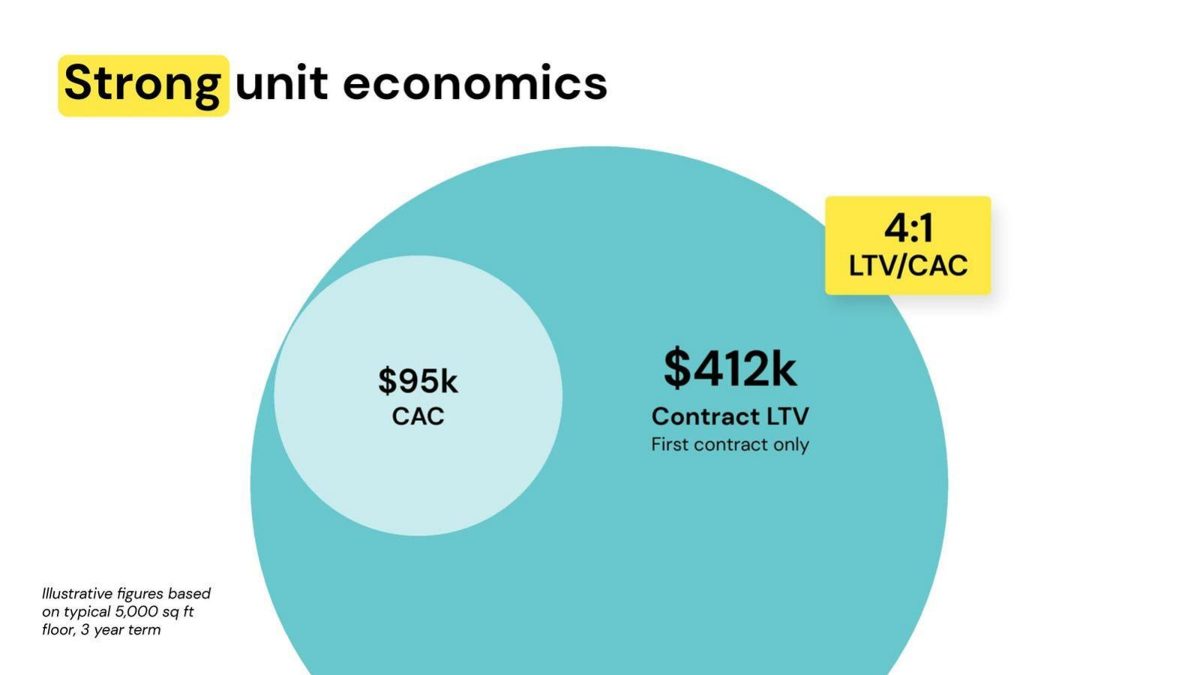
- Unit economics are a highlight, showing a $95k CAC against a $412k Contract LTV, resulting in a 4:1 LTV/CAC ratio (Slide 5).
- Kitt targets a massive market, valuing the office industry at $3 trillion (Slide 6).
- Operational efficiency is quantified by comparing Kitt to the industry: $70psf cost vs $90psf, and 3 months build time vs 5 months (Slide 7).
- The platform acts as a bridge between demand (tenants/brokers) and supply (landlords/agents) via the Kitt Hub and App (Slide 8).
- Visual evidence of the product is provided through a 'Before and After' case study for Oatly, showcasing the tangible results of their fit-out service (Slide 9).
The Macro Argument: A Power Shift in Real Estate
Slides 1-2: The Hook and the Problem
Kitt opens its Seed extension deck with a minimalist title slide that sets a modern, tech-forward tone. However, it is Slide 2 that does the heavy lifting for the narrative. Using a meme-based visual approach (SpongeBob SquarePants), the company argues that "Power has irreversibly shifted from Landlord to Tenant."
This is a classic 'Why Now' slide. By contrasting the 'Pre-COVID landlord' (wealthy and comfortable) with the 'Post-COVID landlord' (stressed and desperate), Kitt identifies a structural change in the $3 trillion commercial real estate market. The implication is that landlords now need a partner like Kitt to make their assets attractive to a new generation of tenants who demand more than just four walls and a ceiling.
Slide 3: The Full-Stack Solution
Slide 3 introduces the product as a "full-stack workspace platform." It breaks the value proposition into three distinct pillars: Scan (market search), Design (customization), and Manage (turnkey operations). This slide is effective because it shows the user interface of the 'Kitt Hub,' a 3D floor plan, and a mobile app managing services like 'Beer Keg' and '100Mbps Private WiFi.' It moves the conversation from a vague service idea to a tangible, tech-enabled product.
Traction and Unit Economics
Slide 4: Social Proof and Growth
Traction is presented through two lenses: brand names and expansion metrics. Slide 4 features a 'logo wall' including Oatly, Kind, Spendesk, and Zwift . More importantly, it highlights a 120% Net Dollar Retention . This is a critical metric for a Seed extension, as it proves that once a tenant is in the Kitt ecosystem, they not only stay but spend more over time. The slide cites specific GMV growth figures for clients like Accedo (+184%) and Cartesian (+178%) , suggesting that Kitt scales alongside its tenants.
Slide 5: The Math of the Business
Slide 5 focuses on "Strong unit economics." The company claims a 4:1 LTV/CAC ratio . The breakdown is specific: a $95k CAC against a $412k Contract LTV . A small footnote clarifies that these figures are illustrative, based on a typical 5,000 sq ft floor and a 3-year term, and notably, the LTV only accounts for the first contract. This conservative approach to LTV calculation is likely intended to build trust with sophisticated investors who are wary of inflated projections.
Market Opportunity and Competitive Advantage
Slide 6-7: The Tipping Point and Efficiency
Slide 6 re-emphasizes the market size, stating the "$3tn office industry is at a tipping point." This leads directly into Slide 7, which quantifies Kitt's competitive advantage over the traditional industry. The comparison is stark: Kitt claims a $70psf cost vs the industry's $90psf , and a 3-month build time vs the industry's 5 months . By reducing both the time-to-occupancy and the capital expenditure, Kitt positions itself as the more efficient choice for both landlords and tenants.
Slide 8: The Ecosystem Map
Slide 8 provides a high-level architectural view of how Kitt sits between 'Demand' (Tenants and Brokers) and 'Supply' (Landlords and Agents). It categorizes their services into four buckets: Lease, Design, Manage, and Finance . This slide explains the 'how'—showing that the Kitt Platform (Hub + App) acts as the central nervous system for the entire transaction and management cycle.
Slide 9: The Tangible Result
The final slide in this sequence is a case study for Oatly . It uses a 'Before and After' visual to show a raw, empty office shell transformed into a vibrant, branded workspace complete with phone booths and lounge areas. This serves as the 'closing argument,' proving that the technology and metrics described in previous slides result in a high-quality physical product.
What Works in the Kitt Deck
Clarity of Narrative: The deck follows a logical progression: the market has changed (Slide 2), we have the solution (Slide 3), it works and scales (Slide 4), the math is sound (Slide 5), and we are faster/cheaper than the old way (Slide 7).
Focus on Retention: In a real estate tech (PropTech) market that has seen significant volatility, highlighting 120% Net Dollar Retention is a masterstroke. It signals that Kitt is not just a one-off fit-out service but a recurring platform that captures long-term value.
Quantified Comparisons: Rather than saying they are "faster" or "better," Kitt provides specific numbers ($70 vs $90, 3 months vs 5 months). This allows investors to model the potential impact of the platform accurately.
What is Missing from the Kitt Deck
The Team Slide: The provided images do not include a team slide. In a Seed extension, investors are betting heavily on the founders' ability to navigate a complex, capital-intensive industry. The absence of bios for the leadership team is a significant omission in this teardown set.
The Ask and Use of Funds: While we know from publisher reports that this was an $8M raise, the slides themselves do not explicitly state the amount being raised or how that capital will be deployed (e.g., geographic expansion, R&D for the platform, or sales hiring).
Financial Projections: The deck focuses on unit economics (the micro) but lacks a slide showing the path to profitability or top-line revenue targets (the macro). Investors usually want to see how these 4:1 LTV/CAC units aggregate into a large-scale business over the next 3-5 years.
Founder Takeaways
Address the 'Why Now' with conviction: Kitt doesn't just say the market is big; they say the market has fundamentally broken in a way that only they can fix. Use macro shifts to justify your existence. · Use 'Illustrative Figures' to simplify complex models: Real estate deals vary wildly in size. By picking a 'typical' 5,000 sq ft unit, Kitt makes their unit economics easy to digest without getting bogged down in the edge cases of every single deal. · Visual Social Proof: If you build a physical product or service, show it. The Oatly 'Before and After' slide is more convincing than ten slides of bullet points about their design capabilities. · Retention is King: For any platform play, show that your existing customers are growing. The +184% GMV growth stat is a powerful indicator of product-market fit.
Frequently asked questions
- What is Kitt's core business model according to the deck?
- Kitt operates as a full-stack workspace platform. This means they handle the entire lifecycle of a commercial lease: finding the space via a marketplace, designing it using 3D modeling, managing the physical build-out, and providing ongoing office management services through their proprietary app and hub.
- How does Kitt justify its unit economics?
- On slide 5, Kitt reports a 4:1 LTV/CAC ratio. They calculate this based on a $95,000 Customer Acquisition Cost (CAC) and a $412,000 Lifetime Value (LTV) for the first contract only. These figures are based on a typical 5,000 sq ft floor with a 3-year term.
- What specific efficiency gains does Kitt claim over traditional real estate firms?
- Slide 7 highlights three key metrics: Cost ($70 per sq ft for Kitt vs $90 for the industry), Design Time (3 weeks vs 8 weeks), and Build Time (3 months vs 5 months). These efficiencies are attributed to their tech-enabled design and immersive experience tools.
- Who are Kitt's notable customers mentioned in the slides?
- The deck lists several high-growth and established brands, including Oatly, Kind, Spendesk, Zwift, PZ Cussons, Geotab, FloQast, and Helsing. They also highlight expansion metrics for Capital on Tap, Cartesian, and Accedo.
- What is the 'tipping point' mentioned in the deck?
- Slide 6 refers to the $3 trillion office industry being at a tipping point. This refers to the post-COVID shift where landlords can no longer simply collect rent; they must now compete for tenants by offering flexible, high-quality, managed spaces, which is the service Kitt provides.