Klue’s Series A deck is a high-signal document that prioritizes unit economics and market validation over stylistic flair. By defining 'Competitive Enablement' as a cross-functional discipline rather than just a tool, the founders positioned Klue as a system of record for enterprise intelligence. The deck is particularly strong in its disclosure of retention and efficiency, showcasing a 9-month CAC payback period and a Bessemer Venture Partners (BVP) Efficiency Score of 4.3x—placing them in the 'Best' category. While specific revenue figures are redacted, the visual trends in deal size, cohor…
Key takeaways
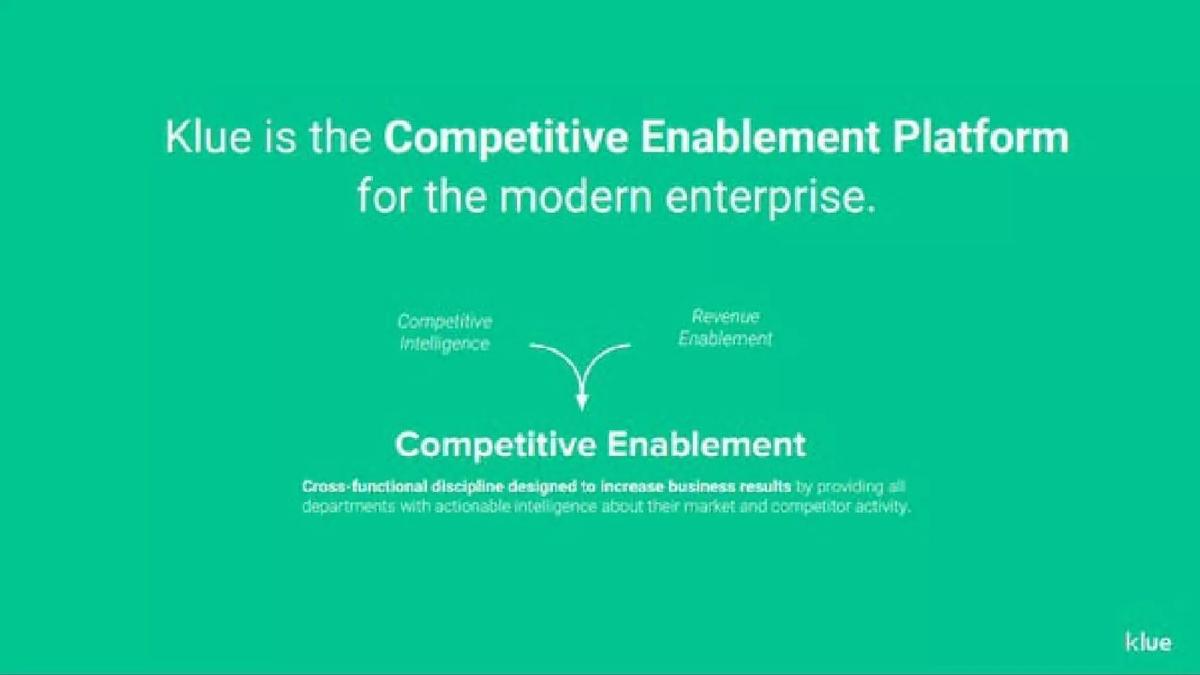
- The company defines a new category, 'Competitive Enablement,' as the intersection of Competitive Intelligence and Revenue Enablement on slide 3.
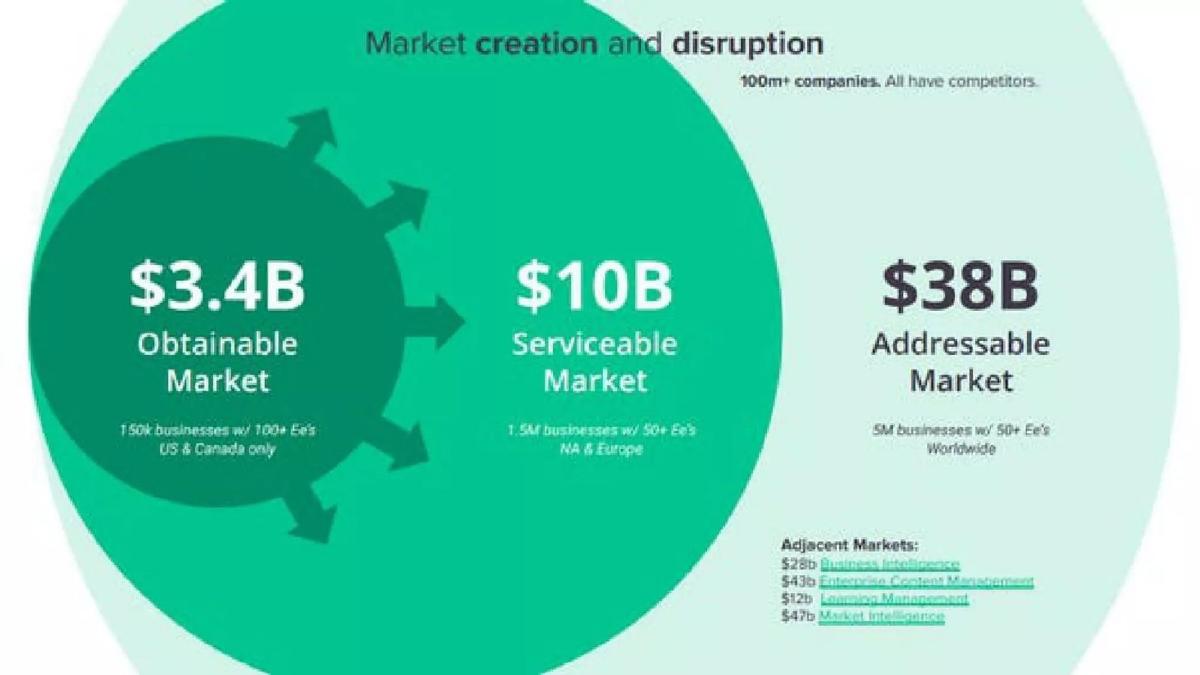
- Klue identifies a $3.4B obtainable market in the US and Canada, scaling to a $38B total addressable market worldwide on slide 4.
- The platform delivers tangible ROI, citing an 8x increase in competitor coverage for Dell and a 16% increase in win rates for K2 on slide 10.
- Capital efficiency is a core theme, with the deck reporting a 9-month CAC payback and a 4.3x BVP Efficiency Score on slide 12.
- The sales model is proven to be repeatable, with 85% of deals closed with minimal CEO involvement as stated on slide 16.
- Product-market fit is quantified with a Net Promoter Score of 68 and 51% of users saying they would be 'very disappointed' without the tool on slide 19.
- The deck explicitly asks for $10M in Series A funding to accelerate growth across verticals and deepen AI workflows on slide 22.
- The team slide highlights significant pedigree, including a CTO who co-wrote Perl and developed a product used by 100M+ people on slide 2.
The Klue Series A Teardown: Selling Efficiency in a Crowded Market
Klue’s pitch deck is a textbook example of how a Series A company should transition from selling a vision to selling a machine. Founded in 2015, Klue entered a market—Competitive Intelligence—that was traditionally seen as a back-office research function. This deck successfully reframes it as 'Competitive Enablement,' a front-line sales tool. With $81,000,000 raised to date according to catalogue facts, this specific deck represents the $10M Series A milestone that catalyzed their enterprise expansion.
Slides 1-3: Category Creation and Team Pedigree
Slide 1 opens with a clear value proposition: intelligence collected effortlessly, curated painlessly, and delivered to win more deals. The visual is a clean dashboard, immediately establishing the product as a modern SaaS platform. Slide 2, the team slide, is exceptionally strong. It doesn't just list names; it lists outcomes. CEO Jason Smith is noted as a '5x Founder' who took a previous startup to '$50m.' CTO Sarathy Naicker’s credentials are even more technical, stating he 'Co-wrote Perl' and developed a product used by '100m+ people.' This immediately de-risks the execution side of the investment.
On slide 3, Klue performs a critical strategic move: category definition. By showing an intersection between 'Competitive Intelligence' and 'Revenue Enablement,' they create a new space called 'Competitive Enablement.' This allows them to avoid being compared to static research firms and instead be compared to high-growth sales tech stacks.
Slides 4-7: Market Opportunity and the 'Why Now'
Slide 4 tackles the TAM (Total Addressable Market). It uses a standard concentric circle model but adds specificity by citing the number of businesses (e.g., '150k businesses w/ 100+ Ee’s US & Canada only' for the $3.4B obtainable market). They also list adjacent markets totaling over $100B, signaling that the platform has room to grow beyond its initial niche.
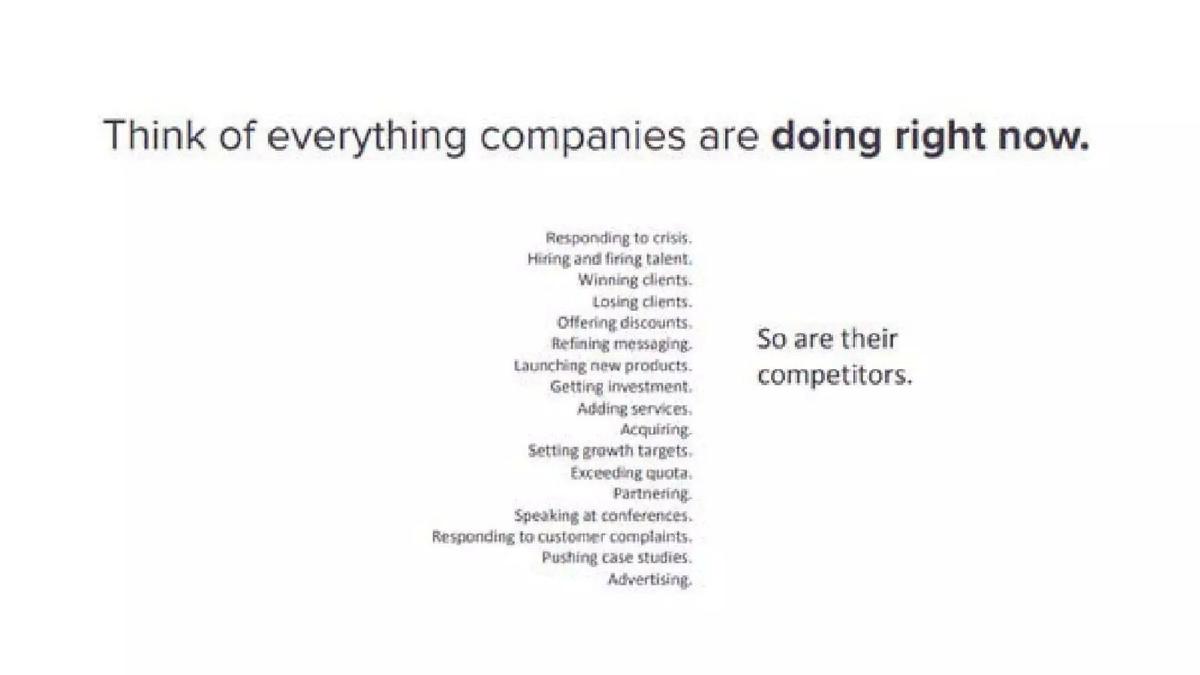
Slide 5 is a 'wall of logos' representing their current impact, while slide 6 uses a simple, text-heavy approach to emphasize that every action a company takes—hiring, winning clients, offering discounts—is being mirrored by their competitors. Slide 7 provides the 'Why Now?' by visualizing the 'Clunky Process' of today. It shows a chaotic web of sources (Slack, Salesforce, Email) feeding into various departments, resulting in 'lost deals, churn to competition and internal friction.'
Slides 8-11: Product Architecture and Customer Validation
Slides 8 and 9 explain the product mechanics: Collect, Curate, and Consume. They position Klue as a 'System of record for compete content.' This is a powerful phrase in enterprise software, as systems of record are rarely ripped out once installed. Slide 10 provides the 'so what' for the product. It claims that Dell saw an '8x' increase in competitor coverage and K2 saw a '16%' increase in competitive win rates. Using recognizable enterprise names like Shopify, Red Hat, Cisco, and Nike at the top of the slide adds massive credibility.
Slide 11 uses a bar chart to show 'Consistent revenue growth and market validation.' While the Y-axis is unlabeled (a common practice in shared decks), the trend is clearly up and to the right. They also include badges from Gartner ('Cool Vendor') and Forrester ('Strong Performer'), which are essential for selling into the enterprise market.
Slides 12-16: The 'Machine' – Unit Economics and Sales Efficiency
This section is the heart of the Series A pitch. Slide 12 is a masterclass in transparency. It lists $4m in previous funding, a 9-month CAC payback, and a 4.3x BVP Efficiency Score. By referencing the Bessemer Venture Partners (BVP) metric, they are speaking the specific language of top-tier VCs. Slide 13 shows that 'Deal sizes are increasing,' with milestones for their first '$XXk' and '$XXXk' new and expansion clients.
Slide 14 highlights their Go-To-Market (GTM) approach, noting that 100% of sales are 'Inside Sales' and they have a 'No Pilots' policy (indicated by a crossed-out 'Pilots' icon). This suggests high demand and a product that doesn't require lengthy, unpaid proof-of-concepts. Slide 15 visualizes enterprise expansion, showing how they grow from one line of business to six plus partners. Slide 16 brings it home with a 'Magic Number' of 2.4 and the fact that 85% of deals close with 'minimal CEO involvement,' proving the sales process is truly repeatable and not just dependent on the founder’s network.
Slides 17-20: Retention and Competitive Landscape
Slide 17 shows climbing client adoption, and slide 18 is a cohort analysis table. Even with redacted numbers, the green shading indicates that cohorts are expanding over time (Net Revenue Retention). They even include a 'contract anomaly' note for a sub-100% cohort, which shows a level of honesty that builds trust with investors. Slide 19 quantifies their 'Love' with a 68 NPS and a 51% 'must-have' rating, comparing themselves favorably to Slack’s 2015 metrics.
Slide 20 positions Klue against the competition. They place themselves in the 'Enterprise' and 'Mid Market' segments, contrasting with a redacted competitor in the 'SMB' space. They also list 'Akin to other category creators' like HighSpot, Salesloft, and Gong.io, along with the amounts those companies raised, to show the potential valuation ceiling for this new category.
Slides 21-23: Roadmap and The Ask
Slide 21 outlines the roadmap toward 'more automated insights,' though the specific details are retracted. Slide 22 is the 'Ask' slide. It explicitly states they are 'RAISING US$10M SERIES A TO ACCELERATE GROWTH.' They break down the use of funds into three categories: vertical/geographic expansion, deepening AI workflows, and 'opportunistic moves in downturn.' Slide 23 closes with the company logo and a final summary of their mission: 'Competitive enablement across every department of every business.'
What Works in the Klue Pitch Deck
1. Metric Rigor: The inclusion of the BVP Efficiency Score and the Magic Number (Slide 12, 16) shows a deep understanding of SaaS unit economics. This isn't just a deck about a 'cool tool'; it's a deck about a profitable growth engine.
2. Category Framing: By inventing the term 'Competitive Enablement' (Slide 3), Klue moves the conversation away from 'nice-to-have' research and toward 'must-have' revenue generation.
3. Social Proof: The deck is saturated with enterprise logos and third-party validation from Gartner and Forrester (Slide 10, 11). For a Series A company, this level of enterprise penetration is highly persuasive.
What is Missing from the Klue Pitch Deck
1. Detailed Financial Projections: While the deck shows historical growth and unit economics, it lacks a forward-looking three-to-five-year financial forecast. Investors usually want to see the path to $100M ARR.
2. Direct Competitor Names: Slide 20 redacts the name of their primary competitor. While common in public versions of decks, a full pitch would need to address exactly how they win against specific incumbents or emerging rivals.
3. Churn Analysis: While they mention 'lower than avg churn' on slide 20 and show expanding cohorts on slide 18, a specific Gross Churn percentage is not provided. In a Series A, investors will dig deep into why customers leave.
What a Founder Should Copy
1. The 'Minimal CEO Involvement' Metric: Slide 16 is one of the most important slides for a Series A founder. Proving that the sales team can close 85% of deals without the founder is the ultimate proof of a scalable business.
2. The 'Why Now' Logic: Slide 7’s visualization of the 'Clunky Process' is excellent. It doesn't just say the current way is bad; it shows the chaos of the status quo, making the solution feel like a logical necessity.
3. NPS and Product-Market Fit Benchmarking: Using the 'How would you feel if you couldn't use [Product]?' question and comparing the result to a known success like Slack (Slide 19) is a brilliant way to quantify sentiment.
4. Use of Funds Specificity: The ask on slide 22 is not just a dollar amount; it's a three-point plan. Founders should always link their capital request to specific strategic levers like 'Deepen AI' or 'Opportunistic moves.'
Frequently asked questions
- What is the primary problem Klue aims to solve?
- According to slide 7, Klue addresses the 'Clunky Process Inside Companies Today.' Intelligence is currently scattered across the web and internal systems, leading to slow and incomplete curation. The deck argues that current consumption methods—like 30-page decks on SharePoint—are often out of date, resulting in lost deals and internal friction.
- How does Klue define its market size?
- On slide 4, Klue breaks the market into three tiers: a $3.4B Obtainable Market (150k businesses with 100+ employees in US/Canada), a $10B Serviceable Market (1.5M businesses in NA/Europe), and a $38B Addressable Market (5M businesses worldwide). They also list adjacent markets like Business Intelligence ($28B) and Market Intelligence ($47B).
- What evidence of product-market fit does the deck provide?
- Slide 19 provides two key metrics: a Net Promoter Score (NPS) of 68, which is labeled as 'High' compared to an industry average of 41, and a survey result where 51% of users claimed they would be 'very disappointed' if they could no longer use Klue. The deck notes that 40% is the benchmark for product-market fit.
- What are the specific unit economics mentioned in the deck?
- Slide 12 highlights a 9-month CAC payback period (fully GM burdened) and a 4.3x BVP Efficiency Score (Net New ARR/Burn). Slide 16 further notes a sales efficiency 'Magic Number' where the company generates 2.4x new ARR relative to the previous quarter's S&M spend.
- Who are the founders and what is their background?
- As shown on slide 2, the company was founded by CEO Jason Smith, a 5x founder and former President of a SaaS company that grew to $50M, and CTO Sarathy Naicker, who co-wrote Perl and was the former Chief Technologist at Sophos. The broader team of 40+ people averages 10+ years of experience each.