Claiming a New Category on a Pitch Deck: Name It, Place It
Saying you are creating a new category is easy and investors hear it constantly.
Claiming a New Category on a Pitch Deck: Name It, Place It Between Known Ones, Show Who Buys It
"We're creating a new category" is one of the most common lines in startup decks, and one of the least examined. Sometimes it is true and important: the buyer has no budget line for what you sell, and you will have to create one. Sometimes it is a way of avoiding a competition slide. Investors know both versions, so the claim on its own earns nothing. This guide looks at four companies that made the claim on a slide, Databook, Accurx, Edurino and Klue, and at what each did to make it believable or left out: naming the category, placing it against categories buyers already recognise, comparing with real companies, and pointing to categories that grew before.
TL;DR
Give the category a plain name, place it between two or three categories your buyer already pays for, and say what the buyer does today instead. Then show at least one sign that buyers accept the new label: a budget, a job title, a paying customer who bought it as something new. Databook does the placing well: 'There are several relatable categories, but our customers see them as point solutions focused on a narrow area of sales, marketing or enablement', with Account Based Marketing, Sales Intelligence and Sales Enablement drawn as three circles of logos. If you put a size on the category, as Accurx does ('This will grow to a $30B market over the next 10 years'), show where the number comes from.
Four slides that claim a new category
Each slide is read at full size. Quotes are exact.
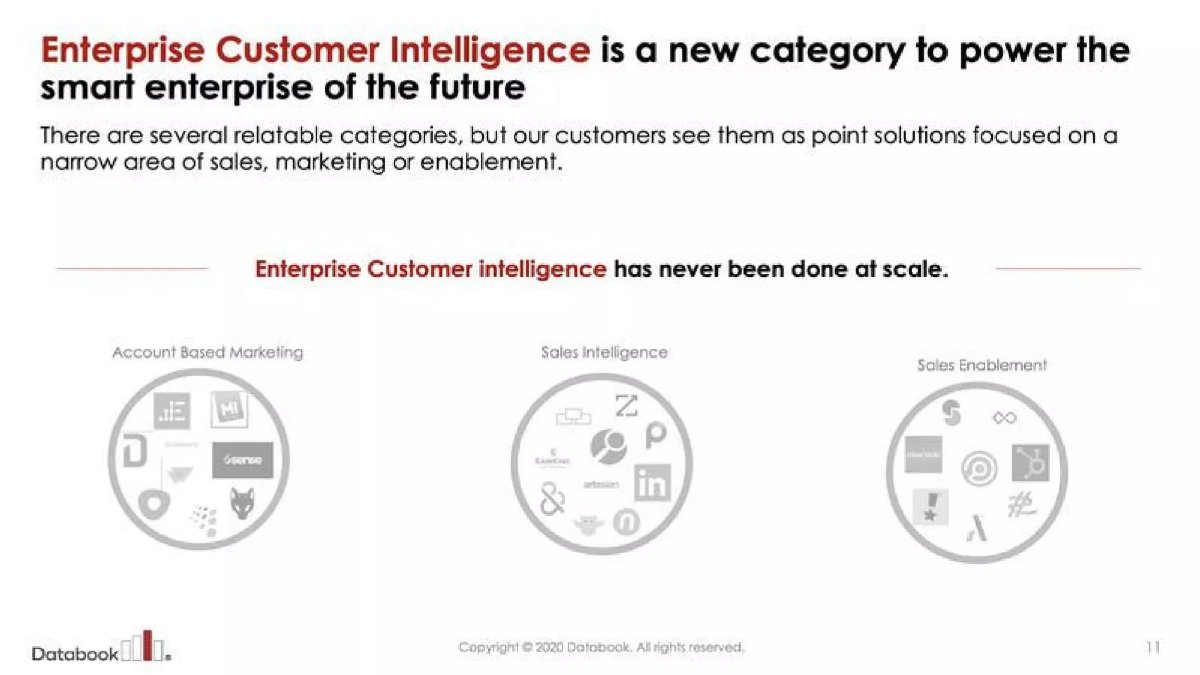
Databook competition slide — slide 12
Customer research software for enterprise sales teams. Category slide (deck dated 2020).
Databook deck, slide 12. Exact stored slide matched to this analysis.
Our analysis: Places the category clearly but never says how it differs.
Evidence and limitation: Neighbouring categories named with logos; no stated difference, customer, count or measure for 'never been done at scale'.
What a founder can adapt: Add one line per neighbour on what it misses, and one customer who moved budget.
Supporting analysis
What the deck claims: "Enterprise Customer Intelligence is a new category"; "our customers see them as point solutions"; three circles: Account Based Marketing, Sales Intelligence, Sales Enablement.
Presentation choice: Shows how to anchor a new category in budgets buyers already have.
When it does not fit: 'Never been done at scale' with no measure.
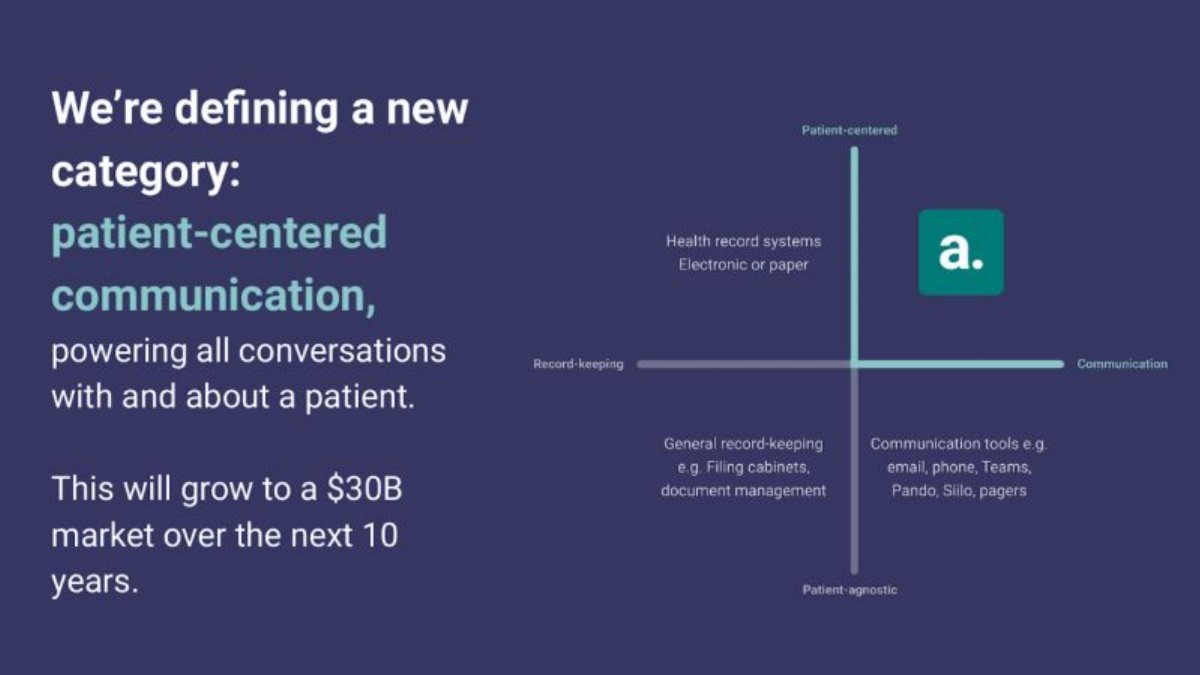
Messaging software for doctors' surgeries and hospitals. Category slide (undated).
Accurx deck, slide 10. Exact stored slide matched to this analysis.
Our analysis: The clearest map in the set; the size is unsupported.
Evidence and limitation: Status quo placed on the chart (paper, phone, pagers); market size has no source or method.
What a founder can adapt: Show the size's method, and one buyer choosing along the axes.
Supporting analysis
What the deck claims: "We're defining a new category: patient-centered communication"; "This will grow to a $30B market over the next 10 years"; two-axis map with record systems, filing cabinets and communication tools.
Presentation choice: Shows a category name that labels an empty quadrant buyers can recognise.
When it does not fit: A forecast category size with no starting figure.
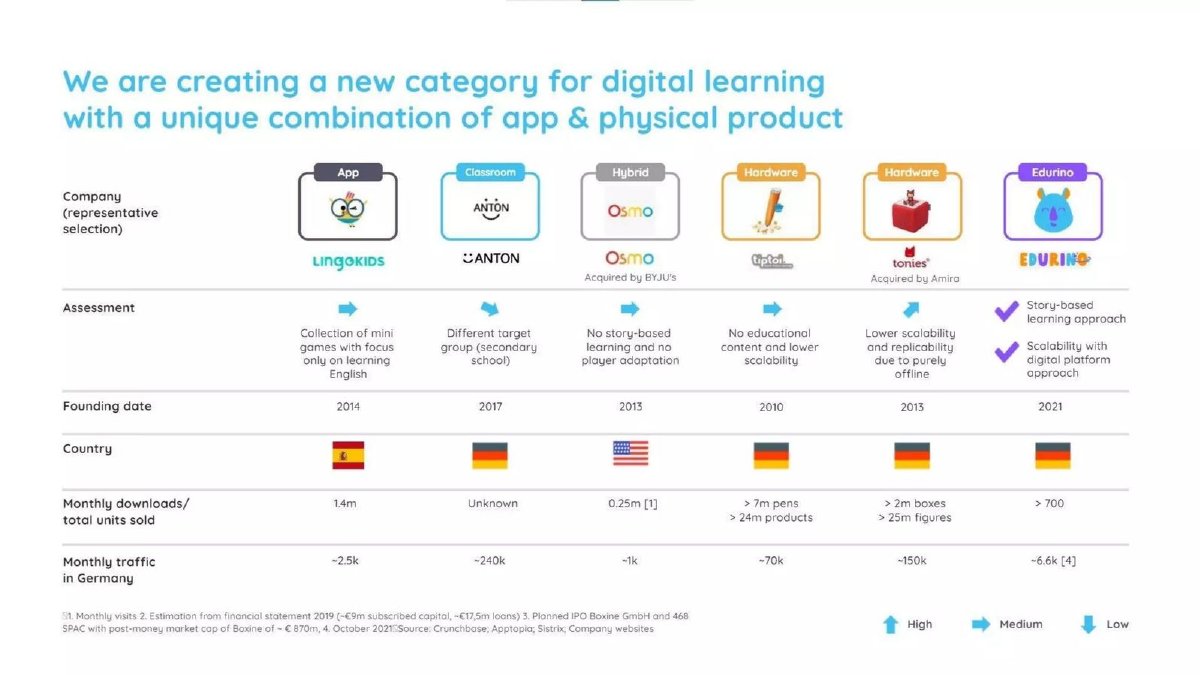
Children's learning apps with physical figures. Comparison table (sources dated October 2021).
Edurino deck, slide 14. Exact stored slide matched to this analysis.
Our analysis: Honest numbers that show a new entrant in a proven space, not a new category.
Evidence and limitation: Neighbours include a 'Hybrid' (Osmo) and hardware sellers with millions of units; two acquired; Edurino 'more than 700' units, '~6.6k' traffic; arrows unexplained.
What a founder can adapt: Retitle around the specific difference and say what the arrows rate.
Supporting analysis
What the deck claims: "We are creating a new category for digital learning with a unique combination of app & physical product"; six companies compared on assessment, founding date, units and German traffic.
Presentation choice: Shows a comparison table that lets a reader test the claim.
When it does not fit: A category headline the table contradicts.
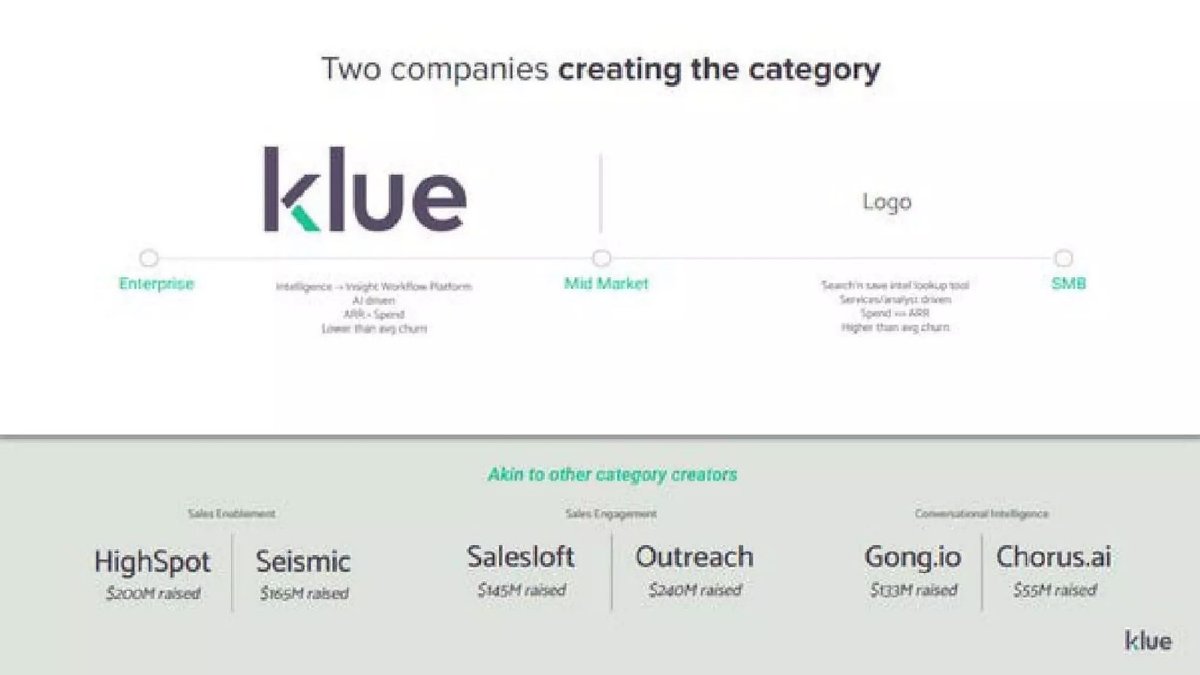
Competitive intelligence software for sales teams. Category slide (undated).
Klue deck, slide 20. Exact stored slide matched to this analysis.
Our analysis: Admits a co-creator and argues by pattern, with thin evidence for each.
Evidence and limitation: Second company unnamed; churn compared with an unstated average; analogues show funding, not revenue. Small ARR labels too blurred to quote.
What a founder can adapt: Name the other company and give Klue's own churn figure.
Supporting analysis
What the deck claims: "Two companies creating the category"; Klue at Enterprise, an unnamed 'Logo' at SMB; "Akin to other category creators": HighSpot $200M, Seismic $165M, Salesloft $145M, Outreach $240M, Gong.io $133M, Chorus.ai $55M raised.
Presentation choice: Shows how to make a category claim without pretending to be alone.
When it does not fit: Other companies' funding presented as proof of your category.
Named, placed against known categories, status quo shown, sized, and evidence that buyers accept it.
Example
Category named
Neighbours shown
Status quo shown
Size given
Buyer acceptance
Databook
Enterprise Customer Intelligence
Three categories with logos
No
No
Asserted ('our customers see')
Accurx
Patient-centered communication
Three quadrants
Yes (paper, phone, pagers)
$30B in 10 years, no method
No
Edurino
App plus physical product
Five companies with figures
No
No
No
Klue
Unnamed on the slide
Six analogue companies, one unnamed co-creator
No
No
No
Key Takeaways
Name the category in words a buyer would use.
Place it against two or three categories buyers already pay for.
Say what buyers do today in its place.
Show real companies in the neighbouring categories, with honest comparisons.
Back any size for the new category with a method.
Show a sign that buyers accept the label: budget, title or purchase.
Prepare your category claim
Answer these before writing the slide.
Name. What would a buyer call this category in one phrase?
Neighbours. Which two or three categories do buyers already pay for nearby?
Today. What do buyers use for this job now, including paper or nothing?
Budget. Which budget line would the purchase come from?
Acceptance. Which customer bought you as something new, and what did they stop buying?
Education. How will buyers learn this category exists, and what will that cost?
Copyable framework: "[Category]: [job for buyer]. Next to [A] and [B]; today buyers use [workaround]. [x] customers created budget for it; [customer] chose us over [alternative]."
Illustrative example 1 — written by us
Before: "Enterprise Customer Intelligence is a new category to power the smart enterprise of the future"
After: "Enterprise Customer Intelligence: why a target account would buy, not just who to call. [x] customers fund it from [budget]."
What improved: Our illustrative rewrite of Databook's headline. Bracketed details are not stated on the slide.
The question this guide answers
This guide answers one founder question: I think we're creating a new category. How do I say that on a slide so that investors take it seriously, rather than reading it as a way to dodge competition?
Our main competition slide guide warns against saying you have no competitors. Our status quo draft covers showing spreadsheets, paper or doing nothing as the main competitor. Our market sizing guides cover top-down and bottom-up estimates for markets that already exist. None of them explains how to present the category claim itself: how to name it, how to place it against what buyers already know, and what evidence shows the category is real. That is this guide's subject. The status quo matters here too, and we refer to it, but a category claim is a different argument: it says buyers will create a new budget line, not just stop using a workaround.
How we chose and read the examples
We searched extracted text across the library for 'new category', 'category creation', 'creating a category' and 'category leader', and kept slides where a private company explicitly claimed to be creating or defining a category. Many matches used 'category leader' as a boast on a traction or summary slide, without explaining the category; we set those aside. We also set aside Briq's 'A New Category with No Direct Competitors' slide, because our status quo draft already uses it, and Claap's two-axis 'There's space for a new category' slide, because it makes the same move as Accurx's with less detail.
We kept four slides that make the claim in clearly different ways: Databook's category slide (deck footer dated 2020), Accurx's 'defining a new category' slide, Edurino's comparison table (its footnotes cite October 2021) and Klue's 'Two companies creating the category' slide. The Accurx and Klue slides show no date. Each was rendered from the source deck and read at full size; Klue's small labels were also enlarged. Any calculations are ours. We did not check any claim against outside sources.
Why investors are wary of category claims
A new category is expensive. If buyers don't already have a budget line for what you sell, someone has to teach them they need it, and that someone is usually you. That means longer sales cycles, more marketing spend before revenue, and a risk that a later entrant benefits from the education you paid for. Investors want to know whether you understand that cost.
It can hide competition. 'Nobody does exactly what we do' is often true and rarely useful. Buyers compare you with something, even if it's a different kind of product. A category claim that leaves out the products buyers actually weigh you against reads as unfamiliarity with the sale.
It makes market size hard to defend. A category that doesn't exist yet has no market reports. Any number on the slide is a forecast of how big it might become, and investors will ask how it was built.
When it's right, it matters a lot. A company that names and leads a category can set its price and its terms, and the category name itself becomes a sales asset. That is why investors don't dismiss the claim; they test it.
Placing the category between ones buyers know: Databook
Databook, which sells customer research software to large companies' sales teams, has a slide headed 'Enterprise Customer Intelligence is a new category to power the smart enterprise of the future'. Under it: 'There are several relatable categories, but our customers see them as point solutions focused on a narrow area of sales, marketing or enablement.' A divider line reads 'Enterprise Customer Intelligence has never been done at scale.' Below are three grey circles labelled 'Account Based Marketing', 'Sales Intelligence' and 'Sales Enablement', each filled with company logos; LinkedIn is recognisable in the middle circle and 6sense in the first.
Naming the neighbours is the strength. A reader immediately knows which budgets Databook is near: marketing's account-based tools, sales' prospecting data and enablement software. The subtitle also attributes the view to customers ('our customers see them as point solutions'), which is the right kind of claim for a category: it's about how buyers think, not just what the product does.
What's missing is the step from 'near' to 'different'. The slide never says what Enterprise Customer Intelligence does that the three circles don't, or which of those budgets it would come from. 'Has never been done at scale' is a claim with no measure. And 'our customers see them' has no customer named, no count and no quote. A stronger version would add one line per circle ('ABM tells you who to target; we tell you why they would buy') and one customer who moved budget from one of the three to Databook.
A two-axis map and a size: Accurx
Accurx, a UK company that makes messaging software used by doctors' surgeries and hospitals, has a slide that reads on the left: 'We're defining a new category: patient-centered communication, powering all conversations with and about a patient. This will grow to a $30B market over the next 10 years.' On the right is a two-axis chart. The horizontal axis runs from 'Record-keeping' to 'Communication', the vertical one from 'Patient-agnostic' to 'Patient-centered'. Three quadrants are filled: 'Health record systems / Electronic or paper' (patient-centered, record-keeping), 'General record-keeping e.g. Filing cabinets, document management' (patient-agnostic, record-keeping) and 'Communication tools e.g. email, phone, Teams, Pando, Siilo, pagers' (patient-agnostic, communication). Accurx's logo sits alone in the fourth.
The map does real work. Each axis is a distinction a buyer would recognise, and the filled quadrants list what hospitals actually use, including paper, filing cabinets, phones and pagers. That's the status quo placed honestly on the chart, and it makes the empty quadrant meaningful: nothing a hospital uses today is both about communication and organised around the patient. The category name, 'patient-centered communication', is simply the label for that quadrant, so the name and the chart explain each other.
The size is the weak point. '$30B market over the next 10 years' has no source, no method and no starting figure on the slide, so a reader can't tell whether it's the current spend on the three filled quadrants, a forecast of the empty one, or something else. Two-axis maps also have a known flaw: the founder chooses the axes, and any company can draw axes that leave it alone in a corner. Accurx's axes are reasonable, but the slide would be stronger if it showed a buyer choosing along them, for example a hospital that bought Accurx instead of a new pager system.
A comparison table that tests the claim: Edurino
Edurino, a German company selling children's learning apps played with physical figures, has a slide headed 'We are creating a new category for digital learning with a unique combination of app & physical product'. It's a table of six companies, described as a 'representative selection': Lingokids (App), Anton (Classroom), Osmo (Hybrid, 'Acquired by BYJU's'), tiptoi (Hardware), tonies (Hardware, 'Acquired by Amira') and Edurino. For each it gives an assessment with an arrow, a founding date, a country, 'Monthly downloads/ total units sold' and 'Monthly traffic in Germany'. Edurino's column has two ticks: 'Story-based learning approach' and 'Scalability with digital platform approach'. Its figures are 'more than 700' downloads or units and '~6.6k' monthly traffic; tiptoi shows 'more than 7m pens, more than 24m products' and tonies 'more than 2m boxes, more than 25m figures'. Footnotes cite Crunchbase, Apptopia, Sistrix and company websites, and date one figure to October 2021.
This is the most honest example in the set, partly by accident. Putting real companies in a table with real numbers lets a reader judge the category claim directly. It shows that combining an app with a physical product isn't new on its own: Osmo is labelled 'Hybrid', and tiptoi and tonies sell millions of physical units. Edurino's claimed difference is narrower: story-based learning combined with a digital platform. Two of its neighbours were acquired, which tells an investor there are buyers for companies in this space. And the table shows Edurino as the youngest and smallest by a wide margin, which is accurate for a 2021 company and doesn't pretend otherwise.
The headline overstates what the table shows. A reader who studies it will conclude Edurino is a new entrant in an existing and proven space (learning products that mix screens and toys) with a specific product angle, not the creator of a category. That's a perfectly fundable story, and arguably a better one, because the neighbours prove demand. The arrows are also unexplained: 'High', 'Medium' and 'Low' appear in a legend, but the slide doesn't say what is being rated. A stronger version would retitle the slide around the specific difference and say what the arrows measure.
Pointing to categories that grew before: Klue
Klue, which sells competitive intelligence software to sales and marketing teams, has a slide headed 'Two companies creating the category'. A line runs from 'Enterprise' through 'Mid Market' to 'SMB'. Klue's logo sits at the enterprise end, labelled 'Intelligence → Insight Workflow Platform', 'AI driven', a line comparing ARR with spend, and 'Lower than avg churn'. At the SMB end is a placeholder reading 'Logo', with 'Search'n save intel lookup tool', 'Services/analyst driven', a second ARR-and-spend line and 'Higher than avg churn'. The source image is low resolution; the comparison symbols in the two ARR lines are too blurred for us to read with confidence, so we don't quote them. Below, under 'Akin to other category creators', are three pairs with amounts raised: HighSpot $200M and Seismic $165M (Sales Enablement), Salesloft $145M and Outreach $240M (Sales Engagement), Gong.io $133M and Chorus.ai $55M (Conversational Intelligence).
Two moves here are worth copying. First, Klue admits it isn't alone: the heading says two companies are creating the category, and the slide places the other at a different end of the market with a different model. That's more believable than a lone logo in an empty quadrant, and it tells an investor the category has a second company competing for it. Second, the bottom panel argues by pattern: in three nearby sales software categories, two companies each grew and raised large sums. The implied claim is that new sales software categories tend to support two well-funded leaders.
Both moves need care. The other company is shown only as 'Logo'. That may be a redaction in the shared version, but as it stands a reader can't check who it is. 'Lower than avg churn' and 'Higher than avg churn' give no figures and don't say whose average. And amounts raised by other companies are evidence that investors funded those categories, not that Klue's category will follow; funding is not revenue. A stronger version would name the second company, give one churn figure for Klue, and add one fact about Klue's own customers, such as how many created a new budget or role for competitive intelligence.
What a strong category slide includes
A plain name. 'Patient-centered communication' and 'Enterprise Customer Intelligence' are both understandable on first reading. Avoid names that need the product to explain them.
Two or three neighbouring categories buyers already pay for. This anchors the new category in budgets an investor can picture. Databook's three circles and Accurx's three quadrants both do this.
What buyers use today. Name the actual alternative, including paper, phones or spreadsheets if that's the truth. Accurx is the only example that puts these on the chart itself.
The difference in one line. Say what the new category does that its neighbours don't, in terms of the buyer's job, not your features.
A sign that buyers accept it. The strongest evidence is a buyer behaving as if the category exists: a budget line created for it, a job title, an analyst who names it, or a customer who bought it in place of something else. None of the four slides shows this directly; it's the most common gap.
A size with a method, or no size. If you put a number on a category that doesn't exist yet, show how it was built: the buyers counted, the price assumed, the adoption expected. Otherwise leave the size to your market slide.
Honest neighbours. If companies like you exist, show them. Edurino's table and Klue's admission of a second company both make the claim more credible, not less.
When not to claim a new category
If buyers already compare you with a named product, you're in an existing category with a better product. Say that. Investors understand 'better and cheaper than X for Y customers' immediately, and it doesn't carry the cost of educating a market.
If your table or chart shows companies selling something similar, the claim will be tested against them, as Edurino's is. Lead with the specific difference instead.
If you can't name what budget the purchase comes from, the category may be a feature of a neighbouring one. That's worth finding out before an investor asks.
If you do make the claim, say how buyers will learn the category exists: who will teach them, through what, and at what cost. A category claim without an education plan reads as if the founder hasn't priced the hardest part.
A template you can adapt
Headline: '[Category name]: [what it does for the buyer in one line].'
Neighbours: '[Category A] does [job]; [Category B] does [job]; buyers use [today's workaround] for [our job].'
Difference: 'We are the first product built for [job] by [buyer], not [what neighbours focus on].'
Acceptance: '[x] customers created a budget or role for [category]; [customer] bought us instead of [alternative].'
Size (optional): '[n] buyers × [price] × [adoption assumption] = [size]; source: [where n comes from].'
What these examples can and cannot show
These four slides show how founders presented a new category claim. They can't show whether the categories became real, whether these companies led them, or how their fundraising went afterwards. We didn't check whether any category named here is now recognised by buyers or analysts.
Treat them as patterns. Databook places its category between three known ones but doesn't say how it differs. Accurx draws a clear two-axis map that includes the status quo but gives a market size with no method. Edurino's table is detailed and honest, and in doing so shows a new entrant in a proven space rather than a new category. Klue admits a second company and points to similar categories that grew, but leaves the other company unnamed and its churn comparison without figures.
Common mistakes
Lone logo in an empty corner. Axes chosen so nobody else fits, with no buyer shown choosing along them.
Unsourced category size. A forecast market for a category that doesn't exist yet, with no method.
Headline contradicted by the table. Calling it new while listing companies that sell something similar.
Funding as proof. Other companies' raises used to show your category will grow.
No education plan. Claiming a new category without saying how buyers will learn about it.
Diagnostic checklist
Category named in buyer words.
Two or three neighbours shown.
Today's workaround placed on the slide.
Difference stated in one line.
One sign of buyer acceptance.
Any size shown with its method.
Frequently asked questions
Is it better to claim a new category or a better product in an existing one?
Claim a category only if buyers have no budget line for what you sell. If they already compare you with a named product, 'better than X for Y' is easier to believe and cheaper to sell.
Should I give my new category a market size?
Only with a method a reader can follow: number of buyers, price and assumed adoption. A bare forecast invites the question you can't answer.
How we chose these examples
Corpus: published pitch deck teardowns on StartupFundraising.com. Founder-uploaded private decks are excluded.
Selection (2026-10-01): we searched extracted text for new category, category creation, creating a category and category leader phrases; set aside 'category leader' boasts that don't explain a category, Briq's slide (used in our status quo draft) and Claap's two-axis slide (same approach as Accurx with less detail); kept four private-company slides with distinct approaches.
Review: the four slides were rendered from the source decks on 2026-10-01 and read in full at full size against company, deck and page number; Klue's small labels were also enlarged, and two comparison symbols that remained unreadable are not quoted (editorial model review, with AI assistance in drafting; not human-reviewed). No claim was checked against outside sources.