Sylvera’s Series A deck is a masterclass in positioning a complex technical product as essential financial infrastructure. By framing the carbon market as a 'debt market without credit ratings,' the company creates an immediate, intuitive need for its product. The deck focuses heavily on the 'why now'—a $50B projected market size by 2030—and the 'how'—using satellite-driven volumetric tree modeling to achieve 4x the accuracy of legacy measures. While the deck is light on traditional venture metrics like ARR or churn, it compensates with massive social proof, listing logos from BlackRock to NA…
Key takeaways
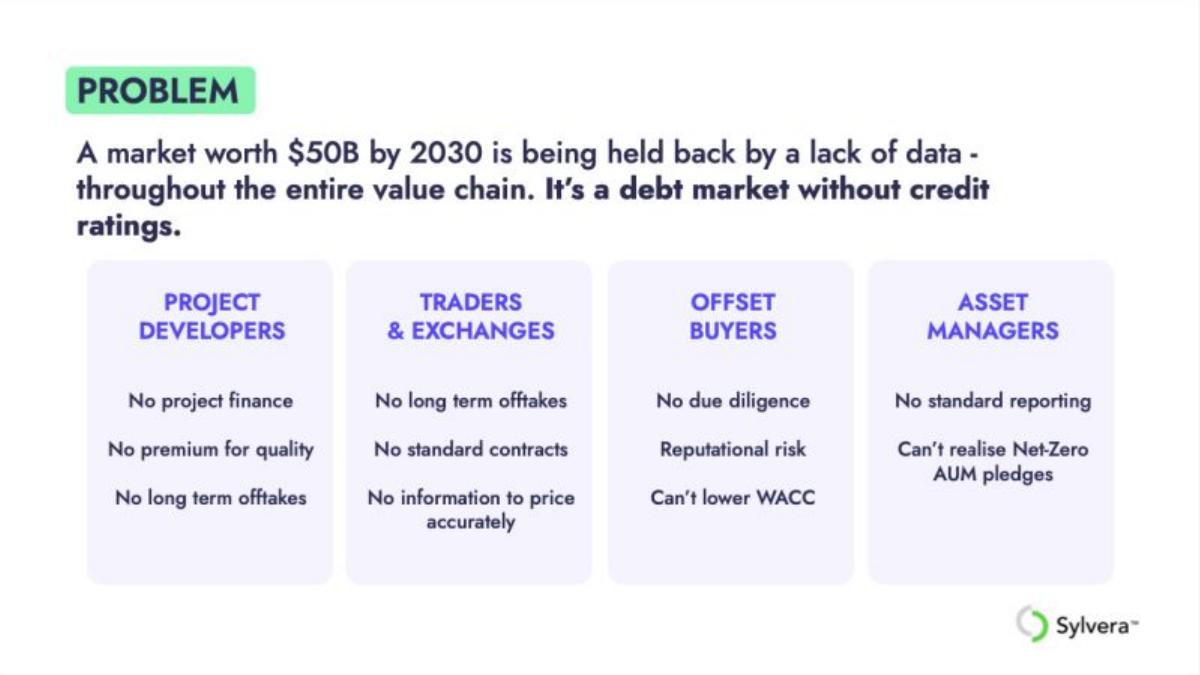
- The deck identifies a $50B market opportunity by 2030 that is currently stalled by a lack of data (Slide 3).
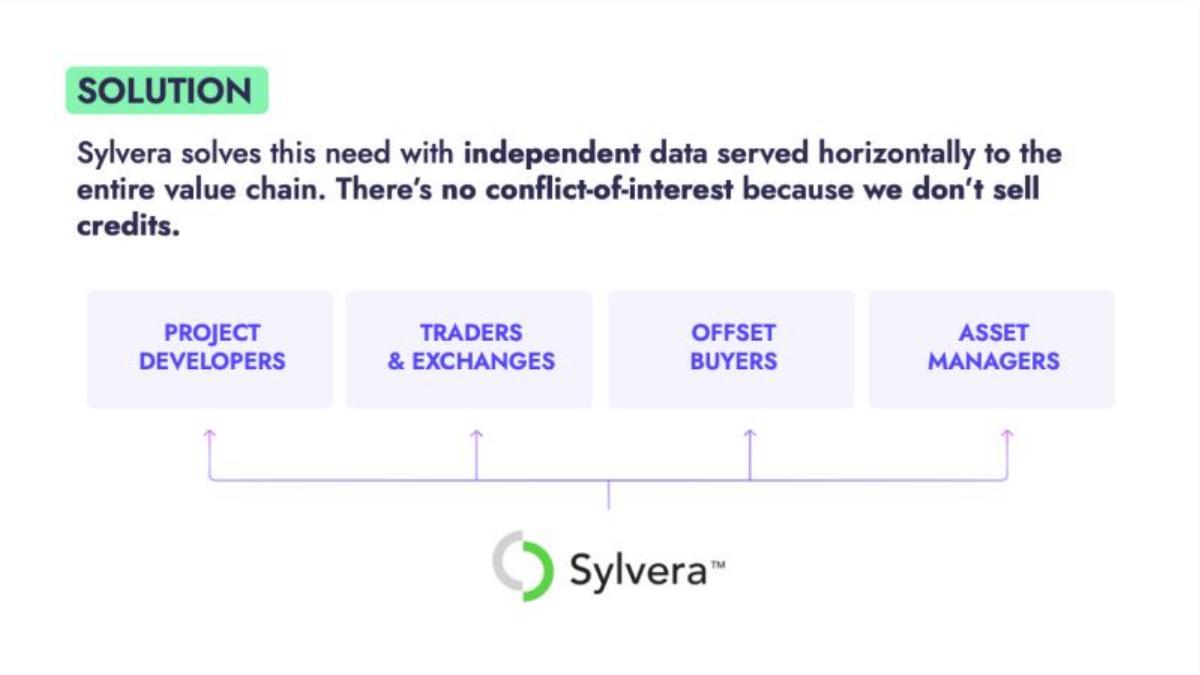
- Sylvera positions itself as a conflict-free provider because it does not sell carbon credits itself (Slide 4).
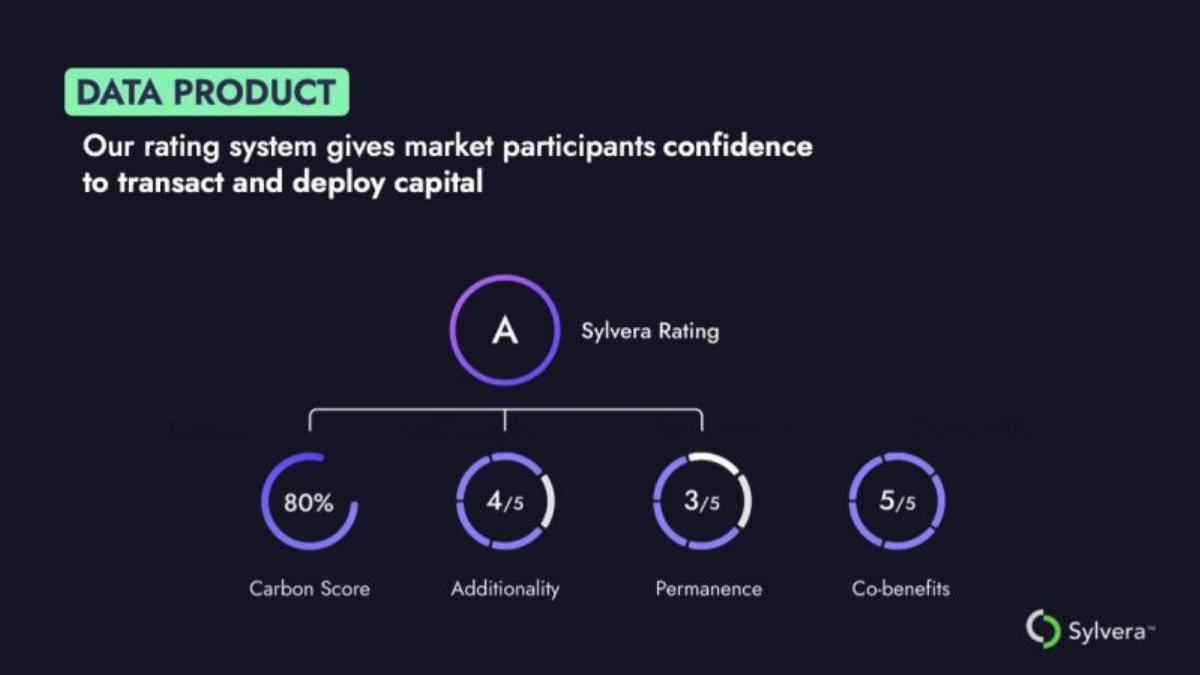
- The product is structured around a 'Sylvera Rating' which aggregates Carbon Score, Additionality, Permanence, and Co-benefits (Slide 5).
- The technology claims 4x the accuracy of legacy in-field measures using satellite data (Slide 7).
- Volumetric tree modeling is cited as providing 13x less uncertainty in biomass quantification (Slide 7).
- The company leverages institutional credibility by citing partnerships with the World Bank, NASA JPL, and UCL (Slide 7).
- The deck omits standard financial slides including current revenue, growth rates, and the specific use of funds for the $32.6M raise.
The Infrastructure of Trust: Sylvera’s Series A Teardown
Sylvera’s 8-slide deck is a lean, high-level presentation designed to establish the company as the definitive rating agency for the voluntary carbon market. In 2022, the company secured $32.6M in Series A funding. The deck focuses less on the granularities of SaaS metrics and more on the systemic necessity of their data in a rapidly expanding global market.
Slide 1: Title Slide
The opening slide is minimalist, featuring the Sylvera logo and the text 'Series A.' The background is a blurred satellite image of terrain, which subtly reinforces the company's reliance on geospatial and satellite data. It establishes a professional, institutional tone from the outset.
Slide 2: The Mission Statement
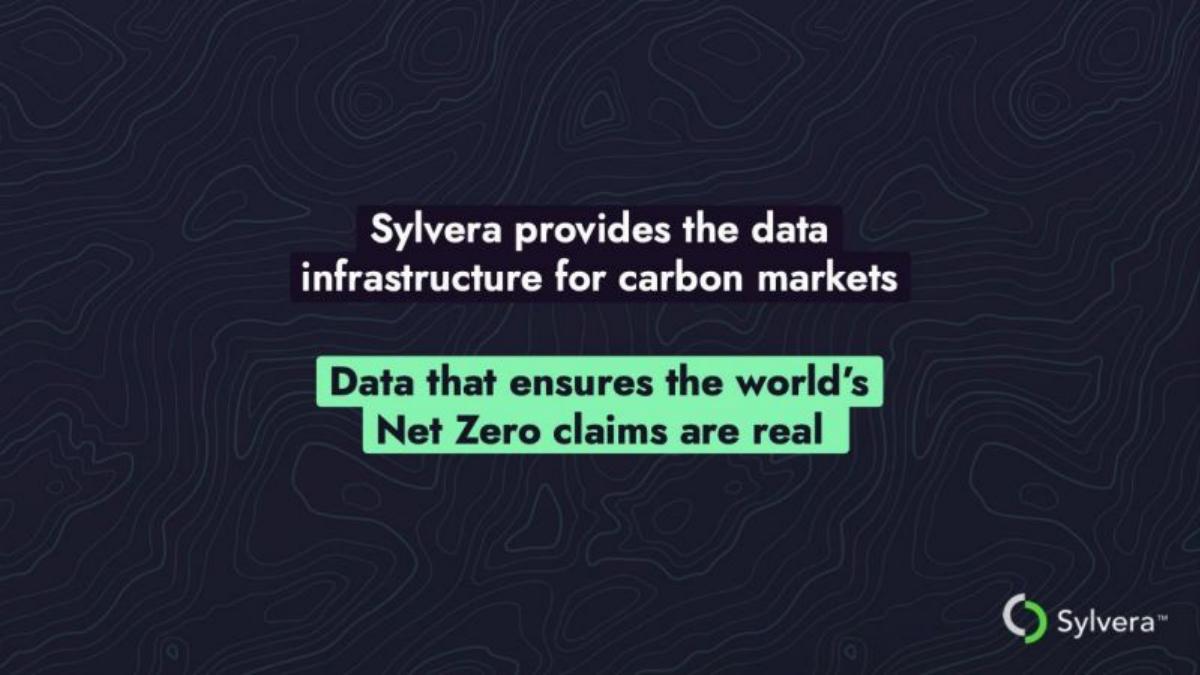
Slide 2 delivers a clear, two-part value proposition: 'Sylvera provides the data infrastructure for carbon markets' and 'Data that ensures the world’s Net Zero claims are real.' This slide addresses the 'Greenwashing' concern head-on, positioning Sylvera as the arbiter of truth in a market often criticized for lack of transparency.
Slide 3: The Problem – A Market Without a Yardstick
This slide is the most critical for establishing the 'Why Now.' It cites a market worth '$50B by 2030' and identifies the primary bottleneck: a lack of data throughout the value chain. The most effective line on this slide is the analogy: 'It’s a debt market without credit ratings.' By comparing carbon offsets to the debt market, Sylvera makes the solution (ratings) feel inevitable. It breaks down the pain points for four specific personas:
Project Developers: No project finance or premium for quality. · Traders & Exchanges: No standard contracts or accurate pricing. · Offset Buyers: Reputational risk and inability to lower WACC. · Asset Managers: Inability to realize Net-Zero AUM pledges.
Slide 4: The Solution – Horizontal Independence
Sylvera positions itself as the horizontal layer serving all four personas mentioned in the previous slide. A key differentiator is highlighted here: 'There’s no conflict-of-interest because we don’t sell credits.' This is a direct shot at competitors who might both develop projects and rate them, emphasizing Sylvera’s role as an independent third party.
Slide 5: The Data Product
This slide visualizes the 'Sylvera Rating.' It shows an 'A' rating as the top-level output, supported by four underlying pillars:
Carbon Score (80%) · Additionality (4/5) · Permanence (3/5) · Co-benefits (5/5)
This breakdown demonstrates that their rating is not a black box but a composite of specific, measurable metrics that matter to institutional investors.
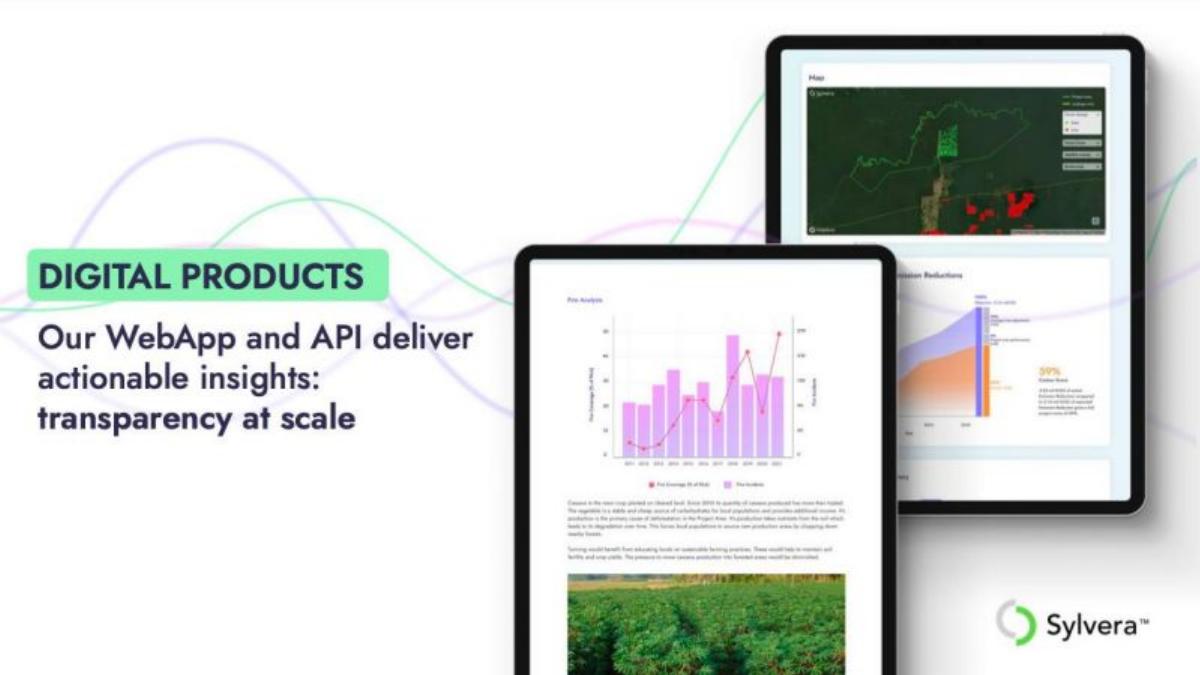
Slide 6: Digital Products
Slide 6 moves from the 'what' to the 'how,' showing screenshots of their WebApp and API. The slide emphasizes 'transparency at scale.' The visuals include maps with fire analysis overlays and charts showing emission reductions over time. This proves the product is functional and provides the 'actionable insights' promised in the headline.
Slide 7: Competitive Advantage
This slide is a 'trust fall' for investors, packed with social proof and technical claims. It is divided into three sections:
Our Technology: Claims 4x accuracy over legacy measures and 13x less uncertainty in biomass quantification using volumetric tree modeling. It mentions partnerships with NASA JPL and the World Bank. · Our People: Instead of individual bios, it uses a 'logo cloud' of elite institutions (Google, BlackRock, Goldman Sachs, Oxford, etc.) to signal a world-class team. · Our Methodology: Reiterates that ratings are based on deep analysis of performance, additionality, and permanence, including biodiversity impacts.
Slide 8: Closing
The final slide in this specific deck is a promotional slide for the source library, bestpitchdeck.com. In the original pitch, this would typically be a 'Thank You' or 'Contact' slide. Notably, the deck concludes without a formal 'Ask' slide or a financial roadmap.
What Sylvera Does Well
1. The Power of Analogy: Comparing the carbon market to a 'debt market without credit ratings' is brilliant. It immediately tells a sophisticated investor exactly where Sylvera fits in the financial ecosystem (the 'Moody’s of Carbon') and why the business model is defensible.
2. Conflict-Free Positioning: In the world of ESG and carbon offsets, integrity is the product. By explicitly stating they do not sell credits, they remove a major due diligence hurdle regarding their objectivity.
3. Institutional Social Proof: For a Series A company, the density of high-tier logos (NASA, World Bank, BlackRock) is exceptional. It suggests that the 'smart money' and the 'smart scientists' have already vetted the tech.
What is Missing from the Deck
1. Financial Traction: There is no mention of Revenue, ARR, number of customers, or growth rates. While the logos suggest high-end users, the deck doesn't quantify the commercial success to date.
2. The 'Ask': The deck does not state how much money is being raised or how the capital will be deployed. While this information is often shared in a separate document or during the meeting, its absence in the deck makes it feel more like a capabilities brochure than a fundraising tool.
3. Competitive Landscape: While they mention 'other players' face conflicts of interest, they don't name specific competitors or provide a feature-by-feature comparison. They rely entirely on their own technical claims (4x accuracy) to imply superiority.
Founder's Playbook: What to Copy
Lead with the 'Infrastructure' Frame: If you are building a tool for an emerging market, don't just call it a 'platform.' Call it 'infrastructure.' It suggests your product is a requirement for the market to function, not just an optional utility.
Quantify Technical Superiority: Don't just say your tech is 'better.' Sylvera uses specific multipliers: '4x the accuracy' and '13x less uncertainty.' These numbers stick in an investor's mind and provide a clear benchmark for technical due diligence.
Segment the Problem: Slide 3 is a perfect template for showing how one problem (lack of data) affects different stakeholders in different ways. This demonstrates a deep understanding of the market's nuances and expands the perceived Total Addressable Market (TAM).
Frequently asked questions
- How much did Sylvera raise with this deck?
- According to the catalogue facts, Sylvera raised $32.6M in a Series A round in 2022. The deck itself is labeled as a 'Series A' presentation on the title slide but does not specify the target amount or the valuation.
- What is Sylvera's core value proposition?
- Sylvera provides data infrastructure and independent ratings for the carbon market. As stated on Slide 2, their goal is to provide 'Data that ensures the world’s Net Zero claims are real.' They act as a third-party validator to ensure carbon offset projects actually deliver the environmental impact they claim.
- Who are the target customers identified in the deck?
- Slide 3 and Slide 4 identify four key segments: Project Developers, Traders & Exchanges, Offset Buyers, and Asset Managers. Each segment faces different risks, such as reputational risk for buyers or a lack of project finance for developers, which Sylvera aims to mitigate.
- What technical advantages does Sylvera claim over competitors?
- On Slide 7, the company claims its satellite-based technology is 4x more accurate than legacy in-field measures. They also highlight 'volumetric tree modelling' which reduces uncertainty in biomass quantification by 13x compared to traditional methods.
- Is there a team slide in the Sylvera pitch deck?
- There is no dedicated team slide with names or headshots. Instead, Slide 7 features a 'Our People' section that displays logos of former employers and academic institutions, including Goldman Sachs, Google, BlackRock, and the University of Oxford, to signal the caliber of the team.