Contrarian Ventures' 2022 pitch deck is a masterclass in transition from a first-time fund to an established institutional player. Seeking to raise a €75m fund (with a €100m cap), the firm leans heavily on the success of Fund I, which they claim achieved top-decile returns. The deck's primary strength lies in its 'Community Moat'—a proprietary ecosystem including the Energy Tech Summit and Climate 50—which serves as both a deal-flow engine and a value-add for founders. By combining hard performance metrics with a clear, sector-specific thesis on European and Israeli climate tech, the firm suc…
Key takeaways
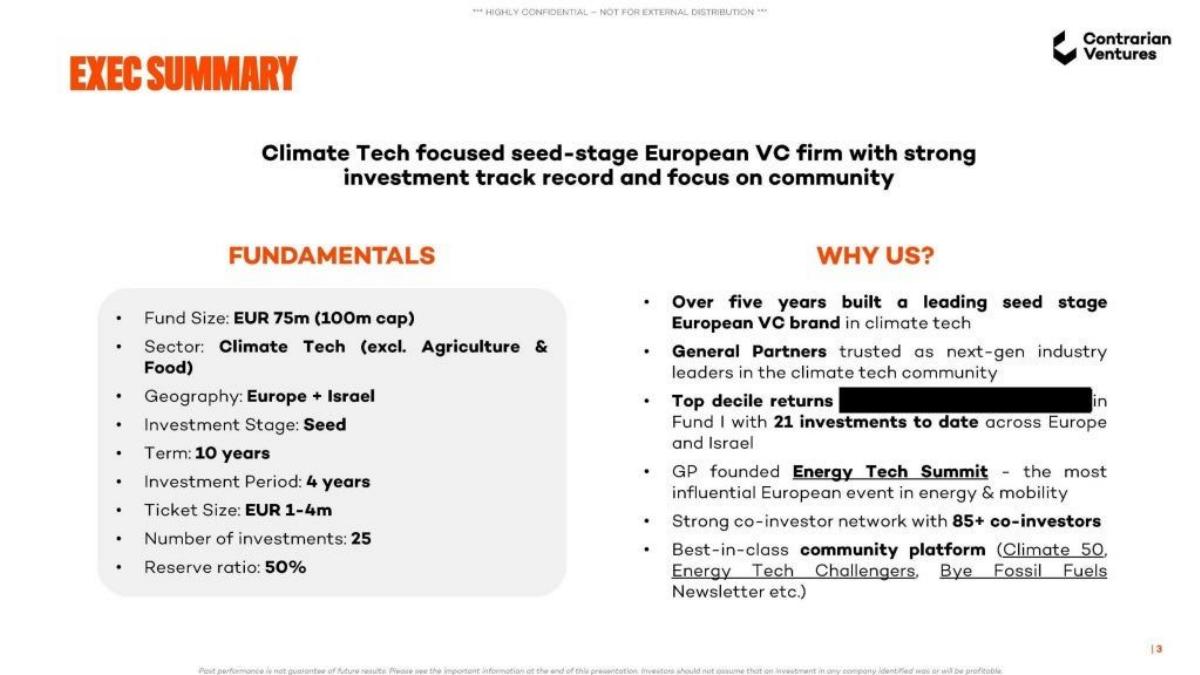
- The fund targets a €75m size with a €100m cap, focusing on seed-stage climate tech in Europe and Israel (Slide 3).
- Contrarian Ventures claims top-decile returns for Fund I, which included 21 investments (Slide 3).
- The investment strategy allocates 60% of capital to software, 20% to hardware-enabled software, and 20% to pure hardware (Slide 13).
- A 'Community Moat' is central to their strategy, featuring an event with 1,500+ attendees and a newsletter with 2,000+ subscribers (Slide 16).
- The firm targets a 13% average equity stake and plans to lead approximately 60% of the seed rounds they enter (Slide 12).
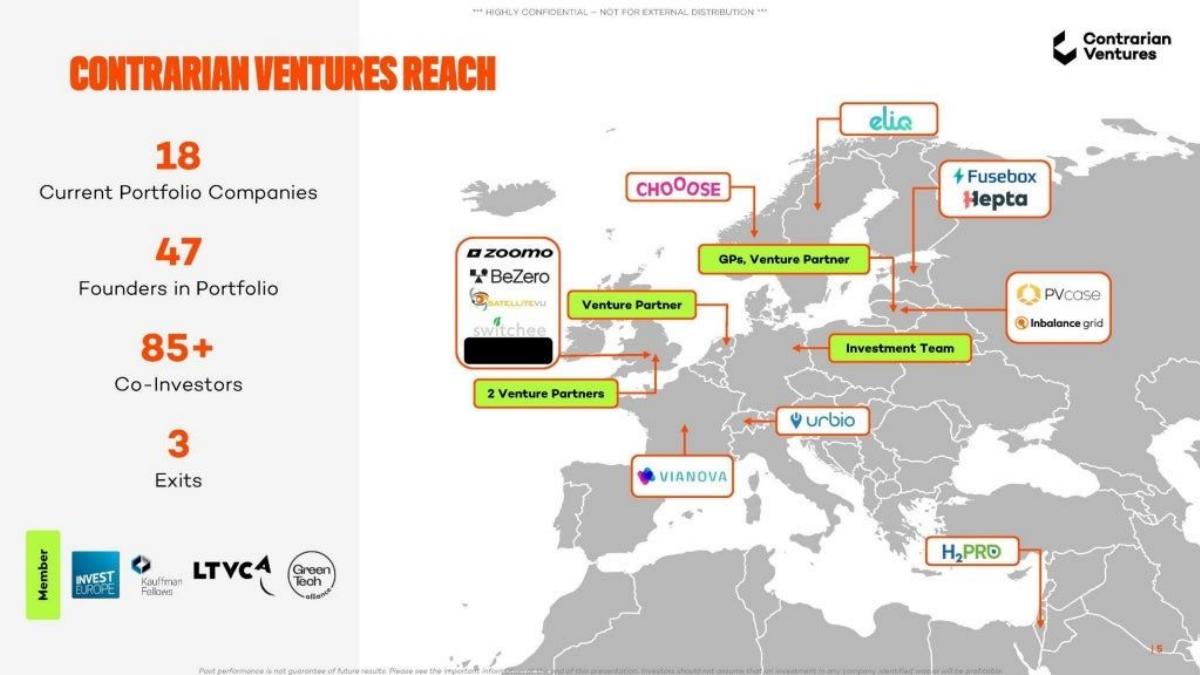
- Traction is evidenced by a network of 85+ co-investors and 3 successful exits as of the deck's publication (Slide 5).
- The team highlights deep institutional backgrounds, including experience at Bank of America Merrill Lynch, BP, and BNP Paribas (Slide 10).
- The deck identifies a $125 trillion investment need by 2050 to reach net-zero goals, framing the fund as a generational opportunity (Slide 7).
The Fund II Pitch: Moving from Emerging to Established
Contrarian Ventures’ July 2022 intro deck is a professional, data-driven document designed to secure commitments for a €75m-€100m Fund II. In the world of venture capital fundraising, the transition from Fund I to Fund II is often the hardest; you no longer have the 'new manager' shine, and you don't yet have a fully realized decade of exits. Contrarian solves this by leaning heavily into their 'Community Moat' and early performance indicators. The deck is structured to prove three things: the market is massive, the team is uniquely positioned to see the best deals, and their previous execution validates the model.
Slides 1-5: The Hook and the Track Record
Slide 1 opens with a bold, minimalist statement: "LET'S NOT BE MINDLESS. WORLD'S CARBON BUDGET IS FINITE." This establishes the urgency of the climate tech sector immediately. Slide 2 is a standard, dense legal disclaimer required for fund marketing.
Slide 3 serves as the Executive Summary and is perhaps the most important slide for an LP. It defines the fund as a "Climate Tech focused seed-stage European VC firm." Key fundamentals are listed clearly: a €75m fund size with a €100m cap, a 10-year term, and a €1-4m ticket size. The 'Why Us?' section on this slide highlights 'Top decile returns' for Fund I and a network of 85+ co-investors. By putting these metrics on page three, they establish authority before explaining the thesis.
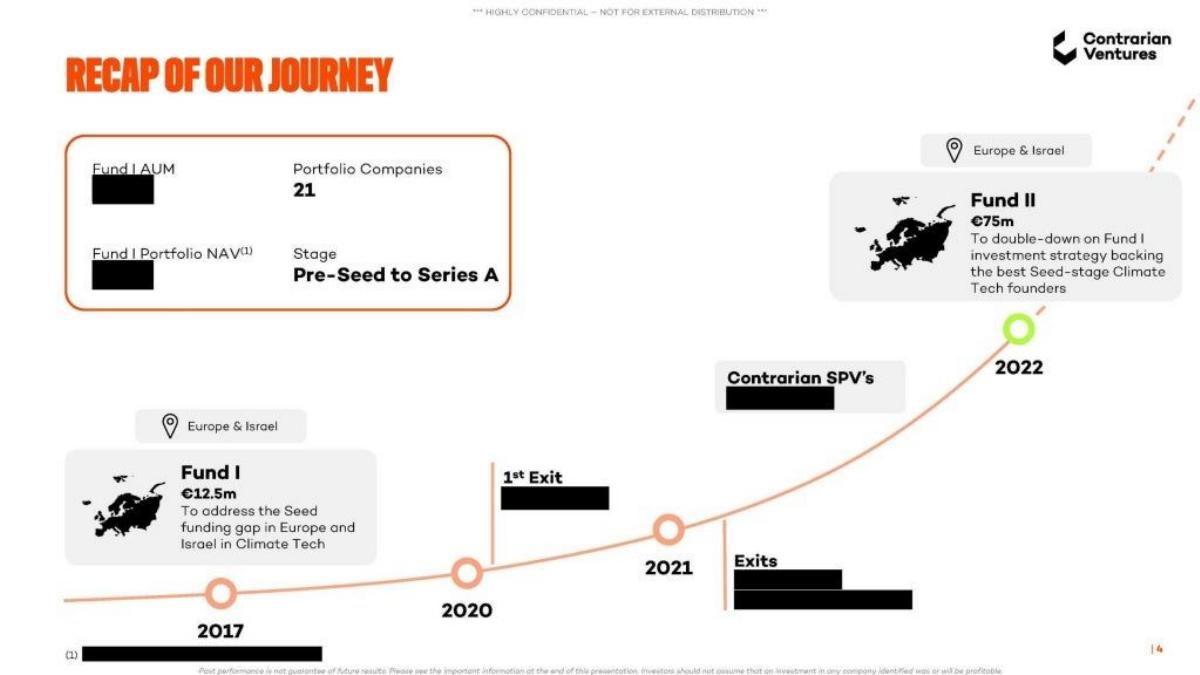
Slide 4 provides a visual 'Recap of Our Journey,' showing the growth from a €12.5m Fund I in 2017 to the launch of Fund II in 2022. It notes that Fund I covered Pre-Seed to Series A and has already seen its first exits. Slide 5 maps their 'Reach,' showing 18 current portfolio companies and 47 founders spread across Europe and Israel. This map is a visual proof of their 'pan-European' claim, showing clusters in the UK, Nordics, and Baltics.
Slides 6-8: The Macro Thesis
Slide 6 is a simple transition slide asking "WHY ARE WE HERE?" This leads into Slide 7 , which frames the 'Generational Opportunity.' This slide is data-heavy, citing the IEA and Global Carbon Budget. It highlights a staggering $125 trillion in investment needed by 2050. By breaking down net-zero goals by sector (e.g., 70% of electricity from renewables), they align their fund's success with global regulatory and environmental necessity.
Slide 8 , titled 'Funding New Pathways to Decarbonized Economy,' uses a timeline to show the shift from "Burning Stuff" to "Not Burning Stuff." It lists specific technology interests like Fusion Energy, Green Hydrogen, and Solid State Batteries. This slide moves the conversation from abstract 'climate' to specific industrial and technological verticals.
Slides 9-10: The Team
Slide 9 transitions to 'OUR TEAM,' followed by Slide 10 , which introduces the personnel. The GP profiles for Rokas Peciulaitis and Tomas Kemtys emphasize institutional pedigree (Bank of America, Centerview Partners) and sector-specific leadership (founding the Energy Tech Summit). The inclusion of Venture Partners in the UK and Netherlands, with logos from Goldman Sachs and Trafigura, suggests a deep bench of advisors that extends beyond the core investment team in Lithuania.
Slides 11-13: Investment Strategy and Allocation
Slide 11 transitions to 'INVESTMENT STRATEGY.' Slide 12 provides the granular details LPs look for: they aim to lead ~60% of seed rounds, target a 13% average equity stake, and maintain a 50% reserve ratio for follow-on investments. The timeline at the bottom of the slide shows they are active from Pre-seed (opportunistically) to Series D (liquidity via secondaries), but their 'Initial Investment' sweet spot is firmly at the Seed stage.
Slide 13 is the 'Opportunity Landscape.' This is a highly effective visualization of their capital allocation targets. They split the fund into 15 software companies (60%), 5 hardware-enabled software companies (20%), and 5 pure hardware companies (20%). This 60/20/20 split is a crucial risk-management signal for LPs who may be wary of the capital intensity of pure hardware in climate tech.
Slides 14-18: The Sourcing and Community Moat
Slide 14 transitions to 'HOW WE SOURCE COMPANIES.' Slide 15 breaks down 'Deal Flow Sources' into internal (personal networks, research) and external (international networks like SXSW, investor networks like Breakthrough Energy). They claim to screen over 1,000 deals annually, a standard but necessary metric for a seed fund.
Slide 16 introduces the 'Community is Our Moat' concept. This is Contrarian's primary differentiator. They list four proprietary platforms: the Energy Tech Summit (1,500+ attendees), Energy Tech Challengers (400+ participants), Climate 50 (200+ VC funds), and the 'Bye, Fossil Fuels' newsletter (2,000+ subscribers). This slide argues that they don't just wait for deals; they build the ecosystem that generates them.
Slide 17 provides social proof via 'Entrepreneurs Trust Our Team.' It features testimonials from CEOs of portfolio companies like H2Pro, BeZero Carbon, and Zoomo. The quote from Talmon Marco (H2Pro) is particularly strong, noting that Contrarian was the first VC to say "Yes" when others wouldn't. Slide 18 summarizes this into a 'Unique Selling Proposition Flywheel,' showing how specialization leads to a community platform, which leads to better deal flow, superior selection, and ultimately, successful exits.
Slides 19-22: The Closing and Call to Action
Slide 19 asks "WHY PARTNER WITH US?" and Slide 20 provides the answer in bullet points. It reiterates that they are a leading brand, have a proven Fund I, and offer exposure to an emerging category with tangible impact. Slide 21 returns to the bold aesthetic of the opening: "LET'S NOT FORGET. THERE IS NO PLANET B." with a contact email for IR. Slide 22 is a promotional slide for the platform that hosted the deck.
What Contrarian Ventures Does Well
The deck excels at differentiation through ecosystem building . Most VCs claim to have a 'network,' but Contrarian provides hard numbers (attendees, subscribers, participants) for proprietary assets they own. This makes their claim of 'unparalleled deal flow' on Slide 15 much more believable than a standard 'we are well-connected' bullet point.
The transparency of fund construction on Slide 13 is also a major strength. By explicitly stating they will only do 20% pure hardware, they address the 'Cleantech 1.0' trauma many LPs still carry, where capital-heavy hardware investments led to poor returns. They are positioning themselves as a modern, software-leaning climate fund.
Finally, the use of social proof is relentless. Between the 85+ co-investors mentioned on Slide 3 and the detailed founder testimonials on Slide 17, the deck creates a sense of FOMO (Fear Of Missing Out) and consensus. They aren't a lone wolf; they are at the center of a large, credible pack.
What is Missing from the Deck
While the deck is highly professional, there are notable omissions common in public versions of VC decks. First, specific Fund I performance data (IRR, TVPI, DPI) is mentioned as 'top decile' but the actual numbers are redacted or omitted. An LP would need to see the underlying spreadsheet to validate this claim.
Second, there is no mention of management fees or carry structure . While these are usually standard (2% and 20%), any deviations or 'GP commit' details are missing. LPs generally want to see how much of their own money the GPs are putting into the fund to ensure alignment.
Third, the exit environment analysis is thin. While they mention 3 exits on Slide 5, there is no detail on the size of these exits or the current M&A/IPO appetite for climate tech in Europe. Given the market downturn in 2022, more detail on the path to liquidity would have been beneficial.
What Other Founders (and Fund Managers) Should Copy
The 'Fundamentals' Box: Slide 3 is a perfect example of how to present a fund or a round. It puts the size, stage, geography, and ticket size in one clear box. This allows an investor to immediately know if the opportunity fits their mandate.
Visualizing the Mix: Slide 13’s breakdown of software vs. hardware is a great way to communicate risk appetite. Founders can use this same logic to show how they spend their capital (e.g., 60% R&D, 20% Sales, 20% Ops).
The Flywheel Slide: Slide 18 does a great job of showing how different parts of the business reinforce each other. If your startup has a community component or a data advantage, a flywheel diagram is the best way to show that your moat grows over time.
The 'Recap of Our Journey' Timeline: Slide 4 is an excellent way to show momentum. It doesn't just list facts; it tells a story of growth, showing that each year brought a new milestone (first exit, new fund, etc.). This creates a narrative of inevitable success.
Frequently asked questions
- What is the specific investment focus of Contrarian Ventures Fund II?
- According to slide 3 and slide 12, the fund focuses on seed-stage climate tech companies in Europe and Israel. They specifically exclude agriculture and food. The strategy involves leading approximately 60% of rounds with ticket sizes ranging from €1m to €4m, aiming for an average equity stake of 13% across 25 target companies.
- How does the firm differentiate itself from other climate VCs?
- The firm relies on what it calls a 'Community Moat' (Slide 16). This includes proprietary assets like the Energy Tech Summit, the Climate 50 platform, and the 'Bye, Fossil Fuels' newsletter. These tools are presented as unique deal-flow sources and value-add platforms that help portfolio companies hire talent and find corporate partners.
- What is the fund's track record based on the deck?
- Slide 4 and slide 5 outline a journey that began in 2017 with a €12.5m Fund I. By 2022, they reported 21 investments, 3 exits, and 85+ co-investors. Most importantly, slide 3 claims Fund I achieved top-decile returns, though specific IRR or TVPI multiples are redacted in the public version of the slides.
- What is the portfolio construction and sector allocation strategy?
- Slide 13 details a clear allocation target: 15 companies (60%) will be software-focused, 5 companies (20%) will be hardware-enabled software, and 5 companies (20%) will be pure hardware. They target sectors including new energy (solar, wind, storage), smart mobility, and buildings/industry (low-carbon heating, circular economy).
- Who are the key people behind the fund?
- The fund is led by Founder and Managing Partner Rokas Peciulaitis (formerly of BoA Merrill Lynch) and General Partner Tomas Kemtys (formerly of Centerview Partners). The team includes analysts, associates, and a network of venture partners across the UK and Netherlands with backgrounds at firms like Goldman Sachs and Trafigura (Slide 10).