Contently’s Series B deck is a masterclass in narrative-driven fundraising, focusing on the transition from a talent marketplace to a comprehensive enterprise SaaS platform. By 2014, the company had established a network of over 20,000 vetted journalists, which they framed as their primary 'unfair advantage' and the entry point for owning the entire content value chain. The deck successfully balances high-level vision—positioning themselves as the 'technological plumbing' for brand publishing—with concrete SaaS metrics, showing a clear path from marketplace spend to high-value annual contract…
Key takeaways
- The deck positions content marketing as the #1 digital priority for brands in 2013, citing a $44 billion spend by early adopters (Slide 2).
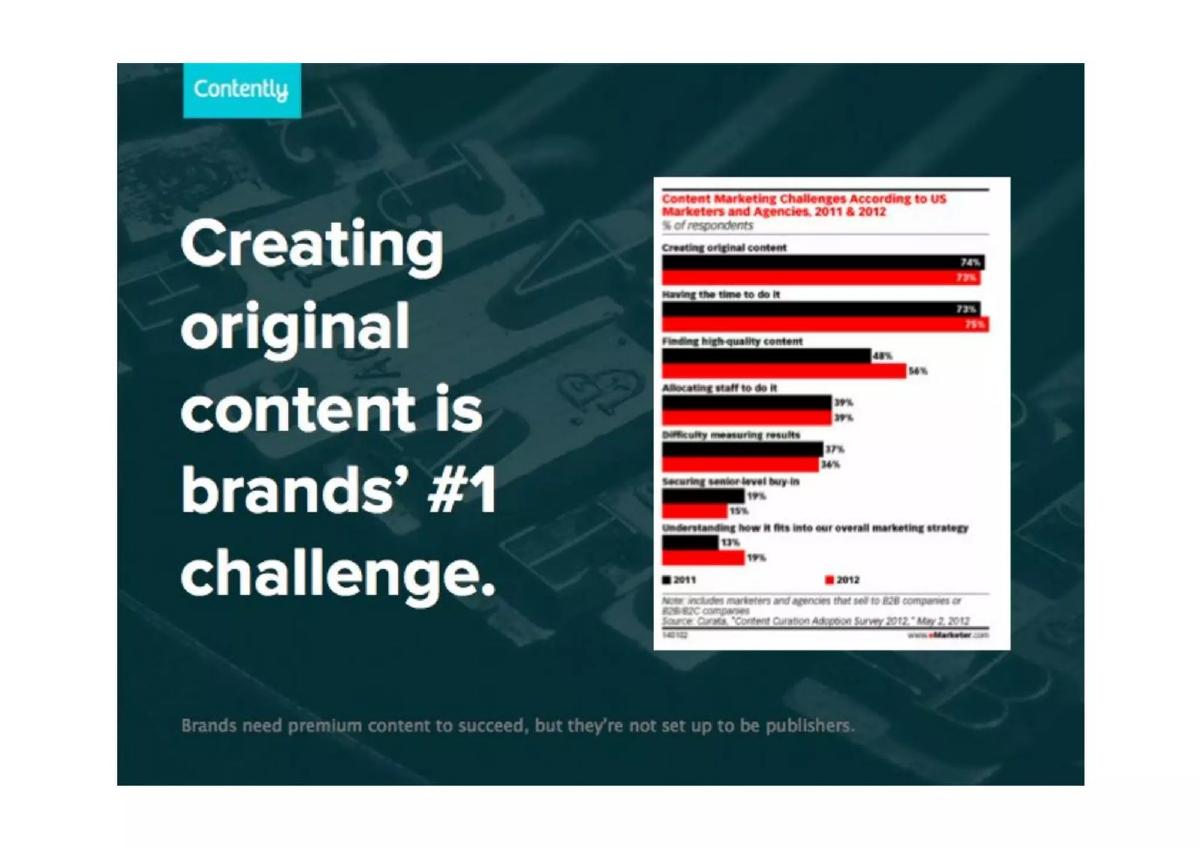
- Contently identifies the 'talent gap' as the primary friction point, noting that 74% of brands struggle with creating original content (Slide 3).
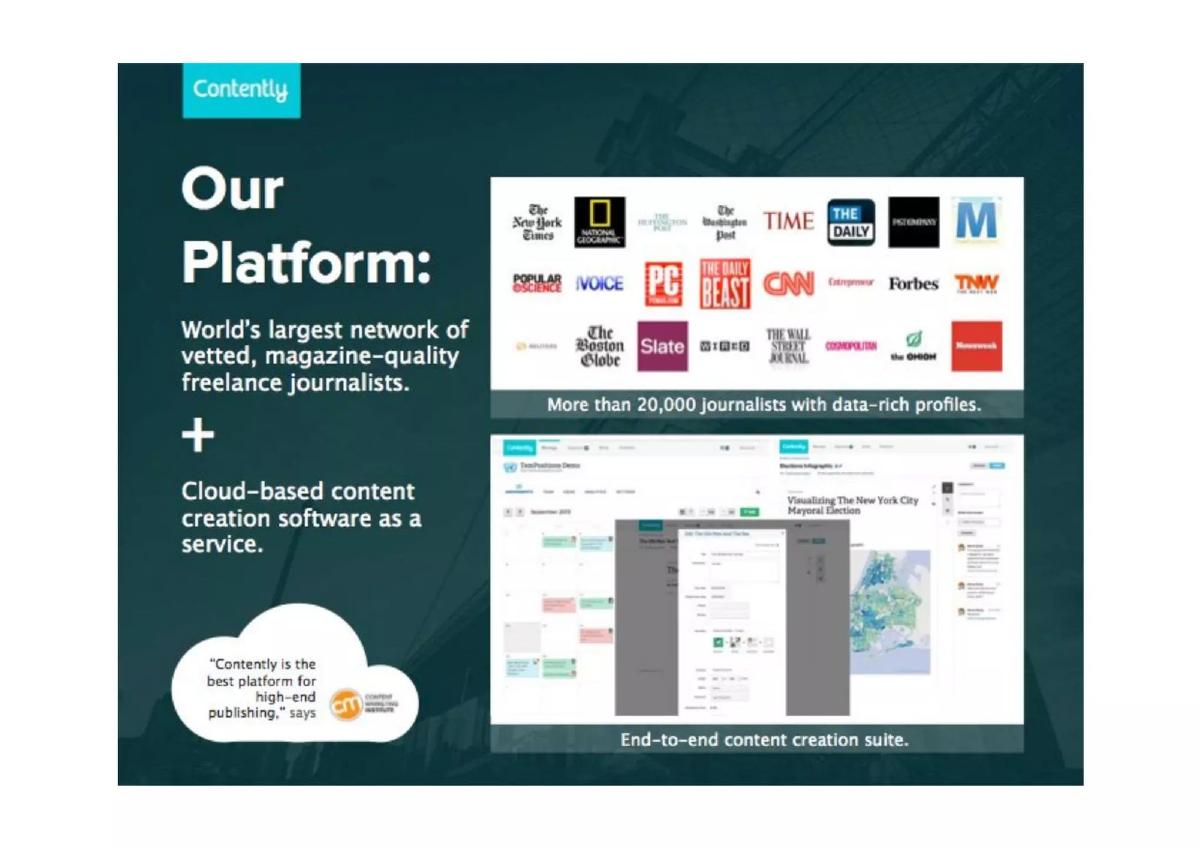
- The platform is defined by two pillars: a network of 20,000+ vetted journalists and a cloud-based content creation SaaS (Slide 5).
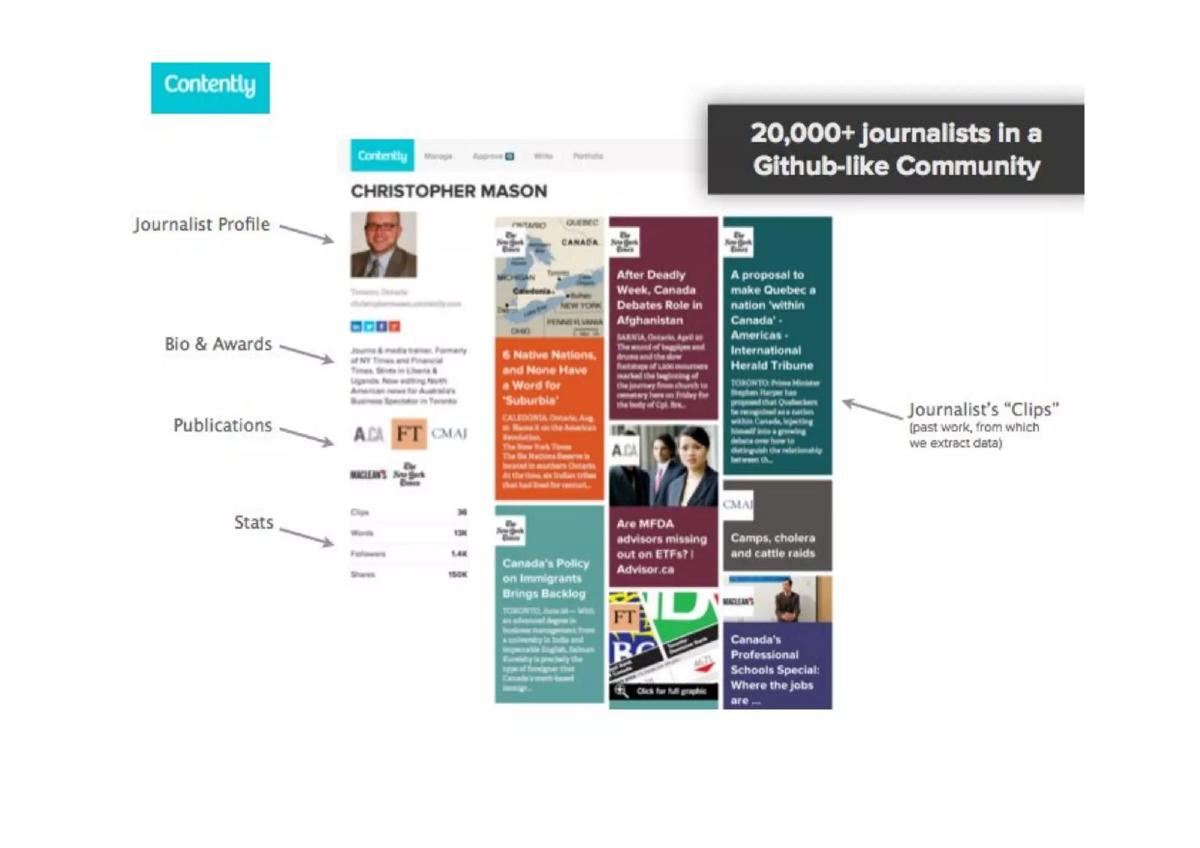
- The company uses a 'Github-like' analogy to describe their journalist community, emphasizing data-rich profiles and portfolio 'clips' (Slide 6).
- Pricing is transparently stated as starting at $3k-$20k per month for the end-to-end cloud workflow (Slide 7).
- The 'unfair advantage' is explicitly tied to the talent network, arguing that the content value chain must start with creation (Slide 12).
- The team slide highlights significant industry pedigree, including a CCO from Columbia Journalism and Wired Magazine (Slide 13).
- The deck outlines a clear roadmap from Series A (2012) to Series B (2013), moving from a talent network into international expansion and distribution (Slide 11).
The Narrative: From Marketplace to Brand Publishing Cloud
In 2014, the term 'content marketing' was transitioning from a buzzword to a line-item necessity for enterprise brands. Contently’s Series B deck, which secured $9M led by Jackson Square Ventures, captures a company at the perfect inflection point. They weren't just a freelance marketplace; they were building the 'technological plumbing' for a new era of corporate media. The deck is structured to prove that they have solved the hardest part of the equation—talent—and are now ready to scale the software layer that sits on top of it.
Slides 1-4: The Macro Opportunity and the Problem
Slide 1: Title Slide The deck opens with the brand name and the subtitle 'Powering The Brand Publishing Cloud.' It immediately establishes a high-level category. The slide includes two large boxes for client logos, though these are redacted in the public version. This sets a tone of enterprise validation from the first second.
Slide 2: The Market Context Contently uses a 'Why Now' approach. It states, 'It’s 2013. Content marketing is the #1 digital priority for brands.' The slide provides a massive macro figure: the 25% of brands already doing content marketing are spending $44 billion on it. It also claims 80% of brands are shifting dollars to content marketing in the coming year. This creates a sense of urgency and a 'rising tide' narrative.
Slide 3: The Specific Friction Point The deck identifies the core problem: 'Creating original content is brands’ #1 challenge.' It includes a chart from eMarketer showing that 'Creating original content' and 'Having the time to do it' are the top two hurdles. The footer adds a critical insight: 'Brands need premium content to succeed, but they’re not set up to be publishers.' This justifies why a third-party platform is necessary.
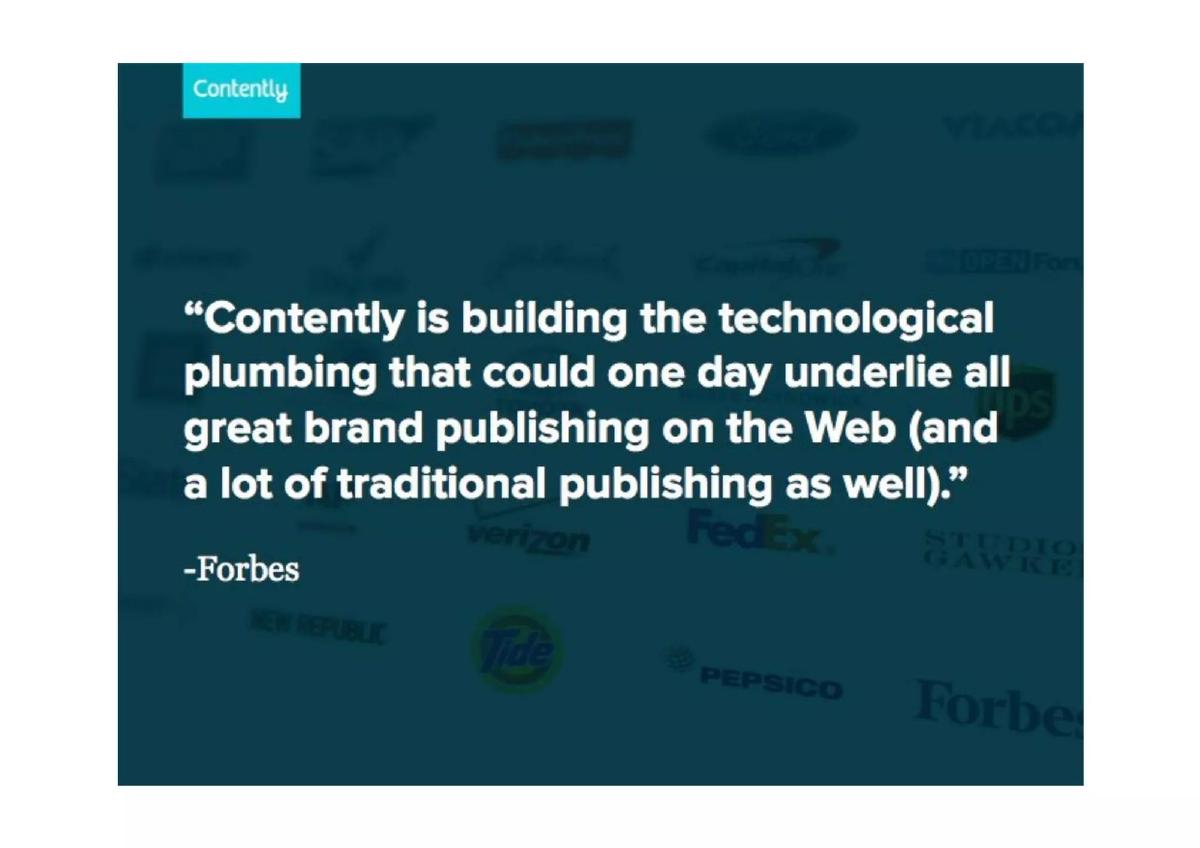
Slide 4: Third-Party Validation Before diving into the product, Contently uses a power quote from Forbes: 'Contently is building the technological plumbing that could one day underlie all great brand publishing on the Web.' This quote is strategically chosen because it uses the word 'plumbing,' suggesting a foundational, infrastructure-level utility rather than a discretionary service.
Slides 5-7: The Solution and Product Architecture
Slide 5: The Two-Pillar Platform This slide defines the product as the 'World’s largest network of vetted, magazine-quality freelance journalists' PLUS 'Cloud-based content creation software as a service.' It visually separates the 'who' (talent) from the 'how' (SaaS). It mentions 20,000 journalists and shows an 'End-to-end content creation suite.'
Slide 6: The Talent Network (The Moat) Contently describes its network as a 'Github-like Community.' This is a clever analogy for 2014, suggesting that just as developers have a home on Github, journalists have a home on Contently. The slide shows a profile for 'Christopher Mason,' highlighting 'Clips' (past work), awards, and stats like followers and shares. This emphasizes that their talent is data-validated, not just a list of names.
Slide 7: The SaaS Workflow This slide showcases the 'End-To-End Workflow In The Cloud.' It features a calendar view of assignments and an 'Edit Assignment' modal. Crucially, it includes pricing: 'Starting at $3-20k/mo.' For a Series B deck, being this explicit about high-ACV (Annual Contract Value) pricing signals to investors that this is a serious enterprise play, not a low-margin 'gig economy' app.
Slides 8-10: Traction and Unit Economics
Slide 8: Revenue Growth Titled 'By The Numbers,' this slide shows a classic 'up and to the right' chart for Gross Revenue. It breaks out 'SaaS' specifically, noting MRR added since January. While the numbers are redacted, the chart shows a clear acceleration in the slope of the curve starting in Q2 2013. It also includes a projection: 'Will end 2014 at $X m revenue run rate.'
Slide 9: Pipeline and ACV This slide focuses on the 'Annualized value of customers closing in Q4.' It distinguishes between 'SaaS Revenue' and 'Marketplace Spend.' This is a vital distinction for a Series B investor; marketplace spend is often pass-through with lower margins, while SaaS revenue is the high-margin engine. The slide also mentions 'ACV' (Annual Contract Value), reinforcing the enterprise sales motion.
Slide 10: The Near-Term Opportunity Contently states its goal: 'Own the entire value chain.' It shows a linear progression: Talent -> Creation -> Distribution -> Secret Plans. A small note at the bottom mentions a pilot that brought in distribution spend from 3 clients, proving that they are already testing the next phase of their growth.
Slides 11-14: Future Roadmap, Advantage, and Team
Slide 11: The Roadmap This slide provides a timeline from Series A (1/2012) to Series B (12/2013). It shows the layers of the business stacking over time: Journalist Network, then SaaS Workflow, then International Expansion, then Distribution and Multimedia Talent. The use of 'Secret Plans!' boxes suggests a roadmap that is both ambitious and protected.
Slide 12: The Unfair Advantage Contently explicitly addresses why they will win: 'Everyone needs talent, and we have the talent network.' They argue that the value chain starts with creation. By owning the talent, they own the entry point. This is their 'moat' against pure-play SaaS competitors who don't have a built-in supply of creators.
Slide 13: The Snapshot (Team and Financials) The 'Snapshot' slide is a dense summary of the company's DNA. It lists the founders, key employees (VP Product from PayPal/Zong, VP BD from Clickable), and high-profile advisors like Scott Belsky and Dharmesh Shah. It also notes they had raised $3.35M to date before this $9M round. The inclusion of the technology stack (Ruby on Rails, PostgreSQL) is a standard touch for the era.
Slide 14: Conclusion The deck ends with the logo and the tagline: 'Tell Great Stories.'
What Works in the Contently Deck
The 'Plumbing' Narrative: By positioning themselves as infrastructure ('technological plumbing') rather than just a service, they move the conversation from a 'nice-to-have' marketing tool to a 'must-have' enterprise platform. · Marketplace-SaaS Synergy: The deck does an excellent job of explaining how the talent network (marketplace) feeds the software (SaaS). They don't treat them as separate businesses but as a unified value chain. · Clear Pricing Tiers: Stating the $3k-$20k/month range immediately qualifies the business as Enterprise SaaS. It tells the investor exactly what kind of sales team and customer success infrastructure will be needed. · Third-Party Validation: Using a Forbes quote as a standalone slide provides massive social proof that is more effective than a self-written mission statement.
What is Missing from the Contently Deck
Churn and Retention Metrics: While the deck shows revenue growth, it omits Net Revenue Retention (NRR) or logo churn. For a Series B SaaS company, these are usually the first things an investor looks for to ensure the growth isn't just 'leaky bucket' growth. · Competitive Landscape: There is no slide comparing Contently to other content marketing platforms (CMPs) or traditional agencies. They rely on the 'unfair advantage' of their talent network to imply superiority without naming competitors. · Detailed Unit Economics: Beyond ACV, the deck doesn't touch on Customer Acquisition Cost (CAC) or the LTV/CAC ratio. Investors at the Series B stage typically want to see the efficiency of the 'sales machine.' · The 'Ask': The public version of the deck does not include a specific 'Ask' slide detailing how the $9M will be spent (e.g., % to sales, % to R&D).
What a Founder Should Copy
The 'Snapshot' Slide: Slide 13 is an excellent way to consolidate team, investors, advisors, and tech stack into a single, high-impact view. It’s much more efficient than having four separate slides for these items. · The Value Chain Diagram: Using a simple Talent -> Creation -> Distribution flow (Slide 10) is a great way to show how a company plans to expand its 'surface area' within a customer's budget. · The 'Github-like' Analogy: If you are building a marketplace, find a 'Github-like' or 'LinkedIn-like' analogy that helps investors immediately understand the behavior and loyalty of your supply side. · Leading with the Problem: Starting with the #1 challenge of your target customer (Slide 3) and backing it up with industry data (eMarketer) is the most effective way to build a 'logical' bridge to your solution.
Frequently asked questions
- What was Contently's primary value proposition in this deck?
- Contently positioned itself as the 'Brand Publishing Cloud.' Their value proposition was twofold: providing access to a vetted network of over 20,000 professional journalists and offering a SaaS workflow tool to manage the creation, approval, and distribution of that content. They aimed to solve the #1 challenge for brands—creating high-quality original content at scale—by providing both the talent and the 'technological plumbing' required to function like a traditional publisher.
- How did Contently justify its 'unfair advantage'?
- According to Slide 12, Contently's unfair advantage was its talent network. They argued that because 'everyone needs talent,' owning the supply side of the marketplace allowed them to control the beginning of the value chain. By starting with creation, they could naturally pull customers into their SaaS workflow and eventually into distribution, making their platform the central hub for all brand publishing activities.
- What were the key financial metrics highlighted?
- While specific dollar amounts are redacted on Slide 8 and 9, the deck emphasizes 'Gross Revenue' run rates and 'SaaS MRR.' It specifically highlights the 'Annualized value of customers closing in Q4' and distinguishes between SaaS Revenue and Marketplace Spend. This distinction is crucial for investors to understand the margin profile of the business, as SaaS revenue typically carries higher multiples than marketplace pass-through spend.
- Who were the key people behind Contently at the time of the Series B?
- The leadership team featured a mix of tech and media expertise. CEO Joe Coleman had experience with CashCrate, CTO Dave Goldberg brought a background from UPenn and Duke, and CCO Shane Snow provided the media 'DNA' with experience at Columbia Journalism and Wired Magazine. The deck also listed high-profile advisors like Scott Belsky (Behance) and Dharmesh Shah (HubSpot), signaling strong ties to both the creative and SaaS communities.
- What was the 'Secret Sauce' or 'Secret Plans' mentioned in the deck?
- The deck uses 'Secret Plans!' as a placeholder on several slides (10, 11) to indicate future product expansions. While the specifics are hidden, the context suggests these plans involved deeper integration into the 'Distribution' phase of the value chain and potentially new 'Multimedia Talent' categories. This is a common tactic in Series B decks to show a massive 'What's Next' without revealing the exact product roadmap to competitors.