Contoso positions itself as a task management solution driving workplace innovation, specifically targeting the Gen Z demographic (ages 18-25). The deck is characterized by aggressive financial modeling, projecting a jump from 50,000 users in Year 1 to 1.6 million users by Year 3, with corresponding gross profits rising from $5.6 million to $216 million. Despite these high-growth projections, the deck suffers from a lack of concrete product details; there are no screenshots, feature lists, or technical specifications explaining how the software actually functions. The funding slide indicates…
Key takeaways
- The company specifically targets Gen Z (18-25 years old) as its primary audience for task management, as stated on slide 4.
- Financial projections are extremely aggressive, forecasting Year 3 revenue of $216,000,000 from 1,600,000 users on slide 16.
- The business model relies on a 15% revenue take rate, though the underlying transaction type is not defined on slide 16.
- Current funding is minimal, totaling only $140,000 across four categories including $14k in angel investments and $32k in cash on hand (slide 19).
- The growth strategy is phased by month, starting with distribution to local startups in February and a general public release in May (slide 13).
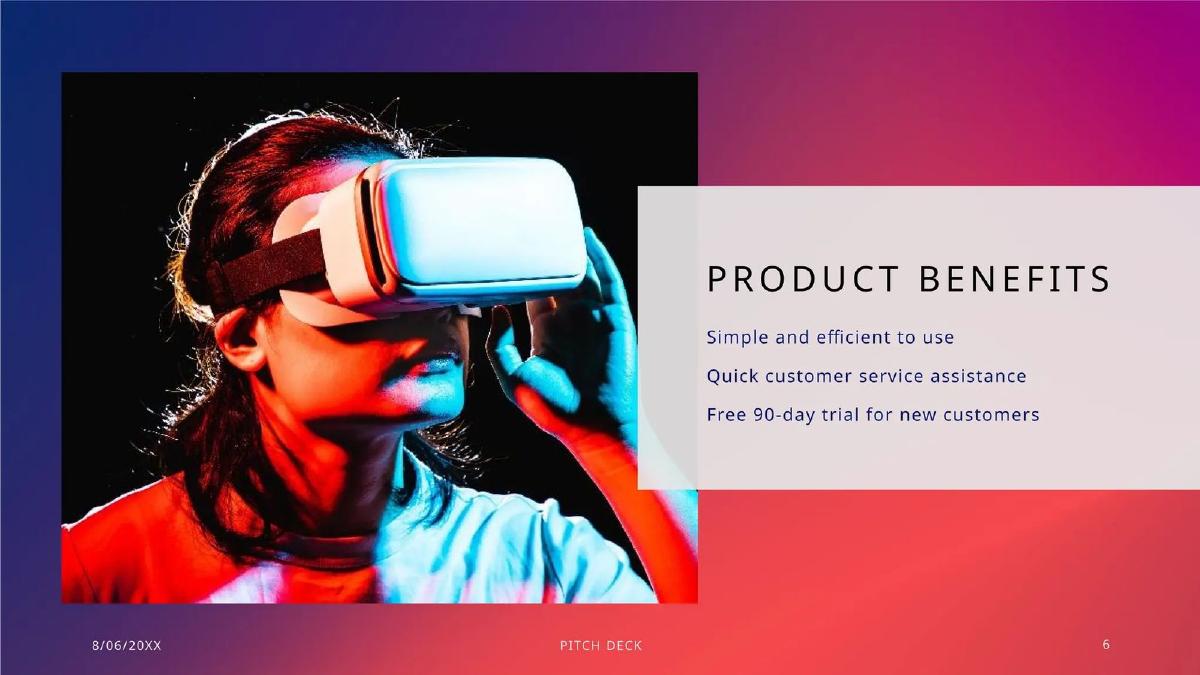
- The deck lacks any visual representation of the software, instead using futuristic stock imagery of VR headsets and robotic hands (slides 1, 7, and 10).
- Market definitions (TAM, SAM, SOM) are mentioned as concepts on slide 10 but lack actual dollar values or geographic boundaries.
- Operating expenses are projected to reach $187,920,000 by Year 3, with Sales & Marketing accounting for the bulk of the spend at $151,200,000 (slide 16).
Contoso Pitch Deck Analysis
The Contoso pitch deck, titled 'Task Management Solution: Driving Workplace Innovation and Growth,' presents a vision for a next-generation productivity tool. While the visual aesthetic is modern and leans heavily into futuristic themes, the content is notably light on technical specifics and heavy on high-level financial projections. The deck consists of 21 slides, though we are analyzing a representative selection of 7 key slides that outline the solution, market, growth, and financials.
Slide 1: Title Slide
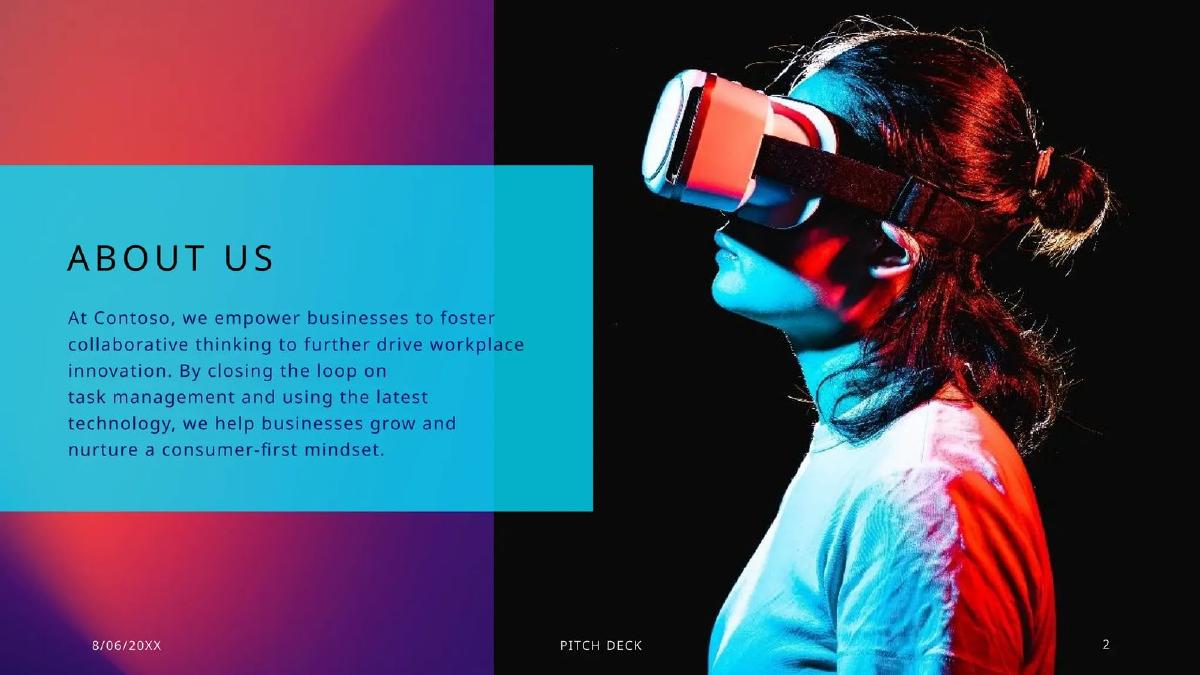
The opening slide features a high-resolution image of a woman wearing futuristic, glowing augmented reality (AR) glasses. The text identifies the document as a 'PITCH DECK' and attributes it to 'Mirjam Nilsson.' The use of AR imagery sets a tone of high-tech innovation, though it is unclear if the task management solution actually utilizes AR or if this is purely stylistic. There is no company logo present on this slide, only the name Mirjam Nilsson, which may represent the founder or presenter.
Slide 4: The Solution
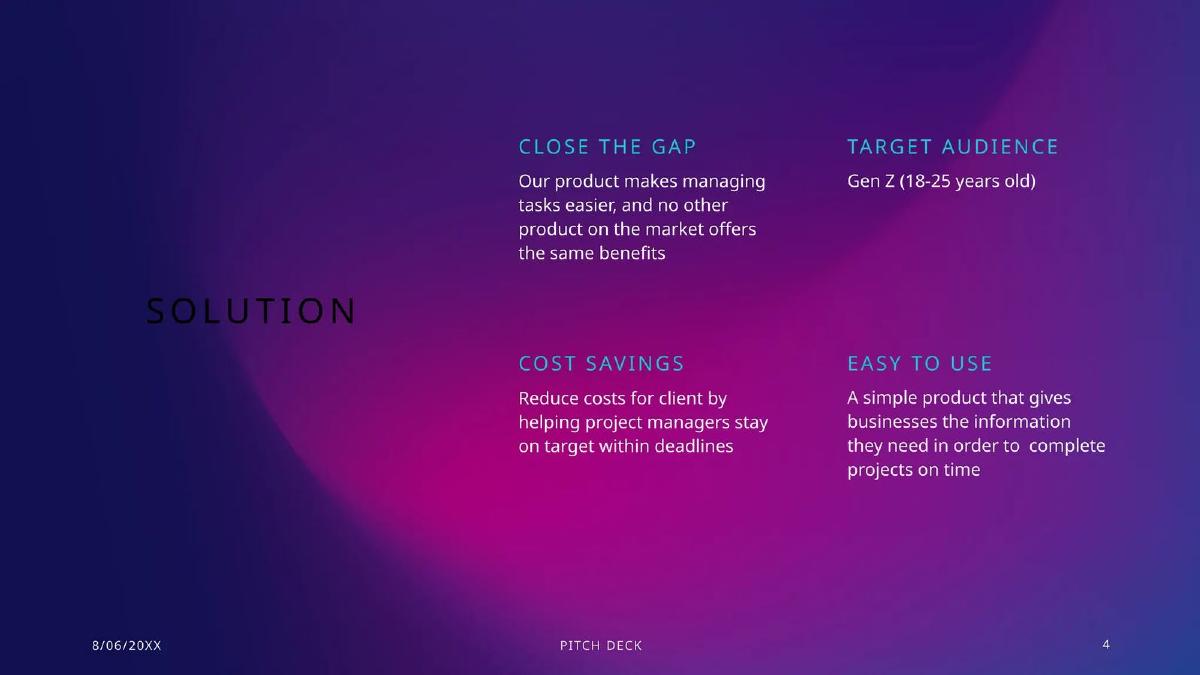
Slide 4 attempts to define the product's value proposition. It breaks the solution into four quadrants: 'Close the Gap,' 'Target Audience,' 'Cost Savings,' and 'Easy to Use.' Under 'Close the Gap,' the claim is made that 'no other product on the market offers the same benefits,' though these benefits are not listed. The 'Target Audience' is specifically defined as 'Gen Z (18-25 years old).' The 'Cost Savings' section notes the product helps project managers stay on target, and 'Easy to Use' promises a simple product that provides necessary information for timely project completion. The slide is high on adjectives but low on features.
Slide 7: Company Overview
This slide serves as a section divider. It features a black background with a robotic hand and a human hand reaching toward each other, reminiscent of Michelangelo's 'The Creation of Adam.' This reinforces the theme of human-AI collaboration or digital transformation. However, as a divider, it provides no data regarding the company's history, mission statement, or current status.
Slide 10: Market Comparison
Slide 10 introduces standard market sizing terminology: Total Addressable Market (TAM), Serviceable Available Market (SAM), and Serviceable Obtainable Market (SOM). It associates these with phrases like 'Opportunity to build,' 'Freedom to invent,' and 'Few competitors.' Critically, the slide contains zero numerical data. There are no dollar amounts or user counts to quantify the market opportunity. It lists a 'Specifically targeted market' for the SOM but does not define what that market is beyond the Gen Z mention on previous slides.
Slide 13: Growth Strategy
The growth strategy is presented as a three-step timeline for a single year (20XX). In February, the plan is to 'Distribute the app to local start ups.' In May, the company intends to 'Release the app to the general public.' By October, the goal is to 'Gather feedback from the start up community to expand availability.' This suggests a very early-stage company that is currently in or approaching a closed beta phase. The strategy is linear and focused entirely on distribution rather than user acquisition tactics or channel partnerships.
Slide 16: Financials
This is the most data-dense slide in the deck, presenting a three-year forecast. The projections are exceptionally aggressive:
Year 1: 50,000 users, $5.6M Gross Profit, $7.5M Total Expenses (Net Loss). · Year 2: 400,000 users, $48M Gross Profit, $52.8M Total Expenses (Net Loss). · Year 3: 1,600,000 users, $216M Gross Profit, $187.9M Total Expenses (First year of profitability).
The revenue is calculated as 'Revenue @ 15%,' which implies a marketplace or commission-based model rather than a standard SaaS subscription. The 'Average Price per Sale' increases from $75 to $90 over the three years. The expense breakdown shows a massive reliance on 'Sales & Marketing,' which scales to $151.2M by Year 3. The math on this slide is internally consistent but assumes a level of scaling rarely seen in the task management space without massive prior investment.
Slide 19: Funding
The funding slide reveals the company's current capital structure. It shows four categories totaling $140,000:
Campaigns: $12,000 (Revenue from online campaigns). · Angel Investments: $14,000. · Cash: $32,000 (Liquid cash on hand). · Shares: $82,000 (Shares converted into USD).
This slide highlights a significant 'credibility gap.' The company has $32,000 in cash but projects spending $7.5 million in Year 1. This indicates the company is likely seeking a multi-million dollar seed or Series A round, though the specific 'Ask' is missing from the slides provided.
What Works
Visual Consistency: The deck uses a consistent color palette of deep purples, blues, and neon accents. The typography is clean and professional, making the slides easy to read during a presentation. The use of high-quality (albeit stock) imagery gives the deck a polished, 'big company' feel.
Clear Demographic Focus: By explicitly targeting Gen Z (Slide 4), Contoso differentiates itself from generic enterprise tools like Asana or Jira. This niche focus allows for a more tailored marketing message, even if the product features aren't yet detailed.
Detailed Expense Allocation: Unlike many early-stage decks that only show revenue, Slide 16 attempts to forecast specific expense categories like Customer Service, Product Development, and Research. This shows the founders are thinking about the operational costs of scaling a large organization.
What is Missing
Product Demonstration: The most glaring omission is the product itself. In a 21-slide deck, there should be at least 3-5 slides showing the interface, the user journey, and the specific 'innovation' mentioned in the title. Without this, investors cannot evaluate the 'Easy to Use' claim.
The Team: There is no team slide in this selection. For an early-stage startup, the pedigree and experience of the founders are often more important than the financial projections. We do not know if Mirjam Nilsson has a background in software, Gen Z marketing, or project management.
The Ask: While the funding slide shows what they have, it doesn't state what they need. A pitch deck must clearly communicate the amount of capital being raised, the valuation (or cap), and the specific milestones that the new capital will enable.
Competitive Analysis: Slide 10 mentions 'Few competitors,' which is a highly questionable claim in the saturated task management market. A proper teardown of how Contoso beats incumbents like Trello, Monday.com, or Notion is essential for investor confidence.
What a Founder Should Copy
The Financial Table Structure: The layout of Slide 16 is excellent. It clearly shows the relationship between user growth, sales volume, and expense scaling. Even if the numbers are ambitious, the format allows an investor to quickly see the underlying assumptions of the business model (e.g., the 15% take rate).
The Phased Growth Strategy: Slide 13 uses a simple, digestible timeline. Breaking a launch into 'Local Startups' then 'General Public' then 'Feedback/Expansion' is a logical way to demonstrate a controlled go-to-market strategy that prioritizes learning before massive scaling.
Clean Section Dividers: Using high-impact imagery for section dividers (like Slide 7) helps pace the presentation and gives the audience a visual break between data-heavy slides. It signals a transition in the narrative, which is helpful for keeping an audience engaged during a live pitch.
Final Summary
The Contoso deck is a visually appealing document that suffers from a lack of substance regarding the actual technology being built. The financial projections are disconnected from the current funding reality, suggesting a company that is dreaming big but has yet to prove its core product value. For this deck to be successful in a real-world fundraising environment, the founders would need to replace the abstract stock photos with actual product screenshots and provide a much more realistic bridge between their current $32k in cash and their projected $7.5M in Year 1 spending.
Frequently asked questions
- What is the core product offered by Contoso?
- Based on the slides, the product is a 'task management solution' designed to help project managers stay on target and meet deadlines. However, the deck provides no screenshots, UI mockups, or specific feature descriptions. It uses abstract imagery of augmented reality and robotics, which may imply a high-tech interface, but the actual functionality remains undefined beyond 'managing tasks easier.'
- Is the financial model realistic for an early-stage startup?
- The model on slide 16 is highly optimistic. It projects scaling from $5.6 million to $216 million in gross profit within three years. Notably, the 'Total Expenses' in Year 1 ($7.5M) exceed 'Gross Profit' ($5.6M), indicating a burn of nearly $2M, yet the funding slide shows only $32k in cash. This suggests a massive, unstated capital requirement to reach these milestones.
- Who is the intended user according to the deck?
- Slide 4 explicitly identifies Gen Z (18-25 years old) as the target audience. While task management is usually a B2B enterprise play, this targeting suggests a consumer-facing or 'prosumer' approach. The deck also mentions 'local start ups' as the initial testing ground in the growth strategy on slide 13.
- What is the current financial standing of the company?
- According to slide 19, the company has raised or generated $140,000 to date. This is broken down into $12k from campaigns, $14k from angel investments, $32k in liquid cash, and $82k in 'shares converted into USD.' This is a very small capital base for a company projecting hundreds of millions in revenue within 36 months.
- What are the biggest omissions in the Contoso pitch deck?
- The deck omits a Team slide, which is critical for establishing credibility. It also lacks a clear 'Ask' (how much money they are currently seeking), a competitive landscape analysis (beyond generic labels), and any evidence of product-market fit or current traction metrics. The absence of actual software visuals is also a significant red flag for a tech solution.