Copado's deck, dated February 2021, serves as a strategic roadmap for a company that has successfully carved out a dominant niche within the Salesforce ecosystem. The presentation effectively balances high-level digital transformation trends with granular, ROI-focused case studies. By quantifying the 'Business Impact' for specific clients—such as a $89.6M annual benefit for a hardware firm—Copado moves beyond technical features to speak the language of the C-suite. The deck is particularly strong in its use of social proof, featuring a massive grid of blue-chip logos and detailed implementati…
Key takeaways
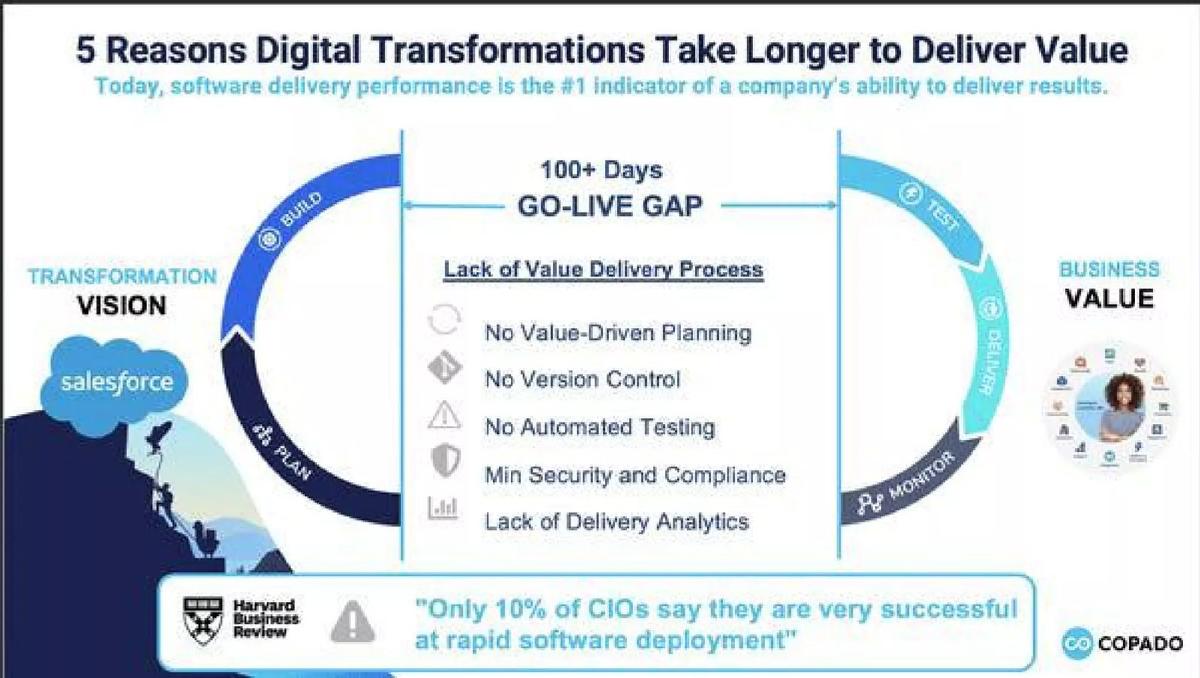
- The deck identifies a specific '100+ Days Go-Live Gap' as the primary friction point for enterprise digital transformations on slide 6.
- Copado leverages a massive partner ecosystem, including top global SIs like Accenture, IBM, and Deloitte, to drive market penetration as shown on slide 11.
- A detailed case study for Linde on slide 7 shows a 42x increase in stories delivered each quarter and a shift from quarterly to monthly releases.
- The platform is positioned as a 'Value Stream Platform' that covers the entire lifecycle from planning to monitoring on slide 8.
- Copado quantifies the cost of building custom DevOps tools at $2.61M, positioning their off-the-shelf solution as a significant cost-saver on slide 14.
- The leadership team features deep experience from Salesforce, Vlocity, and Veeva, reinforcing their ecosystem expertise on slide 13.
- Customer success is quantified through 215 implementations and $17M in renewal transactions over a two-year period on slide 21.
- The deck uses Cisco as a recurring benchmark for ROI, citing figures like $39M/year in value from improved testing on slide 18.
Executive Summary: The Salesforce DevOps Powerhouse
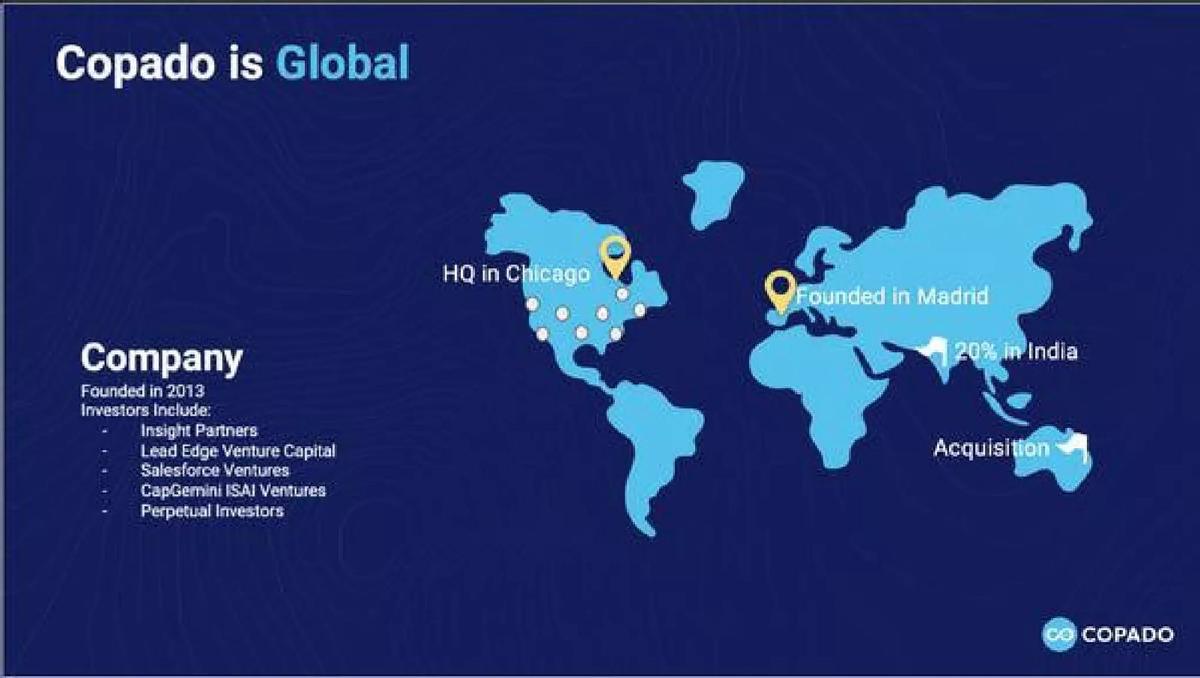
Founded in 2013 and headquartered in Chicago, Copado has established itself as the leading DevOps platform for the Salesforce ecosystem. This teardown examines their February 2021 investor deck, which supported their journey toward raising over $270 million in total funding. The deck is a sophisticated example of how to pitch a vertical SaaS solution to enterprise investors by focusing on 'Value Stream Management' and tangible ROI rather than just technical specifications.
Slides 1-4: Mission and The Enterprise Challenge
The deck opens with a clean, thematic cover featuring a llama (the company's mascot) and a clear mission statement on slide 3: "Make Release Days Obsolete." This is a powerful hook for anyone familiar with the pain of enterprise software deployments. Slide 4 introduces the core challenge: "Enterprise Software is Complicated." By framing the problem as a universal struggle for large organizations, Copado sets the stage for a solution that simplifies complexity.
Slides 5-7: Market Dynamics and The Go-Live Gap
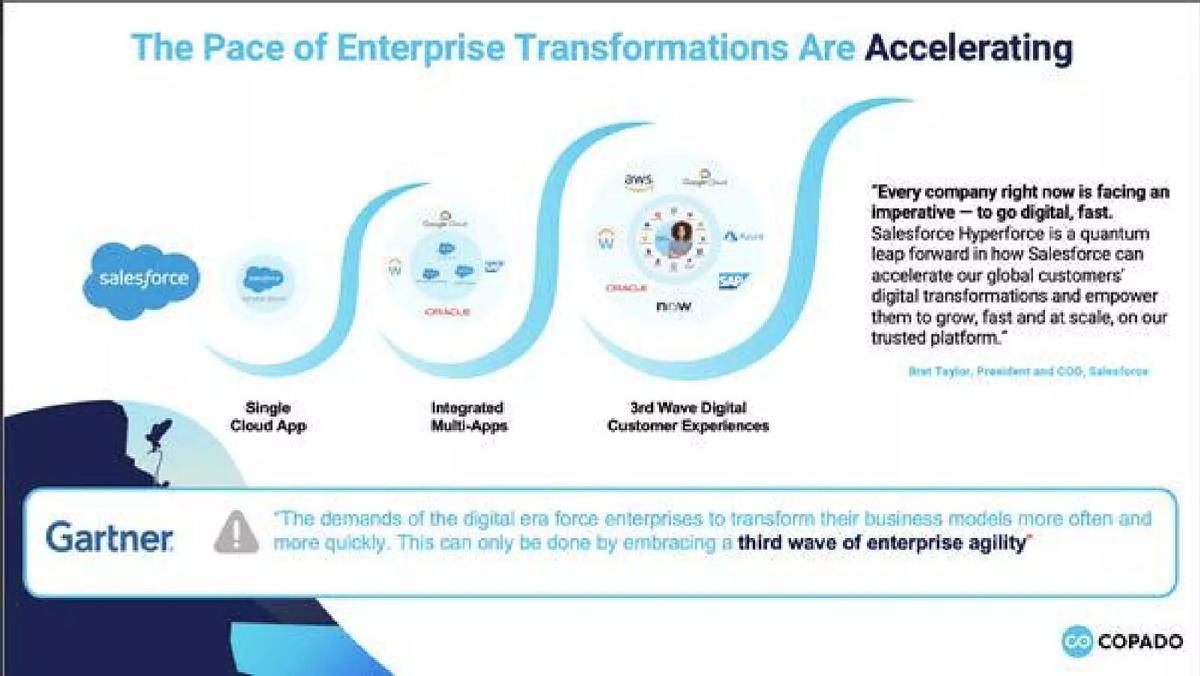
Slide 5 uses Gartner and Salesforce quotes to validate the "3rd Wave of Digital Customer Experiences," suggesting that the pace of transformation is accelerating. Slide 6 is perhaps the most critical in the deck, identifying the "100+ Days GO-LIVE GAP." It lists five reasons transformations fail, including a lack of version control and automated testing. This slide effectively creates a sense of urgency. Slide 7 provides immediate proof of the solution's efficacy through a timeline for Linde, showing a 42x increase in stories delivered and a transition to daily production releases by 2018.
Slides 8-10: The Value Stream Platform and Social Proof
Slide 8 introduces the "Copado DevOps Value Stream Platform," a circular diagram covering Plan, Build, Test, Deliver, and Monitor. This positions the product as a comprehensive lifecycle tool rather than a point solution. Slide 9 doubles down on ROI, citing a $89.6M annual business impact for a high-tech hardware company. Slide 10 is a "logo wall" featuring dozens of blue-chip customers like IBM, Coca-Cola, and T-Mobile, organized by industry verticals. This level of social proof is rare and highly persuasive for Series-stage investors.
Slides 11-13: Go-To-Market and Leadership
Slide 11 outlines a robust partner strategy, categorizing partners into Global SIs (Accenture, Deloitte), Strategic ISVs (Veeva, nCino), and Regional SIs. This suggests a scalable, indirect sales motion that leverages existing enterprise relationships. Slide 12 touches on company values, while Slide 13 introduces a heavy-hitting leadership team. The team's pedigree—with multiple former Salesforce and Vlocity executives—is a clear signal that they have the "insider" knowledge required to dominate this specific niche.
Slides 14-15: The Cost of Inaction and Platform Architecture
Slide 14 presents a competitive matrix that compares Copado against manual processes, custom scripts, and point solutions. It quantifies the cost of building a custom tool at $2.610M, effectively arguing that buying Copado is the only fiscally responsible choice. Slide 15 provides a high-level architectural overview, showing how the platform integrates with various Salesforce clouds (CPQ, Vlocity) and external tools like Jira and GitHub.
Slides 16-20: Deep Dives into Product Modules
These slides follow a consistent format: a product screenshot, a list of features, and a massive ROI figure attributed to Cisco. Slide 16 (Plan) claims $24M/year in value; Slide 17 (Build) claims $20M/year; Slide 18 (Test) claims $39M/year; and Slide 19 (Deliver) claims $2.3M/year. This repetitive structure hammers home the message that every part of the Copado platform generates significant, measurable wealth for the customer. Slide 20 introduces "DevOps 360 Analytics," emphasizing the importance of aligning technical delivery with business goals.
Slide 21: Customer Success Metrics
The final slide provides hard data on the company's growth over the previous two years. It cites "Over 200 Implementations (215)," "6,754 Added Seats," and "$17mm" in renewal transactions. These figures demonstrate strong retention and expansion within the existing customer base, which are key metrics for any SaaS valuation.
What Works in the Copado Deck
Quantified ROI: The deck's greatest strength is its refusal to speak in abstractions. By attaching specific dollar amounts (e.g., $89.6M/yr impact on slide 9) to their claims, they make the investment case about business value rather than technical features.
Ecosystem Authority: The leadership slide (13) and the partner slide (11) work together to prove that Copado is not just a vendor, but a central pillar of the Salesforce ecosystem. This reduces the perceived risk for investors.
Clear Problem Definition: The "100+ Days Go-Live Gap" on slide 6 is a brilliant piece of marketing. It gives a name and a number to a pain point that every CIO understands, making the solution feel necessary.
What is Missing from the Copado Deck
The Ask: There is no slide indicating how much money the company is looking to raise or how they plan to use the capital. This suggests the deck may be a general investor update or a preliminary teaser used before a formal term sheet is discussed.
Financial Projections: While the deck is excellent at showing customer ROI, it omits the company's own P&L projections. Investors would typically want to see a 3-5 year forecast of revenue growth and path to profitability.
Competitive Landscape: Slide 14 groups competitors into broad categories like "Point Solutions" and "Custom Scripts." It does not name specific competitors in the Salesforce DevOps space (like Gearset or Flosum), which might leave some investors wondering about direct market rivalry.
What a Founder Should Copy
The 'Cost of Building' Slide: Slide 14 is a masterpiece of sales engineering. If you are selling a tool that replaces internal dev work, you must quantify the "hidden" costs of labor, maintenance, and delayed rollouts. It turns a 'nice-to-have' into a 'must-have.'
Module-Specific ROI: If your platform has multiple components, follow Copado's lead in slides 16-19. Show a screenshot, list the features, and then provide a specific case study result for that module. This helps investors understand the value of the whole by looking at the parts.
Vertical Positioning: Copado doesn't try to be a DevOps tool for everyone. They are the DevOps tool for Salesforce. Founders should learn from this: dominating a large, specific niche is often more lucrative and easier to pitch than being a generic player in a crowded market.
Frequently asked questions
- What is Copado's primary value proposition?
- Copado positions itself as the DevOps platform that enables digital transformation specifically for Salesforce. Their primary goal, as stated on slide 3, is to 'Make Release Days Obsolete' by automating the release process, increasing productivity, and closing the 'Go-Live Gap' that often exceeds 100 days in enterprise environments.
- How does Copado justify its pricing against custom-built solutions?
- On slide 14, Copado presents a detailed breakdown of the costs associated with building custom DevOps scripts. They estimate the total cost of a custom build at $2.61M, which includes $600k in lost time for the team and $1.3M in costs related to delaying the DevOps rollout. This framing makes their platform appear as a high-ROI alternative.
- Who are the key members of the leadership team?
- The team is led by CEO Ted Elliott and co-founders Federico Larsen (CTO) and Phil Rackwitz (CSO). The leadership bench is deep, featuring executives with backgrounds from Salesforce, Vlocity, Oracle, and Veeva, which is critical for a company operating so closely within the Salesforce ecosystem (Slide 13).
- What kind of ROI can customers expect according to the deck?
- The deck provides specific figures for Cisco across different modules: $24M/year from Value Driven Planning (Slide 16), $20M/year from Collaboration (Slide 17), $39M/year from Testing (Slide 18), and $2.3M/year from Continuous Delivery (Slide 19). For a hardware company, they cite a total business impact of $89.6M per year.
- What is missing from this pitch deck?
- This version of the deck lacks a specific 'Ask' slide detailing the amount of capital being raised and the intended use of funds. It also omits forward-looking financial projections (P&L), detailed unit economics (CAC/LTV), and a specific competitive landscape analysis beyond the 'Custom vs. Point Solution' matrix on slide 14.