Copper Cow Coffee’s 11-slide pitch deck is a lean, image-heavy presentation that prioritizes brand identity and product utility over dense financial modeling. The deck successfully communicates a clear value proposition: high-quality Vietnamese pour-over coffee that is portable and easy to brew. By June 2018, the company reported $80K in monthly revenue with 45% margins, supported by a massive retail footprint of over 2,000 stores including Macy’s and H-E-B. While the deck lacks a formal 'Ask' slide or detailed competitive analysis, it leverages the founder’s personal heritage and professiona…
Key takeaways
- The company achieved $80K in revenue for the month of June 2018 as stated on slide 9.
- Gross margins are healthy for a CPG startup at 45% according to slide 9 and slide 11.
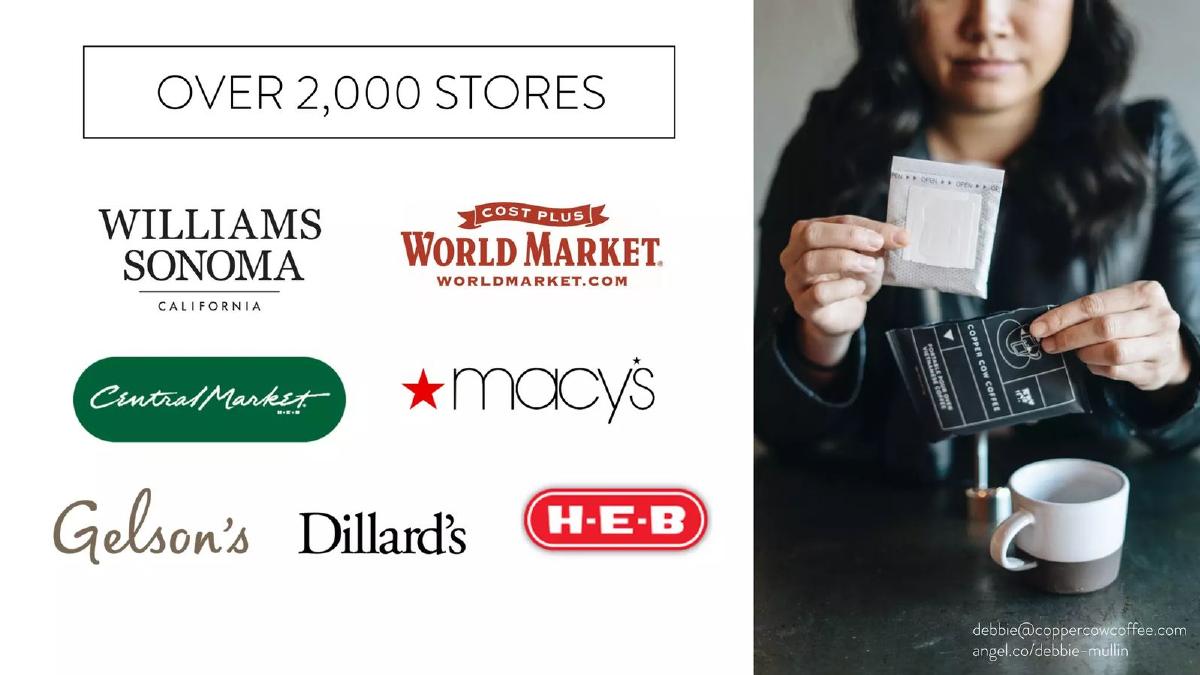
- The brand has secured significant retail distribution in over 2,000 stores, including Williams Sonoma and Macy's (slide 6).
- The deck identifies a $32 billion total addressable market within the American coffee industry on slide 7.
- Founder Debbie Mullin leverages a high-pedigree background with logos from MIT, UC Berkeley, and The World Bank on slide 10.
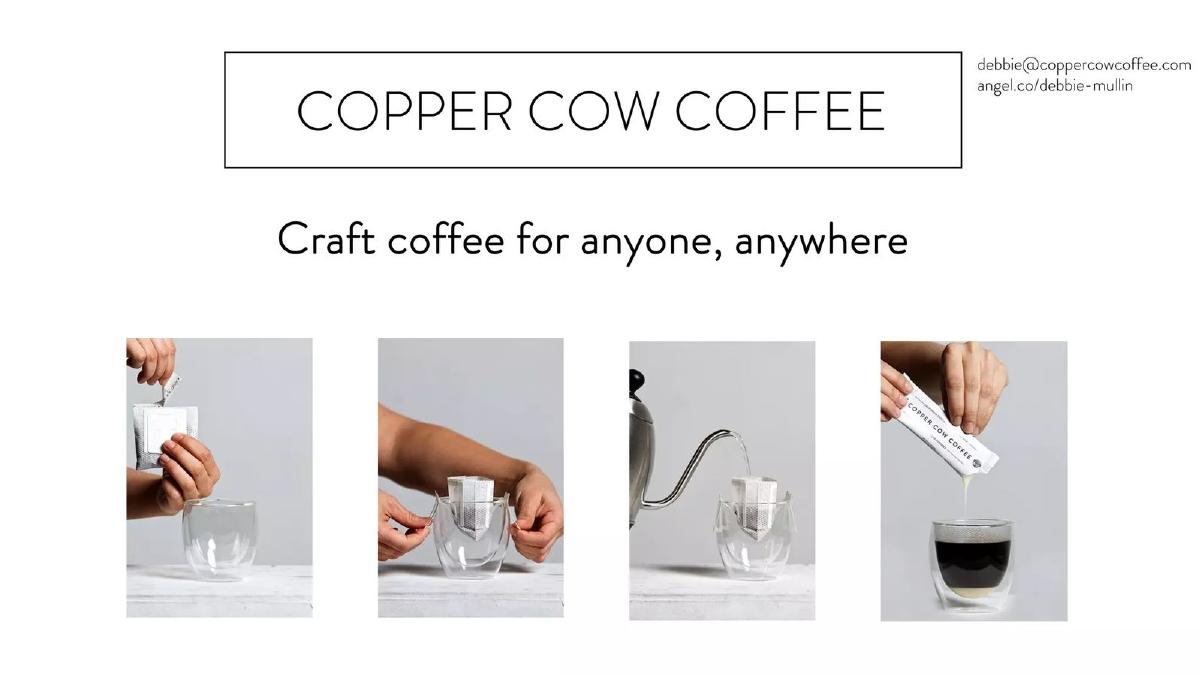
- The product is positioned as 'Craft coffee for anyone, anywhere' using a four-step visual brewing guide on slide 4.
- Future growth is targeted through two specific channels: Office & Hotel and E-commerce (slide 8).
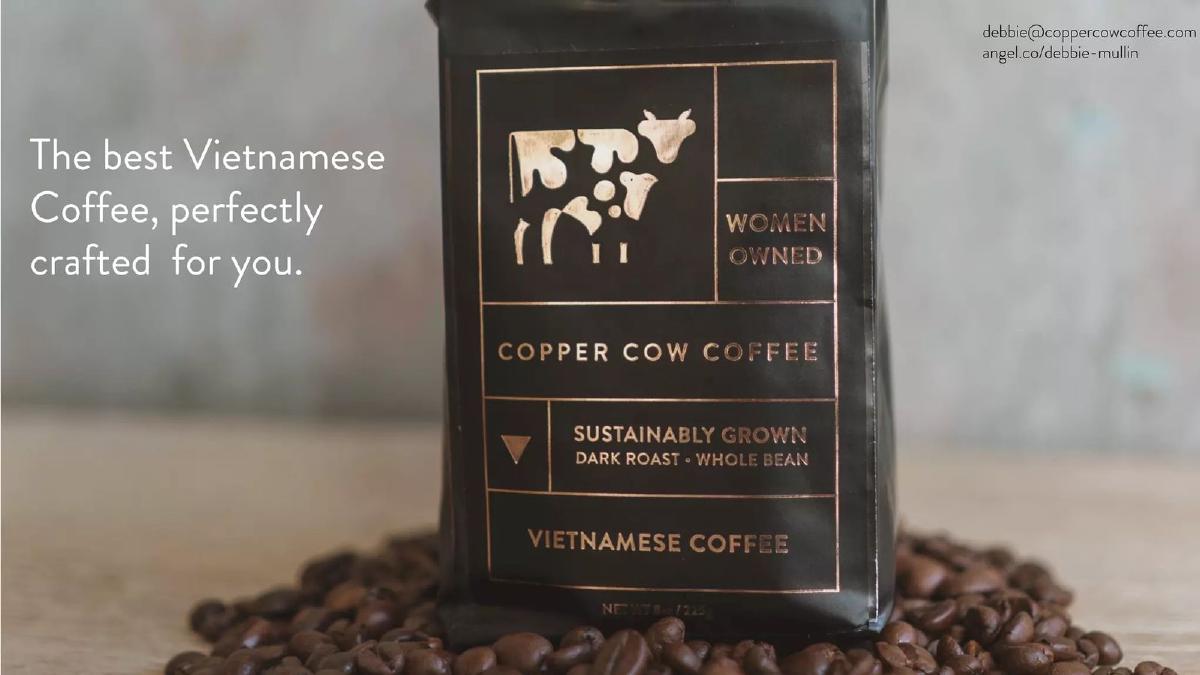
- The deck emphasizes a 'Women Owned' status and sustainable sourcing on its product packaging (slide 3).
Introduction: The Power of Visual CPG Storytelling
Copper Cow Coffee’s pitch deck is a masterclass in minimalist, brand-forward communication. In the Food & Beverages sector, the product is the hero, and this 11-slide deck treats it as such. By blending personal heritage with impressive retail traction, the company makes a compelling case for the premiumization of Vietnamese coffee in the US market. While the deck lacks some of the technical depth found in SaaS pitches, its clarity on margins and distribution makes it a potent tool for CPG investors.
Slide 1: Title and Brand Identity
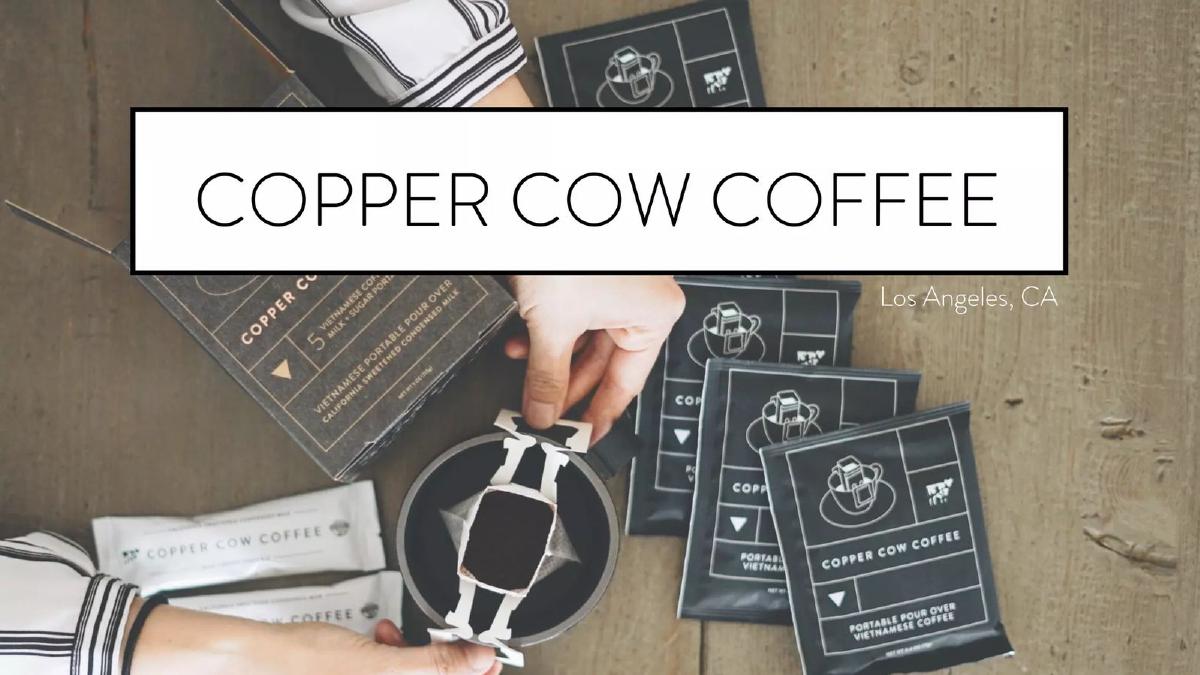
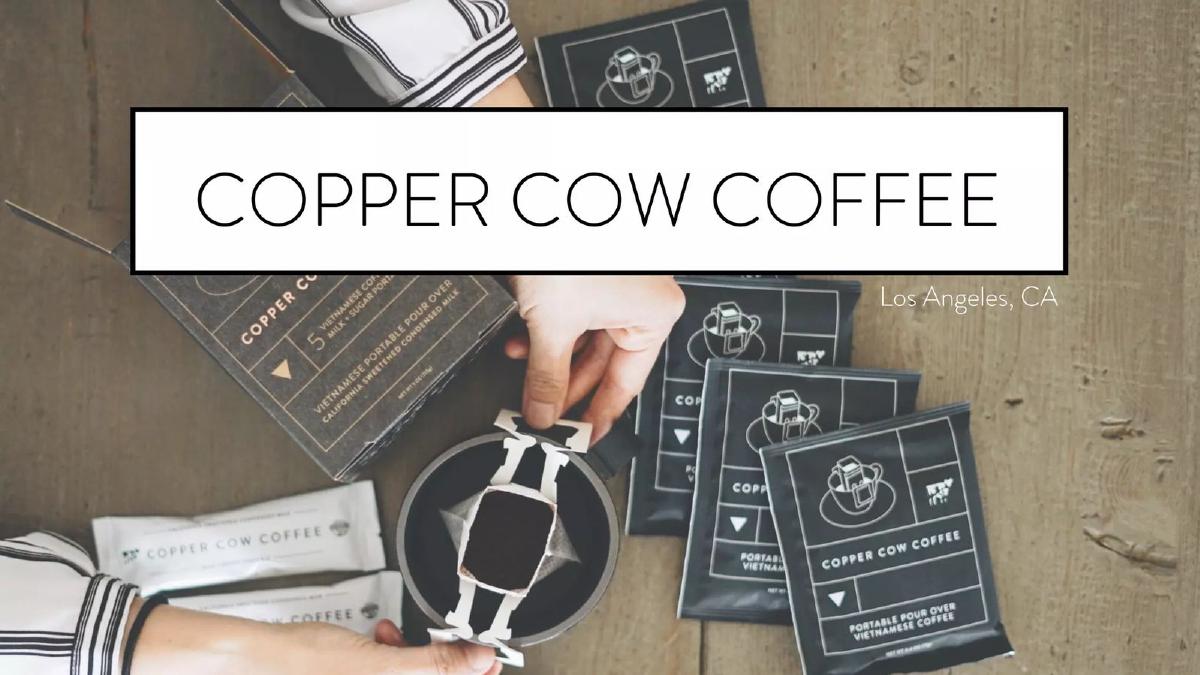
The cover slide is clean and high-contrast. It features the Copper Cow Coffee logo in a bold, serif-free box over a lifestyle photograph of the product in use. The location is specified as Los Angeles, CA . This slide immediately establishes the brand's aesthetic: premium, modern, and accessible. The background image shows the portable pour-over kit, providing an immediate visual cue for what the company actually sells.
Slide 2: The 'Why' and Heritage
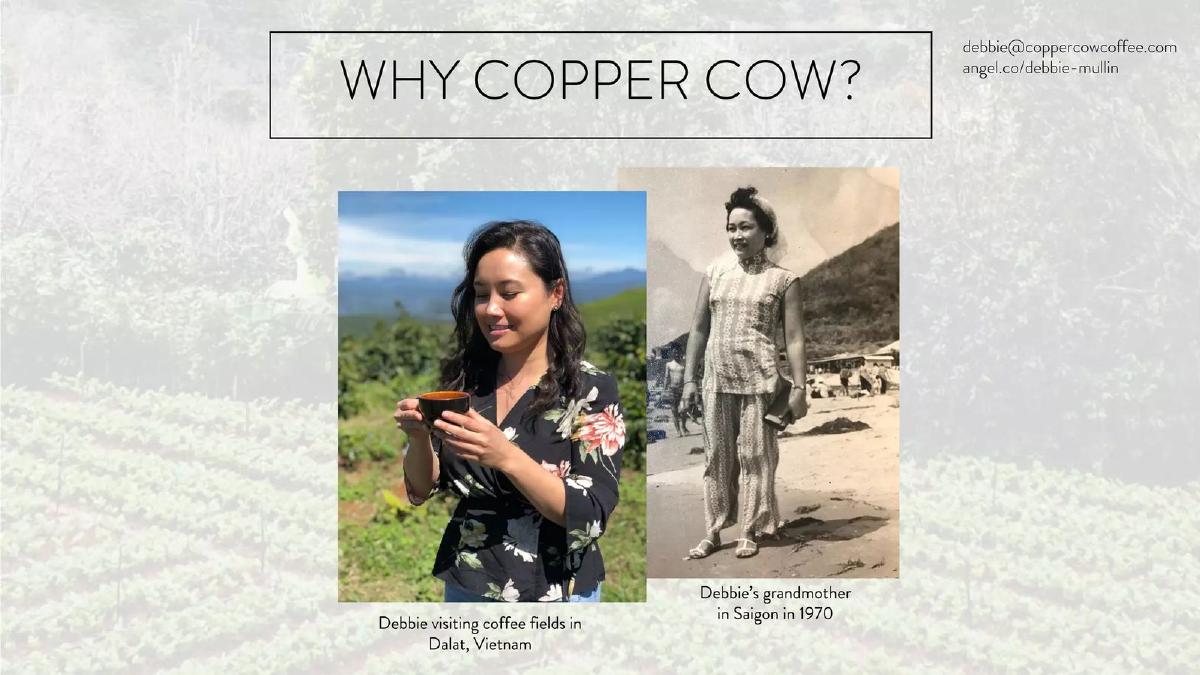
Slide 2, titled 'Why Copper Cow?' , focuses on founder Debbie Mullin’s personal connection to the product. It features two photos: one of Debbie visiting coffee fields in Dalat, Vietnam , and a historical photo of Debbie’s grandmother in Saigon in 1970 . This slide is critical for a food brand; it establishes authenticity and a 'founder-market fit' that goes beyond simple business interest. It suggests the product is rooted in tradition but brought to the modern market by someone with direct ties to the source.
Slide 3: Product and Packaging
This slide showcases the physical product packaging. The copy reads: 'The best Vietnamese Coffee, perfectly crafted for you.' The packaging itself, as shown in the photo, highlights several key selling points: 'Women Owned' , 'Sustainably Grown' , and 'Dark Roast • Whole Bean' . By showing the bag surrounded by loose beans, the deck reinforces the 'craft' nature of the product, moving it away from the perception of low-quality instant coffee.
Slide 4: The Brewing Process
One of the most functional slides in the deck, Slide 4 uses four sequential photos to demonstrate how the product works. The tagline is 'Craft coffee for anyone, anywhere.' The photos show the user opening the filter, hanging it on a glass, pouring hot water, and finally adding the signature sweetened condensed milk. This eliminates any confusion about the 'portable pour-over' concept and highlights the convenience factor—a major selling point for the $32B coffee industry.
Slide 5: Supply Chain Expertise
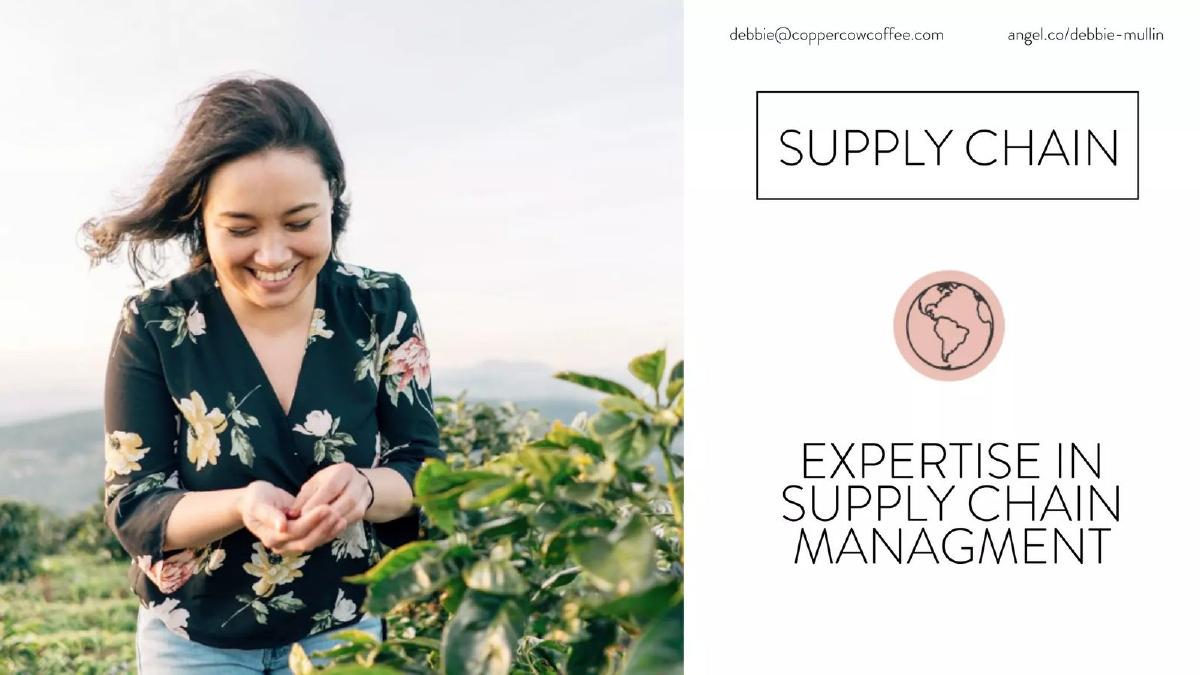
Slide 5 features a large photo of the founder in a coffee field with the heading 'Supply Chain' and the sub-heading 'Expertise in Supply Chain Management.' While it doesn't list specific logistics partners, it signals to investors that the company isn't just a marketing front; they are deeply involved in the sourcing and production process in Vietnam. This is a subtle way to address potential concerns about international sourcing risks.
Slide 6: Retail Traction
This is the 'social proof' slide. Under the heading 'Over 2,000 Stores,' the deck displays logos for Williams Sonoma, Cost Plus World Market, Macy’s, Central Market, Gelson’s, Dillard’s, and H-E-B. For a CPG startup, this is the most important slide in the deck. It proves that there is existing demand and that the brand is capable of maintaining relationships with major national retailers. The 2,000-store figure is a significant milestone for an early-stage company.
Slide 7: Market Size
Slide 7 provides the macro context. It simply states '$32 Billion' and 'American Coffee Industry.' While it doesn't break down the TAM/SAM/SOM (Total Addressable Market, Serviceable Addressable Market, Serviceable Obtainable Market), it establishes that Copper Cow is playing in a massive, established category where even a small percentage of market share represents a significant business.
Slide 8: New Revenue Opportunities
This slide looks toward the future. It identifies two primary growth levers: 'Office & Hotel' and 'E-Commerce.' The visuals show the product in a professional setting and a screenshot of their mobile-optimized website. This tells investors that the company is not solely reliant on physical retail and is looking to capture higher-margin direct-to-consumer (DTC) sales and recurring B2B revenue.
Slide 9: Key Financial Metrics
Slide 9 provides the hard data. It lists '$80K Revenue June 2018' and '45% Margins.' These are strong numbers for a young brand. A 45% margin is healthy for a physical product, suggesting that as they scale, the company has a clear path to profitability. The June 2018 revenue figure provides a snapshot of their growth trajectory at the time of the pitch.
Slide 10: The Team
The team slide focuses on Debbie Mullin (CEO, Founder) and Lillian Mayer (Sales & Customer Success). Debbie’s profile is bolstered by the logos of MIT, University of California Berkeley, and The World Bank. This academic and professional pedigree suggests a level of analytical rigor and operational capability that balances the 'heritage' story told earlier in the deck.
Slide 11: Closing and Contact
The final slide repeats the key metrics: '$80K June 2018' and '45% Margins.' It includes a call to action: 'You Get a Coffee!' and provides the founder’s email address. The image shows the founder brewing a cup, ending the presentation on a personal, approachable note.
What Works in This Deck
The deck’s greatest strength is its visual clarity . In the CPG world, the brand is the product, and Copper Cow uses high-quality photography to make the product look premium and desirable. The traction slide (Slide 6) is exceptionally strong; listing 2,000 stores including names like Williams Sonoma and Macy’s immediately de-risks the investment. Furthermore, the margin transparency (Slide 9) is refreshing. Many early-stage decks hide their unit economics, but Copper Cow leads with a 45% margin, which is a 'green flag' for investors looking for scalable physical goods businesses.
What Is Missing
The most glaring omission is the 'Ask' . There is no mention of how much capital is being raised, the valuation, or the specific milestones that the funding will enable. Additionally, the deck lacks a competitive landscape . The coffee market is incredibly crowded, with players ranging from Starbucks to niche DTC brands like Blue Bottle or fellow Vietnamese coffee startups like Nguyen Coffee Supply. Explaining why Copper Cow’s portable format is superior to these competitors would have strengthened the case. Finally, there are no financial projections beyond the single month of June 2018, leaving investors to guess at the long-term growth potential.
What a Founder Should Copy
Founders should emulate the 'How it Works' visual (Slide 4) . If your product involves a new behavior (like a hanging pour-over filter), you must show, not just tell, how easy it is. The heritage-to-pedigree bridge is also worth copying; Debbie Mullin successfully uses her family history to provide 'soul' to the brand while using her MIT and World Bank background to provide 'substance.' Lastly, the minimalist design ensures that the investor’s eye goes exactly where the founder wants: to the logos of major retailers and the healthy margin percentages.
Frequently asked questions
- What is the specific product innovation being pitched?
- Copper Cow Coffee pitches a portable Vietnamese pour-over system. Unlike standard instant coffee or bulky brewing equipment, slide 4 illustrates a disposable filter that hangs over a cup, paired with a sweetened condensed milk packet. This allows for a 'craft' experience without the need for specialized hardware, targeting the 'anywhere' consumer.
- How does the company validate its market fit?
- Validation is primarily shown through retail traction. Slide 6 lists major national and regional retailers like Williams Sonoma, World Market, Macy’s, and H-E-B. Claiming a presence in over 2,000 stores suggests that the product has already passed the rigorous 'slotting' and procurement requirements of major US distributors.
- What are the financial highlights mentioned in the deck?
- The deck is light on historical financial tables but provides two key data points on slide 9: $80,000 in revenue for June 2018 and a 45% margin. This indicates a $1M run rate at the time of the deck's creation and a margin profile that allows for reinvestment into marketing and distribution.
- Who is the team behind Copper Cow Coffee?
- The deck focuses on two key individuals on slide 10. CEO and Founder Debbie Mullin is highlighted for her academic background at MIT and UC Berkeley, as well as her professional experience at The World Bank. Lillian Mayer is listed as handling Sales and Customer Success, though her specific background is not detailed.
- What is missing from this pitch deck?
- The deck omits several standard venture components: there is no 'Ask' slide (amount of money being raised), no use of funds, no detailed competitor comparison, and no multi-year financial projections. It functions more as a brand overview or a 'teaser' deck than a comprehensive Series A investment memorandum.