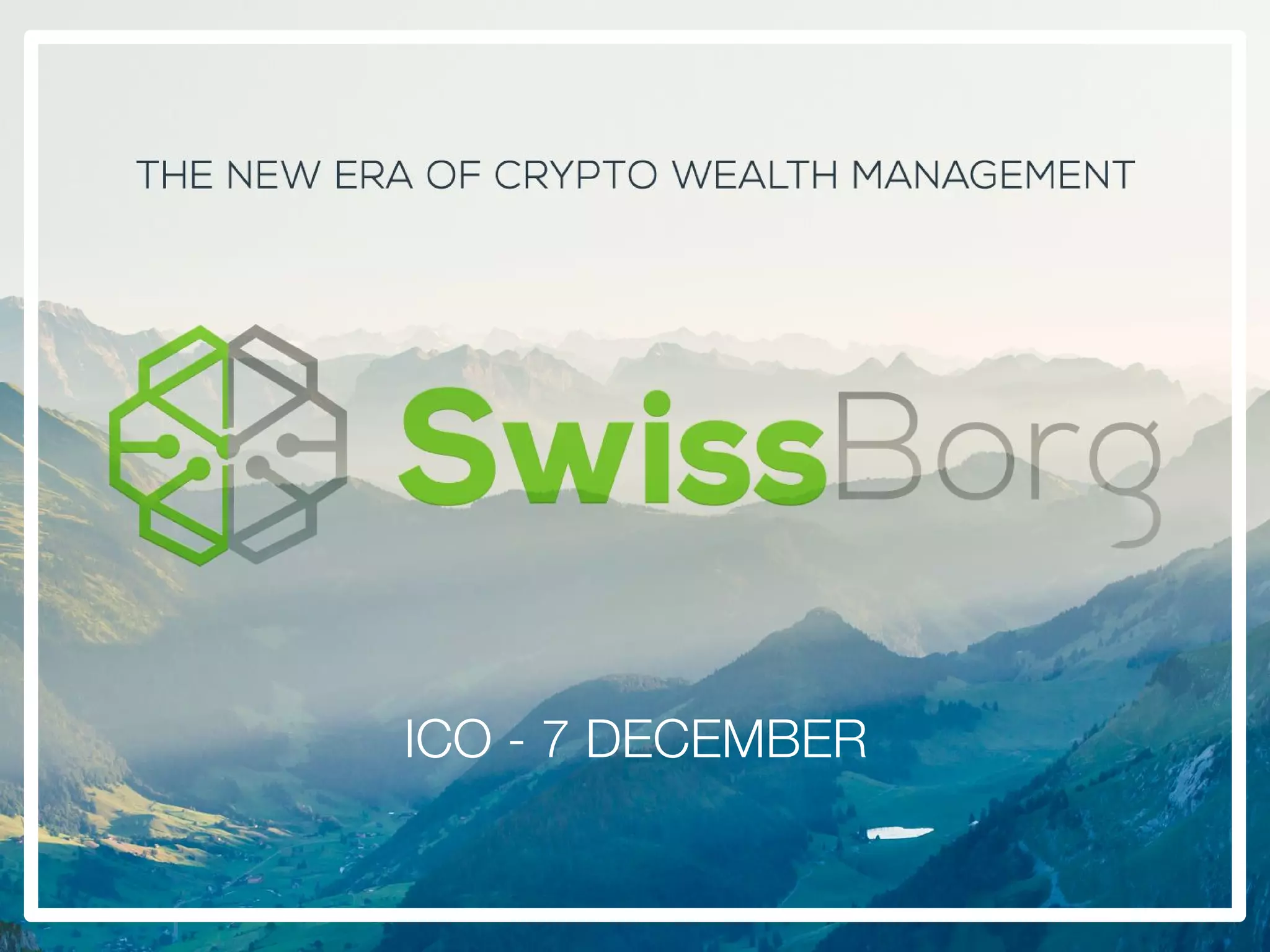
Swissborg’s pitch deck is a quintessential artifact of the 2017 ICO era, prioritizing token mechanics and team credentials over traditional business metrics. The company sought a 50,000,000 CHF hard cap to build a 'meritocratic' crypto wealth management platform. While the deck lacks a standard problem slide or competitive analysis, it excels at establishing institutional credibility, citing over 90 years of combined investment experience and $2 billion in previously managed assets across the team. The revenue model is diversified across five distinct channels, including transaction fees and…
Key takeaways
- The team claims a combined 90+ years of investment experience and $2B in assets managed (Slide 4).
- The funding goal is set at a hard cap of 50,000,000 CHF with a soft cap of 5,000,000 CHF (Slide 7).
- The revenue model relies on two primary streams: transaction fees and performance/management fees (Slide 3).
- Swissborg utilizes a 'Proof of Meritocracy' (PoM) system where token holders participate in referendums (Slide 6).
- Token distribution allocates 62.50% to the TGE participants and 20% to the team and advisors (Slide 7).
- The team includes alumni from major financial institutions like Julius Bär, Morgan Stanley, and RBS (Slide 4).
- The product offering includes 'Smart Mandates,' 'SB Indexes Tokens,' and a 'Cryptallion' closed-end fund (Slide 3).
- Team tokens are subject to a 4-year distribution period with 6-month vesting intervals (Slide 7).
Swissborg Pitch Deck Analysis
Swissborg’s pitch deck is a focused fundraising document designed for an Initial Coin Offering (ICO). It leans heavily on the professional heritage of its founders to bridge the gap between traditional Swiss private banking and the then-nascent world of decentralized finance. The deck is structured to sell a vision of 'meritocratic' wealth management, supported by a complex token economy.
Slide 1: Title Slide
The cover slide establishes the brand identity immediately: 'The New Era of Crypto Wealth Management.' It features the Swissborg logo—a green and grey hexagonal node structure—overlaying a Swiss mountain range. The primary call to action is the date of the ICO: 7 December. This slide is functional, clearly stating the industry and the immediate investment opportunity without unnecessary clutter.
Slide 2: Solution
The solution slide attempts to distill a complex ecosystem into four pillars. It identifies the Ethereum Blockchain as the base layer for 'smart mandates' and Tokenization as the vehicle for portfolio management. The slide also introduces 'Swarm Intelligence' as a basis for democratic decision-making. Visually, it places Swissborg as a central 'temple' or institution serving four distinct groups: Individuals, DAOs, Investment Managers, and Financial Advisors. The footer emphasizes that the project is 'Swiss made & aimed to be regulated,' a key differentiator in the often-unregulated 2017 ICO market.
Slide 3: Revenue Model
This slide is one of the most detailed in the deck, outlining five distinct revenue-generating products. Swissborg identifies two types of income: Transaction Fees (represented by black arrows) and Performance and Management Fees (represented by green arrows). The products include:
Smart Mandates · SB Indexes Token · SB Off Chain Fund · SB Trading Exchange · Cryptallion Close End Token Fund
This diversified model suggests the company intended to act as both an asset manager and a service provider (exchange), capturing value at multiple points in the investment lifecycle.
Slide 4: Swissborg Team (Leadership)
Swissborg uses 'caricature' style headshots for its team, which was a common trend in 2017 but may feel dated today. However, the substance of the slide is strong. It lists seven key leaders, including Cyrus Fazel (Founder/CEO) and Anthony Lesoismier (Co-founder/CSO) . The slide highlights institutional pedigree, featuring logos from Julius Bär, Robeco, RBS, Morgan Stanley, and Lombard Odier . The bottom of the slide aggregates their experience: 90+ years in investment, $2B in assets managed, and 35 years of entrepreneurial experience. This is a classic 'trust' slide designed to reassure traditional investors.
Slide 5: Swissborg Team (Support & Growth)
The second team slide focuses on operational roles, including the Head of Support, Head of Marketing and PR, and Business Developers. It continues the use of institutional logos, such as BNP Paribas and EDHEC Business School . While less critical than the leadership slide, it demonstrates that the company has considered the 'Multicultural' and 'Sales' aspects of the business beyond just the core investment technology.
Slide 6: Swissborg ICO - 7 December
This slide serves as the high-level summary of the token sale. It introduces the CHSB Token and sets a Hard Cap of 50,000,000 CHF . The price is pegged at 0.10 CHF per token. It lists accepted currencies: BTC, ETH, BCH, XRP, LTC, and fiats. The slide also introduces the 'Proof of Meritocracy' (PoM) concept, explaining that token holders can participate in referendums and earn rewards. This is the 'Why Buy' slide for speculators and community members.
Slide 7: Token Details
This slide provides the technical and economic specifics of the CHSB token. It confirms the ERC-20 Ethereum technology and a fixed supply of 1,000,000,000 tokens. Two donut charts break down the allocations:
Use of Proceeds: 24.10% for Tech, 21.15% for Investment Division, 17.70% for Legal & Compliance, and 14.65% for Marketing. · Token Allocation: 62.50% distributed during TGE, 20.00% for Team & Advisors, and 16.50% retained for development.
The slide includes a rigorous vesting note: team tokens are distributed over 4 years with 6-month intervals, and tokens are forfeited if a member leaves, which is a strong signal of long-term alignment.
Slide 8: Investment Process 1/2
This slide visualizes the user journey and product positioning. It uses a 'Return vs. Risk' graph to plot various Swissborg products. The SBC (SwissBorg Cryptallion) fund is positioned as high-return/medium-risk, while Credit Strategy is low-risk/low-return. The slide also shows a mockup of 'Live Reporting' on a desktop screen, giving a glimpse of the intended user interface. It breaks the process into 'Investment Mandate and Token Fund choice' followed by 'Live Reporting,' suggesting a simplified user experience for complex financial products.
What Swissborg Does Well
Swissborg excels at establishing institutional credibility . In a space often criticized for lack of professional experience, Swissborg leans heavily on its team's history at top-tier banks. By quantifying their '90+ years of experience' and '$2B assets managed' on Slide 4, they provide a concrete reason for investors to trust them with capital.
The revenue model (Slide 3) is also a highlight. Unlike many ICO decks that relied on vague 'token appreciation' as a business model, Swissborg clearly outlines how the company itself will stay solvent through management, performance, and transaction fees. This makes the project look like a sustainable business rather than just a token launch.
Finally, the vesting and allocation transparency on Slide 7 is excellent. The specific mention that tokens are forfeited if a team member leaves is a high-standard governance practice that was rare during the 2017 ICO boom.
What is Missing from the Deck
The most glaring omission is a Problem Slide . The deck jumps straight into the solution without articulating exactly what is wrong with current wealth management or why existing crypto exchanges are insufficient. This assumes the reader already agrees that 'Crypto Wealth Management' is a necessary evolution.
There is also a complete lack of Competitive Analysis . The deck does not mention other crypto asset managers, exchanges, or traditional fintech players. This makes it difficult to judge Swissborg's unique value proposition in a crowded market.
Finally, there is no Roadmap . While the ICO date is clear, the deck does not explain when the 'Smart Mandates' or the 'Trading Exchange' will actually launch. For a 50 million CHF ask, investors typically expect a timeline for product delivery and key milestones.
What a Founder Should Copy
Founders should emulate the Team Summary approach on Slide 4. Instead of just listing names, Swissborg aggregates their collective stats (years of experience, total assets managed). This 'power of the collective' is much more persuasive than individual bios alone.
The Revenue Flowchart on Slide 3 is another great template. It clearly distinguishes between different types of fees and shows exactly where the money comes from. This level of clarity is vital for any startup moving from 'growth at all costs' to 'sustainable business model.'
Lastly, the Tokenomics Transparency on Slide 7 is a gold standard for crypto projects. Providing a clear breakdown of both the 'Use of Proceeds' and the 'Token Allocation' in the same view helps investors understand both the capital requirements and the dilution risks simultaneously.
Frequently asked questions
- What is the primary utility of the CHSB token according to the deck?
- According to slide 6, the CHSB is a 'multi-utility token' powered by a system called 'Proof of Meritocracy' (PoM). Its primary stated function is to allow token holders to participate in referendums regarding the ecosystem and be rewarded in tokens for their participation. It is positioned as a governance and reward mechanism rather than just a simple currency.
- How does Swissborg plan to generate revenue?
- Slide 3 illustrates a multi-pronged revenue model. The company generates 'Transaction Fees' from its trading exchange and 'Performance and Management Fees' from four other products: Smart Mandates, SB Indexes Tokens, the Cryptallion Close End Token Fund, and an Off-Chain Fund. This suggests a hybrid approach between traditional finance fee structures and crypto-native exchange fees.
- What are the specific financial targets for the ICO?
- Slide 7 details the Token Generation Event (TGE) parameters. The 'Hard Cap' is 50,000,000 CHF, and the 'Soft Cap' is 5,000,000 CHF. The price per token is set at 0.10 CHF, with 1 CHF roughly equaling 1 USD at the time of the deck's creation. The total supply is fixed at 1,000,000,000 CHSB tokens.
- What is the 'Smart Mandate' mentioned in the solution slide?
- Slide 2 defines 'Smart Mandates' as investment mandates created using Ethereum blockchain technology. These are intended to allow individuals, DAOs, investment managers, and financial advisors to buy and manage portfolios of crypto assets easily through tokenization. The goal is to bring 'sophisticated investment strategies' to all asset classes.
- How is the team's compensation structured to ensure long-term commitment?
- Slide 7 states that tokens allocated to the team and advisors (20% of the total) are subject to a 4-year distribution period. This starts at the end of the TGE (January 7, 2018), with tokens released every 6 months. Crucially, the slide notes that if a team member leaves, their remaining undistributed tokens are forfeited and reallocated to new members.