Svastia by Cambridgene utilizes a highly visual, low-text 10-slide deck to pitch its AI-driven genetic screening solution for cancer therapy. The narrative centers on the staggering costs and failure rates of clinical trials, specifically citing a $1.4B cost per trial and a 90% failure rate. While the deck excels at establishing the problem and showcasing high-tier academic and industry logos—including the University of Cambridge and Genomics England—it is notably thin on technical mechanics and financial specifics. There is no explicit 'Ask' slide, nor are there detailed financial projection…
Key takeaways
- The deck identifies a massive market opportunity in cancer clinical trials, valued at $38B on slide 8.
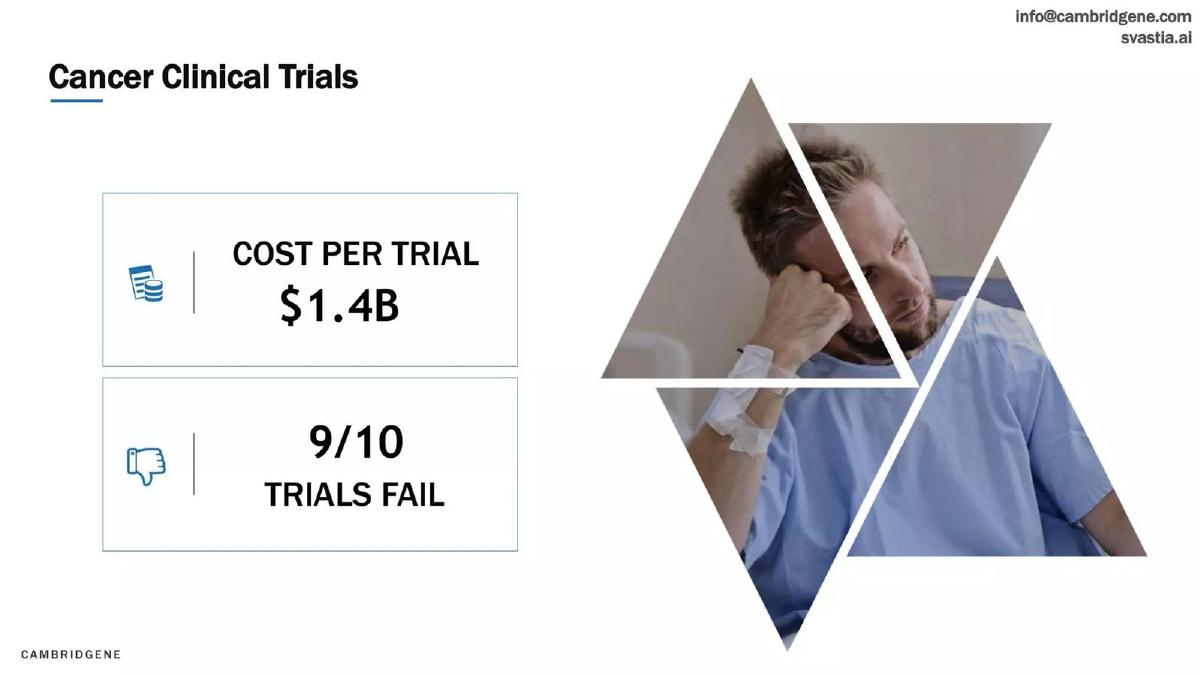
- Clinical trial inefficiency is the core problem, with slide 5 stating that 9/10 trials fail and the average cost per trial is $1.4B.
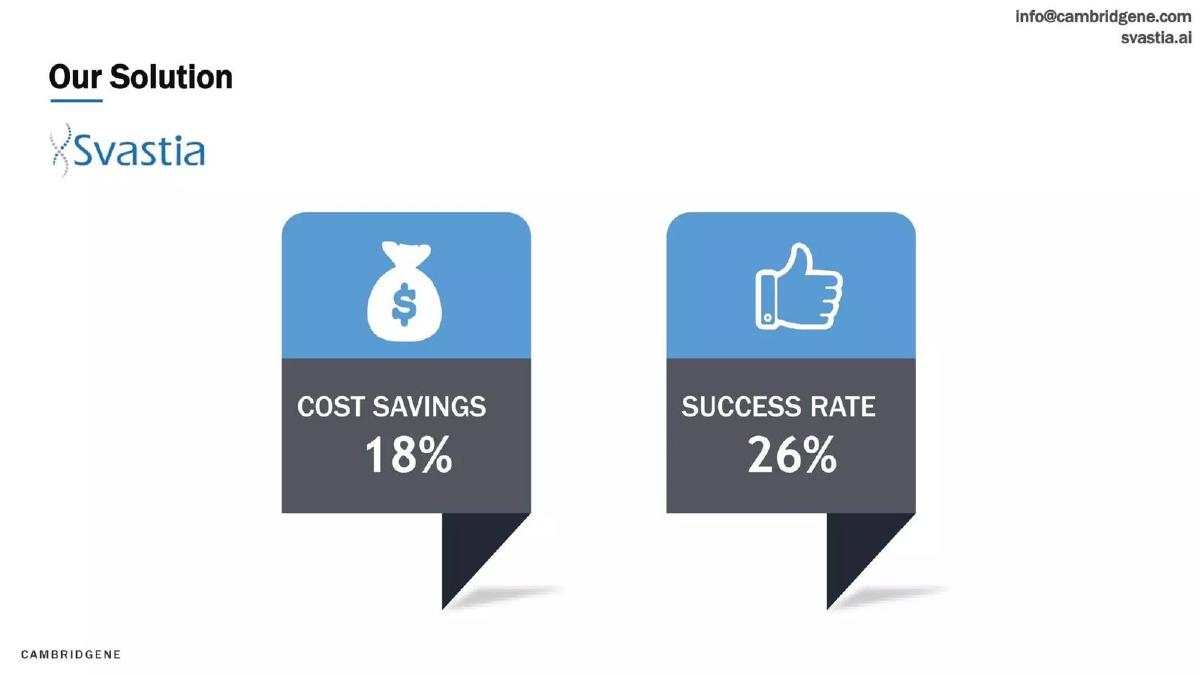
- The solution claims significant efficiency gains, specifically an 18% cost saving and a 26% increase in success rates (slide 6).
- Traction is demonstrated through a list of five customers including LifeArc, Astex Pharmaceuticals, and Genomics England (slide 7).
- The company has secured a hospital partnership with Erasmus MC (slide 7).
- The team slide (slide 9) highlights strong academic ties to the University of Cambridge and the Wellcome Sanger Institute.
- The deck lacks a formal 'Ask' slide, omitting the funding amount sought and the planned use of proceeds.
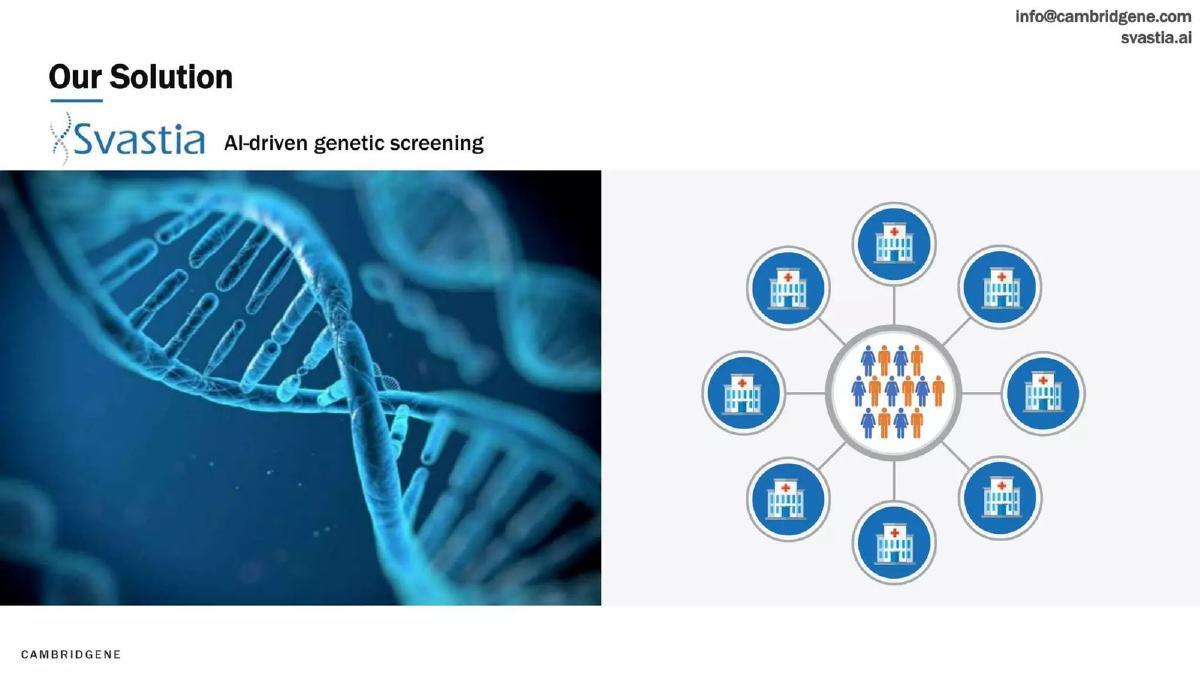
- Technical details on the 'AI-driven genetic screening' are absent, with slide 4 providing only a conceptual graphic.
The Svastia by Cambridgene Teardown
Svastia, a brand under Cambridgene, operates at the intersection of oncology, genomics, and artificial intelligence. This 10-slide deck is a classic example of a 'pedigree-first' pitch. It relies on the gravity of the problem—cancer trial failure—and the prestige of the team's associations to carry the narrative. While it lacks the granular data often demanded by late-stage investors, it serves as a focused introduction for a Seed round.
The Hook and the Problem
Slide 1: Title Slide The deck opens with a clear value proposition: "Genetic Screening For Cancer Therapy." The branding "Svastia by Cambridgene" suggests a product-specific focus within a broader corporate entity. The imagery is emotive, featuring a cancer patient, which sets the somber tone for the problem being solved.
Slide 2: Pain Points (The Persona) This slide is unusually sparse, featuring only the name "Marty" and a photo of a man. In a live presentation, this likely served as a backdrop for a specific patient story. In a standalone deck, however, it provides zero context and represents a missed opportunity to quantify the human or financial toll of current screening failures.
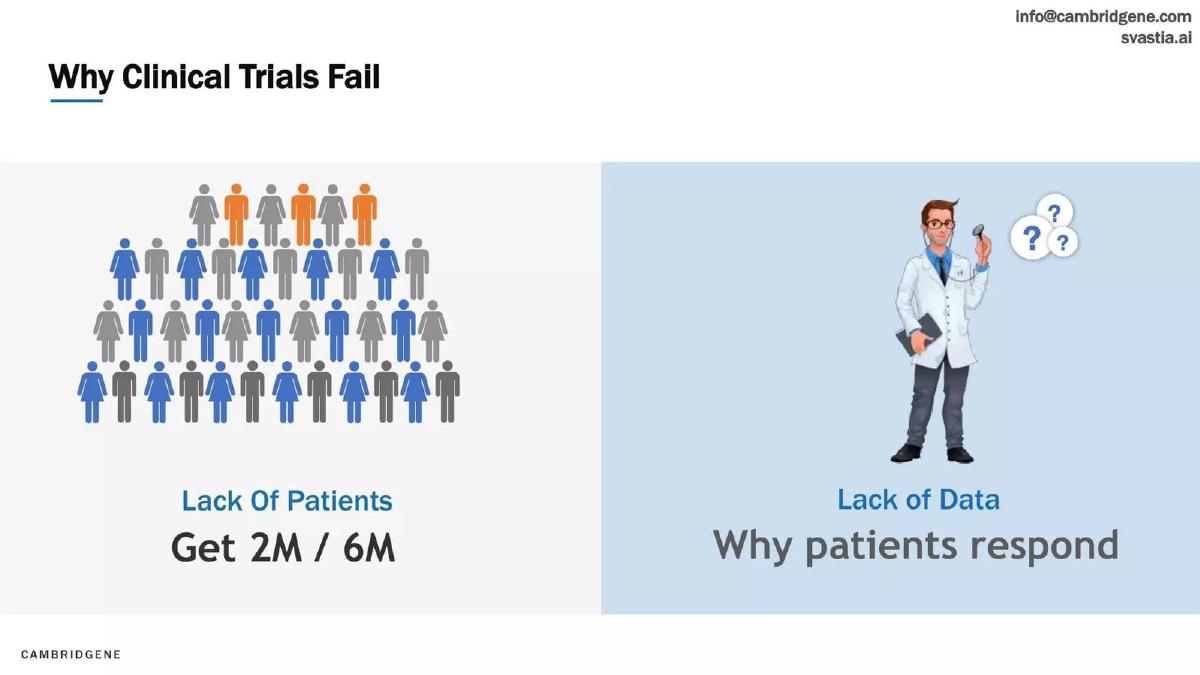
Slide 3: Why Clinical Trials Fail The deck begins to provide data here. It identifies two primary bottlenecks: "Lack of Patients" and "Lack of Data." It notes a significant gap in patient recruitment, stating they "Get 2M / 6M." The right side of the slide highlights the mystery of patient response, asking "Why patients respond," which Svastia intends to answer through multi-omics.
The Solution and Market Dynamics
Slide 4: Our Solution Svastia introduces "AI-driven genetic screening." The slide is purely conceptual, showing a DNA double helix and a hub-and-spoke model connecting hospitals to a central patient pool. While it visually represents the idea of a network, it fails to explain how the AI functions or what specific genetic markers it prioritizes.
Slide 5: Cancer Clinical Trials (The Macro Problem) This is the strongest slide in the deck for establishing urgency. It lists two staggering statistics: a "Cost Per Trial" of "$1.4B" and a failure rate of "9/10 Trials Fail." By framing the problem in billions of dollars, Svastia justifies the need for a high-tech intervention.
Slide 6: Our Solution (The Impact) This slide mirrors the previous one but provides the 'after' state. Svastia claims their intervention leads to "Cost Savings" of "18%" and a "Success Rate" improvement of "26%." These are bold claims for a Seed-stage company, and the deck does not provide the methodology used to calculate these percentages.
Traction and Market Size
Slide 7: Traction Traction is presented through logos. The "Customers" section includes heavy hitters in the UK and European biotech space: LifeArc, Astex Pharmaceuticals, Horizon, Genomics England, and Repositive. The inclusion of "Genomics England" is particularly significant given their role in the 100,000 Genomes Project. They also list Erasmus MC as a "Hospital Partner," indicating a bridge between research and clinical application.
Slide 8: Market The deck defines the Total Addressable Market (TAM) as "$38B" for "Cancer Clinical Trials." This is a large, focused figure that aligns with the earlier slide regarding the $1.4B cost per trial. It suggests that even a small percentage of market capture would result in a massive business.
The Team and Conclusion
Slide 9: Team The team slide is the 'credibility' anchor of the deck. It features four key members: Parthiban Vijayarangakannan (CEO), Prem Achuthan (CTO), Alexey Larionov (Consultant Oncologist), and Anusha Gunasekaran (Cloud/Big Data Engineer). The logos at the bottom—University of Cambridge, Wellcome Sanger Institute, Cancer Research UK, and TU Graz—signal that the team has the academic and technical background necessary to handle complex multi-omics data.
Slide 10: Closing The final slide returns to the emotive theme with the tagline "We Offer Hope To Cancer Patients." It provides the website (svastia.ai) and a contact email. Notably, there is no call to action regarding the fundraise itself.
What Works in the Svastia Deck
Clarity of Problem: The deck does an excellent job of quantifying the inefficiency of the status quo. The $1.4B cost and 90% failure rate are memorable and create an immediate 'why now' for the investment. · Social Proof: For a Seed-stage company, the customer list on slide 7 is impressive. Partnering with organizations like Genomics England provides a level of validation that is difficult to manufacture. · Visual Consistency: The deck is clean, professional, and uses a consistent color palette. It avoids the 'wall of text' trap, making it very easy to digest in under two minutes.
What is Missing from the Svastia Deck
The Ask: This is the most glaring omission. There is no mention of how much money is being raised, the terms of the round, or what the milestones for the next 18 months look like. · Business Model: How does Svastia make money? Is it a per-patient screening fee, a SaaS subscription for pharma companies, or a success-based fee? The deck is silent on revenue mechanics. · Competitive Landscape: The multi-omics and AI-drug discovery space is crowded. The deck does not explain how Svastia differs from competitors like Tempus or Freenome. · Technical Depth: While 'AI' is a popular buzzword, sophisticated investors in the biotech space want to see the underlying architecture or at least a high-level explanation of the data pipeline.
What a Founder Should Copy
The 'Impact' Slide: Slide 6 is a great template for showing the value of a solution. By directly countering the 'Pain' slide (Slide 5) with specific percentage improvements, the founders create a clear 'before and after' narrative. · Logo Placement: If you have high-pedigree partners or academic backgrounds, feature them prominently. Svastia uses these logos to compensate for the lack of detailed financial or technical data. · Minimalist Design: The use of large icons and single, high-impact numbers (like the $38B market size) ensures that the investor remembers the key takeaways even if they only skim the deck.
Frequently asked questions
- What is the primary problem Svastia is solving?
- Svastia addresses the high failure rate and extreme costs associated with cancer clinical trials. According to slide 5, 90% of these trials fail, and the average cost per trial is $1.4 billion. Slide 3 further specifies that these failures are often due to a lack of patients (getting only 2M out of 6M needed) and a lack of data regarding why patients respond to certain treatments.
- How does Svastia's solution improve clinical trial outcomes?
- The company proposes AI-driven genetic screening to better match patients to trials and understand response data. Slide 6 quantifies the impact of this solution, claiming it can generate 18% in cost savings and improve the trial success rate by 26%. This is achieved by unlocking multi-omics data to de-risk the R&D process for pharmaceutical companies.
- Who are Svastia's current customers and partners?
- As shown on slide 7, Svastia has established a customer base that includes LifeArc, Astex Pharmaceuticals, Horizon, Genomics England, and Repositive. Additionally, they have a formal hospital partnership with Erasmus MC (Universitair Medisch Centrum Rotterdam), which likely facilitates access to clinical environments and patient data.
- What is the background of the founding team?
- The team consists of CEO Parthiban Vijayarangakannan, CTO Prem Achuthan, Consultant Oncologist Alexey Larionov, and Cloud/Big Data Engineer Anusha Gunasekaran. Slide 9 indicates a strong pedigree with logos from the University of Cambridge, Wellcome Sanger Institute, Cancer Research UK, and TU Graz, suggesting deep roots in both oncology and data engineering.
- What information is missing from this pitch deck?
- This is a minimalist deck that omits several standard components. There is no 'Ask' slide detailing how much money is being raised or the valuation. It also lacks a competitive analysis, a detailed business model (pricing), financial projections, and a product roadmap. Furthermore, the 'AI' component is mentioned but never explained in technical detail.