Uber's 2008 deck is a classic example of selling the vision before the product exists. It masterfully detailed the painful, inefficient state of the taxi industry, then presented a clear, tech-enabled solution: the '1-Click Car Service'. While light on financials and operational details, its focus on the user, clear articulation of the concept, and bold projection of outcomes made it compelling for its time. It serves as a reminder that a massive idea, clearly communicated, can substitute for early metrics.
Key takeaways
- Focus relentlessly on the problem. The first three slides are dedicated to the broken taxi industry, establishing a clear and relatable pain point before ever mentioning the solution.
- A simple solution hook is powerful. The deck boils the concept down to '1-Click Car Service', an immediately understandable value proposition.
- Use analogies to anchor the vision. Calling it 'The NetJets of car services' instantly positioned it as a premium, tech-forward offering for a specific demographic.
- Frame the potential outcomes. The 'Best-Case/Realistic/Worst-Case Scenario' slide is a smart way for pre-revenue startups to manage expectations and anchor investors on the upside without making concrete financial projections.
- Mockups make the concept real. Including app and website mockups (Slides 8 & 9) helped investors visualize a product that did not yet exist, moving it from abstract idea to tangible solution.
- Start with a laser-focused target market. The deck didn't pitch a service for everyone. It targeted 'Professionals in American cities,' starting with SF, making the go-to-market strategy feel achievable.
- Traction can be minimal if the vision is huge. The 'Progress to Date' slide lists accomplishments like reserving a domain name and filing for an LLC. It shows that for a big enough idea, demonstrating forward momentum, however small, can be enough.
The Car Service Revolution Before The Revolution
Before Uber was a verb, it was a 25-slide pitch deck for a company called “UberCab.” In 2008, Garrett Camp, reeling from a bad taxi experience, conceptualized a new kind of service. This deck was the blueprint. It was not aiming to raise a $100 million growth round; it was a pre-launch concept deck, likely used to raise a small seed or angel round to get the first three cars on the road in San Francisco. The document is raw, the design is rudimentary, and the projections are pure educated guesses. Yet, it led to one of the most disruptive companies of the 21st century and an IPO valued at over $80 billion.
Looking at this deck today provides a masterclass in early-stage fundraising. It is a study in identifying a visceral, universal problem and presenting a simple, elegant solution enabled by new technology. At the time, the iPhone was barely a year old. The App Store was in its infancy. The world was teetering on the brink of a financial crisis. In this context, the UberCab deck did not sell metrics or traction. It sold a vision. It sold a feeling. This teardown will analyze what made this bare-bones presentation so effective in its time and what elements would cause it to fail in the current fundraising environment. For founders raising capital between now and 2026, the lessons are critical: focus on the fundamentals, nail the narrative, and understand that timing is everything.
The Problem: Broken and Unaccountable
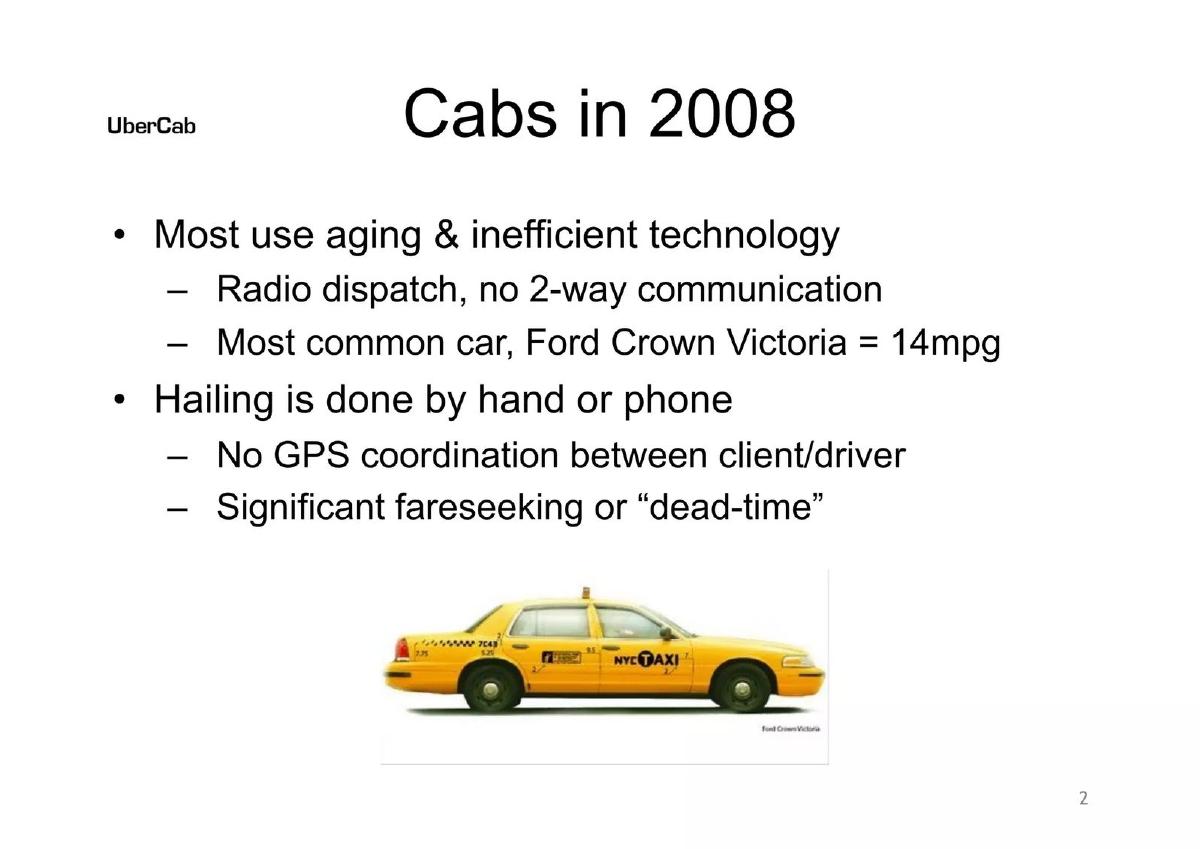
The deck opens by attacking the status quo with precision. It doesn't just say taxis are bad; it explains why they are bad on a systemic level. The slides focus on two core villains: inefficiency and the medallion system. The inefficiency argument is tangible. It points to aging technology like radio dispatch, the lack of GPS coordination, and the abysmal fuel economy of the standard Ford Crown Victoria. These are not abstract complaints; they are operational weaknesses that directly translate to a poor user experience and wasted time for both rider and driver.
This data point on “dead-time” is crucial. It frames the problem not just as a rider inconvenience but as a broken economic model. Wasted driver time means fewer rides, lost income, and a fundamental market inefficiency. Investors see inefficiency as an opportunity for margin. By quantifying the problem—even with simple estimates—the deck immediately signals that a technology solution could unlock significant value.
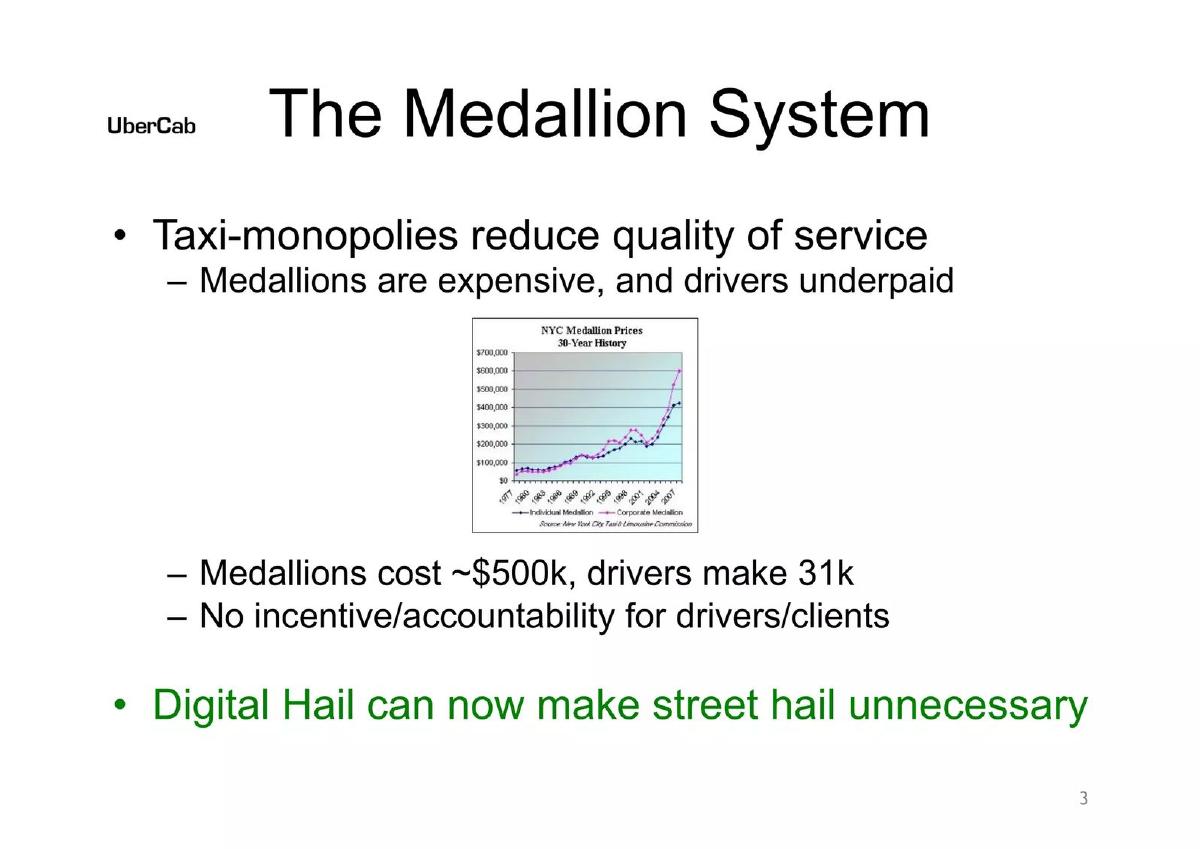
The second pillar of the problem is the medallion system. The deck brilliantly frames this as a government-enforced monopoly that stifles competition and crushes incentives. By citing the high cost of a medallion relative to a driver’s low income, it paints a picture of a captured, corrupted market. This is a powerful narrative for investors, especially those with a libertarian streak. It suggests that the opportunity isn't just to build a better taxi company, but to bypass a regulated, archaic system entirely. The line, “Digital Hail can now make street hail unnecessary,” is the thesis statement for the entire company. It positions technology as the key to regulatory arbitrage.
The Solution: The "NetJets of Car Services"
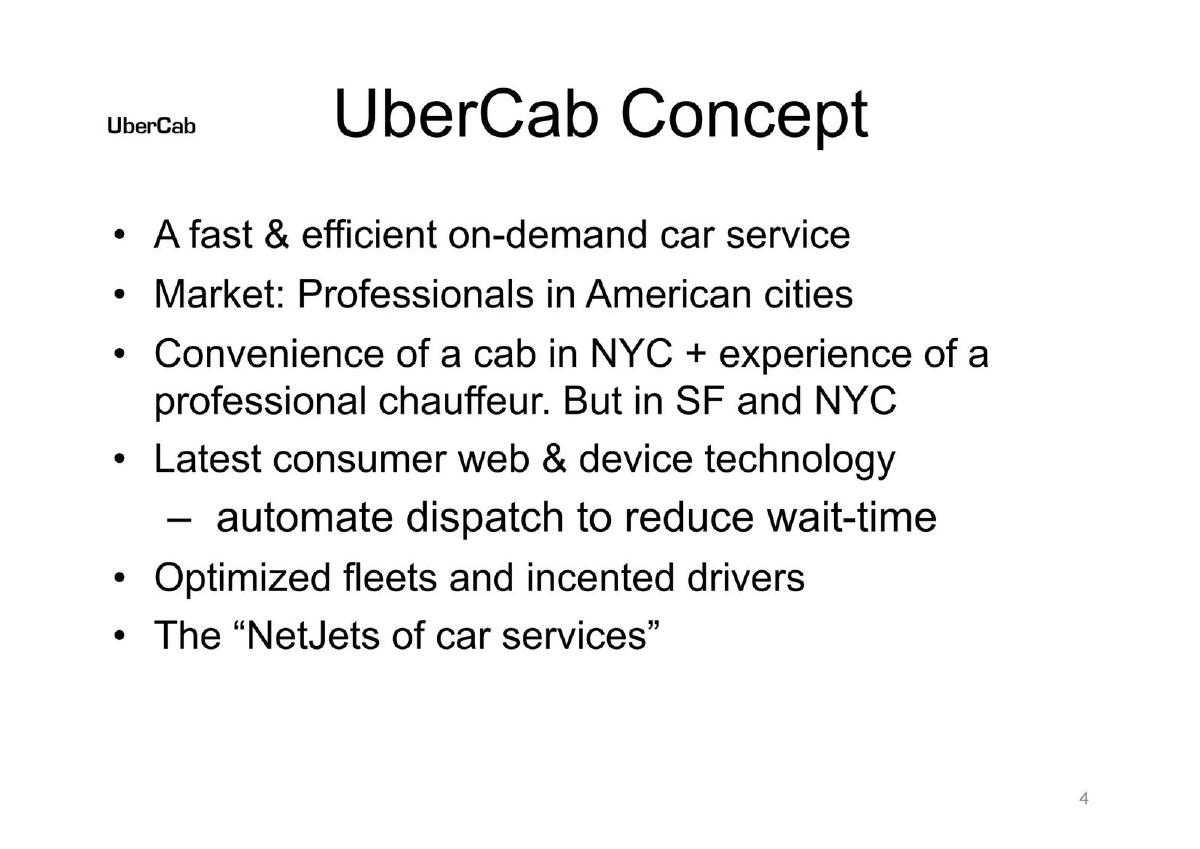
UberCab’s proposed solution is not a cheaper taxi. This is perhaps the most important strategic decision in the entire deck. The concept is explicitly positioned as a premium, members-only service. The deck is not shy about this, calling it “The NetJets of car services.” This was a move of strategic genius for an unlaunched company. By starting at the high end, they could justify a higher price point, achieve profitability on lower volume, and create an aura of exclusivity. It is far easier to start with a premium service and move down-market than the other way around.
This focus on professionals is key. This target demographic is less price-sensitive and values time and convenience above all else. They are also early adopters of new technology, particularly smartphones. The solution is framed as a hybrid: the convenience of a cab with the experience of a professional chauffeur. This simple positioning statement clearly defines the new category UberCab intended to create. It isn't competing with taxis; it's creating a superior alternative that sits between the unreliability of a cab and the high friction of booking a traditional black car service.
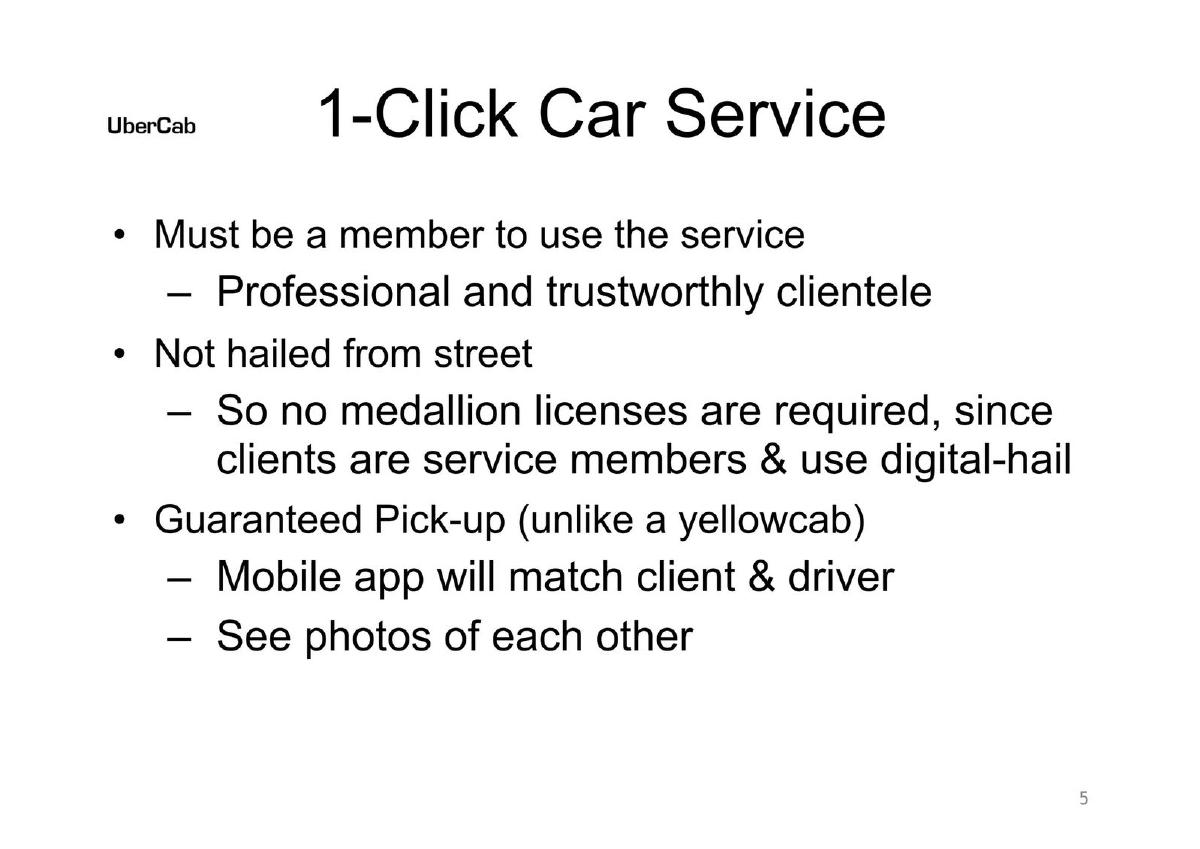
The mechanics of the solution are centered on one core action: the “1-Click Car Service.” The deck promises a guaranteed pickup, a mobile app to match client and driver, and the critical detail that because it’s not a street hail, "no medallion licenses are required." This is the core of their wedge into the market—using a private membership model to sidestep the very regulations outlined in the problem slides. This is a lesson for every founder: your solution must directly and elegantly solve the specific problems you have just laid out.
The Market: Big Enough to Matter, Focused Enough to Win
The market slides in this deck are a case study in effective narrative construction for an early-stage venture. They present a large, tangible Total Addressable Market (TAM) and then methodically narrow the focus to a winnable initial beachhead. The top-down number is ambitious and attention-grabbing:
A multi-billion dollar market is table stakes for any venture-backed business. But the deck doesn't stop there. It adds a crucial detail: “Top 4 players combined only 22% of revenues.” This signals a highly fragmented market, which is exactly what an investor wants to see. A fragmented market is ripe for a technology platform to come in and consolidate it. It means there is no single 800-pound gorilla that will crush you on day one. It's an open field.
The deck then wisely zooms in. After showing the huge TAM, it presents a pie chart breaking down the market by service type, highlighting the “Urban service on-demand” slice that UberCab will target. This is followed by a map of the United States identifying the top five target cities that represent 50% of the entire US market. This demonstrates strategic thinking. They are not boiling the ocean; they have a clear, phased rollout plan starting with San Francisco and New York. This gives investors confidence that the founders understand the importance of focus.
Finally, and perhaps most importantly, the deck includes a slide on smartphone adoption trends. This is the “Why Now?” slide. It provides the technological tailwind that makes the entire concept feasible. Showing investors a massive market is good. Showing them a massive market in the midst of a technological shift that you are uniquely positioned to exploit is how you get a deal done.
The Product: Simple, Visual, and Geo-Aware
The product slides are rudimentary by today’s standards, featuring basic mockups and bullet points. Yet, they succeed because they focus entirely on the core user experience. The central idea is "1-Click request from Geo-aware devices." In 2008, this was futuristic. The deck shows simple screens for an iPhone app and even an SMS-based request system, which was a savvy inclusion given that smartphone penetration was still nascent.
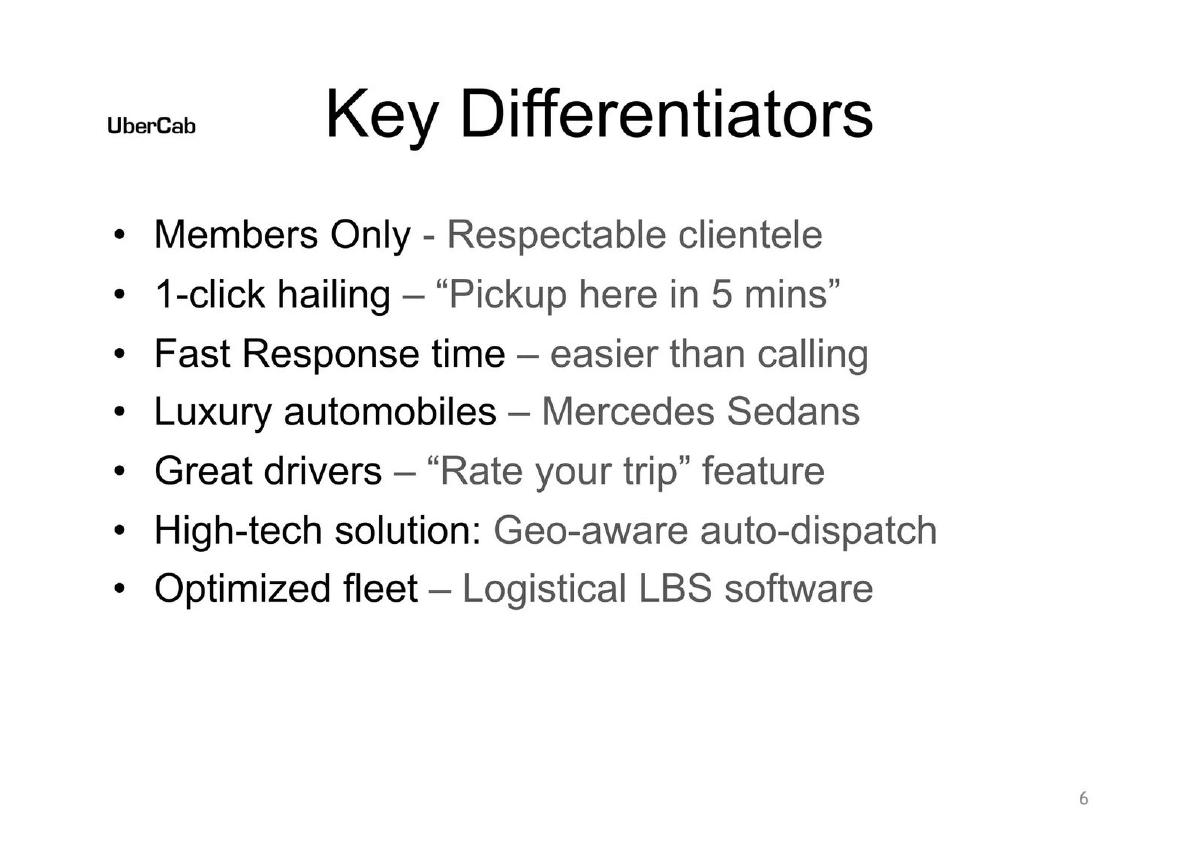
The deck details key features that would become industry standard: seeing the car on a map, automatic dispatch, cashless billing, and a two-way rating system. The rating system (“Rate your trip”) is highlighted as a mechanism for accountability, directly addressing the lack of it in the traditional taxi system. This closed-loop feedback system was a hallmark of Web 2.0 platforms and showed an understanding of how to build trust in a two-sided marketplace.
Mentioning a "patent-pending system" was a classic move to create a sense of defensibility, even if the patent itself was likely more of a placeholder. What was more compelling was the focus on logistics and optimization. Slides on "Demand Forecasting" and "Technology" talk about using "intelligent scheduling" and "operations research for route optimization." While light on detail, these phrases signaled to investors that the founders were thinking beyond just an app. They were thinking about building a complex, data-driven logistics network. This hinted at the true scale of the ambition: to become the operating system for urban transportation.
The Business Model: Profitable by Design
The deck does not contain a dedicated "Business Model" slide with a three-year financial forecast. This would be a significant omission today, but in 2008 for a concept-stage company, it was acceptable. Instead, the model is woven throughout the entire presentation. The core principle is stated clearly: "Profitable by design." The model is a simple premium service with a margin on each ride.
The economics are implied through comparison. The deck notes that traditional car services require hours of notice and transfers average over $60. It implicitly positions UberCab as a superior service that can be priced below a traditional limo but significantly above a taxi. This creates a large pricing umbrella to operate within. The emphasis on luxury vehicles like Mercedes sedans reinforces this premium positioning and justifies the higher price point. It’s a classic value-based pricing strategy: offer 10x the experience for maybe 2x the price.
The "cashless billing system" is presented as an operating principle but is, in fact, a cornerstone of the business model. It removes friction for the user and guarantees payment for the driver, solving a major pain point for both sides. Furthermore, it gives UberCab complete control over the flow of money, enabling them to easily take their commission. This seemingly small feature was a massive innovation that unlocked the entire model.
Traction and Validation: De-Risking the Idea
For a pre-launch company, there is no revenue, no users, and no product. The "Progress to Date" slide is therefore about one thing: demonstrating hustle and de-risking the venture in non-product ways. It’s a checklist of foundational steps.
This is what traction looks like at the concept stage. The founders had reserved the domain name, filed for a trademark, incorporated an LLC, set up a bank account, and even filed a provisional patent. More importantly, they had recruited five advisors and 15 potential clients. This showed they were already building a community and validating the idea with their target market, even on a micro-scale. These are not vanity metrics; they are signals to an investor that the founders are serious and disciplined.
The most important part of this slide is the “NEXT” section. It lays out a clear, tangible plan for the capital they are about to raise: buy three cars, develop the app, and prepare for a demo. This transforms the pitch from a mere idea into an operational plan. An investor can see exactly what their money will buy: a tangible, testable beta service. This is infinitely more compelling than a vague request for "working capital."
Competition: Redefining the Category
Notably, this deck lacks a traditional 2x2 competitive landscape matrix. This was a deliberate and intelligent choice. A standard matrix would have placed UberCab in a box alongside taxis and limo services, defining them by the existing market. Instead, the founders framed the competition on their own terms throughout the deck. The "competition" is the broken experience of hailing a cab and the high-friction process of booking a limo. UberCab is positioned not as a competitor within a category, but as the creator of a new category.
Slides like "User Benefits" make this explicit by comparing UberCab to both alternatives side-by-side. Taxis are unreliable and dirty. Limos are expensive and inflexible. UberCab, the deck argues, takes the best of both and eliminates the negatives. This narrative strategy is far more powerful than a chart. It reframes the entire discussion and forces the investor to see the world through the founder's eyes. The only brand they acknowledge is "YellowCab," which they use as a stand-in for the entire dysfunctional taxi industry they plan to disrupt.
The Team: The Invisible Slide
There is no team slide. In a modern pitch deck, this would be an immediate and fatal flaw. VCs invest in people first, ideas second. For a pre-product, pre-revenue company, the credibility, experience, and resilience of the founding team are the only real assets. So how did this deck succeed without one?
The answer is that this deck was a tool for a conversation, not a stand-alone document. Garrett Camp had already founded StumbleUpon and sold it to eBay for $75 million. His credibility was immense. He wasn't an unknown first-time founder. The team’s pedigree was likely the first thing discussed in the meeting, long before the projector was turned on. This context is critical. The deck supported the story, but the founders were the story. For any founder without a previous nine-figure exit, this approach would be suicide. Your team slide is your most important asset; it must be in the deck.
The Ask: Vague but Directional
The "ask" is buried at the bottom of the "Progress to Date" slide. It is astonishingly vague:
"A few million" is not a number. It gives no indication of valuation, the type of security (e.g., SAFE, convertible note, equity), or a detailed use of funds. By 2026 standards, this slide would get a founder laughed out of a room. A modern "Ask" slide must be specific: "We are raising a $2M Seed round at a $10M post-money valuation via a SAFE. This gives us 18 months of runway to achieve 1,000 weekly rides and $50k in monthly recurring revenue."
However, in the context of a 2008 concept-stage pitch to a small group of angels or seed funds, it was directional enough. Paired with the "NEXT" steps, it communicated the immediate goals: get a small office, hire a General Manager to run the San Francisco operation, and get the beta live. The ambiguity also gave the founders flexibility in negotiations. While this informality is a relic of a different era, it underscores that the purpose of the ask is to start a conversation about what it will take to reach the next set of milestones.
What Worked
A Visceral, Universal Problem: Everyone had experienced the pain of trying to get a taxi. The deck leveraged this shared frustration brilliantly. · Simple, Elegant Solution: "Push a button, get a car." The simplicity of the core concept was its greatest strength. It was easy to grasp, remember, and share. · Strategic Market Wedge: Starting with a premium "members-only" service in a single city was a masterful way to de-risk the launch, create scarcity, and establish a high-value brand before going mass-market. · Powerful "Why Now?": The inclusion of smartphone adoption data provided the crucial technological tailwind. It answered the question of why this idea was possible now and not five years earlier. · Category Creation Narrative: Instead of competing with taxis or limos, the deck framed UberCab as an entirely new category that blended the best of both, effectively making the competition irrelevant. · Vision of a Logistics Network: Hints of "demand forecasting" and "route optimization" signaled a much larger ambition than just a car service app, appealing to investors looking for massive, scalable opportunities.
What Would Fail in 2026
No Team Slide: In today's market, this is a non-starter. Without a dedicated slide detailing founder experience, domain expertise, and roles, investors would assume the team is weak. · Zero Pre-Launch Traction Metrics: "15 clients recruited" would be insufficient today. Investors would expect a waitlist with thousands of sign-ups, data from user interviews, or a functional MVP with early feedback. · Rudimentary Design: While content is king, investors now see hundreds of decks a week. A deck with this level of design would be perceived as unprofessional and would struggle to stand out. · Vague "Ask" and Use of Funds: "A few million" is not an ask. Founders are expected to have a precise fundraising target tied to a detailed 18-24 month operating plan and specific milestone goals. · Laughable "Worst-Case Scenario": Stating the worst case is a "10 car, 100 client service" would signal to a VC that the founders lack ambition and are not aiming for venture-scale returns. This slide actively works against raising institutional capital. · Top-Down Market Sizing: The $4.2B market size is a top-down number. Today's founders are expected to build a bottom-up TAM analysis (e.g., # of target customers x average annual spend) to prove they deeply understand their specific market.
Lessons for Founders Raising in 2026
Nail the Problem-Solution Narrative: This is timeless. Spend half your time making the problem feel painful and personal. Then present your solution as the only logical antidote. · Your Team Is Your Primary Asset: Unlike Uber’s deck, you must feature a team slide. It should be one of the first five slides. Detail why your specific team is uniquely qualified to solve this problem. · Traction is a Measure of Hustle: Even pre-product, you can build a waitlist, conduct customer discovery interviews, get letters of intent, and build an audience. The bar for pre-launch traction is higher than ever. Show, don't tell. · Define Your Beachhead Market: Show you have a focused go-to-market strategy. Start small, dominate a niche, then expand. A credible, phased rollout plan builds investor confidence. · The "Ask" Must Be Specific: Know exactly how much you are raising, on what terms, and what it buys you. Your financial plan must show you have a path to the next fundable milestone. · Anchor Your Pitch in a "Why Now?": Identify the technological, cultural, or regulatory shift that makes your company possible today. It creates urgency and shows you are building for the future, not the past.
The 2008 UberCab deck is a historical artifact from a different fundraising world. It is a skeleton, held together by a powerful core idea and the off-screen credibility of its founders. It would not get funded today in its current form. The standards for traction, team presentation, and financial specificity have risen dramatically. However, the deck's core genius remains a powerful lesson for all entrepreneurs. It identified a profound, widespread pain point and presented a radically simple solution at the precise moment a new technology platform—the smartphone—made it possible. It sold a vision, not a spreadsheet. For founders today, wading through demands for metrics and traction, this is the essential truth to remember: a powerful, well-timed story is still the most valuable asset you can have.
Frequently asked questions
- What was the fundraising ask in this Uber deck?
- The deck itself does not state a specific ask. The final slide mentions 'Raise a few million' as a next step. The actual first round was a $200,000 angel investment in 2009, followed by a $1.25 million seed round in 2010. The vagueness in the deck is typical for a document meant to start conversations, not close a deal on the spot.
- How would this pitch deck perform in today's fundraising environment?
- It would struggle in a modern seed round. Today's seed rounds are typically $2M to $4M and investors expect a launched MVP, early user data, and preferably some initial revenue. A concept-only deck like this would be more appropriate for a pre-seed round of $500k to $1.5M, and it would face heavy scrutiny on the go-to-market strategy and regulatory risks.
- What is the biggest weakness of the Uber 2008 deck?
- Its biggest weakness is the complete dismissal of regulatory risk. The deck claims 'no medallion licenses are required' because the service is for members. This was a naive assumption that ignored the entrenched taxi monopolies and political realities. A modern investor would immediately identify this as a critical, unaddressed risk that could kill the company.
- What do the market size slides get wrong?
- The market size slides are weak and lack substance. Slide 17 presents a '$4.2B annually' market figure without sourcing or methodology. Slide 18 shows a generic pie chart with no explanation of its data. A 2024-era deck would require a detailed Total Addressable Market (TAM) analysis, likely using a bottoms-up approach (e.g., number of potential users x average spend) to build a credible case.
- What is one thing this deck did exceptionally well that is still relevant?
- Its exceptional articulation of the problem. Too many founders today jump into their solution. This deck spends significant time detailing why taxis in 2008 were a terrible experience, using specifics like inefficient dispatch and the monopolistic medallion system. By making the pain visceral and relatable, the eventual solution seems not just valuable, but necessary.