Meet5’s 11-slide deck focuses on the transition from digital connection to real-life interaction for the 40+ demographic. The company reports significant scale with 2.5 million members and 300,000 monthly participants as of Slide 2. The narrative centers on a 'Freemium' model and a unique 'Community Captain' system, which utilizes over 1,250 volunteers to drive local engagement. A standout metric is the 85% retention rate for their 'golden cohort' after six months, a figure rarely seen in consumer social apps. While the deck is light on specific financial projections and competitive landscape…
Key takeaways
- The platform has achieved significant scale in Europe with 2.5 million members and 40,000 activities per month (Slide 2).
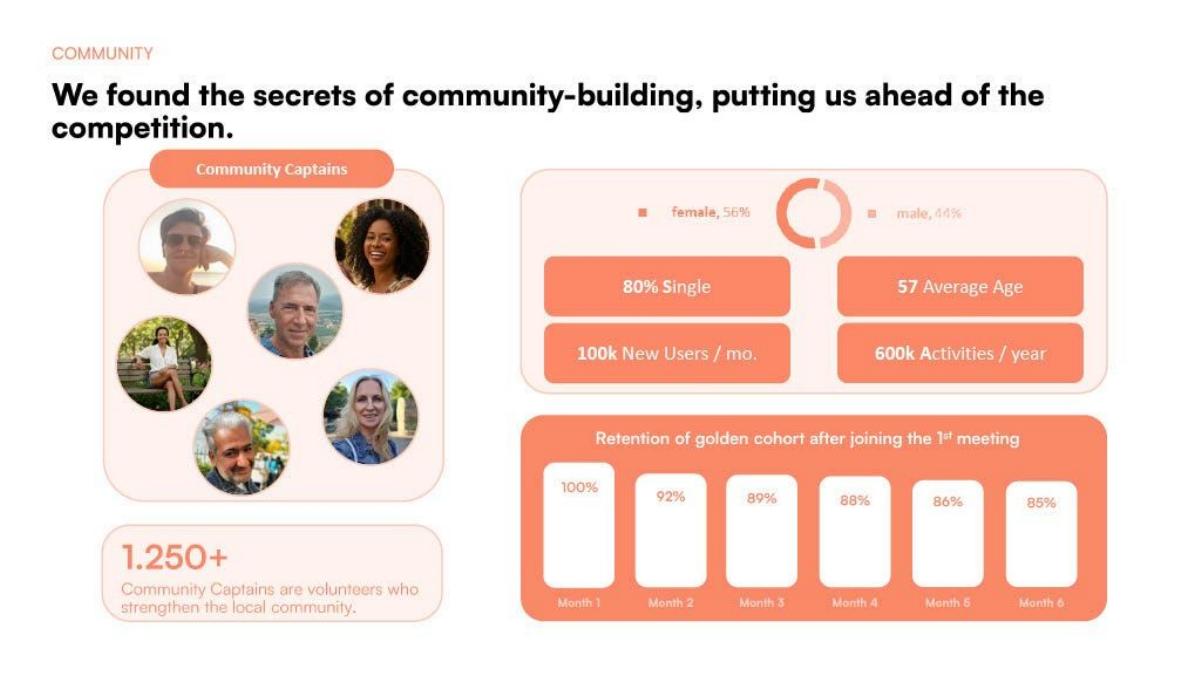
- Meet5 targets a specific underserved demographic with an average user age of 57, 80% of whom are single (Slide 7).
- Retention is exceptionally high for a social app, maintaining 85% of the 'golden cohort' through month six after their first meeting (Slide 7).
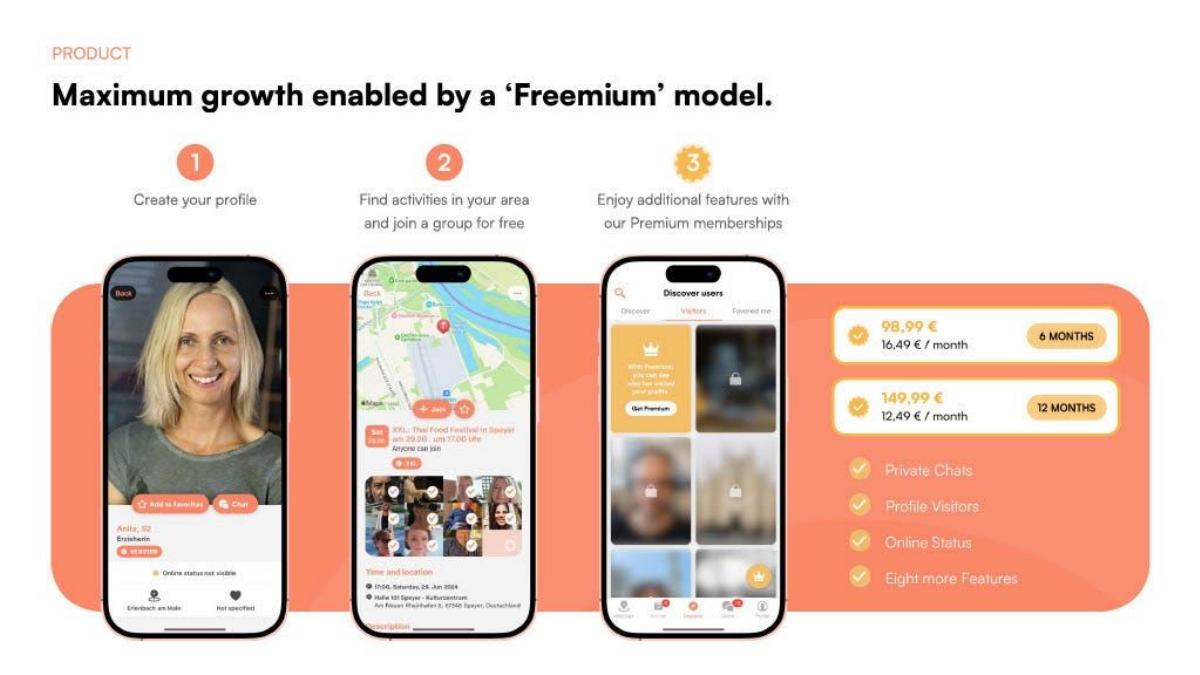
- The business model relies on a 'Freemium' structure to enable maximum growth (Slide 6).
- Community management is decentralized through 1,250+ volunteer 'Community Captains' who strengthen local ties (Slide 7).
- The company is aggressively expanding into North America, listing 20+ U.S. cities as active or target locations (Slide 9).
- User engagement is diverse, with 'music & dance' and 'food & drink' leading as the most popular activity categories (Slide 9).
- The team has grown to 65 employees representing 15 nationalities to support international scaling (Slide 11).
Executive Summary: The Business of Real-World Connection
Meet5 is a Frankfurt-based consumer social app that raised $9M in a Series A round in 2024. The platform addresses the 'loneliness epidemic' by facilitating in-person group meetings for adults over 40. Unlike traditional social media, which often traps users in digital loops, Meet5 uses a 'Freemium' mobile interface to drive offline participation. With 2.5 million members and a 65-person team, the company is now focused on replicating its European success in the North American market.
Slide 1: Title and Vision
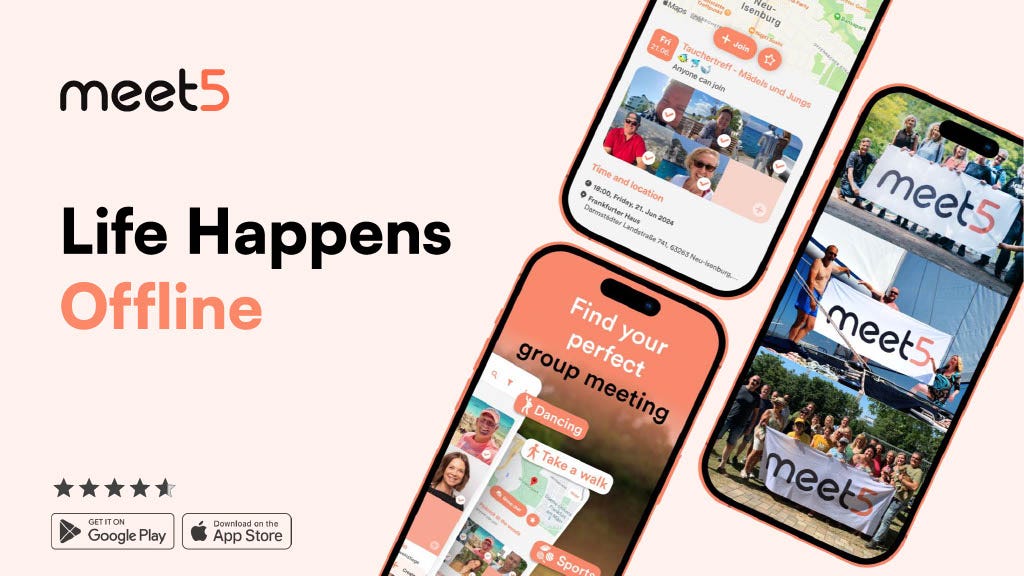
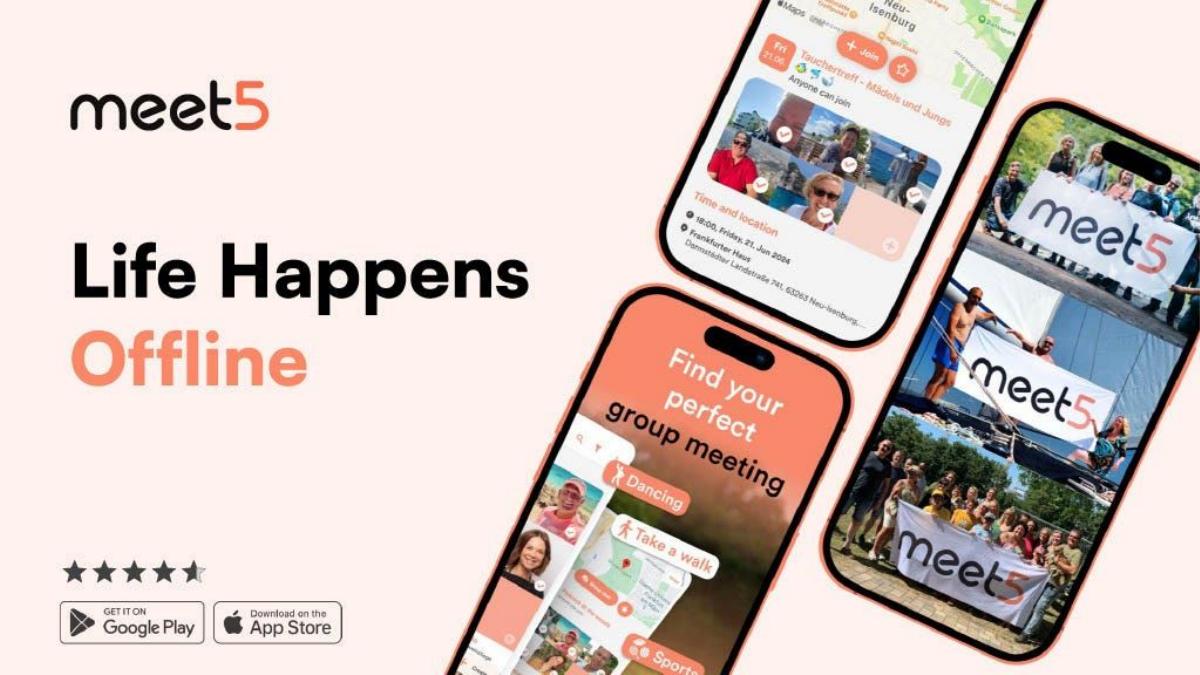
The deck opens with the tagline 'Life Happens Offline.' This immediately positions the product as an antithesis to traditional, screen-heavy social networks. The slide features high-quality imagery of the app interface and people engaging in outdoor activities. It highlights three core activity pillars: Dancing, Taking a walk, and Sports. The inclusion of App Store and Google Play badges, along with a 4.7/5 star rating, establishes immediate credibility for a product that is already live and well-received.
Slide 2: Traction and Scale
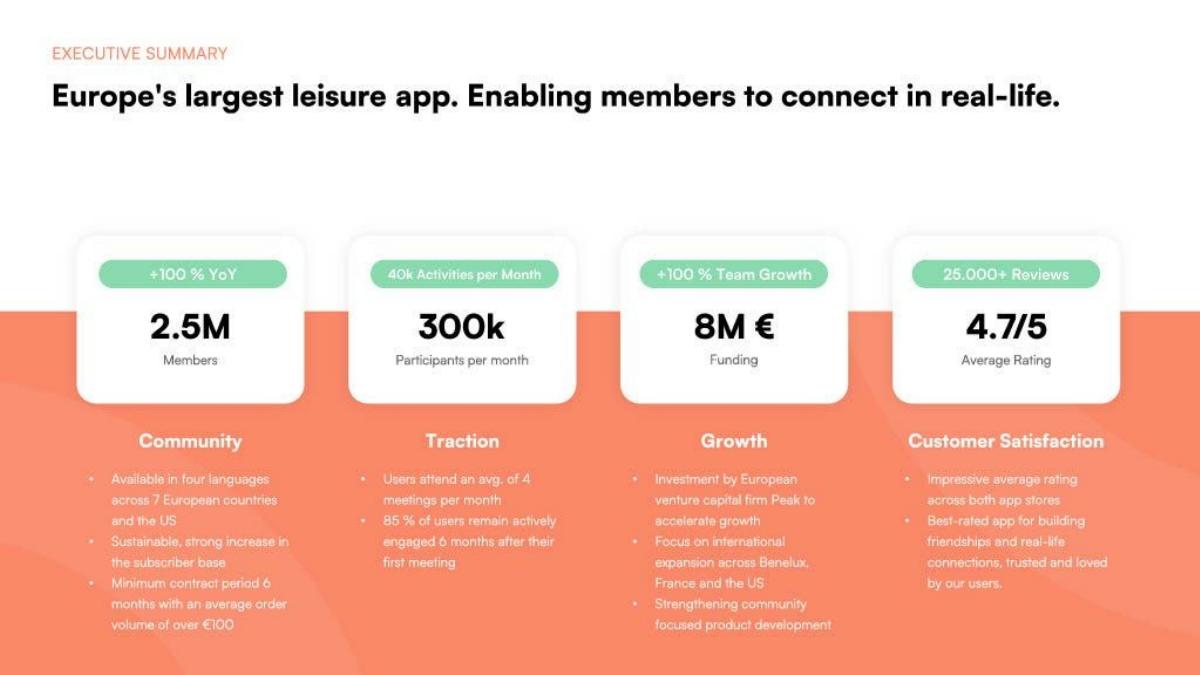
Slide 2 is a 'big numbers' slide designed to overwhelm any doubts about product-market fit. The company claims to be 'Europe's largest leisure app.' Key metrics listed include 2.5 million members, 40,000 activities per month, and 300,000 monthly participants. The slide also notes +100% Year-over-Year growth and +100% team growth. Interestingly, it mentions 8M € in prior funding, providing context for the current Series A raise. The 25,000+ reviews mentioned reinforce the user satisfaction claim from the cover slide.
Slide 3: The Problem Statement
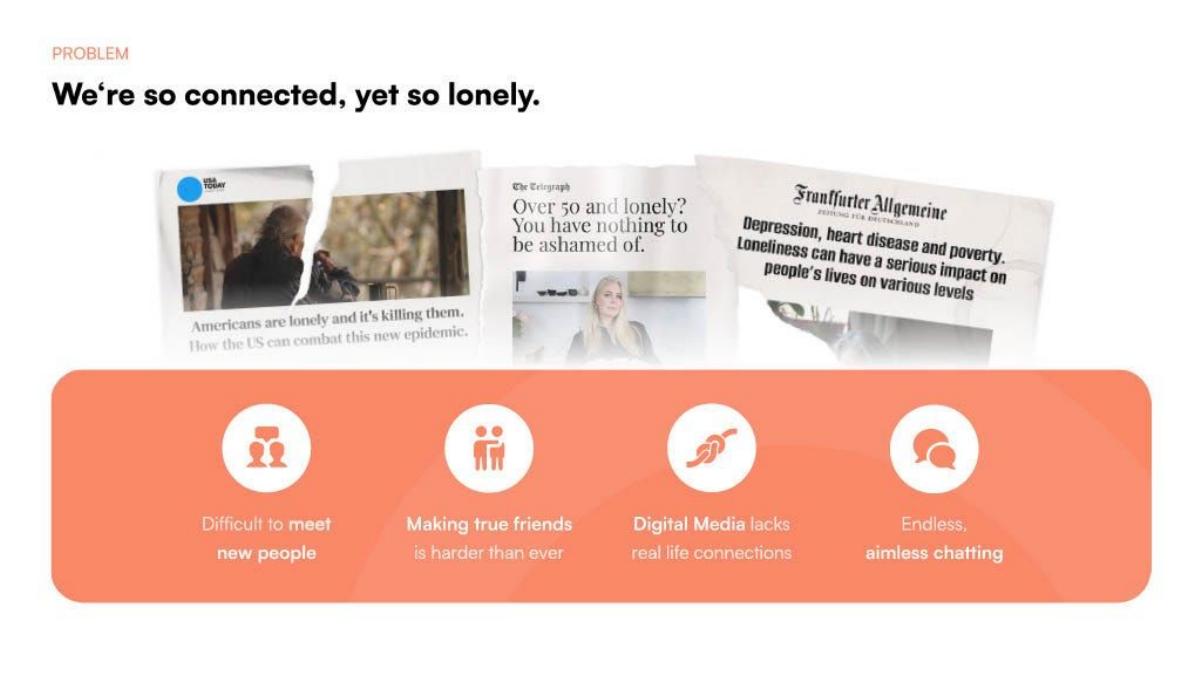
The problem is framed through the lens of social isolation: 'We’re so connected, yet so lonely.' To validate this, the slide uses clippings from major publications like USA Today, The Telegraph, and Frankfurter Allgemeine, citing loneliness as a 'new epidemic.' The slide identifies four specific pain points: the difficulty of meeting new people, the increasing hardness of making true friends, the lack of real-life connections in digital media, and 'endless, aimless chatting'—a direct jab at dating apps and traditional social media.
Slide 4 & 5: The Solution and Value Proposition
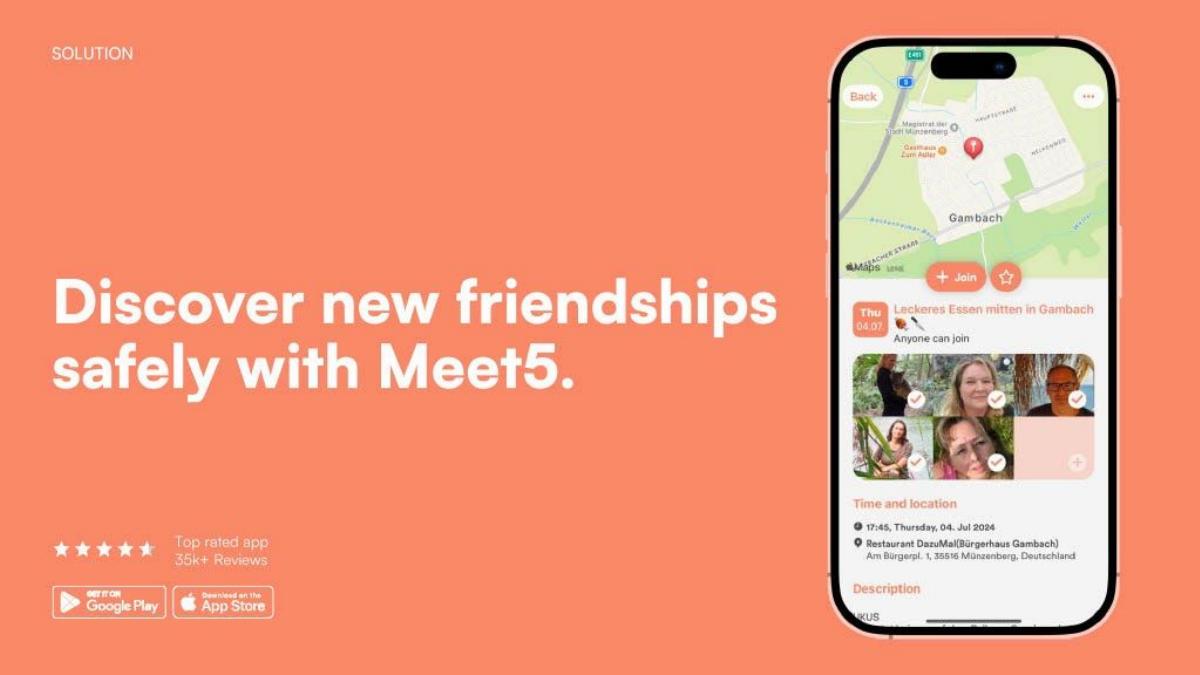
Slide 4 introduces the brand as a safe way to discover friendships. Slide 5 expands on this with the headline 'A thousand friends at hand.' It breaks the solution down into four pillars: Real Life (meeting directly through activities), Small Groups (ensuring comfort and a relaxed atmosphere), Community (finding support and belonging), and Safety (public gatherings, which the slide notes are 'especially important for women'). The imagery emphasizes older adults in group settings, clearly defining the target user without needing to state the age range yet.
Slide 6: Business Model
This slide is brief, stating that 'Maximum growth' is enabled by a 'Freemium' model. While it lacks a breakdown of what features are paid versus free, the choice of the word 'Freemium' suggests a subscription or micro-transaction layer common in social apps. For a Series A deck, investors might expect more detail here, but the focus remains on the scale of the user base as the primary asset.
Slide 7: The 'Secret Sauce' and Retention
This is arguably the most important slide in the deck. It introduces 'Community Captains'—over 1,250 volunteers who moderate and strengthen local communities. This decentralized labor model is a significant competitive advantage, as it allows for hyper-local growth without linear increases in headcount. The slide also provides a demographic deep dive: 56% female, 44% male, 80% single, and an average age of 57. The 'Retention of golden cohort' chart is the standout metric, showing that 85% of users who attend their first meeting are still active six months later. This level of stickiness is rare in the consumer app space.
Slide 8 & 9: Market Dominance and Demographics
Slide 8 claims the #1 spot in Europe and signals global ambitions. Slide 9 provides the data to back this up, showing a map of the US and Europe. It lists over 20 US cities, including Austin, Chicago, Miami, and Nashville, as part of their expansion. A pie chart for 'Unique Joins' shows the DACH region as the current stronghold, with the USA appearing as a small but growing slice. The slide also includes a bar chart of activity types, showing that 'music & dance' and 'food & drink' are the primary drivers of engagement.
Slide 10: North American Expansion
This slide focuses on the timeline, stating that scaling in North America began in July 2025. This indicates that the $9M raise is likely being deployed heavily into US user acquisition and local community building to replicate the European 'Captain' model overseas.
Slide 11: The Team
The final slide shows a large group photo of the 65 employees. It highlights the diversity of the team (15 nationalities) and ends with a call to action: 'LET'S COMBAT LONELINESS!' This brings the narrative full circle, connecting the business metrics back to the social mission introduced on Slide 3.
What Works in the Meet5 Deck
Exceptional Retention Data: The retention chart on Slide 7 is the strongest part of the deck. Showing 85% retention at month six for a social app is a powerful indicator of product-market fit and long-term viability. It suggests that once a user crosses the threshold of an in-person meeting, the platform becomes a staple of their social life.
Clear Demographic Targeting: Many social apps try to be everything to everyone. Meet5 is unapologetic about targeting the 40+ (and specifically the 50+) demographic. By providing the average age (57) and relationship status (80% single), they show investors they understand exactly who their customer is and how to reach them.
The Volunteer Model: The 'Community Captain' system (Slide 7) addresses the biggest challenge of social apps: moderation and local engagement. By leveraging 1,250+ volunteers, Meet5 has built a scalable way to maintain community quality without the overhead of thousands of local employees.
What is Missing from the Meet5 Deck
Unit Economics: While the deck mentions a 'Freemium' model, it provides zero data on Customer Acquisition Cost (CAC), Lifetime Value (LTV), or Average Revenue Per User (ARPU). For a Series A raise of $9M, investors typically want to see the 'money in, money out' math that proves the model scales profitably.
Competitive Landscape: The deck claims to be 'ahead of the competition' (Slide 7) but never identifies who that competition is. Whether it is Meetup.com, Facebook Groups, or niche dating apps, a teardown of why Meet5 wins against these incumbents would have strengthened the 'moat' argument.
Financial Projections: There is no slide detailing the 'Ask' or how the $9M will be specifically allocated beyond a general mention of North American scaling. A forward-looking revenue target or a roadmap of product milestones would have provided a clearer picture of the company's trajectory.
Founder's Guide: What to Copy
Use Third-Party Validation for the Problem: If you are tackling a social issue like loneliness, don't just say it's a problem. Copy Slide 3’s approach of using headlines from reputable news sources to prove that the market need is a recognized global crisis.
Highlight Your 'Golden Cohort': If your overall retention is noisy, find your 'golden cohort'—the users who have completed a specific high-value action (like attending a meeting). Showing that these users stay at a high rate (as seen on Slide 7) proves that your core product loop works.
Show the Human Element: For a community-based business, a group photo of the team (Slide 11) and photos of actual users (Slide 5) are more effective than abstract icons. It reinforces the 'Life Happens Offline' brand promise.
Leverage a 'Captain' or 'Ambassador' Strategy: If your business relies on local density, follow the Meet5 lead by formalizing a volunteer or ambassador program. Highlighting this in your deck shows investors that you have a strategy for organic, low-cost growth and community self-regulation.
Frequently asked questions
- What is the primary demographic for Meet5?
- According to Slide 7 and Slide 9, Meet5 specifically targets the 40+ community. The data shows an average user age of 57, with 80% of the user base being single and a gender split of 56% female and 44% male.
- How does Meet5 maintain high user retention?
- Slide 7 credits their 'Community Captains'—a group of over 1,250 volunteers—as the secret to their community building. This human-centric approach results in 85% retention for their core cohort six months after the first in-person meeting.
- What is the revenue model for the app?
- Slide 6 explicitly states that Meet5 operates on a 'Freemium' model. While the deck does not detail specific pricing tiers or feature gates, the goal of this model is cited as enabling 'maximum growth.'
- Where is Meet5 currently operating?
- Slide 9 shows that the majority of their 'Unique Joins' come from the DACH region (Germany, Austria, Switzerland), followed by BENELUX and France. They began scaling in North America in July 2025, targeting cities like Austin, Chicago, and Miami.
- What are the most popular activities on the platform?
- Based on the bar chart on Slide 9, 'music & dance' is the most popular activity category, followed by 'food & drink,' 'outdoor,' and 'culture.' Other categories include 'fun games,' 'markets & festivals,' and 'sports & fitness.'