MedStack’s 16-slide Seed deck is a masterclass in identifying a specific, high-friction bottleneck within a massive industry. By quantifying the 'hidden' costs of healthcare app development—specifically the $100,000 spent on legal and server ops—the founders move beyond a simple 'hosting' pitch to a 'market accelerator' narrative. The deck uses clear, logical progression: from the macro pressures on providers to the micro failures of IT diligence. While it lacks a specific 'Ask' slide and detailed financial projections, it compensates with strong social proof through 12 customer logos and a c…
Key takeaways
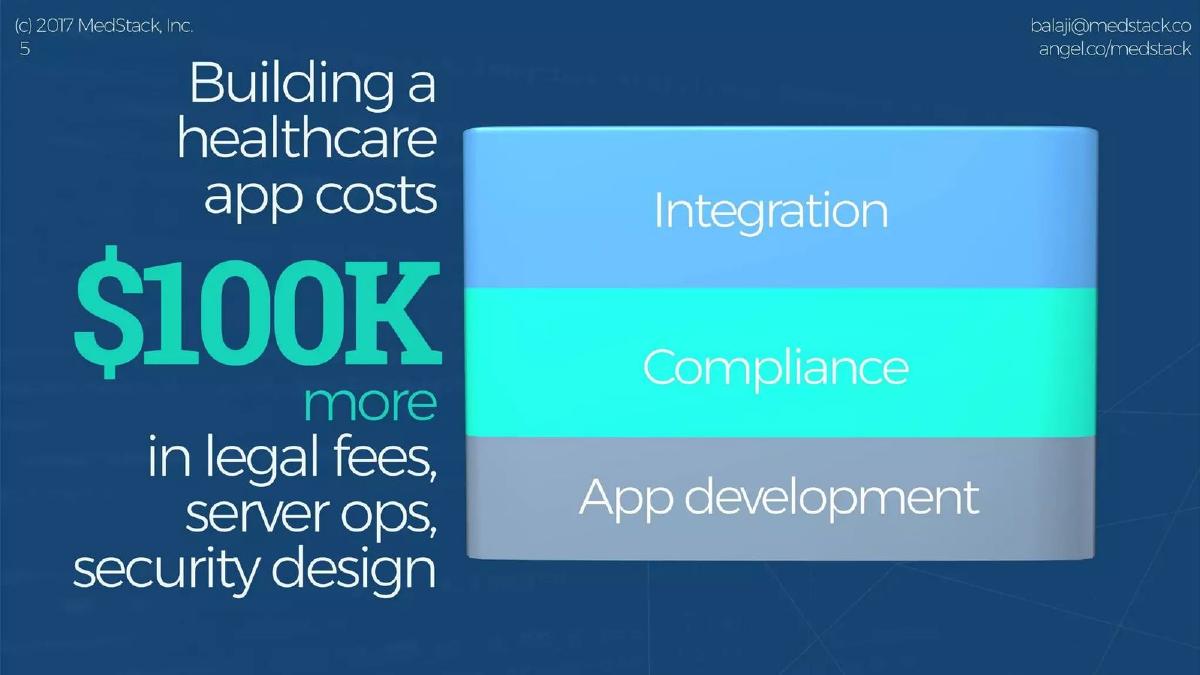
- The deck identifies a $100,000 'compliance tax' in legal and security fees that developers face before even starting app development (Slide 5).
- MedStack claims their platform allows healthcare apps to reach the market 60% faster by standardizing security and privacy architecture (Slide 8).
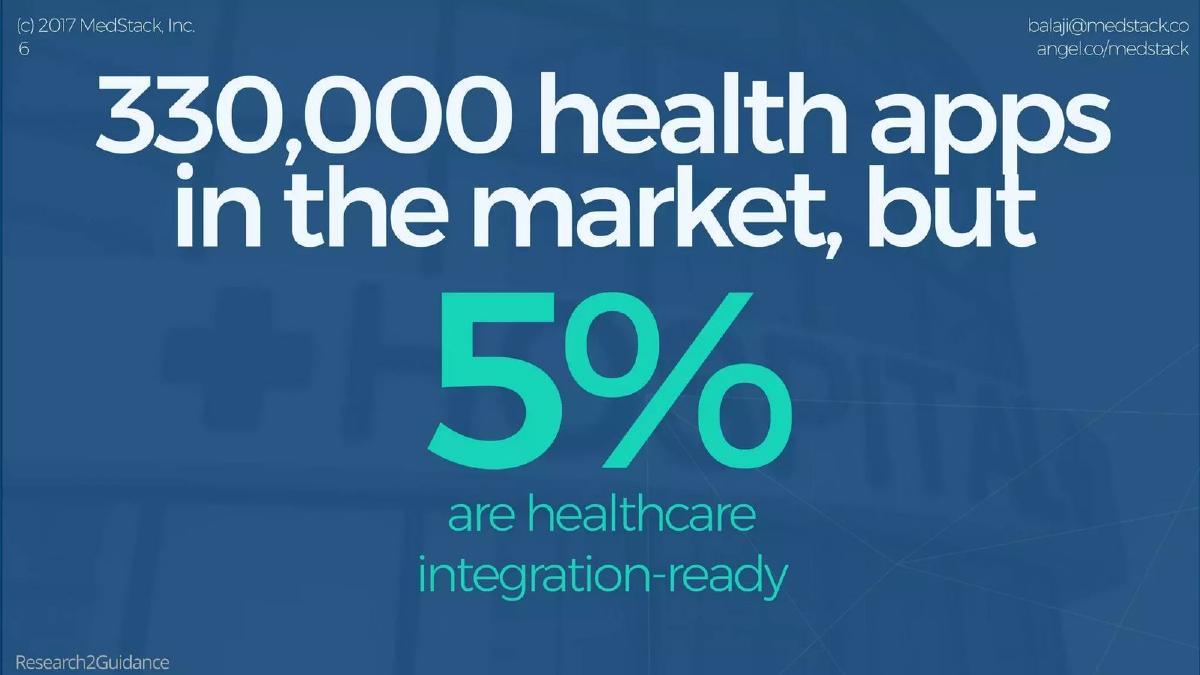
- The market opportunity is framed by the fact that 330,000 health apps exist, but only 5% are 'integration-ready' for healthcare enterprises (Slide 6).
- The pricing model is transparently broken down into a formula: Server configuration x Compliance premium + FHIR server + Add-ons (Slide 10).
- A competitive matrix positions MedStack as the most affordable option at $350/mo, compared to competitors like Aptible and Datica which start at $2,500-$3,000 (Slide 11).
- The deck provides significant social proof with 12 customer logos and five detailed testimonials emphasizing time and money saved (Slide 12).
- The founders cite deep domain experience, including the CEO's role as the launch Product Manager of BBM and the CTO's creation of the world's first QR code app (Slide 15).
- The deck omits a formal 'Ask' slide, leaving the specific funding requirements and use of proceeds to the catalogue listing rather than the slides.
Executive Summary: The Compliance-as-a-Service Narrative
The MedStack pitch deck from 2017 is a focused, 16-slide presentation that targets the friction between healthcare app developers and the highly regulated environments they seek to enter. Rather than pitching a generic cloud hosting service, MedStack frames itself as a 'market accelerator.' The core narrative is that compliance is a $100,000 barrier to entry that MedStack removes, allowing developers to focus on care rather than legal paperwork. With a clear value proposition of being '60% faster to market,' the deck successfully bridges the gap between technical infrastructure and business outcomes.
Slides 1-3: The Macro Context and Market Friction
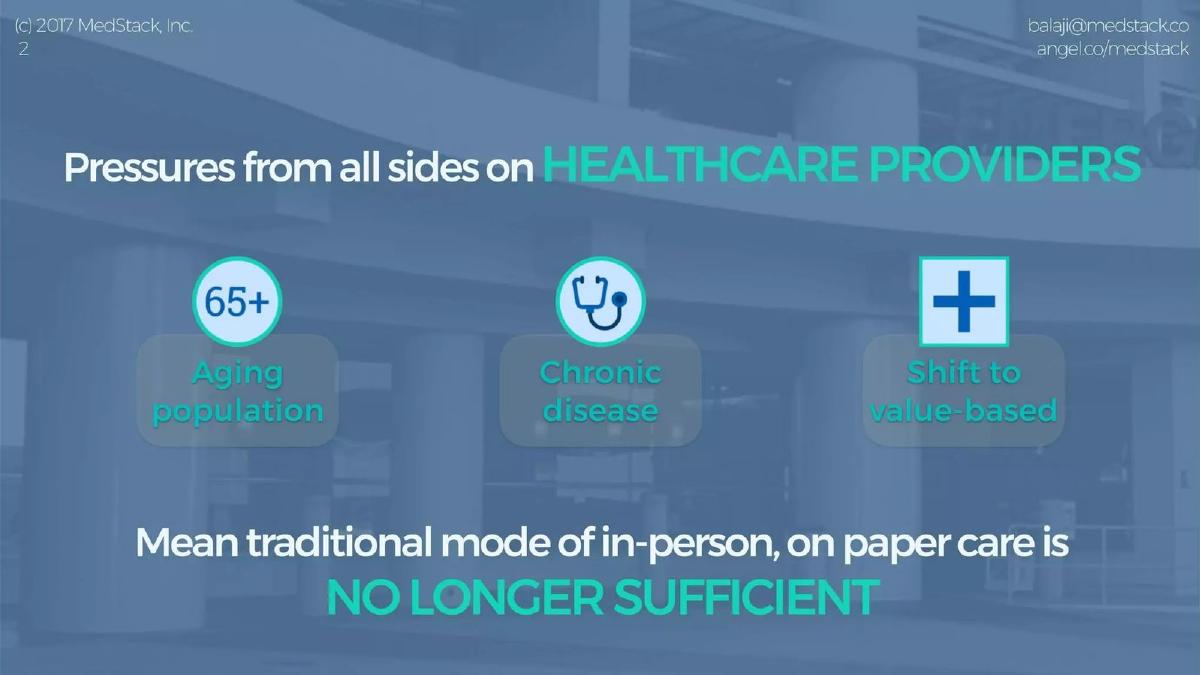
The deck opens with a standard title slide (Slide 1) branding MedStack as "The Platform for App-Enabled Healthcare." It immediately moves into the 'Why Now' (Slide 2), citing three pressures on healthcare providers: an aging population, chronic disease, and a shift to value-based care. This slide establishes that the traditional mode of paper-based care is no longer sufficient.
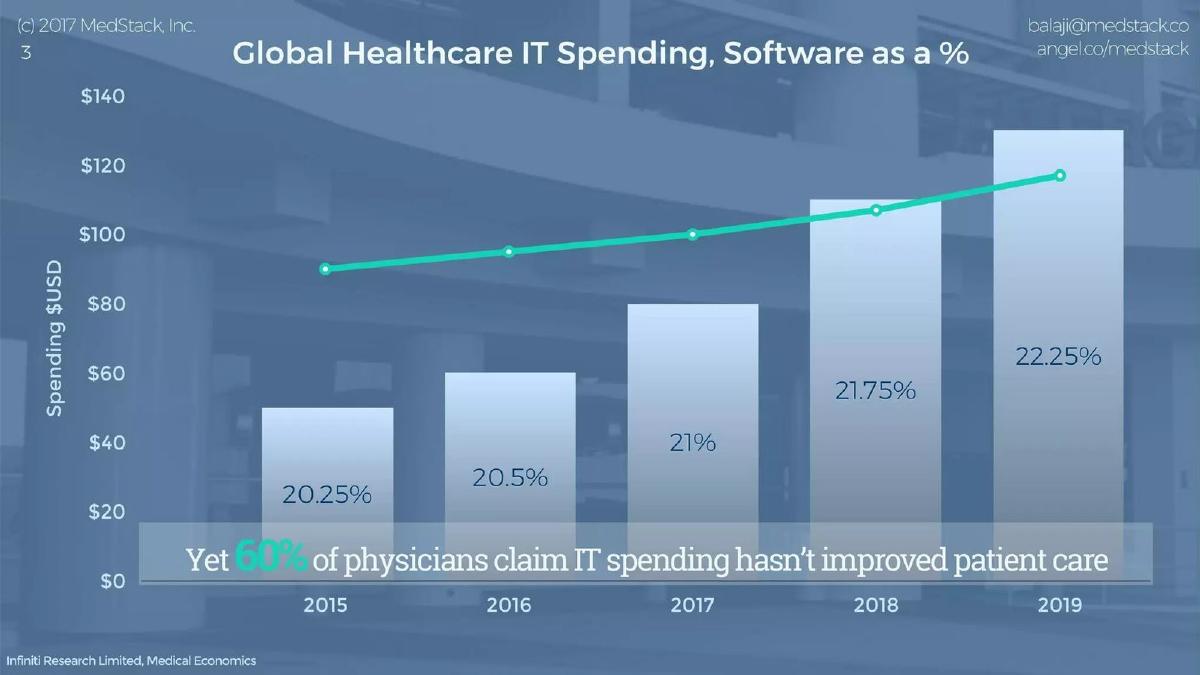
Slide 3 provides the quantitative backing for this pressure. It shows Global Healthcare IT Spending rising from roughly $50B in 2015 to a projected $130B+ in 2019. However, the 'kicker' on this slide is a quote at the bottom: "Yet 60% of physicians claim IT spending hasn't improved patient care." This sets up the problem: money is being spent, but the solutions aren't reaching the front lines effectively.
Slides 4-7: Identifying the $100k Bottleneck
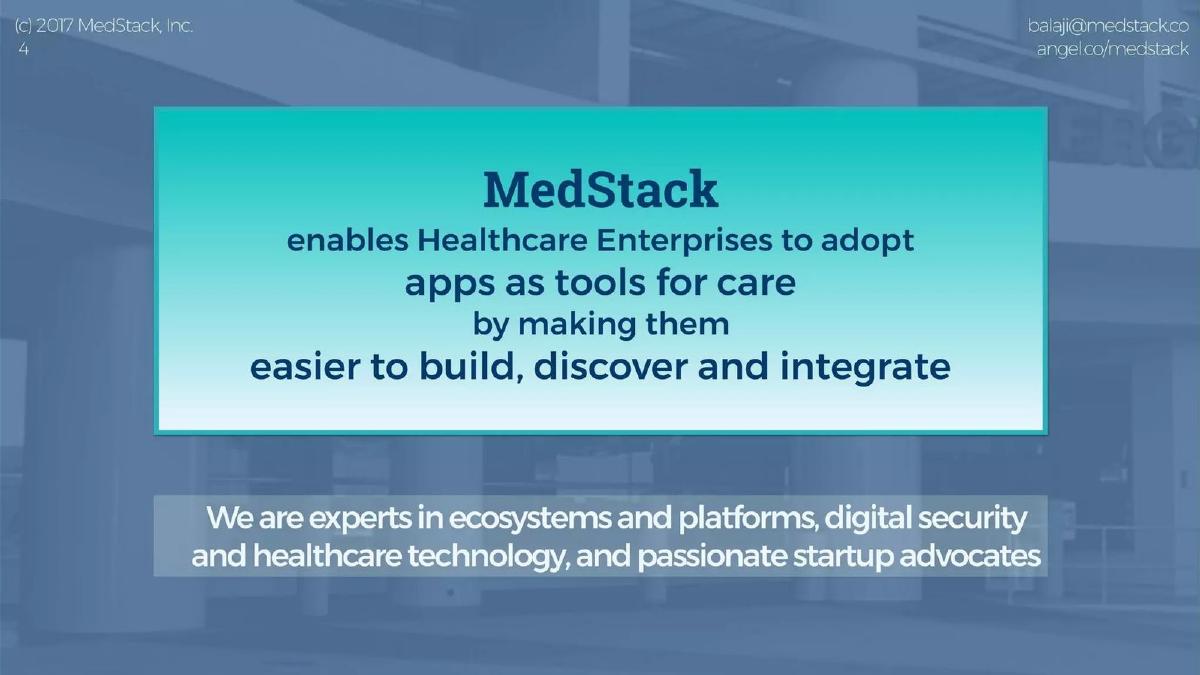
Slide 4 introduces MedStack's mission: enabling enterprises to adopt apps by making them easier to build, discover, and integrate. This is followed by the most impactful slide in the deck—Slide 5. It quantifies the problem: "Building a healthcare app costs $100K more in legal fees, server ops, security design." This 'Compliance Tax' is the primary pain point MedStack aims to solve.
Slide 6 highlights the scale of the missed opportunity, noting there are 330,000 health apps in the market, but only 5% are "healthcare integration-ready." Slide 7 illustrates the 'IT Diligence' bottleneck at the enterprise level. It shows a series of apps hitting a wall of Security Diligence, Privacy Diligence, and EHR Data Integration, concluding that hospitals simply don't have the capacity to support app adoption at scale.
Slides 8-10: The Solution and Product Architecture
Slide 8 presents the MedStack solution as a filter that standardizes these layers, claiming to make apps "60% faster to market." Slide 9 breaks down the four pillars of the product: 1. Privacy and Security protocols built via an intelligent compiler; 2. Pre-written HIPAA Compliance documentation; 3. Developer Flexibility (supporting various languages and databases); and 4. Data Interoperability via built-in HL7 FHIR APIs.
Slide 10 details the Monthly Pricing model. It is presented as a formula: (Server configuration X Compliance premium) + FHIR server + Add-ons - Incentive discounts. This transparency is rare in seed decks and suggests a mature, self-serve or highly structured sales motion. It also lists what is included: hosting, policy documentation, and referrals to privacy consultants.
Slides 11-14: Competition, Traction, and Roadmap
Slide 11 is a direct competitive matrix. MedStack compares itself to Amazon (with BAA), Aptible, Datica, and Healthcare Blocks. MedStack claims to be the only one offering a full suite of services, including an 'Intelligent DevOps engine' and 'Interoperability product solution.' Most notably, it highlights a price point of $350/month, positioning itself as the 'accessible' choice against competitors charging $1,500 to $3,000+.
Slide 12 provides social proof through a 'Customer Success' slide. It features 12 logos (including Maple, Caredove, and CircleLink Health) and five testimonials. The quotes emphasize that MedStack allowed these companies to launch without worrying about hosting or HIPAA compliance. This slide is critical for a Seed stage company to prove that their '60% faster' claim is validated by real-world users.
Slides 13 and 14 look toward the future. Slide 13 introduces 'Coming Soon' features like AI-based security diligence and active compliance monitoring. Slide 14 introduces 'MedStack Enterprise,' a dedicated hospital environment for managing multiple apps, including a marketplace for app discovery. This shows the transition from a developer tool to an enterprise platform.
Slides 15-16: The Team and Closing
Slide 15 introduces the founders. Balaji Gopalan (CEO) is highlighted for his 10 years of platform experience and his role as the launch PM for BlackBerry Messenger. Simon Woodside (CTO) is noted for 10 years in healthcare apps and building the world's first QR code app. The slide effectively uses logos (Apple, BlackBerry, Monolith) to borrow institutional credibility.
The deck concludes on Slide 16 with contact information and a list of accelerator/partner logos at the top, including 500 Startups and Dreamit Health. This serves as a final layer of validation for the company's pedigree.
What Works in This Deck
Quantified Problem: Assigning a specific dollar value ($100k) to the problem of compliance makes the ROI of the solution immediately obvious. · Clear Value Prop: The '60% faster to market' claim is repeated and supported by the product breakdown. · Strong Social Proof: The combination of 12 logos and specific testimonials on Slide 12 builds significant trust in a sector where 'security' is the primary concern. · Competitive Pricing: The pricing matrix on Slide 11 makes a compelling case for MedStack as the high-value, low-cost leader in the space.
What Is Missing
The Ask: There is no slide stating how much money is being raised or what the milestones for the next 18 months are. · Financial Projections: While the pricing model is clear, there is no indication of current ARR, growth rates, or future revenue targets. · Market Sizing (TAM): The deck mentions 330,000 apps, but it doesn't translate this into a Dollar-denominated Total Addressable Market. · Go-To-Market Strategy: The deck explains the product well but doesn't detail how they plan to acquire the next 1,000 developers (e.g., partnerships, content marketing, or direct sales).
What a Founder Should Copy
The 'Formula' Slide: Slide 10's pricing formula is an excellent way to explain a complex SaaS billing model simply. · The Diligence Flowchart: Slide 7 and 8's 'Before and After' visualization of the IT diligence process is a perfect way to show how a platform 'greases the wheels' of a complex industry. · Domain Expertise Framing: The team slide (Slide 15) doesn't just list titles; it lists specific, relevant achievements (e.g., 'Launch PM of BBM') that prove the founders have built platforms at scale before.
Frequently asked questions
- What is the core problem MedStack is solving?
- MedStack addresses the 'compliance tax' in digital health. According to Slide 5, building a healthcare app costs an extra $100,000 in legal fees, server operations, and security design. Furthermore, Slide 7 explains that healthcare enterprises lack the IT capacity to handle the security and privacy diligence required to adopt new apps at scale, creating a bottleneck for innovation.
- How does MedStack differentiate itself from cloud providers like AWS?
- While AWS offers a Business Associate Agreement (BAA), MedStack's competitive matrix (Slide 11) shows that AWS lacks 'Compliant DevOps,' 'Compliance policy documentation,' and an 'Intelligent DevOps engine.' MedStack positions itself as a specialized layer on top of public clouds that handles the specific regulatory requirements of healthcare that general cloud providers do not automate.
- What is MedStack's pricing strategy?
- MedStack uses a modular monthly pricing model. As shown on Slide 10, the cost is calculated based on server configuration and a compliance premium, with optional add-ons for FHIR servers. Slide 11 highlights their entry-level price of $350 per month, which is significantly lower than the $1,500 to $3,000+ charged by competitors like Datica and Aptible.
- Who are the founders and what is their background?
- The company was led by CEO Balaji Gopalan and CTO Simon Woodside. Gopalan brought 10 years of platform experience, including being the launch PM for BlackBerry Messenger (BBM). Woodside brought 10 years of healthcare app experience and a background in digital security, having built the world's first QR code app (Slide 15).
- What significant information is missing from this deck?
- The deck is missing several standard venture components: there is no 'Ask' slide detailing how much capital is being raised, no financial projections or 'pro-forma' revenue targets, and no detailed breakdown of the Total Addressable Market (TAM) in dollar terms. It also lacks a slide on unit economics (CAC/LTV) or a detailed go-to-market strategy beyond the product roadmap.